Showing posts with label Angela Hume. Show all posts

Saturday, January 15, 2022

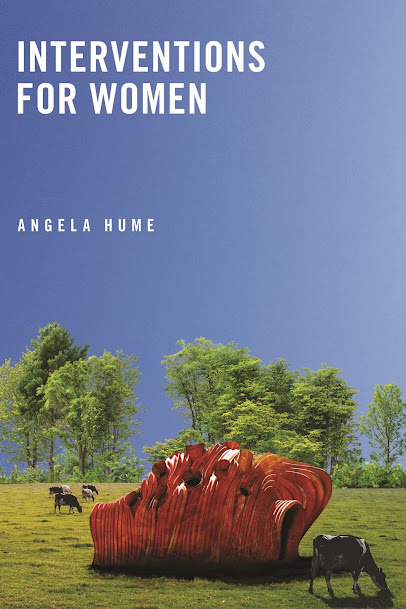
Angela Hume, Interventions for Women


ruled by appetite
i wanted to write

a truth from the
whole

of the scratched-
out line

between what you
call mine

what counts as
your body

and what’s a
depository

for Roundup   Teflon
sphenol A

Bay Area, California poet and editor Angela Hume’s [see her 2016 “12 or 20questions” interview here] second full-length poetry title, following Middle Time (Oakland CA: Omnidawn, 2016) as well as a smattering of chapbooks [see my review of her most recent here], is Interventions for Women (Omnidawn, 2021). Through an accumulation of six sequences, themselves composed as accumulations of short, lyric bursts, Hume sketches one phrase on top of another, writing on the impact of the world on women’s bodies, from climate to agriculture, settler colonialism and sexual violence, white supremacy to genetic engineering on food, writing wave upon wave of interlocking, interconnected wave of assault upon the physical and spiritual body. Set in sections of extended, accumulative fragments—“may the human animals,” “interventions for women,” “drowning effects,” “you were there,” “meat habitats” and “say no”—each section opens with a brief introduction of sorts, situating the poem-section in very specific temporal and subjective spaces; she sets the scene, as it were, allowing her lyrics to open and expand from that singular point. The section “you were there,” for example, opens: “Oakland and Point Reyes National Seashore, California, 2017-2018. // I wrote this poem after the April 15, 2017, Berkely community demonstrations against white nationalist and neo-Nazi groups who staged a rally at Martin Luther King Jr. Civic Center Park, and also at the end of the 2011-2017 California drought.” The poem itself, begins:

out of the drought
and the dead land

we came undone 

cortisol   hypotension
Maalox   adrenaline

beneath a shrill
unblinking cerulean

we’re all writing
this poem   i join in

Her poems accumulate, phrase upon phrase, but exist almost as Jenga-towers: to remove one word or one phrase would be to tear the whole structure apart. The intricacy of her point-by-point is overshadowed, slightly, through the ease and flow of the lines, allowing her lines to sit on the page as a series of stretches, but amass in the readers’ attention as a singular structure.

Through these brief introductions to each section, Hume provides context and even boundaries to her poem-sections, stretching out her lyric across a broad spectrum. The communal aspect of the writing, “i join in,” as Hume offers, connects the work in Interventions for Women to a far larger movement of resistance, something comparable to, for example, Layli Long Soldier’s Whereas (Graywolf, 2017) [see my review of such here], as well as works composed-in-resistance to the Northern Gateway Pipeline in Burnaby BC, including Christine Leclerc’s Oilywood (Nomados Literary Publishers, 2013) [see my review of such here] and Stephen Collis’ Once in Blockadia (Talonbooks, 2016) [see my review of such here], and, more generally, various pieces in Nyla Matuk’s Resisting Canada: An Anthology of Poetry (Signal Editions/Vehicule Press, 2019) [see my review of such here]. The writing exists consciously and deliberately alongside and as part of a far larger movement and structure of resistance, offering support, critique and weight and a call-to-action. As the title sequence, second of the six, opens:

Cambridge, Massachusetts, North Branch and Minneapolis, Minnesota, and Oakland, California 2019-2020.

I wanted to write a poem about how the industrial food system alienates feminized people from their bodies, and how this alienation requires, colludes with, an exacerbates economic and racial oppressions along with the exploitation of animals. And about how the industrialization of agriculture has been more or less coextensive with the development of modern institutions and technologies for the surveillance and control of the intimate body activities (eating, fucking, reproducing) of women and girls.

While “interventions for women” addresses global food systems and hunger, along with the state and NGO approaches to naming systemic failures, its focus is on settler food production and eating in the United States. There is much more to be said about the violence of the food system internationally, not to mention everything else.

I wanted to say that I intend the title ironically.


Tuesday, December 03, 2019

Meet the Presses’ Indie Market (part three,


Brooklyn NY: One of the latest titles from Brooklyn publisher Doublecross Press (who were attending their first Meet the Presses Indie Market this time around) is Angela Hume’s meat habitats (2019). As the “note” at the back of the collection offers: “Some language here is adapted from reports on allegations against Harvey Weinstein and Brett Kavanaugh; a report on health effects of dramatic societal events; reports on dairy and global whey protein markets; language describing a project of the Terreform architecture group for smart city design, ecological planning, and art; and other sources.”  meat habitats is an absolutely stunning chapbook-length sequence built on parse and pause, hesitation and abrupt stops; a meditation on and around language and the body, and the violence done to and upon both, one often wrapped up around the other, as she writes, mid-way through the chapbook:

you thought your body was your own

but a body is not a boundary
a door is not a dam

no sentient being
was harmed in

laboratory growth
of the skin

In case you weren’t aware, Hume [see her 2016 “12 or 20 questions” interview here] is the author of a small handful of poetry chapbooks, including  Melos (Projective Industries, 2015), The Middle (Omnidawn, 2013) and Second Story of Your Body (Portable Press at Yo-Yo Labs, 2011), as well as the full-length debut, Middle Time (Omnidawn, 2016).

flattened cells     a tight
weave

clutch the organism     form
a protein envelope

a self-regulating
environment

more or less stable    victory
in the unlikely history

of something
and not nothing

we go out    invade

plant and animal
cellular structures

restrict water flow

assemble harm

pathologize need

things we never should

Cobourg ON/Banff AB: One of the latest from Stuart Ross’ Proper Tales Press is Banff, Alberta poet, editor etcetera Derek Beaulieu’s small chapbook, Extispicium (2019) [see Derek's piece celebrating 40 years of Proper Tales Press here, by the by], an excerpt of which appeared in his selected poems, Please, No More Poetry: The Poetry of derek beaulieu (WLU Press, 2013). While I don’t know the specific structure he was working with in this extended prose piece, one might suspect, from being aware of some of his previous work, how it might have been composed through a system of recombining materials from a particular source text (and potentially from his own biography, given the suggestions put forward in this particular excerpt). Either way, the prose is an entertaining rush, and something I could hear, slightly, in the voice of (as this text, somehow, insists on being read/heard aloud) the publisher of this wee title, Stuart Ross. How did that happen?

A purple used since antiquity as the mark of wealth and lavish opulence. I remember something happening did it. Did something happen I remember it. I remember it did it happen. Something happens I remember it. It happened and she remembers. He remembers. She remembers. She remembers so does he. I was born in Montréal. I was born in Montréal or Montreal. I was born in Montréal or Montreal or Brossard or Longueuil. When I was born I was born in Brossard but then I was born in Longueuil but now I was born in Brossard again but I wasn’t born there. I was born in Montréal or Montreal but we lived in Brossard. I was born in Montréal or Montreal but I lived once I was born in Brossard. Brossard was itself and then it was in Longueuil and then it was itself again but the whole time it was part of Montréal or Montreal. I was born in Montreal. Brossard has no cemetery.


Wednesday, October 05, 2016

12 or 20 (second series) questions with Angela Hume

Angela Hume lives in Oakland. She is the author of the poetry chapbooks Melos (Projective Industries, 2015), The Middle (Omnidawn, 2013) and Second Story of Your Body (Portable Press at Yo-Yo Labs, 2011). Her first full-length book of poetry is Middle Time (Omnidawn, 2016). You can learn more about Angela at http://angelamhume.tumblr.com/.

1 - How did your first chapbook change your life? How does your most recent work compare to your previous? How does it feel different?
Brenda Iijima’s Portable Press @ Yo-Yo Labs published my first chapbook, Second Story of Your Body (2011). I wrote to Brenda out of the blue because I knew she had published Evelyn Reilly, whose work I loved. At the time I didn’t know Brenda at all. It was quite bold of me. I remember the night the chapbooks arrived in the mail. Brenda creates original artwork for her covers and surprises her authors with them. Seeing the physical books for the first time was magical. I opened the box to find gorgeous, mysterious book objects that were mine and not mine at once. It was one of the best gifts I’d ever received.

2 - How long does it take to start any particular writing project? Does your writing initially come quickly, or is it a slow process? Do first drafts appear looking close to their final shape, or does your work come out of copious notes?
My process is a slow one. I write in fragments. I assemble them into series. I revise unrelentingly, for as long as possible, even after work has been published. I live alongside my poems. 

3 - Are public readings part of or counter to your creative process? Are you the sort of writer who enjoys doing readings?
Readings can feel like acts of self-flagellation—standing up in front of a crowd, looking around and noticing who did or didn’t show up, forcing feeling to confess itself to itself as performance. Readings can leave me with feelings of self-doubt, unlikability, and overexposure. For people with social anxiety, they’re like diving into an ice-cold lake on an already unseasonably cool day. They hurt. They wake you up. They make you feel alive in the only body you have.

4 – What do you see the current role of the writer being in larger culture? Does s/he even have one? What do you think the role of the writer should be?
Writers can play any role they like. Writers are just people who do things in the world, and one of those things happens to be writing. I think that writers should aspire to be the things that I think all people should strive to be: passionate friends, lovers, activists, feminists, students, teachers, environmental stewards. 

5 - Do you find the process of working with an outside editor difficult or essential (or both)?
Working with my editor at Omnidawn Publishing, Gillian Hamel, is a dream. She’s an extremely perceptive, sensitive reader.

6 - How easy has it been for you to move between genres (poetry to critical prose)? What do you see as the appeal?
I write both poetry and literary criticism. The reading and writing I do around both are often in direct conversation. I don’t think it’s always true that being a critic and a theorist makes you a better poet. In fact it’s often not the case. But for me, developing as a reader of poetry and theory has been really important to my growth as a poet.

7 - What kind of writing routine do you tend to keep, or do you even have one? How does a typical day (for you) begin?
I get up, make coffee, eat cereal, and do a little writing—notes, journaling, e-mails, sometimes literary criticism, sometimes poetry. I do my best work in the late morning and early afternoon.

8 - When your writing gets stalled, where do you turn or return for (for lack of a better word) inspiration?
Rivers, forests, oceans.

9 - What fragrance reminds you of home?
Summer air through the metal mesh of a screen in Middle America.

10 - David W. McFadden once said that books come from books, but are there any other forms that influence your work, whether nature, music, science or visual art?
All of the above! I love music by girls and queers with guitars, old art, and up-to-the-minute science news. Other “forms” that influence my work: sex, civil disobedience, interspecies encounters, cooking/eating, travel.

11 - What other writers or writings are important for your work, or simply your life outside of your work?
Here’s my chance to give shout-outs to some of my brilliant friends! I’ve been co-editing a cluster of articles on the topic of “queering ecopoetics” with the poet-scholar Samia Rahimtoola, who is very smart and savvy about environmental politics. Three wonderful writers, Laura Woltag, Jasmine Kitses, and Lily Brown, inspire me with their creative work and also have rescued me with their insight and intelligence, especially of late. As I’ve said elsewhere, Brenda Hillman is my sister-mother-mentor; the poet’s wisdom she offers me helps me achieve a greater sense of myself as both a poet and a human.

Writings perpetually important to both work and life? Some are Antigone and Electra by Sophocles. The poems of Emily Dickinson. The essays of Audre Lorde.   

12 - If you could pick any other occupation to attempt, what would it be? Or, alternately, what do you think you would have ended up doing had you not been a writer?
I haven’t ruled out going back to school to study environmental science or policy and planning.

13 - What made you write, as opposed to doing something else?
I’ve simply been doing it for as long as I can remember, with absolute abandon.

14 - What was the last great book you read? What was the last great film?
I’ve been reading a handful of good books recently: Annie Proulx’s Barkskins, Summer Brennan’s The Oyster War, Ruth Ozeki’s My Year of Meats, Hölderlin’s Hyperion. I’ve also been reading Angela Willey’s critical work on “biopossibility” and what she calls “queer feminist materialist science studies.” I thought the film The Lobster was great.

15 - What are you currently working on?
Recently in Point Reyes, I participated in a residency as an NEA fellow through the Mesa Refuge and the Point Reyes National Seashore Association (PRNSA) themed “Climate Change at the Western Edge.” It was transformative. I stayed and worked next to the Giacomini Wetland Restoration Project, an area on the south side of Tomales Bay that was diked in the 1940s to create pastureland. In 2007 PRNSA and the National Park Service removed the levees in order to allow tides and fresh water to flow naturally and turn the area back into a tidal marsh. This is an important restoration project for number of reasons. One is that wetlands serve as a natural buffer against flooding. So wetland restoration is one way we can help build resiliency into our coastlines as we look ahead to climate-related sea level rises.

Most of the monitoring reports on Giacomini Wetlands say habitats and species are evolving toward conditions in natural tidal marshes. That said, researchers warn that we can’t necessarily expect a linear model of change. Instead, restoration may follow a nonlinear trajectory with interruptions and “thresholds” along the way. So I started reading about what restoration ecologists call “threshold dynamics,” in which restoration is understood to be a highly contingent, nonlinear process, as opposed to a continuous, progressive one.

Thinking about ecology restoration in this way means adjusting the structure of our expectation and being open to factors that we cannot control. I find myself asking: what kind of environmental ethos, or environmental love, even, does this new way of thinking entail? A less comfortable and comforting love for sure—a less ends-oriented one. And so the poem I’ve been working on is a little bit about the particular case of the Giacomini Wetlands and restoration science, but also our current situation under the conditions of global climate change and all of the complex human emotions that we experience as a result—feelings of anticipation that our hopes will be satisfied, disappointment when we don’t get what we want, and grief about the loss of oikos, the Greek word from which “ecology” comes, meaning family and household.

In particular, I’ve been trying to write about what queer experiences of oikos—what for queers are often frustrated or thwarted experiences of family and home—can teach us about how to better recognize and love what we might think of as our increasingly non-normative natures and ecologies.