There was no hope
that a reading
customer could
leave this thick and
cold silence. She
shivered and rose
again looking
to go for coal.
She put water
once in the hot
water bottle
which could not sing
any more while
the new she-cat
slept in its fur
behind the stove.
Egoistic
particulars
raised their eyes to
look across the
old window prints
of falling snow –
the street had turned
completely white.
Alone, she crossed
her happy arms
desiccated
upon her chest,
and put her nose
outside to re-
cord the world of
whole spectacle. (Victor Coleman, “ivH 58 [coda]”)
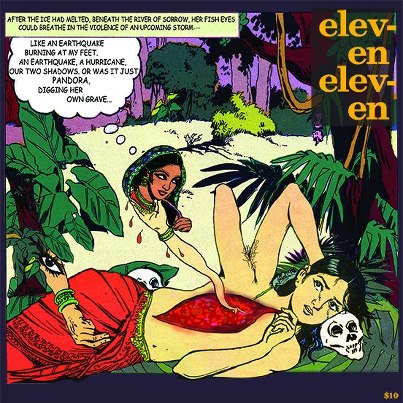
The most startling thing about the thirteenth
volume of the bi-annual eleven eleven: A Journal of Literature and Art (San Francisco CA: 2012) might be in the inclusion of new poems by Toronto poet Victor Coleman, a writer who rarely (it seems) appears in trade journals
(although, as I learn through Coleman’s bio, a chapbook of this work appears or
has appeared this year with Toronto’s BookThug). I suspect the inclusion of
work by Michael Boughn, a writer who co-edits and co-conspires with Coleman
(including co-editing the recent University of California Press edition of Robert Duncan’s The H.D. Book), might have something to do with that.
Possibly. But either poet’s work is worth more than the price of admission, and
I wonder what the late John Newlove might have thought about Boughn’s poem in
this issue, the odd, hilarious and marvelous “Doukhobor Butts”? The piece
begins:
The truth is often saggy, naked, dimpled
in ways unsuspecting youths from the desert
intersect with a kind of stunned but vague
recognition that north is more direction
than most needles can tell. Is it
the condition that wreaks or the havoc
that conditions? The flames bear confusion
into the thick of alien’s sudden
illumination. […]
For the two hundred and fifty-plus pages of the
journal, I’m a bit surprised at the sheer amount of writers I’ve not previously
heard of, a wide range of magnificent work by such as John Pluecker, Floyd
Salas, Lee-Ann Roripaugh, Judy Roitman, Eugene Rico and Clay Matthews, all new
discoveries, thanks to this issue. This is the benefit, I suppose, of a journal
that doesn’t consider the writers they publish for another issue or three. And
the bee images by Rebecca Szeto, “from the ongoing series Traces: Daily
Meditations on Just Beeing,” are quite stunning. Otherwise, it’s good to
see new work by familiar names such as Sarah Rosenthal, françois luong, and
Rebecca Loudon (a recent discovery).
from Lizard
Mostly eats the living.
On account of her
eyes. They see what
moves. She stalks
the world nude, I
want to say reveals
the world’s nudity.
Want to say, we’re
all that emperor.
That lonely thing
with mirrors (Sarah Rosenthal)
Another particular highlight was the interview
Peta Rake conducted with Newfoundland-based photographer/performance artist Kay Burns, and her work The Other, a series of staged photographs of the
artist as female historical figures who lived their lives as men. Might this be
a touring work, perhaps? As Rake introduces the interview:
Dress is an exploration of not only self, but of the other. Enacting
these alternate identities has become a process of discovery for performance
based artist Kay Burns. The women Burns researched and portrayed in her
project, The Other, made a “pragmatic decision to dress as men in order
to move forward in a career path that would have been unacceptable for women at
that time.” And the women have such varieties of career; Margaret Ann Bulkley
as the military doctor and surgeon Dr. James Barry; Mary Charlene Parkhurst as
the stagecoach driver for Wells Fargo Charley Parkhurst; Charlotte O’Leary as
the zoo keeper and bear trainer Charlie O’Leary. What becomes integral to
Burns’ project is that the women she seeks to re-inhabit do not implement male
dress as one-off masquerade, but that they had lived their entire adult lives
as men, with their female genders only revealed posthumously.


