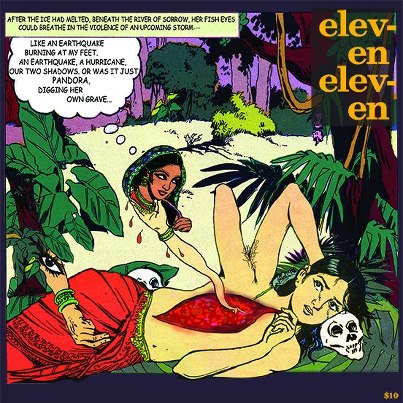
Genève/Geneva Chao has a B.A. In French,
an M.A. in English, and an M.F.A. in poetry. Her poems and translations have
been published in Boxkite, Can We Have Our Ball Back?, (Satellite) Telephone,
n/a literary journal, New American Writing, DIAGRAM, the L.A. Telephone Book,
and others. Her translations of Gérard Cartier's Tristran and
Nicolas Tardy's (with François Luong) Encrusted on the Living have
appeared from [lx] press, where she is an editor. She has twice been a Tamaas
resident for work on the intersectionality of language/poetry and dance/the
body.
1
- How did your first book change your life? How does your most recent work
compare to your previous? How does it feel different?
Well, one of us is wave one of us is
shore is my first book published (as opposed to the
dozen or so books that are currently lost on various stolen hard drives or
moldering boxes of paper). It has been wonderful so far. Otis has been very
kind and conscientious with me, a pleasure to work with. In the past, I’ve had
periods where I did not succeed in making the time to finish whole books; I've
had things pulled because I failed to please the person in charge socially or
sexually; I’ve turned down offers from friends to take a manuscript — I
understand that poetry is a small world and that we necessarily work with and
for our friends, but for me it was important to have some sense that the work
was being considered on its own merits and that my relationship with the
publishers as a human did not have a defining role, so I did not want to do it
that way. So I just sent this manuscript into Otis’s open reading period and
they took it. And yes, that was validating, certainly. But — and for me this is
a very important but — the real work of life-changing happened before I even
submitted it, when I emerged from a period of indentured domestic servitude the
like of which often befalls otherwise fortunate women, and which was debasing
and exhausting. This debasement and exhaustion made me understand that no
external recognition about myself as a poet was at all relevant to me. I think
often we crave recognition because we think it will Velveteen Rabbit us into
being flesh and blood and a heartbeat, and of course that never happens, or you
just become an enormous whore for more and more of it. And I was always both
jealous of and repulsed by the public-like-a-frogness of it all. So my life was
changed when I wrote this book and I committed to publicly admitting that I was
writing, and the publishing of it is entirely secondary. That said, because
Otis is a teaching MFA program, when they invited me to read there it was a
fantastic audience of mostly students — the public was allowed too — all of
whom had read the work and had interesting questions about it. So that was
life-changing because it allowed me to engage in a dialogue about the work that
did not feel like poseur b.s., which is the instinctive reaction I have at
readings or parties when people start conceptually droning about their work,
but which actually seemed to move the work forward.
2 - How did you come to poetry first, as opposed to, say, fiction or non-fiction?
I
read Emily Dickinson as a child, and Shakespeare, and of course I walked around
my house reciting them, and then in my early teens Creeley and Bunting and
Stevens and Pound and Laura Riding and so on. I was and am always interested in
spareness, as an aesthetic, more than ampleness, and in the plasticity of
poetry in terms of verse/narrative/theme/music. I of course always loved
reading novels, but now I find a lot of them — the Oprah book club ones, the
upper middle class white lady bedside ones, horribly dull. I think a lot of
these big contemporary American and British novels are class markers. I have
friends who read them constantly and pass them to me and... I really want to
like Claire Messud, for example, but I couldn’t finish her last thing. I still
love all the novels I read as a child, of course, which I think is because I
find novels that explore morality — and all the great children’s novels are
about this, how you decide who you are, what principles or crimes you’re going
to plant your flag on — very satisfying. So I am now writing children’s novels.
3
- How long does it take to start any particular writing project? Does your
writing initially come quickly, or is it a slow process? Do first drafts appear
looking close to their final shape, or does your work come out of copious
notes?
It
depends. I do a lot of gestating work. The actual writing is usually pretty
quick, and fully formed — minor edits but not a lot of major overhaul. If I
feel something needs major overhaul I’m more apt to chuck it and start the next
thing, imbued will all the beautiful knowledge of that failure.
4 - Where does a poem usually begin for you? Are you an author of short pieces that end up combining into a larger project, or are you working on a "book" from the very beginning?
My
late friend Stacy Doris once told me that she only wrote books and never
individual poems. I think this is a useful way of thinking about it. I like the
exploration of a theme through the length of a book — though I write very short
books so I can get back to bumping Nicki Minaj or making smoothies or whatever.
I have a hard time with the standalone poem; I’m not interested in it. I’ve
never liked the poems in the New Yorker or those “intelligent” magazines that
interrupt their socially pertinent reportage to bring you a poem so you can
feel cultured on your way to the tennis club. Not that they are uniformly bad
(just most of them), but I dislike this presentation. I suppose I am greedy for
more. I want each poem to be the ice cream in the ice cream sandwich in a whole
box of ice cream sandwiches, not one stingy truffle all dolled up on a plate.
5 - Are public readings part of or counter to your creative process? Are you the sort of writer who enjoys doing readings?
I
do enjoy doing readings, during which I make many inappropriate jokes and will
probably at some point segue into karaoke or parkour. I have trouble taking
readings too straight, but I love connecting to the reader. I am my reader too.
6
- Do you have any theoretical concerns behind your writing? What kinds of
questions are you trying to answer with your work? What do you even think the
current questions are?
I
have ONLY theoretical concerns behind my writing. one of us is wave one of
us is shore is of course a lover’s discourse, and it’s one that
specifically gnaws on what Guy Bennett in my reading at Otis wonderfully called
“the inadequacy of language.” In this case it’s the inadequacy of French and of
English to each other, to translation, to the experience they attempt to
describe; the book is in many a bad translation of itself. I have a finished
manuscript called i, poor monster that is about motherhood and
how it irrevocably alters (not always constructively) one’s mental and physical
architecture, sometimes with disastrous results. This started when two very
good friends of mine and I all became mothers and our lives instantly fell
apart. Motherhood can be catastrophic. It is a seismic shift. Sometimes Lois
Lane disappears into the fissure.
7
– What do you see the current role of the writer being in larger culture? Does
s/he even have one? What do you think the role of the writer should be?
The
role of the writer is to make things that people want to read. Beyond that,
it’s nice if sometimes they change the world, not necessarily in sweeping
gestures but through intelligence and increment. Ursula le Guin was talking in
a recent interview about how she was always secretly making her protagonists
people of color and readers would never notice; I remember this very clearly,
reading The Wizard of Earthsea as a child and not noticing
Ged, the protagonist’s, coppery-red skin and then in the second book it’s
contrasted to Tenar’s white skin and you’re like Ohhhh miscegenation! My
parents were miscegenators, so this was very reassuring to me.
8 - Do you find the process of working with an outside editor difficult or essential (or both)?
No.
9 - What is the best piece of advice you've heard (not necessarily given to you directly)?
Well,
the great Canadian poet Alanis Morissette says “the moment I let go of it/is
the moment I got more than I could handle” and, though perhaps wildly
optimistic, this is an attitude I wish more people would adopt. We have too
much poverty mentality and status-grubbing, particularly in the arts. And
Creeley says “bite it but take care not to hurt,” which I think is also good
advice.
10 - How easy has it been for you to move between genres (poetry to translation)? What do you see as the appeal?
Translation
for me is very much a lending of my voice and skill to try to render into one
language what I see as the character of a work. It is a work of service. Poetry
for me is a work of attacking problems, of analysis. This is the place where I
live. And novels are a work of the pleasure of imagining.
11 - What kind of writing routine do you tend to keep, or do you even have one? How does a typical day (for you) begin?
For
poetry, I write one poem every morning first thing, while drinking coffee. For
novels, I write one thousand words every morning first thing, while drinking
coffee. I am extremely rigid about this and I like total silence when I do it,
although of course the silence is often punctuated by the screams of battling
children. But I am always fighting my way back into that silence where the work
can emerge. Because I also have a full-time job plus many other
responsibilities, I sometimes miss a day, but it is rare for me not to average
over five days a week. If I had fewer other things to do, I would write for
longer in the morning. If I have something else to do, like an essay, I crank
it out after lunch. I do not write in the evening at all; that is time for food
and noise.
12 - When your writing gets stalled, where do you turn or return for (for lack of a better word) inspiration?
I
am not a big believer in writing getting stalled — I more sidle up to it if
it’s skittish — but I need to take a lot of breaks to do physical things, like
walk or eat. Then I find everything falls into place. But of course my routine
is a way of keeping things well oiled.
13 - What fragrance reminds you of home?
Lavender.
Lilacs. The dusty smell of California dirt. Salt water. Eucalyptus,
particularly in mist or rain.
14 - David W. McFadden once said that books come from books, but are there any other forms that influence your work, whether nature, music, science or visual art?
Yes,
but not directly; more as an overlay. The sections of one of us is wave one of
us is shore are named from a song by the great French rapper M.C. Solaar,
“Matière grasse contre matière grise” (“Fat matter versus grey matter,”
literally translated). I love to appropriate structures from science: I wrote a
poem called “Five Specifics,” published by DIAGRAM a
hundred years ago, that is of course all based on physics: specific gravity,
heat, impulse, performance — such great metaphor words.
15
- What other writers or writings are important for your work, or simply your
life outside of your work?
I
really enjoy critical theory, structuralism/poststructuralism, and semiotics,
Barthes and Saussure and Deleuze/Guattari and Baudrillard (especially
Baudrillard, who cracks me up) and Guy Debord and etc., but I don’t take it
very seriously. These things seem to me like fine amusements. It may be naive
to think they provide us with any kind of actual wisdom. But I think that
particular twentieth century way of dismantling cities or systems into
intentions and attitudes, of trying to understand what everything means, or
what it represents or dissembles about, is very much a habit of mine. Other
than that…I read a lot of different things, but I wouldn’t say they’re part of
my process. The fiction I read is a way of stepping out of that place of
constructing and into a space of just rapaciously consuming, with juice running
down my chin.
16 - What would you like to do that you haven't yet done?
Well,
hang glide, obviously. Stacy used to always threaten that we would show up at
Fort Funston and seduce a bunch of hang gliders into taking us up for free.
Using our feminine wiles. I never actually saw her use her feminine
wiles in anything like such a deliberate or targeted way, and I’m not all sure
I’d know how, but I would go along for the ride. This now has to happen in an
alternate universe. Otherwise, I am not a big believer in bucket lists. Many
parts of my life give me intense pleasure and engagement. I do an enormous
amount of work of many different types. That is already pretty good, I think.
17 - If you could pick any other occupation to attempt, what would it be? Or, alternately, what do you think you would have ended up doing had you not been a writer?
I
think I could have been a great Hero. I don’t mean like Supergirl. I mean like
a priestess in a tower setting out torches for her hot affair with some
world-class swimmer.
18 - What made you write, as opposed to doing something else?
I
was too shy to sing in public. Legions of people in karaoke bars worldwide will
tell you that’s no longer the case.
19 - What was the last great book you read? What was the last great film?
Great
is a very heavy word. I don’t see a lot of movies because it’s expensive. The
last movie I saw that was really great was called Enemies of the People. It’s a
documentary by a journalist, Thet Sabbath, who lost his parents in the
Cambodian genocide and who gets to know Nuon Chea, who is featured in the film.
I think I’ll recuse myself from the book question.
20 - What are you currently working on?
I’m
currently working on a series called Hillary Is Dreaming, which follows the
election and is an observation/analysis of the many fucked-up chimeras Hillary
Clinton has been transformed into, either by the gaze and words of others or by
herself or her intimates. I find this fascinating and grotesque. I get up and
read various newspapers and magazines and everybody’s Twitter accounts and do
keyword searches and I try to imagine what it would be like to inhabit that
body, to be its puppeteer. Of course I realize that talking about feminism and
media is a thing white women do, but I thought I might give white woman a
break: these are the economies of all our lives.