Showing posts with label Sarah Rosenthal. Show all posts

Monday, January 12, 2026

Touch the Donkey : new interviews with Sarah Rosenthal, Susan Gevirtz + Aidan Chafe,

Anticipating the release on Thursday of the forty-eighth issue of Touch the Donkey [a small poetry journal], why not check out the interviews that have appeared over the past few weeks with contributors to the forty-seventh issue: Sarah Rosenthal, Susan Gevirtz and Aidan Chafe.

Interviews with contributors to the first forty-six issues (nearly three hundred interviews to date) remain online, including:
Kirstin Allio, Joseph Donato, Beatriz Hausner, Nicole Markotić, Lisa Pasold, Lina Ramona Vitkauskas, Dag T. Straumsvåg, brandy ryan, Misha Solomon, D. A. Lockhart, Dominic Dulin, Jordan Davis, Larkin Maureen Higgins, J-T Kelly, Jennifer Firestone, Austin Miles, Alice Burdick, Henry Gould, Leesa Dean, Tom Jenks, Sandra Doller, Scott Inniss, John Levy, Taylor Brown, Grant Wilkins, Lori Anderson Moseman, russell carisse, Ariana Nadia Nash, Wanda Praamsma, Michael Harman, Terri Witek, Laynie Browne, Noah Berlatsky, Robyn Schelenz, Andy Weaver, Dessa Bayrock, Anselm Berrigan, Alana Solin, Michael Betancourt, Monty Reid, Heather Cadsby, R Kolewe, Samuel Amadon, Meghan Kemp-Gee, Miranda Mellis, kevin mcpherson eckhoff and Kimberley Dyck, Junie Désil, Micah Ballard, Devon Rae, Barbara Tomash, Ben Meyerson, Pam Brown, Shane Kowalski, Kathy Lou Schultz, Hilary Clark, Ted Byrne, Garrett Caples, Brenda Coultas, Sheila Murphy, Chris Turnbull and Elee Kraljii Gardiner, Stuart Ross, Leah Sandals, Tamara Best, Nathan Austin, Jade Wallace, Monica Mody, Barry McKinnon, Katie Naughton, Cecilia Stuart, Benjamin Niespodziany, Jérôme Melançon, Margo LaPierre, Sarah Pinder, Genevieve Kaplan, Maw Shein Win, Carrie Hunter, Lillian Nećakov, Nate Logan, Hugh Thomas, Emily Brandt, David Buuck, Jessi MacEachern, Sue Bracken, Melissa Eleftherion, Valerie Witte, Brandon Brown, Yoyo Comay, Stephen Brockwell, Jack Jung, Amanda Auerbach, IAN MARTIN, Paige Carabello, Emma Tilley, Dana Teen Lomax, Cat Tyc, Michael Turner, Sarah Alcaide-Escue, Colby Clair Stolson, Tom Prime, Bill Carty, Christina Vega-Westhoff, Robert Hogg, Simina Banu, MLA Chernoff, Geoffrey Olsen, Douglas Barbour, Hamish Ballantyne, JoAnna Novak, Allyson Paty, Lisa Fishman, Kate Feld, Isabel Sobral Campos, Jay MillAr, Lisa Samuels, Prathna Lor, George Bowering, natalie hanna, Jill Magi, Amelia Does, Orchid Tierney, katie o’brien, Lily Brown, Tessa Bolsover, émilie kneifel, Hasan Namir, Khashayar Mohammadi, Naomi Cohn, Tom Snarsky, Guy Birchard, Mark Cunningham, Lydia Unsworth, Zane Koss, Nicole Raziya Fong, Ben Robinson, Asher Ghaffar, Clara Daneri, Ava Hofmann, Robert R. Thurman, Alyse Knorr, Denise Newman, Shelly Harder, Franco Cortese, Dale Tracy, Biswamit Dwibedy, Emily Izsak, Aja Couchois Duncan, José Felipe Alvergue, Conyer Clayton, Roxanna Bennett, Julia Drescher, Michael Cavuto, Michael Sikkema, Bronwen Tate, Emilia Nielsen, Hailey Higdon, Trish Salah, Adam Strauss, Katy Lederer, Taryn Hubbard, Michael Boughn, David Dowker, Marie Larson, Lauren Haldeman, Kate Siklosi, robert majzels, Michael Robins, Rae Armantrout, Stephanie Strickland, Ken Hunt, Rob Manery, Ryan Eckes, Stephen Cain, Dani Spinosa, Samuel Ace, Howie Good, Rusty Morrison, Allison Cardon, Jon Boisvert, Laura Theobald, Suzanne Wise, Sean Braune, Dale Smith, Valerie Coulton, Phil Hall, Sarah MacDonell, Janet Kaplan, Kyle Flemmer, Julia Polyck-O’Neill, A.M. O’Malley, Catriona Strang, Anthony Etherin, Claire Lacey, Sacha Archer, Michael e. Casteels, Harold Abramowitz, Cindy Savett, Tessy Ward, Christine Stewart, David James Miller, Jonathan Ball, Cody-Rose Clevidence, mwpm, Andrew McEwan, Brynne Rebele-Henry, Joseph Mosconi, Douglas Barbour and Sheila Murphy, Oliver Cusimano, Sue Landers, Marthe Reed, Colin Smith, Nathaniel G. Moore, David Buuck, Kate Greenstreet, Kate Hargreaves, Shazia Hafiz Ramji, Erín Moure, Sarah Swan, Buck Downs, Kemeny Babineau, Ryan Murphy, Norma Cole, Lea Graham, kevin mcpherson eckhoff, Oana Avasilichioaei, Meredith Quartermain, Amanda Earl, Luke Kennard, Shane Rhodes, Renée Sarojini Saklikar, Sarah Cook, François Turcot, Gregory Betts, Eric Schmaltz, Paul Zits, Laura Sims, Stephen Collis, Mary Kasimor, Billy Mavreas, damian lopes, Pete Smith, Sonnet L’Abbé, Katie L. Price, a rawlings, Suzanne Zelazo, Helen Hajnoczky, Kathryn MacLeod, Shannon Maguire, Sarah Mangold, Amish Trivedi, Lola Lemire Tostevin, Aaron Tucker, Kayla Czaga, Jason Christie, Jennifer Kronovet, Jordan Abel, Deborah Poe, Edward Smallfield, ryan fitzpatrick, Elizabeth Robinson, nathan dueck, Paige Taggart, Christine McNair, Stan Rogal, Jessica Smith, Nikki Sheppy, Kirsten Kaschock, Lise Downe, Lisa Jarnot, Chris Turnbull, Gary Barwin, Susan Briante, derek beaulieu, Megan Kaminski, Roland Prevost, Emily Ursuliak, j/j hastain, Catherine Wagner, Susanne Dyckman, Susan Holbrook, Julie Carr, David Peter Clark, Pearl Pirie, Eric Baus, Pattie McCarthy, Camille Martin and Gil McElroy.

The forthcoming forty-eighth issue features new writing by: Sunnylyn Thibodeaux, David Hadbawnik, Adam Haiun, Laressa Dickey, Tanis MacDonald, Monroe Lawrence, Jessie Jones and Frances Cannon!


And of course, copies of the first forty-six issues are still very much available. Why not subscribe?

Included, as well, as part of the above/ground press annual subscription! 2026 now available!

We even have our own Facebook group, and a growing above/ground press substack. It’s remarkably easy.
Saturday, August 22, 2020

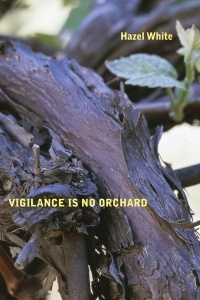
Hazel White, Vigilance Is No Orchard


A project arrives in space.

Figure what is given:

Mountain backdrop
alluvial fan to the sea
“at the edge inventing:

“Try dill—or Queen Anne’s lace—threaded through a cedrela grove, or Gold Plate
achillea (yarrow) threaded through plant stakes.”

Try talkback. Try leapfrogging bewilderment with a
readiness to act.

Make a rustle.

Not a metaphysical hum
from over the horizon but something presently large in the bush
in the hand. (“View 2 : the way about”)

Thanks to a parcel of books gifted by the author, I’m just now going through San Francisco poet Hazel White’s second full-length collection, Vigilance Is No Orchard (New York NY: Nightboat, 2018), on the heels of her debut, Peril as Architectural Enrichment (Berkeley CA: Kelsey Street, 2011). Constructed as seven sections plus postscript—“View 1 : away from vertical,” “View 2 : the way about,” “View 3 : what wants to occur,” “View 4 : drought/worry of direction,” “Refuge 1 : cut at it,” “Refuge 2 : forcing a shape” and “Refuge 3 : losing sight”—the poems in Vigilance Is No Orchard exist as a lyric prose suite (constructed out of seven lyric prose suites), a sequence of short fragmented bursts that accumulate into and around the garden, writing openly and across the field of composition. As part of a short 2018 interview posted at The Cultural Landscape Foundation, White responds that “I wrote it [Vigilance Is No Orchard] in response to a work of landscape architecture: the garden Isabelle Greene designed in 1982 for Carol Valentine, internationally known as the Valentine Garden. I hope very much that my time researching the experience of space and developing a dense and particular mode of expression (both of these necessary to my writing about Greene’s extraordinary garden) has enriched my understanding of landscape.” There is something quite compelling about the fact that both of White’s books respond to ideas of architecture: each book is clearly structured as a single unit, held together through a sequence of intricate, open, ongoing lyrics. “Weight rolled off the page; risk bought it. Synthesis of direction and what to do. / then was no time for figuring, fingering, if this hillside might stall all navigation.” (“View 1 : away from vertical”). There is so much in the space between her words and her lines; an expansiveness, stretched out and across a wide canvas. There is also such a wonderful musicality, a flow, to White’s lyric, such as this opening stretch to a fragment of the second section, that reads: “Currency strums through the sternum sideways along the shoulder bones to the / back, which is a text, not a mass, but movement, each rib loose, the way life is. Fly it? // I ride it. Sounds may rocket out of the mouth.” As the postscript to the collection provides:

At the end of the garden—

an orchard and a field of pork and beans growing in, growing out, no fuss, language earning its keep. Why did I go in to index its presence, risk such a vascular distribution! I tie the why of it into the larger landscape (no upright needed) to make a new out-of-frame direction, transparent churn toward exit, brittle flecks of effort on the insides of my arms, but I keep my chin lifted. The image no longer money but the spring that lost its victorious tones against the trunk of the pomegranate tree and presents itself, if I squat, in a memory beneath my feet.

—Reader, you’ve come through, across, close by. I’m thinking of you from here, in San Francisco, six miles in from the Pacific Ocean, verifying the lines of my dress, its embroidery, a round-the-back button of my own. Because a garden, like a photograph, can die, I’m placing the flat fact of it here, in the dry, like certainty’s stored apples and pears.

White’s is a book on building, unbuilding, collecting and assembling, articulating how language, structures and gardens are constructed, both naturally and artificially. American poet Cole Swensen wrote on the seventeenth-century French baroque gardens designed by the father of the form, André Le Nôtre, in her Ours (University of California Press, 2008), and Montreal poet Stephanie Bolster wrote on formal gardens in A Page from the Wonders of Life on Earth (Brick Books, 2011), and White’s exploration of the works of landscape architect Isabelle Greene and her iconic Valentine garden feel both a sibling collection to those two, although one with a different kind of looseness and openness. After all, Swensen and Bolster are writing on formal gardens leaning more on the Victorian ethos—nature controlled and domesticated—while White’s subject suggests less an overpowering structure than a collaborative, wilder one.

As part of a four part interview with White conducted by Sarah Rosenthal for her Sculpting my Life blog, around the composition of Vigilance Is No Orchard, she described the process of putting the book together as a “twenty year process.”

I’ve thought a lot about why this project took twenty years. I’ve come to understand that as an English person, I wasn’t writing about a Southern California landscape from the perspective of someone raised here. I had to take up habitation in a foreign aesthetic. It’s very hard to have lost one’s original place. It’s even harder to write about that. Yet I felt I might never encounter a more mysterious or necessary subject. So what choice did I have? I had to address that desperate resettling.


Tuesday, March 04, 2014

new from above/ground press: Schapira, Schmaltz, mclennan, Rosenthal + Tourbin,

OVERHEARD WHILE HIDING FROM THE SUN
Kate Schapira
$4

See link here for more information

MITSUMI ELEC. CO. LTD.: keyboard poems
Eric Schmaltz
$4

See link here for more information

from Hark: a journal
rob mclennan
$4

See link here for more information

Estelle Meaning Star
Sarah Rosenthal
$4

See link here for more information

THE STREAM and other poems
Dennis Tourbin
$4

See link here for more information


keep an eye on the above/ground press blog for author interviews, new writing, reviews, upcoming readings and tons of other material;

published in Ottawa by above/ground press
February 2014
a/g subscribers receive a complimentary copy of each

To order, send cheques (add $1 for postage; outside Canada, add $2) to: rob mclennan, 2423 Alta Vista Drive, Ottawa ON K1H 7M9 or paypal (above). Scroll down here to see various backlist titles (many, many things are still in print).

Review copies of any title (while supplies last) also available, upon request.

and don’t forget about the 2014 above/ground press subscriptions; still available! Did you see what we made in January? Other forthcoming chapbooks by David Phillips, Susanne Dyckman and Pearl Pirie, and watch for new “poem” broadsheets by m erskine, Rachael Simpson and Elizabeth Robinson!

Sunday, September 23, 2012

eleven eleven #13


There was no hope
that a reading
customer could
leave this thick and
cold silence. She
shivered and rose
again looking
to go for coal.

She put water
once in the hot
water bottle
which could not sing
any more while
the new she-cat
slept in its fur
behind the stove.

Egoistic
particulars
raised their eyes to
look across the
old window prints
of falling snow –
the street had turned
completely white.

Alone, she crossed
her happy arms
desiccated
upon her chest,
and put her nose
outside to re-
cord the world of
whole spectacle. (Victor Coleman, “ivH 58 [coda]”)

The most startling thing about the thirteenth volume of the bi-annual eleven eleven: A Journal of Literature and Art (San Francisco CA: 2012) might be in the inclusion of new poems by Toronto poet Victor Coleman, a writer who rarely (it seems) appears in trade journals (although, as I learn through Coleman’s bio, a chapbook of this work appears or has appeared this year with Toronto’s BookThug). I suspect the inclusion of work by Michael Boughn, a writer who co-edits and co-conspires with Coleman (including co-editing the recent University of California Press edition of Robert Duncan’s The H.D. Book), might have something to do with that. Possibly. But either poet’s work is worth more than the price of admission, and I wonder what the late John Newlove might have thought about Boughn’s poem in this issue, the odd, hilarious and marvelous “Doukhobor Butts”? The piece begins:


The truth is often saggy, naked, dimpled
in ways unsuspecting youths from the desert
intersect with a kind of stunned but vague
recognition that north is more direction

than most needles can tell. Is it
the condition that wreaks or the havoc
that conditions? The flames bear confusion
into the thick of alien’s sudden

illumination. […]

For the two hundred and fifty-plus pages of the journal, I’m a bit surprised at the sheer amount of writers I’ve not previously heard of, a wide range of magnificent work by such as John Pluecker, Floyd Salas, Lee-Ann Roripaugh, Judy Roitman, Eugene Rico and Clay Matthews, all new discoveries, thanks to this issue. This is the benefit, I suppose, of a journal that doesn’t consider the writers they publish for another issue or three. And the bee images by Rebecca Szeto, “from the ongoing series Traces: Daily Meditations on Just Beeing,” are quite stunning. Otherwise, it’s good to see new work by familiar names such as Sarah Rosenthal, françois luong, and Rebecca Loudon (a recent discovery).

from Lizard

Mostly eats the living.
On account of her
eyes. They see what
moves. She stalks
the world nude, I
want to say reveals
the world’s nudity.
Want to say, we’re
all that emperor.
That lonely thing
with mirrors (Sarah Rosenthal)

Another particular highlight was the interview Peta Rake conducted with Newfoundland-based photographer/performance artist Kay Burns, and her work The Other, a series of staged photographs of the artist as female historical figures who lived their lives as men. Might this be a touring work, perhaps? As Rake introduces the interview:

Dress is an exploration of not only self, but of the other. Enacting these alternate identities has become a process of discovery for performance based artist Kay Burns. The women Burns researched and portrayed in her project, The Other, made a “pragmatic decision to dress as men in order to move forward in a career path that would have been unacceptable for women at that time.” And the women have such varieties of career; Margaret Ann Bulkley as the military doctor and surgeon Dr. James Barry; Mary Charlene Parkhurst as the stagecoach driver for Wells Fargo Charley Parkhurst; Charlotte O’Leary as the zoo keeper and bear trainer Charlie O’Leary. What becomes integral to Burns’ project is that the women she seeks to re-inhabit do not implement male dress as one-off masquerade, but that they had lived their entire adult lives as men, with their female genders only revealed posthumously.

Sunday, June 05, 2011

Ongoing notes: the dusie kollectiv,

Here are some brief reviews of more of recent chapbooks received as part of the “dusie 5 kollectiv” [see my three notes on such here, here and here].

San Francisco CA: I'm enjoying the wonderment of Bay Area poet Sarah Anne Cox's MEDEA 10-18 (2011), following up her dusie 4 kollectiv offering, MEDEA 1-9 (2010). The character Medea, in Greek myth, of course, is the wife of Jason and mother of his two children. Abandoned by Jason for another woman, Medea's story centres around seeking revenge on her errant, former husband, a story that Sarah Anne Cox slips in, around and through in peripheral and direct ways, twirling lyric around the narrative structure in a sequence of poems. Might Cox be slowly composing and releasing this sequence only in association with dusie? I'm intrigued by the slowness, but wondering how many years must we wait for a larger, longer and possibly complete manuscript? There's a part of me, though, that doesn't mind waiting to see what might come of this, next.
11

Let yourself slide into the lines, slip in unnoticed
and live there in the dirt and coarse gravel beach
once we stepped off the boat it was difficult to
get back on, we did see the ships coming, laden
we lived among wealth and so the items
arrived for trade. sometimes I'd walk to the beach
where the ships pulled up to see if I was there,
some part of me, some eastern black sea part
but all those red faced men dissemble calling
themselves from
no where. from the future.
I've been looking her name up, and keep finding scatterings of listings, including for trade poetry collections Arrival (Krupskaya, 2002) and, possibly, Parcel (O Books, 2007), but uncertainties abide. Where might all her poems be, and will perhaps some even manage to cross a border or two?
12

To get to the beginning you must go backward.
You must file an affidavit of intent
You must pull up the claims in newspaper reports
You must listen patiently to every version
You must be prepared to argue anything.
You must stop cradling the baby and let him go
You must stop cradling the baby and murder
Minneapolis MN: I have to admit, it was the title of Elisabeth Workman'sMaybe Malibu, Maybe Beowulf (2011) that really reached out and grabbed me, forcing me to sit down with this (compared to many other of the dusie 5 kollectiv chapbooks) relatively straightforward-looking pink chapbook (see a review someone wrote of a previous of her dusie chaps here). Are all of her titles this good? Moving through her collection, poems include “HARDCORE BRADY BUNCH ASEXUAL REPRODUCTION,” “HOW NOW MUFF-FED RUMPUS,” “THE CANADIAN TUXEDO IN THE AGE OF MECHANICAL REPRODUCTION” and “THE UNSPOKEN REVERENCE THAT IS DWARF QUEEFING,” so I'd have to say unequivicoally yes. Yes they are.
A DICK DESTINY

The difference is “a factually correct object.”

I may be missing a subtlety here but it is Toledo
and we are rotating in a rolodex of wuv
in a hot air balloon over Sarajevo
something like another monolithic Post-it Note against the firmament
the message cut into tiny pieces with a steak knife
spoon-fed to the mouths of cows at the expense of
another quality docudrama
a probe, a hole, a “Burger King.”
I do like the near-electric movement of some of Workman's lines, the sing and the pop of her turns and snappy breaks (one online source I found refers to her as a “Flarf poet”), weaving in cultural references, all in a way that reminds me of Canadian poet Marcus McCann, weaving language play with irreverent pop-culture stings. Where might I find more, I wonder?

San Francisco CA: I've been reading the work of Bay Area poet, editor and critic Sarah Rosenthal for a few months now, so was quite pleased to see her small and graceful dusie offering, The Animal (2011), including text by Rosenthal and images by Amy Fung-yi Lee. What is this book, The Animal? She writes a narrator with possibly her own name, having conversations with birds, blurring the line between what is animal and what just might be human, and wondering exactly what the difference is. Constructed with hand-sewn dos-à-dos binding, the chapbook includes lyric and prose poems, a fragmented collation that may or may not be part of a larger project, writing:
The animal is
hungry in winter
after wars

Stories are made
from footage
as if this
and that animal
cared, broke bread
or bones together

The narrator
states the happily
ever after tale

Forget the narrator.
The choices are
vegetable, mineral,
or animal
Rosenthal, through books such as Manhatten (2009), seems interested in the book as unit of composition, writing out longer sequences that collage themselves into being, and into a kind of structural and thematic unity, and The Animal seems no different, while still allowing enough vibrancy and space to perhaps grow much larger.
Dear X,

You're real, but I can't come meet you because I'm sitting in a bar looking out through a picture window at orange geese with red beaks. The color must be natural but it's easy to suspect something's amiss and think Agent Orange and Red Dye Number Something. The geese have landed and are facing their leader who's honking directions at them and then they'll take off again.

This is a dream idea of geese infused with lack of expertise. Agent Orange wasn't orange.

I'm sitting at a Lazy Susan table thinking if it were filled with food and there were a family, how perfect to spin and share. But this place is deserted except for a couple of waitresses, one of whom just served me a beer, dark and rich like a piece of the most wholesome bread. I drank most of it immediately and as you know I can't handle alcohol. So we'll see. This place used to be a top establishment but the guys who recently acquired it have let it go to hell, keep a minimum crew and just squeeze whatever they can out of it. At least they can't ruin beer, or the solid, oak wood of the tables and bar. The geese took off at some point in this writing. They were a surprise in three dimensions, tinted with fear. By the way—they weren't outside plate glass. They were right here.

I love you,
S