Showing posts with label Robert Duncan. Show all posts

Tuesday, March 11, 2025

my Vancouver is as boundless as the sea : Vancouver, part one,

You probably caught that Christine and I recently headed west to read through Poetry in Canada at Simon Fraser University, thanks to the machinations of Stephen Collis and Isabella Wang. Do you remember when we read in Vancouver through Lunch Poems at SFU in February 2020, mere weeks prior to the Covid-era [see my report on such here], or our reading together last fall in Calgary [see my report on such here], or our paired reading and workshop over in St. Catharines, Ontario (wishing I'd done a report on this, but time got away from me)? I’ve been enjoying the possibilities of our paired readings, the counterpoint between her work and mine providing an interesting balance, I would think. As well, we so rarely get opportunities to run around and have adventures sans children (our St. Catharines trip didn't really allow for much in the way of adventuring, heading straight in to run workshop, read and return).

We flew out of Ottawa on a delayed flight (oh, Air Canada) and made our hotel by 10pm or so (was that Ontario time or Vancouver time? I'll admit I've lost track), staying once more at the infamous Sylvia Hotel, and possibly even the same room we'd stayed in, prior (the fifth floor, overlooking the neighbouring building's skylight, and not the actual beach along English Bay). We caught the statues first thing, morning light across the water, and even saw a trio of swimmers emerge from the water. Is this February, still? Ten degrees, which means a nearly thirty degree difference between here and home. The grass is green, and the sun, warm on the skin.


A photo by the same statues as our prior visit, then breakfast. After breakfast, I sat for a bit with coffee and a recent Divya Victor title, by Sputnik & Fizzle. And from there, we headed out to the Vancouver Art Gallery [Christine, with Jolanta Marcolla's 1975 "Kiss" in video loop behind her, as part of the exhibit Multiple Realities: Experimental Art in the Eastern Bloc, 1960s–1980s], which I'd only been attempting to visit across my last three stops in Vancouver (whether 2020, or when I read in Vancouver with Stephen Brockwell in 2017 [see my report on such here]; I can't even recall when I read in Vancouver prior to that; maybe 2004? that would be an awfully long time ago). It suggest it really might be twenty-five years since I've set foot here, perhaps.


We made for the Emily Carr exhibit first, hitting the top floor and moving down, as the front desk recommended. I appreciated that various texts in the exhibit spoke directly to Carr's own misunderstandings and even appropriations of local indigenous markers, images and cultures, running wild with her own presumptions and blind-spots. It certainly made for a far more respectful understanding of Carr's work, and what Carr was responding to, actually acknowledging some of those conflicting contexts, Carr being very much a person of her time.


The absolute highlight of our time there had to be the work by Dominican Republic-born, New York City-based artist Firelei Báez. Her work is remarkable, explosive, complex, historically responsive and wonderfully detailed (including the doorway you saw Christine walk through, above). All I want to do is show my poor snapshots of her vibrant colours, but you should try to catch any show she has, to see what marvels she has produced (and large scale, which my pics don't really capture). Oh, her work, her work. Her incredible work.


The 'art in the eastern bloc' show was extremely interesting, showcasing the vibrancy of various artists during that period, attempting performances, conversation and interconnection that would have been risk-taking during that era, in those spaces. And how young they all looked, pushing the boundaries of personal and artistic freedom. I was reminded of stories during Milan Kundera's early exile, copies of his work (and so many others, all of which were officially suppressed) running through an underground network up to and through the Velvet Revolution.

Hey! We met Vancouver poet Marc Perez on the street outside! He had a debut full-length collection out last fall with Brick Books that I've been trying to get my hands on, without any luck. Hopefully we can figure out an interview soon. Our meeting was completely random, as I was attempting a street map for our lunch, and he wandered by. Hey, are you rob mclennan? I sure am, fella!

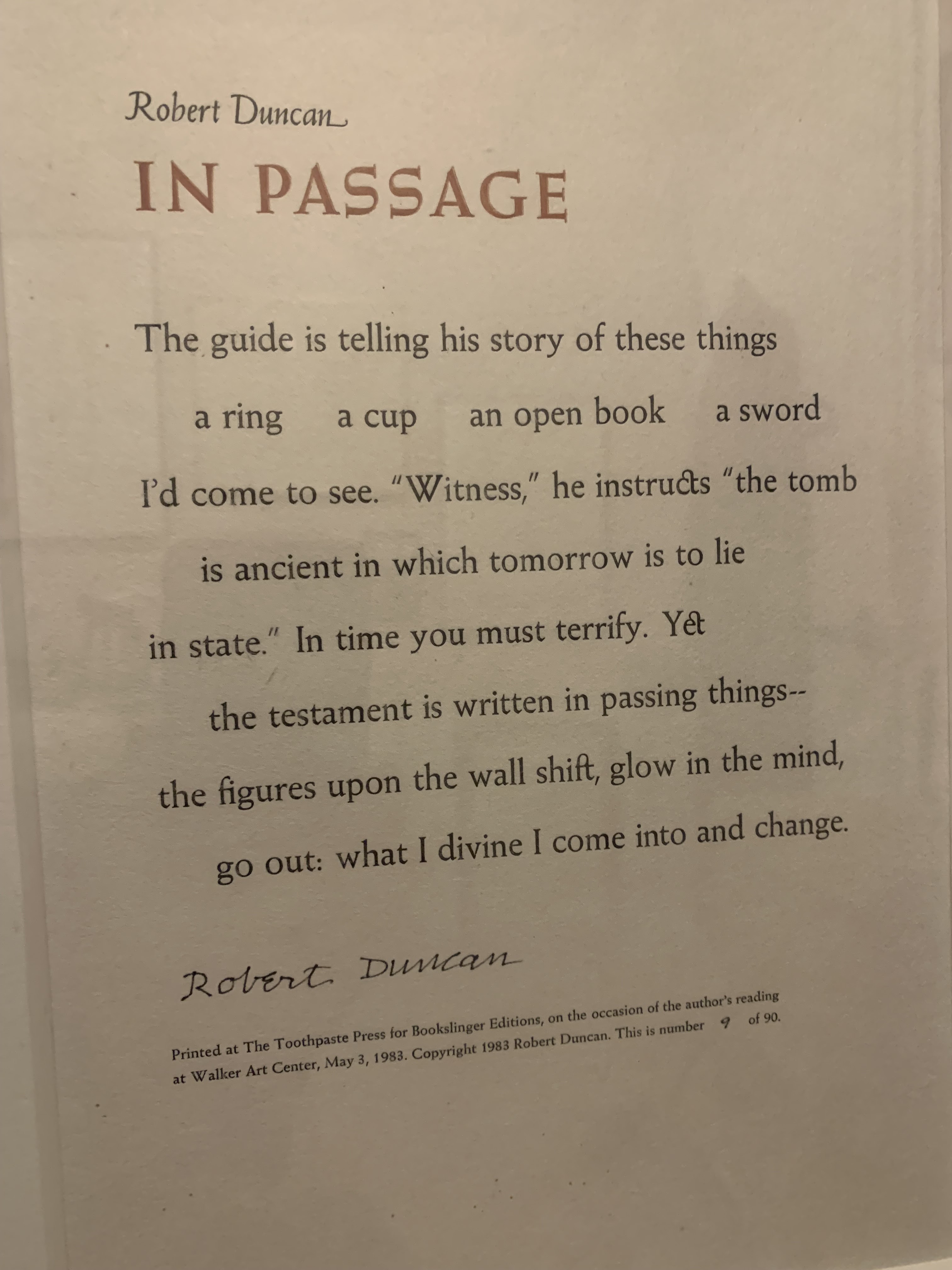
After lunch, we made for Vancouver's infamous The Paper Hound Bookshop, where we each picked up a small handful of items--Christine caught a bpNichol title from Talonbooks I actually hadn't heard of before, Monotones (1971); and I picked up a copy of Kevin Killian's Selected Amazon Reviews, and Patrick Lane's Winter (1990), which is truly a classic (I'm not usually into Lane's work, but this book is sharp). Did you know the bookshop has an array of framed letterpress broadsides covering their bathroom walls? Apparently the collection came from Peter and Meredith Quartermain during their downsizing, and the bookstore had no other wall-space, so here they lay, for when that moment either staff or the occasional customer have a moment to contemplate. There's a lot of Robert Duncan on these walls.

We cabbed back to our hotel, as Christine was running low on energy, and managed to pass what looked like teenagers in antiquated dress by a fancy house; what was that? Christine looked it up, and we discovered the Roedde House Museum, "the restored 1893 home of Canada's first bookbinder," the German-born immigrant from Cleveland, Ohio, Gustav Roedde (1860-1930). Oh, we have to go to that. It was only open for another hour, and not at all open the following day. We immediately rushed back to catch this most stunning Victorian house (it has a sunroom turret!), set up as self-guided tours one can wander throughout. Had we not wandered by, we wouldn't have known! And Christine is, as you know, is not only a trained and skilled bookbinder, but the National President of the Canadian Bookbinders and Book Artists Guild, so we couldn't pass up the opportunity.

There wasn't much in the space directly relating to his bookbinding work, as his bindery would have been off-site elsewhere (there was a photo of such, at least), but the house was absolutely packed with items, information and a musty scent (most windows were open, as I'm sure the volunteer at the front desk appreciated, especially since the day was so warm).


It was hard not to get distracted by all the items, the details, of such a space. A whole corner of one room dedicated to Queen Victoria, for example. Did family homes of that era really hold small shrines for their Queen, plates displaying their Prime Minister? It was curious to consider this a possibility, or simply a display of items from that particular era. When I asked about the plate with Sir Robert Borden, Prime Minister from 1911 to 1920, rambling on to the front desk about my recently-discovered fact of him being fourth cousin (once removed) to the infamous Lizzie Borden [seriously: I wrote a whole post on this; they're both distantly related to me], the front desk volunteer, who appeared not much younger than myself, claimed to not know who either of these people were. Really? I mean, you've really not heard of either of these folk? An older well-bearded gentleman overheard us, wondering what we were discussing about Borden, so I repeated my ramble. They were related? before turning to her. You haven't heard of Lizzie Borden?

And then he SANG THE WHOLE LIZZIE BORDEN POEM TO US. It was absolutely glorious.

As I left the museum, the volunteer on her cellphone, looking both individuals up. 


Back at the Sylvia (a fifteen minute walk or so), we had a moment to catch our breath, me downstairs at Sylvia's Bar for a bit sketching notes before Christine met up with me (she needed a quiet moment upstairs first), before we headed out for our paired reading at Simon Fraser University [I'll save all of that for the next post: to be continued...]

Sunday, December 08, 2024

Lemonade (August 21, 2011 – December 5, 2024)

Our beloved cat, Lemonade, who turned thirteen this past August, collapsed the other night in clear distress. I rushed him to the Emergency Vet Clinic not ten minutes away, but he passed within five or six minutes of landing. What the hell happened? I was still filling out paperwork. At home and throughout the car ride he was howling, howled, in a way that seemed frightening; collapsed on our bedroom floor and drooling, unable to move.

Not even enough time for the Veterinary assistant to bring me into the room. It was the suddenness, more than anything else. An emotional whiplash. He’s actively dying, they said. His heart or a clot, although they were able to medicate him for a bit of relief. Do you want to go in with him, even as a further interrupted, saying it was already too late. I signed my name to a form. Christine, still at home, attempted to comfort our distraught children, upending their bedtime. Aoife, who chose to remain home from school the next day, as she couldn’t stop crying. Rose, who chose to go, so she could talk it out with her friends.

It was somewhere in the fall of 2011 that Christine told me that she wanted either a baby or a dog or a cat or a flower. It was a list I found startling, as we were neither married nor engaged at that point (nor had any of that been discussed), a year into living together in a third-storey walk-up in Centretown. God sakes: a baby? In that moment, I had no idea if she was serious. A cat, I thought, seemed easy enough. A flower might be the wrong answer, although she did list it. Heading over to the Humane Society off Hunt Club Road, we chanced upon a kitten on a high perch, amusing himself by startling his peers by dropping down on them. This is the one. We selected this rakish black-and-white bundle known to the staff as “Pepe,” so named as he reminded the staff of the cartoon skunk from Warner Bros. cartoons. Beyond the cultural implications, we didn’t think he looked like a Pepé.

Lemonade. He looked, I thought, like a Lemonade. Four months old, we officially fostered for a bit until he had run through some medication for a stomach issue, before we could fully adopt him. His stomach issue persisted, providing a variety of medicated food attempts before one would settle, and then, re-settle. Lemonade: the kitten who pounced on us in the middle of the night, later scratch at the closed bedroom door at all hours, pulling up carpet. We eventually placed a plastic car liner underneath the door, to protect the floor of our McLeod Street apartment. He was an indoor cat, unable to be out without leash (which he barely tolerated). We watched him fall off the couch, we certainly weren’t about to let him roam around outside by himself. We allowed him to wander (accompanied) a bit at Sainte-Adèle, preferring the comfort of bushes than the open space of the yard.

He was a polydactyl, attending extra toes on every foot, the way his paws attempting flies looked like two catcher’s mitts on either side of any errant black speck. He caught the rare fly that snuck into the house, which we appreciated, but he ate them, which we thought was quite gross. You’re gross, Lemonade. Soon after he arrived, I composed a short sequence of poems that appeared in my Centretown collection, A halt, which is empty (2019): “Lemonade, polydactyl (or, / the cat with twenty-two toes,),” a title that played off Michael Ondaatje’s classic The Man with Seven Toes (1971). They told us that to declaw a cat would be inhumane, and it eventually meant we had to take him to the vet for trimming, otherwise his nails would catch on our carpet, and we were too likely to be scratched. As my piece begins:

this new kitten;                        bone-cleave,
            hindrance; to de-claw


is to pick out bone; inhumane,

they tell us,

                        [see the full poem here]

Can one of you feed your brother, I would ask our young ladies. With three daughters, he was my only boy. Aoife used to argue, pointing out that he wasn’t really their brother, and he was adopted. I would point out that I, too, was adopted. Does that make me any less family to my parents, my sister? The idea eventually took root, Aoife announcing to teachers and classmates that she had three siblings, including a brother, who was actually a cat. It counts, certainly. Aoife, who would lay her head on Lemonade’s back as he rested on our bed. Rose would regularly come through and pet him, attempting to get him to pay her attention as well.

During pandemic, as he required tooth extraction, I sat in a parking lot in Ottawa’s east end awaiting the results of his follow-up appointment. He and I were the same age, then. His extraction cost enough that we began to refer to him as our second car, and the poem I sketched out in that parking lot became “Summer, pandemic,” a piece forthcoming in the book of sentences (2025): “This body as a means // to dialogue, and his teeth held / in synaptic space. From this lone parking lot // in Ottawa’s east end, veterinarian staff report his outbursts, frustrated // at their prodding. He is such / a mood.” [see the full poem here]

He was temperamental, skittish. Always acting as though, if we were both walking within the same room, I was clearly there to murder him, somehow. He’d scatter. He wished to remain in our orbit, but often too far for us to reach or to pet. Kitten Lemonade, who would jump up and set his head and front paws on my shoulder whenever I sat down, something he outgrew by the time we were on Alta Vista, but he was never a lap-cat. He would sit near, often on his own blanket-space on the couch, or, eventually, in the bedroom with Christine, held there through two different maternity leaves, or through her recovery stretch since her 2019 stroke. He kept good company. Lemonade attended her days, often complaining when she wasn’t home, attempting to herd anyone else into that empty space. “I know a little language of my cat,” Robert Duncan wrote, to open “A little language,” a poem that rests in Ground Work: Before the War (1984), “though Dante says / that animals have no need of speech and Nature / abhors the superfluous.” He communicated what he needed, the past few years more vocal in his requirements for attention, food. Cats, they say, who predominantly speak aloud to communicate with humans, and less so with each other.

He was our constant, between Christine and I; one of our first marks or measures of permanence, more important to our household than I could have first imagined. Our young ladies had known him their whole lives, this meandering cat who sniffed around during their baby and toddler stretches, remaining just out of reach. Marge Piercy, as part of her poem “The cat’s song” from Mars & Her Children (1992), wrote: “My emotions are pure as salt crystals and as hard.” Lemonade, on his part, required us, but he required his distance, offering our young ladies a patience far more than with us, although there was the rare time he would snap if they crossed him. Never a scratch but a warning. He understood, it would seem, their difference.

Responding to my social media notification on his passing, someone offered the poem from Jubilate Agno” by English poet Christopher Smart (1722-1771), a link from the Poetry Foundation website. The excerpt, at least, composed for his “Cat Jeoffry,” filled with reverence and Christian ardor, and this small couplet that makes the point perfectly:

For there is nothing sweeter than his peace when at rest.
For there is nothing brisker than his life when in motion.


Tuesday, July 30, 2024

Michael Boughn, Measure’s Measures: Poetry & Knowledge


            The word “poetics” has been around for a while, though its meaning changes. Aristotle’s Poetics was primarily a set of genre definitions (tragedy, epic, comedy), desire effects (fear, pity, wonder), their result (catharsis), and the rules and methods necessarily to create them. Milton refers to poetics as the “laws of a true Epic poem.” Purely technical in the sense of addressing poetry (and drama) as governed by laws external to and formative of its composition, poetics became identified (and discussed) as prosody and aesthetics in later thinking. The only question facing the poet is whether or not he or she knows the rules and is able to master them well. (“Poetics’ Bodies—Some Poetry Wars, 1913-1990”)

I’m very much enjoying Toronto poet and critic Michael Boughn’s latest, Measure’s Measures: Poetry & Knowledge (Barrytown NY: Station Hill Press, 2024), with an introduction by Charles Stein, a delightful and lively collection of essays of consideration, reconsideration, histories, accumulation, agreements and disagreements, attending a sequence of curiosities around some important decades of contemporary poetic form and thought. Boughn focuses his collection around The New American Poetry 1945-1960 (1960), the infamous poetry anthology edited by Donald Allen that attempted to define the upcoming generation of American poets, as well as connect a diverse array of contemporary poetics around the country for the first time, clustering poets into genres (some thought, arbitrarily), from the Black Mountain poets, the New York School and San Francisco Renaissance. Stretching multiple essays on the anthology generally, and on specific poets such as (and specific arguments upon or around) Robert Creeley, Robin Blaser, H.D., Robert Duncan and Charles Olson, as well as pieces surrounding multiple of these and their concerns, battles and poetics, Boughn provides a wonderful foundation of information around an incredibly lively and productive period of American writing that still holds rippling effects across contemporary poetics across the United States, Canada (in part through influences into 1960s TISH, Talon and Coach House poets and poetics) and far beyond. His essay on the long poem, for example, I found particularly compelling, pushing me to reconsider my own long-held presumptions upon the form and its history. “But the questions lingered: Is a poem a long poem, as many have asked before me, just because it’s—long? And if that’s the case, then how long is long enough to be a long poem? Or is a poem a long poem because it can lay claim to some common generic feature—beyond indetermine length—some, say, structure or convention? Or, as Smaro Kamboureli has argued, to an ’evolved form,’ a specific, restless resistance to generic definition?” (“How Long Is Long Enough?”). Boughn has that most interesting blend of curiosity and resistance that provides new ways of thinking across questions that have run across poetics for decades; some of these may never find answers, but his questions extend new thinking beyond those original boundaries.

There is something incredible in the way Boughn writes from within the moment in and around the activity he articulates—he was co-editor and one of the co-conspirators of assembling Robert Duncan’s infamous The H.D. Book, after all (something discussed here but also within Lisa Jarnot’s recent lectures [which I reviewed over here])—but with the distance of time: years of working through and with this material as writer, critic, teacher and reader, all of which bring considerable weight to his arguments. If you want to know why the mentors of your mentors, the heroes of your heroes, didn’t get along, and what the disagreements were and how they began, for example. The essay on Robert Creeley’s anger, for example, is remarkable; but one remarkable piece within a collection of remarkable pieces.

In a culture that seems to hold too many young poets featuring content not only above but seemingly to the exclusion of a comprehension of form, Boughn offers his take on a myriad of threads, and an incredible background on a period of writing that exploded onto the larger consciousness in ways that most would either have forgotten about or have been completely unaware. As he writes to close the essay “The New American Poetry Revisited—Yet Again,” an essay that really showcases his strengths as a professor:

            This is a long, devious way from where I started, typical of the course conversations take in relation to this book. And it still doesn’t begin to cover the depths of thinking The New American Poetry brings to the table. The impossibility of fully opening those depths to the blank faces around the seminar room can be overwhelming, or it can become part of a move toward unleashing a ruckus in the room. At least if you’re lucky. That’s what makes teaching it, thinking about it, different than any other anthology. For the young people coming to it cold, in complete innocence, not just of the book, but of poetry itself beyond some meagre exposure to the Romantics and Eliot, it can be like running into a wall face-first. But if you can get them to address the wall as something they bring to their reading, and then show them how to begin to take it apart, it will begin to yield the book’s astonishments and clarities, introducing the students to a new modality of thinking and knowing. Some more than others, of course. But it seems to me that you probably couldn’t ask for more than that from a book.

The force of that anthology when it landed was immense, and there is a great deal of contemporary writing still feeling the effects. There is just such clarity here. One of the more readable critical volumes I’ve read in a while, and I actually found myself wanting more, once I worked through to the end.

Stan Persky, in a recent conversation, suggested to me that the first step in teaching poetry is to explain to students how poetry is a “linguistic mode of knowledge,” comparable to narrative or mathematics. A mode of knowledge, or, say, thinking, is like what I just called a register.


Monday, June 10, 2024

Lisa Jarnot, FOUR LECTURES


            What I had intuited about the possibilities of the poem were confirmed by [Robert] Duncan and his circles (both at Black Mountain and in San Francisco): that a poem was obviously not a static commodity, it was an organic system living in time and space.

Any new title by Jackson Heights, Queens poet Lisa Jarnot is equally exciting to a new title in The Bagley Wright Lecture Series produced through Wave Books, and Jarnot’s FOUR LECTURES (Wave Books, 2024) manages to provide both simultaneously. “I seem to have the mind of a poet,” she writes, near the opening of the first lecture, “which makes me good at poaching and weaving, and not so inclined to traditionally academic discourse.” There is something delightfully and deceptively uncomplicated about Jarnot’s language across these four lectures, set into a cadence of intimate complexity. If you aren’t aware, I’m a big fan of The Bagley Wright Lecture Series as produced through Wave Books, although at times I’m often too busy responding to and through such generative texts via my own writing to be able to properly respond to the books themselves through the space of a review, although I have managed to post reviews of Rachel Zucker’s The Poetics of Wrongness (2023) [see my review of such here] and Dorothy Lasky’s Animal (2019) [see my review of such here], as well as mention Joshua Beckman’s Three Talks (2018) via the substack a while back.

Jarnot is the author of a small mound of poetry titles, including Some Other King of Mission (Providence RI: Burning Deck, 1996), Ring of Fire (Zoland Books, 2001; Salt Publishers, 2003), Black Dog Songs (Chicago Il: Flood Editions, 2003), Night Scenes (Flood Editions, 2008), Joie De Vivre: Selected Poems 1992-2012 (San Francisco CA: City Lights, 2013) [see my review of such here] and A Princess Magic Presto Spell (Flood Editions, 2019) [see my review of such here], as well as Robert Duncan, The Ambassador from Venus: A Biography (Berkeley CA: University of California Press, 2012). These four lectures offer an insight, across a wide critical landscape, of how Jarnot the poet got to where she is now, writing on grad school, beat poets, errant youth, interacting with Robert Creeley and the incredible fact of her being able to catalogue Robert Duncan’s papers and archive, and learning the depth and the breadth of his work through that particular process. If you are a reader of Duncan, or even if you aren’t, the tale she tells of helping save and salvage the legendary scattered manuscript of what was later published as Robert Duncan’s The H.D. Book (University of California Press, 2011), edited by Michael Boughn and Victor Coleman, is absolutely wild. “The H.D. Book became the single most important influence on my understanding of a poetics. And not a single page of it disappointed.” she writes, as part of the second lecture. Jarnot’s lectures provide insight to how she developed an approach to understanding and acknowledgings the traditions but also working to break through to what might follow, as she writes early in the second lecture, “ABANDON THE CREEPING MEATBALL,” an essay subtitled “An Anarcho-Spiritual Treatise”:

The first room is not just a room but also a book. The room is in a house on the north side of Buffalo in the late 1980s. The book is The H.D. Book by Robert Duncan. The house, at 67 Englewood Avenue, housed an anarchist collective, or at least we, the inhabitants, imagined ourselves that way. There were usually about ten of us living in that house at a time, in our late teens and early twenties, mostly students. I’ve been trying to remember what drew us all together there. Our scene was a little bit queer, it was very much to the left of center, and I think we were mostly coming from tight places, economically, within our families of origin. We were mostly of the first generation in our families to go to college. Two instincts were very alive in that moment, in that house: first, a fierce resistance to the culture around us; to the educational culture, to the social expectations, to the state, to religion. And we did identify as anarchist with a capital A: we were very clear that anarchy never meant “helter-skelter” chaos, but that it meant listening for more organic alternatives to the inscribed laws around us. We were looking for natural orders of community. And that resistance to the culture made room for a lot of revelation about potential alternatives.