You
probably caught that
Christine and I recently headed west to read through Poetry in Canada at Simon Fraser University, thanks to the machinations of
Stephen Collis and Isabella Wang. Do you remember when we read in Vancouver
through Lunch Poems at SFU in February 2020, mere weeks prior to the Covid-era [
see my report on such here],
or our reading together last fall in Calgary [
see my report on such here], or our paired reading and
workshop over in St. Catharines, Ontario (wishing I'd done a report on this, but time got away from me)? I’ve been enjoying the possibilities
of our paired readings, the counterpoint between her work and mine providing an
interesting balance, I would think. As well, we so rarely get opportunities to run around and have adventures sans children (our St. Catharines trip didn't really allow for much in the way of adventuring, heading straight in to run workshop, read and return).
We flew out of Ottawa on a delayed flight (oh, Air Canada) and made our hotel by 10pm or so (was that Ontario time or Vancouver time? I'll admit I've lost track), staying once more at the infamous Sylvia Hotel, and possibly even the same room we'd stayed in, prior (the fifth floor, overlooking the neighbouring building's skylight, and not the actual beach along English Bay). We caught the statues first thing, morning light across the water, and even saw a trio of swimmers emerge from the water. Is this February, still? Ten degrees, which means a nearly thirty degree difference between here and home. The grass is green, and the sun, warm on the skin.
A photo by the same statues as our prior visit, then breakfast. After breakfast, I sat for a bit with coffee and a recent
Divya Victor title, by Sputnik & Fizzle. And from there, we headed out to the
Vancouver Art Gallery [Christine, with
Jolanta Marcolla's 1975 "Kiss" in video loop behind her, as part of the exhibit
Multiple Realities: Experimental Art in the Eastern Bloc, 1960s–1980s], which I'd only been attempting to visit across my last three stops in Vancouver (whether 2020, or when I read in Vancouver with Stephen Brockwell in 2017 [
see my report on such here]; I can't even recall when I read in Vancouver prior to that; maybe 2004? that would be an awfully long time ago). It suggest it really might be twenty-five years since I've set foot here, perhaps.
We made for the Emily Carr exhibit first, hitting the top floor and moving down, as the front desk recommended. I appreciated that various texts in the exhibit spoke directly to Carr's own misunderstandings and even appropriations of local indigenous markers, images and cultures, running wild with her own presumptions and blind-spots. It certainly made for a far more respectful understanding of Carr's work, and what Carr was responding to, actually acknowledging some of those conflicting contexts, Carr being very much a person of her time.
The absolute highlight of our time there had to be
the work by Dominican Republic-born, New York City-based artist Firelei Báez. Her work is remarkable, explosive, complex, historically responsive and wonderfully detailed (including the doorway you saw Christine walk through, above). All I want to do is show my poor snapshots of her vibrant colours, but you should try to catch any show she has, to see what marvels she has produced (and large scale, which my pics don't really capture). Oh, her work, her work. Her incredible work.
The 'art in the eastern bloc' show was extremely interesting, showcasing the vibrancy of various artists during that period, attempting performances, conversation and interconnection that would have been risk-taking during that era, in those spaces. And how young they all looked, pushing the boundaries of personal and artistic freedom. I was reminded of stories during Milan Kundera's early exile, copies of his work (and so many others, all of which were officially suppressed) running through an underground network up to and through the Velvet Revolution.
Hey!
We met Vancouver poet Marc Perez on the street outside! He had a debut full-length collection out last fall with Brick Books that I've been trying to get my hands on, without any luck. Hopefully we can figure out an interview soon. Our meeting was completely random, as I was attempting a street map for our lunch, and he wandered by. Hey, are you rob mclennan? I sure am, fella!
After lunch, we made for
Vancouver's infamous The Paper Hound Bookshop, where we each picked up a small handful of items--Christine caught a bpNichol title from Talonbooks I actually hadn't heard of before,
Monotones (1971); and I picked up a copy of
Kevin Killian's Selected Amazon Reviews, and Patrick Lane's
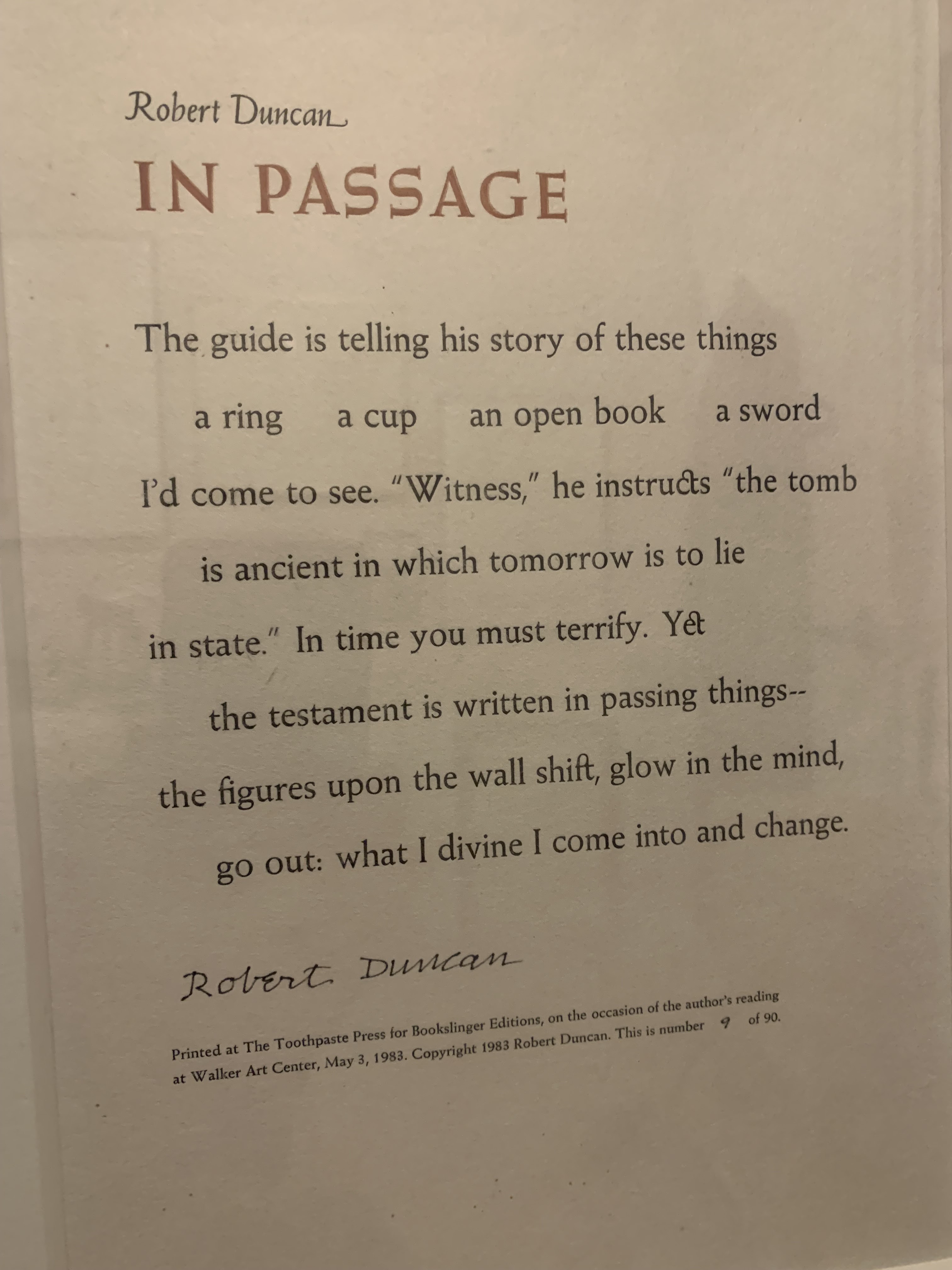
Winter (1990), which is truly a classic (I'm not usually into Lane's work, but this book is sharp). Did you know the bookshop has an array of framed letterpress broadsides covering their bathroom walls? Apparently the collection came from Peter and Meredith Quartermain during their downsizing, and the bookstore had no other wall-space, so here they lay, for when that moment either staff or the occasional customer have a moment to contemplate. There's a lot of Robert Duncan on these walls.
We cabbed back to our hotel, as Christine was running low on energy, and managed to pass what looked like teenagers in antiquated dress by a fancy house; what was that? Christine looked it up, and we discovered the
Roedde House Museum, "the restored 1893 home of Canada's first bookbinder," the
German-born immigrant from Cleveland, Ohio, Gustav Roedde (1860-1930). Oh, we have to go to that. It was only open for another hour, and not at all open the following day. We immediately rushed back to catch this most stunning Victorian house (it has a sunroom turret!), set up as self-guided tours one can wander throughout. Had we not wandered by, we wouldn't have known! And Christine is, as you know, is not only a trained and skilled bookbinder, but the
National President of the Canadian Bookbinders and Book Artists Guild, so we couldn't pass up the opportunity.
There wasn't much in the space directly relating to his bookbinding work, as his bindery would have been off-site elsewhere (there was a photo of such, at least), but the house was absolutely packed with items, information and a musty scent (most windows were open, as I'm sure the volunteer at the front desk appreciated, especially since the day was so warm).
It was hard not to get distracted by all the items, the details, of such a space. A whole corner of one room dedicated to Queen Victoria, for example. Did family homes of that era really hold small shrines for their Queen, plates displaying their Prime Minister? It was curious to consider this a possibility, or simply a display of items from that particular era. When I asked about the plate with Sir Robert Borden, Prime Minister from 1911 to 1920, rambling on to the front desk about my recently-discovered fact of him being fourth cousin (once removed) to the infamous Lizzie Borden [
seriously: I wrote a whole post on this; they're both distantly related to me], the front desk volunteer, who appeared not much younger than myself, claimed to not know who either of these people were. Really? I mean, you've really not heard of either of these folk? An older well-bearded gentleman overheard us, wondering what we were discussing about Borden, so I repeated my ramble. They were related? before turning to her. You haven't heard of Lizzie Borden?
And then he SANG THE WHOLE LIZZIE BORDEN POEM TO US. It was absolutely glorious.As I left the museum, the volunteer on her cellphone, looking both individuals up.
Back at the Sylvia (a fifteen minute walk or so), we had a moment to catch our breath, me downstairs at Sylvia's Bar for a bit sketching notes before Christine met up with me (she needed a quiet moment upstairs first), before we headed out for our paired reading at Simon Fraser University [I'll save all of that for the next post:
to be continued...]

.png)
(26).png)