Showing posts with label Emily Carr. Show all posts

Tuesday, March 11, 2025

my Vancouver is as boundless as the sea : Vancouver, part one,

You probably caught that Christine and I recently headed west to read through Poetry in Canada at Simon Fraser University, thanks to the machinations of Stephen Collis and Isabella Wang. Do you remember when we read in Vancouver through Lunch Poems at SFU in February 2020, mere weeks prior to the Covid-era [see my report on such here], or our reading together last fall in Calgary [see my report on such here], or our paired reading and workshop over in St. Catharines, Ontario (wishing I'd done a report on this, but time got away from me)? I’ve been enjoying the possibilities of our paired readings, the counterpoint between her work and mine providing an interesting balance, I would think. As well, we so rarely get opportunities to run around and have adventures sans children (our St. Catharines trip didn't really allow for much in the way of adventuring, heading straight in to run workshop, read and return).

We flew out of Ottawa on a delayed flight (oh, Air Canada) and made our hotel by 10pm or so (was that Ontario time or Vancouver time? I'll admit I've lost track), staying once more at the infamous Sylvia Hotel, and possibly even the same room we'd stayed in, prior (the fifth floor, overlooking the neighbouring building's skylight, and not the actual beach along English Bay). We caught the statues first thing, morning light across the water, and even saw a trio of swimmers emerge from the water. Is this February, still? Ten degrees, which means a nearly thirty degree difference between here and home. The grass is green, and the sun, warm on the skin.


A photo by the same statues as our prior visit, then breakfast. After breakfast, I sat for a bit with coffee and a recent Divya Victor title, by Sputnik & Fizzle. And from there, we headed out to the Vancouver Art Gallery [Christine, with Jolanta Marcolla's 1975 "Kiss" in video loop behind her, as part of the exhibit Multiple Realities: Experimental Art in the Eastern Bloc, 1960s–1980s], which I'd only been attempting to visit across my last three stops in Vancouver (whether 2020, or when I read in Vancouver with Stephen Brockwell in 2017 [see my report on such here]; I can't even recall when I read in Vancouver prior to that; maybe 2004? that would be an awfully long time ago). It suggest it really might be twenty-five years since I've set foot here, perhaps.


We made for the Emily Carr exhibit first, hitting the top floor and moving down, as the front desk recommended. I appreciated that various texts in the exhibit spoke directly to Carr's own misunderstandings and even appropriations of local indigenous markers, images and cultures, running wild with her own presumptions and blind-spots. It certainly made for a far more respectful understanding of Carr's work, and what Carr was responding to, actually acknowledging some of those conflicting contexts, Carr being very much a person of her time.


The absolute highlight of our time there had to be the work by Dominican Republic-born, New York City-based artist Firelei Báez. Her work is remarkable, explosive, complex, historically responsive and wonderfully detailed (including the doorway you saw Christine walk through, above). All I want to do is show my poor snapshots of her vibrant colours, but you should try to catch any show she has, to see what marvels she has produced (and large scale, which my pics don't really capture). Oh, her work, her work. Her incredible work.


The 'art in the eastern bloc' show was extremely interesting, showcasing the vibrancy of various artists during that period, attempting performances, conversation and interconnection that would have been risk-taking during that era, in those spaces. And how young they all looked, pushing the boundaries of personal and artistic freedom. I was reminded of stories during Milan Kundera's early exile, copies of his work (and so many others, all of which were officially suppressed) running through an underground network up to and through the Velvet Revolution.

Hey! We met Vancouver poet Marc Perez on the street outside! He had a debut full-length collection out last fall with Brick Books that I've been trying to get my hands on, without any luck. Hopefully we can figure out an interview soon. Our meeting was completely random, as I was attempting a street map for our lunch, and he wandered by. Hey, are you rob mclennan? I sure am, fella!

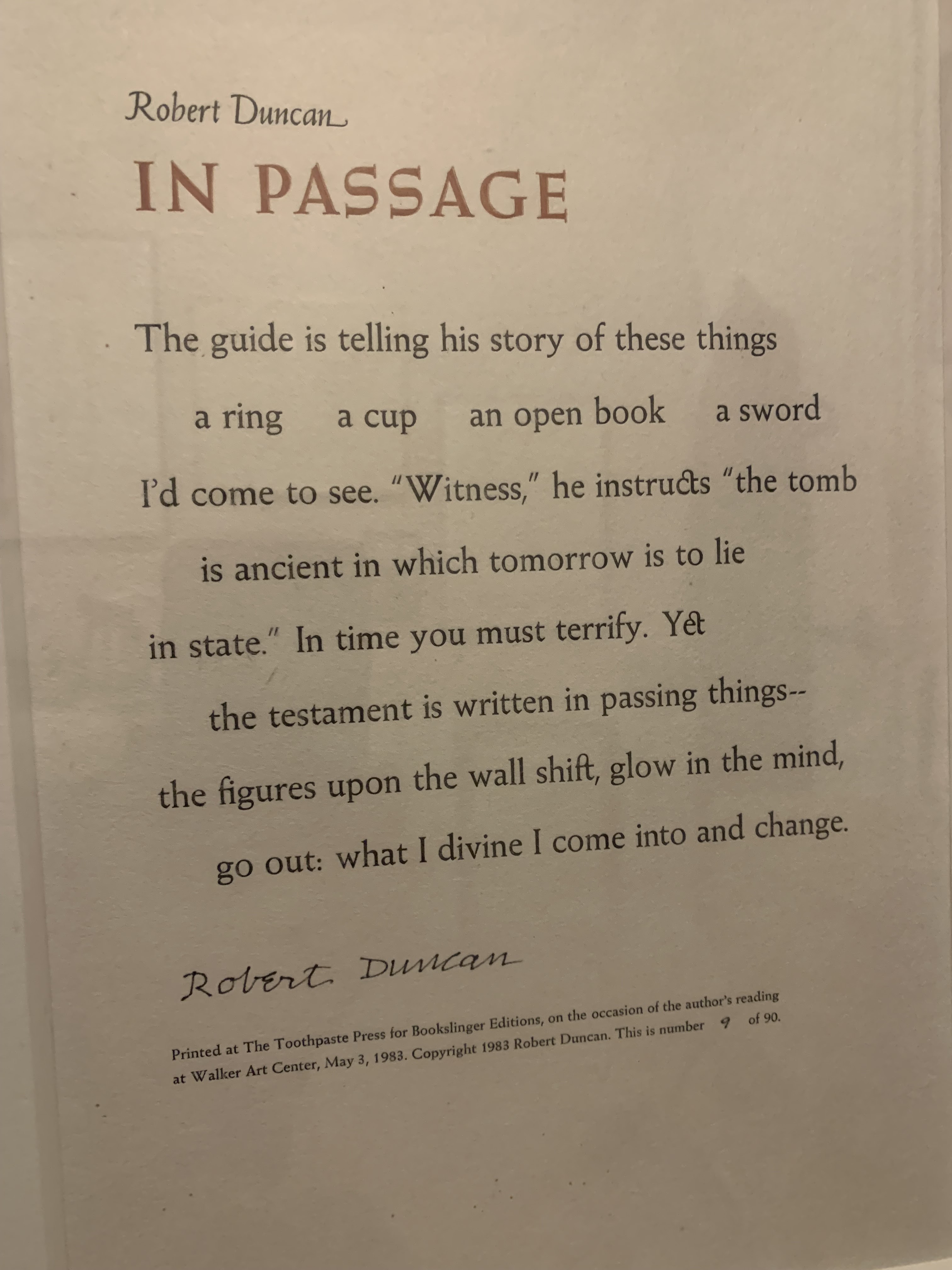
After lunch, we made for Vancouver's infamous The Paper Hound Bookshop, where we each picked up a small handful of items--Christine caught a bpNichol title from Talonbooks I actually hadn't heard of before, Monotones (1971); and I picked up a copy of Kevin Killian's Selected Amazon Reviews, and Patrick Lane's Winter (1990), which is truly a classic (I'm not usually into Lane's work, but this book is sharp). Did you know the bookshop has an array of framed letterpress broadsides covering their bathroom walls? Apparently the collection came from Peter and Meredith Quartermain during their downsizing, and the bookstore had no other wall-space, so here they lay, for when that moment either staff or the occasional customer have a moment to contemplate. There's a lot of Robert Duncan on these walls.

We cabbed back to our hotel, as Christine was running low on energy, and managed to pass what looked like teenagers in antiquated dress by a fancy house; what was that? Christine looked it up, and we discovered the Roedde House Museum, "the restored 1893 home of Canada's first bookbinder," the German-born immigrant from Cleveland, Ohio, Gustav Roedde (1860-1930). Oh, we have to go to that. It was only open for another hour, and not at all open the following day. We immediately rushed back to catch this most stunning Victorian house (it has a sunroom turret!), set up as self-guided tours one can wander throughout. Had we not wandered by, we wouldn't have known! And Christine is, as you know, is not only a trained and skilled bookbinder, but the National President of the Canadian Bookbinders and Book Artists Guild, so we couldn't pass up the opportunity.

There wasn't much in the space directly relating to his bookbinding work, as his bindery would have been off-site elsewhere (there was a photo of such, at least), but the house was absolutely packed with items, information and a musty scent (most windows were open, as I'm sure the volunteer at the front desk appreciated, especially since the day was so warm).


It was hard not to get distracted by all the items, the details, of such a space. A whole corner of one room dedicated to Queen Victoria, for example. Did family homes of that era really hold small shrines for their Queen, plates displaying their Prime Minister? It was curious to consider this a possibility, or simply a display of items from that particular era. When I asked about the plate with Sir Robert Borden, Prime Minister from 1911 to 1920, rambling on to the front desk about my recently-discovered fact of him being fourth cousin (once removed) to the infamous Lizzie Borden [seriously: I wrote a whole post on this; they're both distantly related to me], the front desk volunteer, who appeared not much younger than myself, claimed to not know who either of these people were. Really? I mean, you've really not heard of either of these folk? An older well-bearded gentleman overheard us, wondering what we were discussing about Borden, so I repeated my ramble. They were related? before turning to her. You haven't heard of Lizzie Borden?

And then he SANG THE WHOLE LIZZIE BORDEN POEM TO US. It was absolutely glorious.

As I left the museum, the volunteer on her cellphone, looking both individuals up. 


Back at the Sylvia (a fifteen minute walk or so), we had a moment to catch our breath, me downstairs at Sylvia's Bar for a bit sketching notes before Christine met up with me (she needed a quiet moment upstairs first), before we headed out for our paired reading at Simon Fraser University [I'll save all of that for the next post: to be continued...]

Saturday, June 04, 2016

Emily Carr, Whosoever Has Let A Minotaur Enter Them, Or A Sonnet—


American poet Emily Carr’s [see my 2015 Jacket2 piece on her here] third trade poetry collection, after Directions for Flying, 36 fits: a young wife’s almanac (Furniture Press, 2010) [see my review of such here] and 13 ways of happily (Parlor Press, 2011) [see my review of such here], is Whosoever Has Let A Minotaur Enter Them, Or A Sonnet— (San Francisco CA: McSweeney’s, 2016), a self-described volume of “divorce poems.” Carr’s poems are elegantly carved fragments, composed as scraps and ellipses that collage into something elusive, yet incredibly coherent. Structured in six sections—“drama of the forfeit,” “show & tell,” “scouts across america,” “amateurs,” “cathedral” and “state of grace”—her collection of “divorce poems” revels in compound words and the portmanteau, and a wonderfully striking linguistic density of meaning and sound, as she writes in the opening poem “) A SPLITBRAIN GRACE NOTE”:

imagine it: fleshliness.

leapfrog slingshot see (like eve side-arming apples from the trees.

gravity curls fernstalk, a red wind licks

your elbows. in current downriver singing the ocean grows. smoke
bellies the flagpole. slim–

ankled oaks dream in the soil.

he goes ahead coatless, lightsoaked. breathing in folds, like a fish. he
deals all his selves (was it a rib or catgut


LIKE THE COROLLAS OF A DYING SUN HOW/ BRILLIANT

Carr is also the author of a number of poetry chapbooks, including & look there goes a sparrow transplanting soil (above/ground press, 2009) (reprinted in full in the anthology Ground rules: the best of the second decade of above/ground press 2003-2013), UP THE SHINBONE SUPERLATIVES (Horse Less Press, 2012), Resurrection Refrains: 22 Tarot Lyrics in the Form of the Yellow Brick Road (Dancing Girl Press, 2013), STAY THIS MOMENT: THE AUTOPSY LYRICS, ACTS 1 & 2 (Little Red Leaves, 2013) and STAY THIS MOMENT: THE AUTOPSY LYRICS,ACTS 3 & 4 (Little Red Leaves, 2015), some of which has appeared since in trade editions, and some, such as “THE AUTOPSY LYRICS,” suggest a further full-length volume. Her poems, much like Toronto poet Margaret Christakos’ poetry collections, are constructed out of fractals and fragments and sentence-strands that break, sequence and accumulate into something far larger.

) IN THE BONE MARGIN

gentled on tended lawn, slender neurotic dinosaurs.

pale cows bewildered in the open air.

a greyhound pursued to static. her thin & scarcely believable arms.
fishy sounds from sherbet strollers. in the flaming

liturgical distance: souvenir flowers, beer

cans, propeller wings, clipped feathers, tears. railroads

part like children. a suicide swaggers in a garden plot. breaking

this fall, itself


FALLING/                 WHILE BREAKING

As the back cover of Whosoever Has Let A Minotaur Enter Them, Or A Sonnet— offers: “A swiftly moving poetry of love—and divorce—that rips open romance in the age of men who, for all they love you, just don’t know how to love you anymore. These fairytales are for the heartbreakers as much as the heartbroken, for those smitten with wanderlust, who, no matter how hard they try, aren’t at home with themselves or this world—the beauty of that, in a kind of SOS way.” Carr utilizes fairytale and myth to speak of marriage and an eventual break, as in the poem “) STRUGGLING (IN FACT),” that includes: “the grassblades touch & touch in their small distances, the myth / begins: as family life, one lash by lash undreamt— [.]” Marriage is a subject that runs through the length and breadth of her published work, exploring marriage, happiness, expectation, heartbreak and disappointment as a kind of extended, meditative study, akin to the work of Anne Carson or Cole Swensen, attempting to approach the minutiae of the break (via myth) from multiple angles. As the opening of her author biography at the end of the collection tells us:

emily carr writes murder mysteries that turn into love poems that are sometimes (by her mcsweeney’s editors, for example) called divorce poems. some other folks say she’s writing a life-long love poem, & that’s probably true, too. regardless of the form she’s writing in, she’s most interested in experiment, with heart.


Wednesday, February 06, 2013

Grain magazine 40.2: short grain contest issue,


A
he played injun in god’s country
where boys proved themselves clean

dumb beasts who could cut fire
out of the whitest sand

he played english across the trail
where girls turned plum wild

garlic and strained words
through the window of night

he spoke through numb lips and
breathed frontier (“injun,” Jordan Abel)

The “short grain contest issue” of Grain magazine is newly out, along with poems by the three prize-winners I picked as poetry judge. Picking from a stack of numbered poems, I selected a piece by Sean Howard for first prize, a piece by Jordan Abel for second, and a piece by Kate Marshall Flaherty for third. The fiction judge this time around was Lawrence Hill, who selected short fictions by Susan Mersereau, Madeline Sonik and Alexandra Sadinoff for first, second and third prizes. Before judging this contest, I hadn’t even heard of Vancouver poet Abel or Toronto poet Flaherty, and was quite taken with the work of Abel, to the point that I immediately had to find out where he was, and solicited a chapbook manuscript from him (his above/ground press title appeared earlier this month, and he even has his first trade collection out this year with Talonbooks).

The judges for this year’s contest, deadline April 1, 2013, are Toronto writer Stan Rogal for fiction, and Winnipeg writer Méira Cook for poetry.

Not that the issue is only and all about contests; Sandra Ridley has two remarkable poems in the new issue, titled “XIII” and “XV,” obviously part of a longer sequence that I would love to see at some point. Part of “XIII” reads:

When your darling thinks of it. When she was concerned with it then. When she believed in the meticulous awareness of sundries of detail. Despair became her whole history. She had a lack of willingness. A lack of discipline.

Her crudest form.

With the same insistence. She is compelled to tendency. Falls with a rigorous ferocity.

Perpetual.

            Bitten arms.

                        Bitten hands.

Each imposition accumulated a certain privilege. A catechism given willingly. Or by force. A little later. You relegated her to her bed where you attached her true name. There. Your darling remains. Her body more constant than her mind.

                                                            Beside herself. Each confusion interchangeable.

She comes along. She comes happy.

Poet Emily Carr also has five new poems in the issue, influenced by the Tarot deck. As her biographical note reads, she is the author of “a Tarot novel. While Writer-in-Residence at Camac Centre d’Art, she composed Straight No Chaser on ‘the poetry of fear.’”

MESSIAH ON PAROLE
knight of wands

As if you were grass or dead—

The truth hums, the truth trembles. The truth holds.
(What do you want you ought to make up your mind.

Solitary for months Lord & she has learned to live directly—
(There’s been a change of wings at the drive-in.

Whitely I am ready to be Liberty says broken apart, revealed,
reborn—

(Or do you believe I have no plot, even this was taken from
me, as all lies are…

(Would you catch that feeling: in fire & algebra, as windows
are opened, & a bomb is manoeuvered—)

& how she had become human to survive. & would she survive.

Quixotic when you say what is this festival of wet everywhere?
When you say “the sun burns & the lark is singing” what do you mean?

Come again?

What is the heroine to/do when love becomes transparent,
I mean treacherous—

The journal also celebrates forty years, a landmark that Toronto journal Descant recently celebrated as well. What does one gift for the journal that turns forty?

Here is the short “from the poetry judge” note I wrote, included in the issue:

There is an argument I’ve heard against author bios, most often heard after I make any kind of public complaint about a journal that excludes them, whether New American Writing or BafterC. Just who are some of these writers I’m reading? It’s the first thing I usually read in any lit journal. I always want to know more, get some context to the writing in front of me. Is there more I can read? A book, a chapbook, perhaps?

After going through the poetry entries for the 2012 Short Grain Competition, I think I understand the counter-argument a bit better now, able to read through a wealth of poems without interference or biographical baggage. I still haven’t changed my mind on the matter, but at least now I understand.

Perhaps this was why former Grain editor Sylvia Legris thought to bring me on to judge this year’s contest. Legris, who disagrees with me entirely on the issue. Perhaps this was her way to show and not tell, allowing me to come to my own realization. Or, perhaps, I’m simply reading far too much into this, as I so often do.

Contests can be difficult things, for a whole array of reasons, the most notable being, simply, that it is one person’s particular point-of-view. This might not be the list that you, reader, might have picked. This list is short, and simple-sweet. I picked the poems that struck me, and wouldn’t let me set them aside. I picked the poems I thought were doing the most interesting things, in the most interesting ways, according to my own particular biases. This is more difficult than one might think, if you haven’t gone through the process.

“Judging” implies so many things, a word packed with connotations. Let’s just say I opinioned, instead. Let’s just say I offered. As requested, here are the poems of this stack of pieces I thought deserving of prize-winning, in order:

FIRST PRIZE: "something like being (five flights, for rafi),"

I’ve long favoured the sequence, and this short-lined poem is fragmented, and entirely compact, packing in a space slightly smaller than the poem. Not all needs to be said to be articulated. In this poem, speech is made out of single words, and less than. It can be that simple, that complicated.

SECOND PRIZE: "injun,"

I’m fascinated by the movement here, the halts and spaces, the rhythms of this abecedarian-fragment, poems “j” to “o” of “injun.” Is there a full sequence somewhere of these? I’d love to see them. I liked very much how the poem questions and keeps questioning, the troubled naming of the title, the troubled past and complicated present. The politics and social upheavals are here, patterned through the broken words, the broken speech and hypnotic movements. I am so taken with just how this poem ebbs and breaks, and ebbs and flows.

THIRD PRIZE: "Gullywash,"

It was the last couplet I kept returning to, again and again. Something about those last two lines entirely struck, sharp and fantastic. There is a flood that happens, “Clears whole towns / in its wake.” Incredible. Otherwise, the opening strikes for its ruckus laughter, its language-play nearly subversive for the fact that it looks so damned fun. I admire the joy that moves through here, especially given the dark places the poem goes, without dismissing or diminishing the seriousness of that dark. Why do so many poems have to be dour?