Showing posts with label Divya Victor. Show all posts

Tuesday, March 11, 2025

my Vancouver is as boundless as the sea : Vancouver, part one,

You probably caught that Christine and I recently headed west to read through Poetry in Canada at Simon Fraser University, thanks to the machinations of Stephen Collis and Isabella Wang. Do you remember when we read in Vancouver through Lunch Poems at SFU in February 2020, mere weeks prior to the Covid-era [see my report on such here], or our reading together last fall in Calgary [see my report on such here], or our paired reading and workshop over in St. Catharines, Ontario (wishing I'd done a report on this, but time got away from me)? I’ve been enjoying the possibilities of our paired readings, the counterpoint between her work and mine providing an interesting balance, I would think. As well, we so rarely get opportunities to run around and have adventures sans children (our St. Catharines trip didn't really allow for much in the way of adventuring, heading straight in to run workshop, read and return).

We flew out of Ottawa on a delayed flight (oh, Air Canada) and made our hotel by 10pm or so (was that Ontario time or Vancouver time? I'll admit I've lost track), staying once more at the infamous Sylvia Hotel, and possibly even the same room we'd stayed in, prior (the fifth floor, overlooking the neighbouring building's skylight, and not the actual beach along English Bay). We caught the statues first thing, morning light across the water, and even saw a trio of swimmers emerge from the water. Is this February, still? Ten degrees, which means a nearly thirty degree difference between here and home. The grass is green, and the sun, warm on the skin.


A photo by the same statues as our prior visit, then breakfast. After breakfast, I sat for a bit with coffee and a recent Divya Victor title, by Sputnik & Fizzle. And from there, we headed out to the Vancouver Art Gallery [Christine, with Jolanta Marcolla's 1975 "Kiss" in video loop behind her, as part of the exhibit Multiple Realities: Experimental Art in the Eastern Bloc, 1960s–1980s], which I'd only been attempting to visit across my last three stops in Vancouver (whether 2020, or when I read in Vancouver with Stephen Brockwell in 2017 [see my report on such here]; I can't even recall when I read in Vancouver prior to that; maybe 2004? that would be an awfully long time ago). It suggest it really might be twenty-five years since I've set foot here, perhaps.


We made for the Emily Carr exhibit first, hitting the top floor and moving down, as the front desk recommended. I appreciated that various texts in the exhibit spoke directly to Carr's own misunderstandings and even appropriations of local indigenous markers, images and cultures, running wild with her own presumptions and blind-spots. It certainly made for a far more respectful understanding of Carr's work, and what Carr was responding to, actually acknowledging some of those conflicting contexts, Carr being very much a person of her time.


The absolute highlight of our time there had to be the work by Dominican Republic-born, New York City-based artist Firelei Báez. Her work is remarkable, explosive, complex, historically responsive and wonderfully detailed (including the doorway you saw Christine walk through, above). All I want to do is show my poor snapshots of her vibrant colours, but you should try to catch any show she has, to see what marvels she has produced (and large scale, which my pics don't really capture). Oh, her work, her work. Her incredible work.


The 'art in the eastern bloc' show was extremely interesting, showcasing the vibrancy of various artists during that period, attempting performances, conversation and interconnection that would have been risk-taking during that era, in those spaces. And how young they all looked, pushing the boundaries of personal and artistic freedom. I was reminded of stories during Milan Kundera's early exile, copies of his work (and so many others, all of which were officially suppressed) running through an underground network up to and through the Velvet Revolution.

Hey! We met Vancouver poet Marc Perez on the street outside! He had a debut full-length collection out last fall with Brick Books that I've been trying to get my hands on, without any luck. Hopefully we can figure out an interview soon. Our meeting was completely random, as I was attempting a street map for our lunch, and he wandered by. Hey, are you rob mclennan? I sure am, fella!

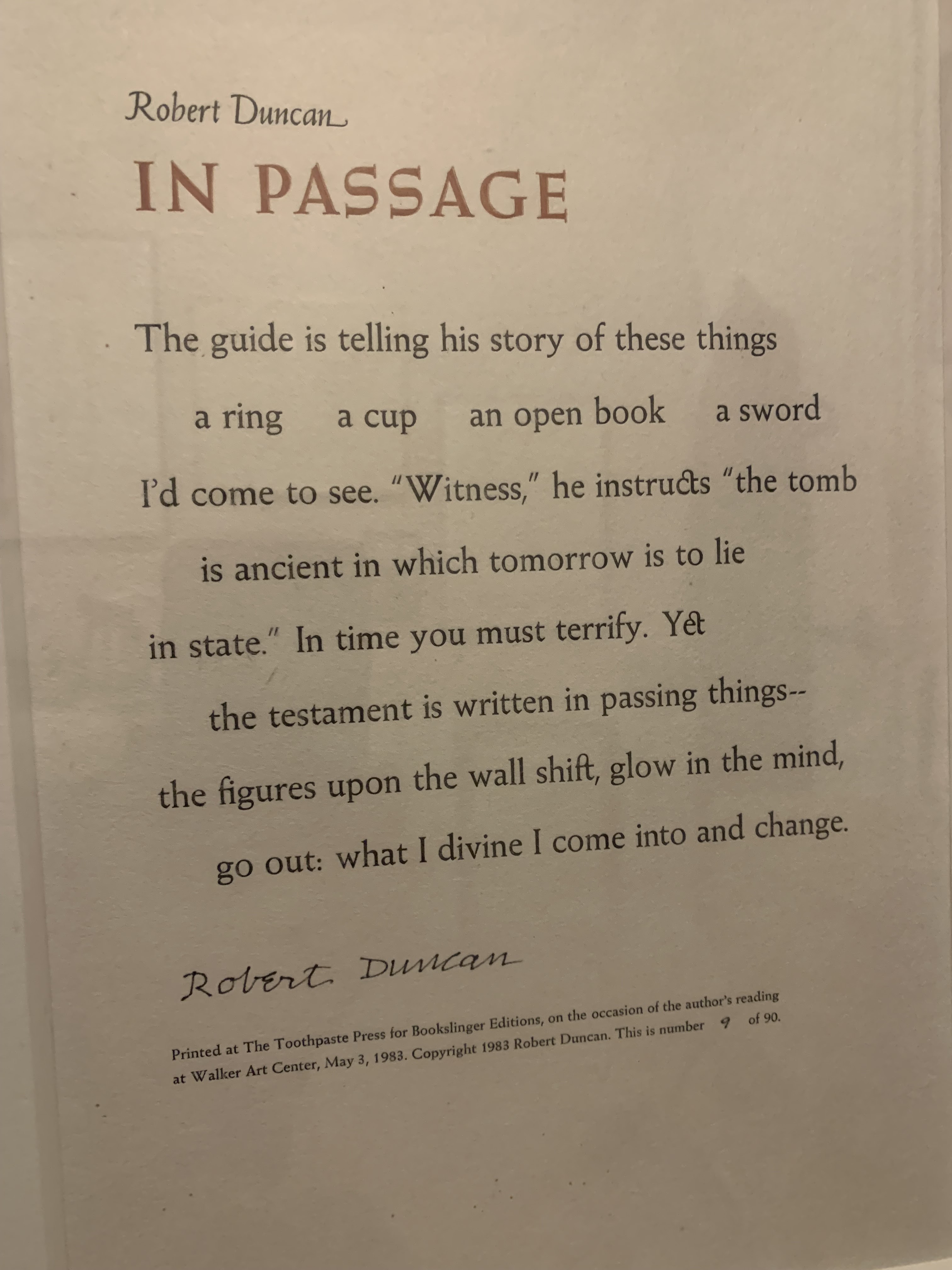
After lunch, we made for Vancouver's infamous The Paper Hound Bookshop, where we each picked up a small handful of items--Christine caught a bpNichol title from Talonbooks I actually hadn't heard of before, Monotones (1971); and I picked up a copy of Kevin Killian's Selected Amazon Reviews, and Patrick Lane's Winter (1990), which is truly a classic (I'm not usually into Lane's work, but this book is sharp). Did you know the bookshop has an array of framed letterpress broadsides covering their bathroom walls? Apparently the collection came from Peter and Meredith Quartermain during their downsizing, and the bookstore had no other wall-space, so here they lay, for when that moment either staff or the occasional customer have a moment to contemplate. There's a lot of Robert Duncan on these walls.

We cabbed back to our hotel, as Christine was running low on energy, and managed to pass what looked like teenagers in antiquated dress by a fancy house; what was that? Christine looked it up, and we discovered the Roedde House Museum, "the restored 1893 home of Canada's first bookbinder," the German-born immigrant from Cleveland, Ohio, Gustav Roedde (1860-1930). Oh, we have to go to that. It was only open for another hour, and not at all open the following day. We immediately rushed back to catch this most stunning Victorian house (it has a sunroom turret!), set up as self-guided tours one can wander throughout. Had we not wandered by, we wouldn't have known! And Christine is, as you know, is not only a trained and skilled bookbinder, but the National President of the Canadian Bookbinders and Book Artists Guild, so we couldn't pass up the opportunity.

There wasn't much in the space directly relating to his bookbinding work, as his bindery would have been off-site elsewhere (there was a photo of such, at least), but the house was absolutely packed with items, information and a musty scent (most windows were open, as I'm sure the volunteer at the front desk appreciated, especially since the day was so warm).


It was hard not to get distracted by all the items, the details, of such a space. A whole corner of one room dedicated to Queen Victoria, for example. Did family homes of that era really hold small shrines for their Queen, plates displaying their Prime Minister? It was curious to consider this a possibility, or simply a display of items from that particular era. When I asked about the plate with Sir Robert Borden, Prime Minister from 1911 to 1920, rambling on to the front desk about my recently-discovered fact of him being fourth cousin (once removed) to the infamous Lizzie Borden [seriously: I wrote a whole post on this; they're both distantly related to me], the front desk volunteer, who appeared not much younger than myself, claimed to not know who either of these people were. Really? I mean, you've really not heard of either of these folk? An older well-bearded gentleman overheard us, wondering what we were discussing about Borden, so I repeated my ramble. They were related? before turning to her. You haven't heard of Lizzie Borden?

And then he SANG THE WHOLE LIZZIE BORDEN POEM TO US. It was absolutely glorious.

As I left the museum, the volunteer on her cellphone, looking both individuals up. 


Back at the Sylvia (a fifteen minute walk or so), we had a moment to catch our breath, me downstairs at Sylvia's Bar for a bit sketching notes before Christine met up with me (she needed a quiet moment upstairs first), before we headed out for our paired reading at Simon Fraser University [I'll save all of that for the next post: to be continued...]

Tuesday, June 08, 2021

Divya Victor, Curb


SETTLEMENT

Settlers, over the land, over the sea
over the tile, over the stone floors
settlers over the furs, over the pinewood planks

of the house settled, the houses settled into the ground
the houses so buried; settling

pulling life like splinters
from the toboggans & caravans pulling cargo

settled out of suitcases, settled down
we settled in & so settled we

into our ways & with those ways did we settle
for this emptying of history

for this sternum rent in two
for this conscience as quiet

as the snap of a wishbone
sucked white.

The latest from Divya Victor is Curb (New York NY: Nightboat Books, 2021), a powerful and, at times devastating, book-length poem centred around grief and racial violence to a population regularly and routinely challenged on their right to simply exist. She speaks of the strength of community, even through unimaginable heartbreak. As the press release offers: “Divya Victor documents how immigrants and Americans navigate the liminal sites of everyday living: lawns, curbs, and sidewalks undergirded by violence but also constantly repaved with new possibilities of belonging. Curb witnesses immigrant survival, familial bonds, and interracial parenting in the context of nationalist and white-supremacist violence against South Asians. The book refutes the binary of the model minority and the monstrous, dark ‘other’ by reclaiming the throbbing, many-tongued, vermillion heart of kith.” Curb exists in the shadow of routine and repeated racial violence against South Asians, specifically in wake of, as the press release reminds, “our post-9/11 political landscape.” She writes the wounds and conflicts, citing specific examples of violence that her poems respond to. Victor is the author of five prior full-length collections—Goodbye John! On John Baldessari (2012), Partial Derivative of the Unnameable (Troll Thread, 2005), Things To Do With Your Mouth (Les Figues, 2014), Natural Subjects (Trembling Pillow Press, 2015) and Kith (Book*hug/Fence Books, 2017)—as well as the chapbooks SUTURES (2009), Hellocasts by Charles Reznikoff by Divya Victor by Vanessa Place (2011) and UNSUB (2014).

Curb is constructed in thirteen poem-sections blending the lyric with prose, blending the personal with documentation, writing out responses to both general and specific instances of racial violence. Writing discomfort, grief and trauma, Curb is document, testament and testimony; naming the victims, the assaults and the assaulters. As the poem ‘PAVEMENT,” composed to respond to the assault and death of Divyendu Sinha in Old Bridge, New Jersey in June 2010: “I forget the his name walking up the stairs / all the fricatives abandoned in the basement / where I read the his news reports—early casualties // at the foot of the my desk. these dog eared returns / never lead me to him you only / to myself [.]” In an essay posted on April 30, 2019 at Harriet, the Poetry Foundation Blog, “>>[WOMAN WAILING]: On the Problem of Representing Trauma as a Brown Woman Within the Institution of Poetry,” Victor writes on her concerns around writing cultural trauma through poetry:

FACT (confessional): I worry, all the time, that my work participates in the maintenance of whiteness’s comfort with itself—a comfort which easily assimilates the processes of learning and understanding “cultures” constructed to sustain and affirm its hegemonic position. I worry that I work, through the defaults of my historical and social positions, in Feel Good Incorporated without my consent. Because I participate within discourses and fields which have worked, overtime, to exclude women of color, I worry all the time that I’m going to write, forever and until I die, for the enlightenment, comfort, and spiritual rehabilitation of white people. Worse: That I will write and perform, for as long as I live, about the death of my kind, for white people who will survive. Put another way, I worry, like Prageeta Sharma has, that my lexicon and my body are bound up in “cheap signaling.” Put yet another way (& to draw on Dawn Lundy Martin’s phrasing), I worry about populating a grave of “bodies that are unaware of their utilitarian bluntness in the symbolic order of race.” I experience this worry as a fear: a fear of permanently orphaning of my future-self at the stoop of Poetry, capital P.

In many ways, the book is anchored by the sequence “Threshold,” the seventh of the book’s thirteen sections. A sequence in eight parts, it is one of numerous pieces throughout the collection that responds to a particular example of violence, and the poem’s post-script reads: “February 22, 2017. Srinivas Kuchibhotla was shot in a bar in Olathe, Kansas, by Adam Purinton, a white supremacist who believed that Kuchibhotla was an illegal immigrant from Iran. The shooter yelled, ‘Get out of my country!’ before he shot & murdered Srinivas. Then, the shooter went to another local bar & bragged that he had shot an immigrant. // On that day, I was pregnant & moving into my third trimester.” Each poem in this particular sequence, save the first, opens with the same line, “When I read the news / of the shooting,” allowing each section to further document and examine the trauma of that particular moment by returning to it, and allowing it as a repeated jumping-off point. Structurally, one might see this poem in comparison to John Newlove’s classic 1960s-era poem “Ride Off Any Horizon,” which explored aspects of history from the Canadian prairies, as the second poem in Victor’s sequence reads:

When I read the news
of the shooting, this belly
plumed into an apse— it distended

upward, a balloon hollow
but leaden, these lungs lifted

here— this diaphragm fled, bore through
a tent made of ligament

& rope. The billow screeched
In these ears, pulled here— these legs apart

these toes went numb & cold. The ground
beneath me collapsed, turned to dunes

& the sand quickened. Here— this belly
carrying those pounds of flesh

began to take flight
in seconds it was

in— here— this mouth, pressing against here— these teeth—
a pear balloon, hot flush

with wet wings beating, with wet wings thrashing
in these lungs. The breath

an ocean of blood. This skin
here— a dam, detonating. A pulse, here

pulling history
towards these feet.


Friday, January 25, 2019

Michael Nardone, The Ritualites


Away from a relative plane of table conversation,
    The last forks and spoons resume a familiar
Progression, clattering the sink’s tin basin in time
    With Aunt Ange’s O! no! oblivion. Laugh tracks
Wrangle down the hall, jingles clump, APPLAUSE
    Lights up – cues an interlude of who’s on sale –
Have it your way right away be all you can be just
    Do it. Soon it’s static. So the drowsed
Shuffle off to a continent of sleep; they will retire
    There, trim some hedges, craft umbrellas, maintain
A permanent muzak. Like that, a pulse of snores
    Crowds the house, then shush, they scatter once
The windows inhale – through, over the tree peaks –
    Out, aimless away, over Susquehanna. (“O, OR, PLAINS, PENNSYLVANIA”)

Montreal-based poet and critic Michael Nardone’s second full length collection, following Transaction Record (Gauss, 2014), is The Ritualites (Toronto ON: Book*hug, 2018), a collection self-described as a “book-length poem on the sonic topography of North America. Composed at sites all across the continent—from Far Rockaway to the Olympic Peninsula, Great Bear Lake to the Gulf of California—the book documents the poet’s listening amid our public exchanges, mediated ambiances, and itinerant intimacies.” And while I love the nuclear green text radiating on a bright orange cover, it does (for me, at least), make the text on the back of the collection entirely unreadable. In an interview conducted by Book*hug intern Mary Ann Matias and posted on the publisher’s website, Nardone speaks to the process of conceiving and constructing the collection:

As opposed to narrating an event, I became fascinated with constructing ways to situate the reader in the event’s midst – as an active listener attending to that situation’s complex polyphony. I became interested in exploring the idea of voice, of voices, of vocality, of the apparent sense of immediacy one feels in listening, and, then, in constructing into poems the variety of ways those voices and that listening is mediated. So, The Ritualites is a product of these initial studies and experiments in listening, in transcription, in resonance.

The Ritualites, then, situates itself as a book of deep listening across a wide swath of North American geographies, something Divya Victor reinforces in her brief introduction:

Michael Nardone’s poetry unsettles territories as it roves through the continent, documenting the neon signs and the billboards, the dinner table conversations, and the overheard terrors of everyday Americans. The book orchestrates unlikely and compelling movements between abstract, parodic narrative and lyric elegy, which Nardone writes as modulated, cerebral laments for an era’s failure to reach utopia. […] My hope has always been for poets to subscribe not to movements or schools of aesthetics, but to be the bearers of urgent form—form as a thing to be broken and held close, at once.

There is something fascinating in how Nardone’s work concurrently works through highly formal poetry structures and a post-language lyric, experimenting with structures and cadences familiar to the work of, say, Stephen Brockwell, just as much as KSW writers such as Colin Smith or Jeff Derksen. One can see it in “O, OR, PLAINS, PENNSYLVANIA,” the twelve-poem sonnet sequence near the beginning of the collection, or further on, as Nardone writes: “Am kiddin / Come on / Get over here / Everyone waitin for ya / Me and Dan / And there’s a band / Playin Stairway to Heffin / Knew that’d getcha / Seeya on the patio / Bye babe / Wooh” (“TOPOLOGIES/OTOGRAPHIES”).

What does our overheard conversation say about us? And what do the snippits transcribed say about Nardone? There is an urgency to these poems, one that attempts both an order and the acknowledgment of a lack of that same order, shifting back and forth throughout. Occasionally, Nardone infers that his is a project of listening without any sort of editorial agency, and other times, entirely inserting himself, shifting and projecting, and offering what and how he wishes you to engage with what he has gathered.

As you read this book, try to stand apart from your self.

            You are not your feelings.

            You are not your thoughts.

            As you read this, notice what information you receive, and by notice I mean: simply observe.

            You deserve to feel great about your life.

            Try to project your consciousness into the corner of this room and see yourself, there, in your mind’s eye, reading this book.

            Can you see yourself almost as though you were someone else? (“UNFIXED TERRITORIES”)