Showing posts with label Meredith Quartermain. Show all posts

Friday, June 06, 2025

new from above/ground press: Witek, Kolewe, Christie, Ballard, Reid, Jenks, Tierney, Houglum + Quartermain,

Terri Witek, DOWN WATER STREET $6 ; R. Kolewe, Tierra del Fuego (excerpts from a fiction) $5 ; Jason Christie, PSA $6 ; Micah Ballard, A N G E L D U S T $6 ; Monty Reid, cuba A book: twentieth anniversary edition $6 ; Tom Jenks, Chimneys $5 ; Orchid Tierney, pedagogies for the planthroposcene $5 ; Brook Houglum, INVENTORY $5 ; Meredith Quartermain, Things Musing $5

published in Ottawa by above/ground press
April-May 2025
a/g subscribers receive a complimentary copy of each


To order, send cheques (add $2 for postage; in US, add $3; outside North America, add $7) to: rob mclennan, 2423 Alta Vista Drive, Ottawa ON K1H 7M9. E-transfer or PayPal at at rob_mclennan (at) hotmail.com or the PayPal button (above). See the prior list of recent titles here, scroll down here to see a further list of various backlist titles, or click on any of the extensive list of names on the sidebar (many, many things are still in print).

keep an eye on the above/ground press blog for author interviews, new writing, reviews, upcoming readings and tons of other material
; and you know that 2025 subscriptions (our thirty-second year!) are still available, yes? i can totally backdate; AND THE ABOVE/GROUND PRESS POSTAL INCREASE SALE CONTINUES UNTIL JULY 9, 2025! oh, and you know above/ground press has a substack now? sign up (for free!) for announcements, and even new features! AND SAVE THE DATE: the above/ground press 32nd anniversary reading/launch/party will be at RedBird Live in Old Ottawa South on Thursday, August 7th! tickets available soon.

With forthcoming chapbooks by: Michael Sikkema, Ellen Chang-Richardson, Lina Ramona Vitkauskas, Charlotte Jung and Johannes S.H. Bjerg, J-T Kelly, Beatriz Hausner, Mandy Sandhu, Jon Cone, Yaxkin Melchy (trans. by Ryan Greene, Mrityunjay Mohan, Laynie Browne, Nada Gordon, Andrew Brenza, Noah Berlatsky, David Phillips, and probably others! (yes: others,


Tuesday, March 11, 2025

my Vancouver is as boundless as the sea : Vancouver, part one,

You probably caught that Christine and I recently headed west to read through Poetry in Canada at Simon Fraser University, thanks to the machinations of Stephen Collis and Isabella Wang. Do you remember when we read in Vancouver through Lunch Poems at SFU in February 2020, mere weeks prior to the Covid-era [see my report on such here], or our reading together last fall in Calgary [see my report on such here], or our paired reading and workshop over in St. Catharines, Ontario (wishing I'd done a report on this, but time got away from me)? I’ve been enjoying the possibilities of our paired readings, the counterpoint between her work and mine providing an interesting balance, I would think. As well, we so rarely get opportunities to run around and have adventures sans children (our St. Catharines trip didn't really allow for much in the way of adventuring, heading straight in to run workshop, read and return).

We flew out of Ottawa on a delayed flight (oh, Air Canada) and made our hotel by 10pm or so (was that Ontario time or Vancouver time? I'll admit I've lost track), staying once more at the infamous Sylvia Hotel, and possibly even the same room we'd stayed in, prior (the fifth floor, overlooking the neighbouring building's skylight, and not the actual beach along English Bay). We caught the statues first thing, morning light across the water, and even saw a trio of swimmers emerge from the water. Is this February, still? Ten degrees, which means a nearly thirty degree difference between here and home. The grass is green, and the sun, warm on the skin.


A photo by the same statues as our prior visit, then breakfast. After breakfast, I sat for a bit with coffee and a recent Divya Victor title, by Sputnik & Fizzle. And from there, we headed out to the Vancouver Art Gallery [Christine, with Jolanta Marcolla's 1975 "Kiss" in video loop behind her, as part of the exhibit Multiple Realities: Experimental Art in the Eastern Bloc, 1960s–1980s], which I'd only been attempting to visit across my last three stops in Vancouver (whether 2020, or when I read in Vancouver with Stephen Brockwell in 2017 [see my report on such here]; I can't even recall when I read in Vancouver prior to that; maybe 2004? that would be an awfully long time ago). It suggest it really might be twenty-five years since I've set foot here, perhaps.


We made for the Emily Carr exhibit first, hitting the top floor and moving down, as the front desk recommended. I appreciated that various texts in the exhibit spoke directly to Carr's own misunderstandings and even appropriations of local indigenous markers, images and cultures, running wild with her own presumptions and blind-spots. It certainly made for a far more respectful understanding of Carr's work, and what Carr was responding to, actually acknowledging some of those conflicting contexts, Carr being very much a person of her time.


The absolute highlight of our time there had to be the work by Dominican Republic-born, New York City-based artist Firelei Báez. Her work is remarkable, explosive, complex, historically responsive and wonderfully detailed (including the doorway you saw Christine walk through, above). All I want to do is show my poor snapshots of her vibrant colours, but you should try to catch any show she has, to see what marvels she has produced (and large scale, which my pics don't really capture). Oh, her work, her work. Her incredible work.


The 'art in the eastern bloc' show was extremely interesting, showcasing the vibrancy of various artists during that period, attempting performances, conversation and interconnection that would have been risk-taking during that era, in those spaces. And how young they all looked, pushing the boundaries of personal and artistic freedom. I was reminded of stories during Milan Kundera's early exile, copies of his work (and so many others, all of which were officially suppressed) running through an underground network up to and through the Velvet Revolution.

Hey! We met Vancouver poet Marc Perez on the street outside! He had a debut full-length collection out last fall with Brick Books that I've been trying to get my hands on, without any luck. Hopefully we can figure out an interview soon. Our meeting was completely random, as I was attempting a street map for our lunch, and he wandered by. Hey, are you rob mclennan? I sure am, fella!

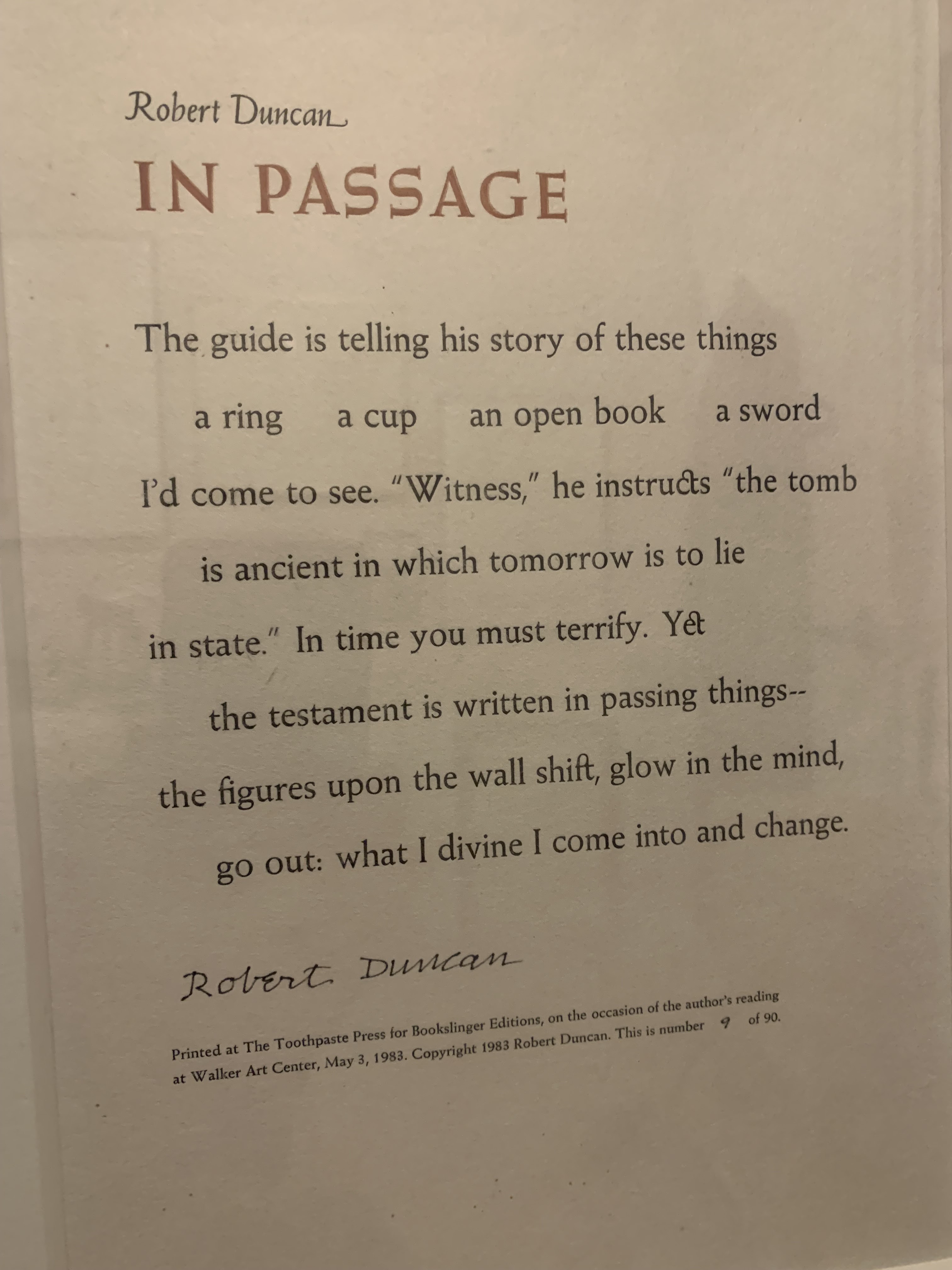
After lunch, we made for Vancouver's infamous The Paper Hound Bookshop, where we each picked up a small handful of items--Christine caught a bpNichol title from Talonbooks I actually hadn't heard of before, Monotones (1971); and I picked up a copy of Kevin Killian's Selected Amazon Reviews, and Patrick Lane's Winter (1990), which is truly a classic (I'm not usually into Lane's work, but this book is sharp). Did you know the bookshop has an array of framed letterpress broadsides covering their bathroom walls? Apparently the collection came from Peter and Meredith Quartermain during their downsizing, and the bookstore had no other wall-space, so here they lay, for when that moment either staff or the occasional customer have a moment to contemplate. There's a lot of Robert Duncan on these walls.

We cabbed back to our hotel, as Christine was running low on energy, and managed to pass what looked like teenagers in antiquated dress by a fancy house; what was that? Christine looked it up, and we discovered the Roedde House Museum, "the restored 1893 home of Canada's first bookbinder," the German-born immigrant from Cleveland, Ohio, Gustav Roedde (1860-1930). Oh, we have to go to that. It was only open for another hour, and not at all open the following day. We immediately rushed back to catch this most stunning Victorian house (it has a sunroom turret!), set up as self-guided tours one can wander throughout. Had we not wandered by, we wouldn't have known! And Christine is, as you know, is not only a trained and skilled bookbinder, but the National President of the Canadian Bookbinders and Book Artists Guild, so we couldn't pass up the opportunity.

There wasn't much in the space directly relating to his bookbinding work, as his bindery would have been off-site elsewhere (there was a photo of such, at least), but the house was absolutely packed with items, information and a musty scent (most windows were open, as I'm sure the volunteer at the front desk appreciated, especially since the day was so warm).


It was hard not to get distracted by all the items, the details, of such a space. A whole corner of one room dedicated to Queen Victoria, for example. Did family homes of that era really hold small shrines for their Queen, plates displaying their Prime Minister? It was curious to consider this a possibility, or simply a display of items from that particular era. When I asked about the plate with Sir Robert Borden, Prime Minister from 1911 to 1920, rambling on to the front desk about my recently-discovered fact of him being fourth cousin (once removed) to the infamous Lizzie Borden [seriously: I wrote a whole post on this; they're both distantly related to me], the front desk volunteer, who appeared not much younger than myself, claimed to not know who either of these people were. Really? I mean, you've really not heard of either of these folk? An older well-bearded gentleman overheard us, wondering what we were discussing about Borden, so I repeated my ramble. They were related? before turning to her. You haven't heard of Lizzie Borden?

And then he SANG THE WHOLE LIZZIE BORDEN POEM TO US. It was absolutely glorious.

As I left the museum, the volunteer on her cellphone, looking both individuals up. 


Back at the Sylvia (a fifteen minute walk or so), we had a moment to catch our breath, me downstairs at Sylvia's Bar for a bit sketching notes before Christine met up with me (she needed a quiet moment upstairs first), before we headed out for our paired reading at Simon Fraser University [I'll save all of that for the next post: to be continued...]

Thursday, August 27, 2020

The Capilano Review 3.41 (Summer 2020)


Spiritual

We asked the world if it was alive. “Oh,” the walls said, “we aren’t religious, but we are spiritual.” We thought we must be hallucinating, but then the wine rumbled in our stomachs, our lamp reached back to Persia, and the bath tried to drown us. “Once the world turns on, good luck turning it off,” said the drugs in our palm. “Plug your ears,” the future said, “hold your hands in front of the screen, close the ancient texts, none of it will help. Good luck.” (Liam Siemens)

I spent a week away from my desk, which allowed me to catch up on a bit of my journal reading, including going through The Capilano Review 3.41 (Summer 2020). I’m always interested to see what The Capilano Review has going on, and this issue is their “open issue,” featuring multiple works of poetry, prose, artwork and interviews. As Matea Kulić offers in her “Editor’s Note” on this issue’s themeless theme: “We soon noted, however, even admits pieces we had initially considered light or humorous in tone, a shadow side—an uncanny edge, a surrealist blow. Mourning, both individual and collective, emerged as a major theme. While inevitably ‘there is this holding on’ (Andrea Actis), the contributors to this issue consider how one form of life must be grieved for another to grow. As Andrea Javor aka Mystic Sandwich writes, it ‘isn’t the end of the world; it’s the end of a world.’”

Ottawa poet Conyer Clayton and Toronto poet (formerly Ottawa, where he was part of In/Words Magazine and Press) Bardia Sinaee co-won the 2019 Robin Blaser Poetry Prize and both have poems included in this issue. When Conyer is good, she is very good: “A crowd is a sharp cut in the rocks. / What came in on the air this morning? / Dung and past lives. Rejected // pollen, poor seeds, such statistics / for life, and we don’t even know how / water is drawn up.” (“Habitual”). I am very curious to see Sinaee’s full-length debut, Intruder, which is scheduled for spring 2021 with House of Anansi Press. “It was the summer of whippits and ketamine,” he writes, to close the third of his four poems in the issue, “Cadillac,” “Every other guy had a Goku tattoo // but only I could ride around on a cloud / because I was pure of heart [.]”

Otherwise, much of the work that jumped out of me from this issue were prose poems. For example, I’m gratified to see new work by former editor Andrea Actis, along with the discovery in her bio that she has a debut poetry collection out next spring from Brick Books. Having only seen bits and pieces of her work over the years, I am eager to see what this debut might hold. Her extended prose sequence, “Soul Ash,” is quite magnificent, and begins:

And you know you get everybody you want in there. And you can keep it and spread it. Yet I feel that somehow this might be just having no material parts of them. Like a really smart person making the argument for her. So then that’s blinded by his belief that it is soul to these people? So very. Dispersed. But what sense slews why soul might simply be what I remember of someone and love of them? I remind her why my love no I don’t have investments I’m looking to protect them.

Another highlight had to be the shorter prose sequence “DEEPING YELLOWS,” a piece by Sheung-King (an author with a novel out in October with Book*hug) that remained with me for longer than I had expected. The turns in the piece are quite compelling. As the piece begins:

I light a joint, which is illegal. Getting high in the shower with me is a bucket. The bucket is upside down. My phone is playing the song Yellow Magic (1978). Warm water from the shower lands on the back of my neck, runs down my chest, and drips from the tip of my penis onto the bucket, making an empty sound. Years later, I hear the same sound in the documentary Ryuichi Sakamoto: Coda (2017). In one scene, Sakamoto is seen standing in the rain holding a bucket over his head and listening to the sound of the rain landing on the bucket. His bucket is blue. Mine is yellow.

Montreal writer Gail Scott is interviewed at length by Vancouver writer Meredith Quartermain, an interview conducted at the Quartermains during a reading tour Scott was doing last fall. The interview, centred around a newly-published revised edition of Heroine moves into some interesting territory, including tying Scott’s work and attention to more contemporary engagements, from Robert Glück and San Francisco’s New Narrative, Christine Buci-Glucksmann, Richard Wagamese, Jordan Abel and Liz Howard, and Sheila Heti’s How Should A Person Be?. The interview closes:

MQ: You’ve mentioned that avant-garde practice has risen up and fallen back at various points in the twentieth century. Can you talk a little more about that?

GS: The avant-garde reappears cyclically, in conjunction with other factors. Often you hear people referring to the notion of avant-garde as dead or passé. I agree that the term is problematic, but it is useful for demonstrating that the emergence of radical poets, those whose sense of urgency is forcément in relation to the socio-political situation of a given era, is inevitable. The avant-garde emerges in company with radical social movements that, themselves, advance and recede. Its lessons are eventually partially absorbed, as are those of social contestation. I started writing in a period of significant social change that spawned artists and writers looking for new modes of expression. In art and politics, there is reform and revolution. The former is well-meaning, liberal, and not prepared to give up profiting from power structures such as capitalism and racism. Then there are movements, and they often come from justice-seeking minority groups, that understand huge upheaval is required for there to be real, systematic change. I believe we have come back to that time again, and with it a new generation of artists, a new sense of urgency.

And did you know that there’s a new biography of Robin Blaser? I’m still trying to get my hands on a copy, but Jami Macarty reviews it, at the end of this issue: A Literary Biography of Robin Blaser: Mechanic of Splendor, by Miriam Nichols (Palgrave, 2019). As she offers: “Nichol’s biography vitalizes Blaser, the poet, and his poetry, while also offering particulars of his life in his words, such as the first time he opened ‘the door to a mysterious man with a mustache, dark glasses, a trench coat, sandals, his feet painted purple for some incredible reason.’ That ‘mysterious man’: Jack Spicer. When Blaser and Stan Persky broke up, Blaser complained that Persky ‘took the curtains.’ Nichols also shares particulars from her personal history as Blaser’s student, colleague, and friend, such as ‘Blaser’s preferred white’—Chablis, and his penchant for shopping—‘he found a pink jacket that became a favorite.’ All the while, Nichols stays wholly true to her intention to offer a literary biography, pairing Blaser’s ‘distinctive discourse of poetry’ with her distinctive discourse of biography.”


Sunday, June 07, 2020

Meredith Quartermain, Lullabies in the Real World


To the Un World

stumble stoop stutter-clog
musty muse music
to unknown woods

I would a stargazer,
would a bison-memory be
fringe of spindles on clear-cut ridge
cross river recross
back slip back sneak
unthread Canadia

wiring small glass cones
cockeyed track-side concrete ties
make cents, boy and granddad
play chess, what’s hidden from this
pink bunched glimpse of fireweed

song of innocence, song of despair
for tankers, hoppers, containers
feeding ten million mouths
song of claim, song of emptiness
song of illusion, song of madness
wiring usless us along
through unspoken
not dis-hidden watching
camouflaged eyes

Vancouver poet, editor and publisher Meredith Quartermain’s latest is the poetry title Lullabies in the Real World (Edmonton AB: NeWest Press, 2020), a collection that “reflects and refracts Canada from diverse angles, and challenges colonizing literatures such as the Odyssey and various canonical British and US voices. As it moves from west to east, the book journeys back in time to interrogate historical events such as the Battle of the Plains of Abraham and the exclusion of the Acadians. It ends by imagining a time before or outside colonization.” On the surface, that description reads as highly ambitious, working to articulate and interrogate a variety of historical social and political upheavals and connecting those upheavals to the shape of the contemporary landscape. Quartermain is the author of numerous poetry books and chapbooks over the past twenty years, including Spatial Relations (Diaeresis, 2001), A Thousand Mornings (Nomados, 2002), The Eye-Shift of Surface (Greenboathouse Books, 2003), Vancouver Walking (NeWest Press, 2005), Matter (BookThug, 2008), Nightmarker (NeWest Press, 2008) and Recipes from the Red Planet (BookThug, 2010), and a number of threads have emerged from her work, including an engagement with the prose line, a lyric of strolling and observing (akin to Beaudelaire’s flâneur), and an engagement with a broad range of considerations around her “local.” For her Lullabies in the Real World, Quartermain broadens her scope across a great physical and historical distance, writing across the length of west to east—the Siege of Quebec and the Plains of Abraham, Louis Riel, Cabot’s Trail, crossing the Rocky Mountains, the Red River Rebellion, the Group of Seven and multiple other points, references, individuals and moments—as a sequence of jumping off points, writing slant on state violence and racist policies and actions, asking how one could ever expect calm to emerge from such fury, and peace to emerge from punching down. “the weather hazy,” she writes, to end the poem “Captain Montrésor with General Wolfe on the River,” “wind fresh / the weather clear, wind foul, tide-flood making / the weather foggy / the weather clear [.]”

There’s an enormous amount of play in her language, reveling in a collage of sound, meaning and reference, such as the opening poem, “Unreal to real,” that writes: “Buy low. Sky blue. Who’s it? Not you, / lift the latch crosspatch / of Prufrock’s Xanadu / Xanada Canadu. / Wheel your red barrow / in Blake’s cathedral / bpNichol St Rains St Ruggles.” Through poems set in six sections, Quartermain writes to bpNichol, imagines marching up the Saint John River, and writes of Saskatchewan grain elevators. Quartermain writes of an array of diverse voices, activities and actions set aside by the thin lines of acknowledged history that her poems work to claim, re-claim and set back into conversation, collecting them together into a book-length collaged portrait of a landscape both real and imagined, official and unacknowledged. And, as the final poem in the collection, “Standing on Cabot’s Trail,” ends:

I wish this wish were not clumsy, vain
lurched blindnesses called words

I wish it were music by Coltrane or Shostakovich
I wish it could counterpoint all at once every language
            of every planet, animal, bacteria, mineral and molecule
and somehow pour out like a milky way
from this upsidedown canoe of a beak
these diamond eyes rowling in my head
this tumbleweed tail
these usless wingstubs

you would hear it
you would put down your guns