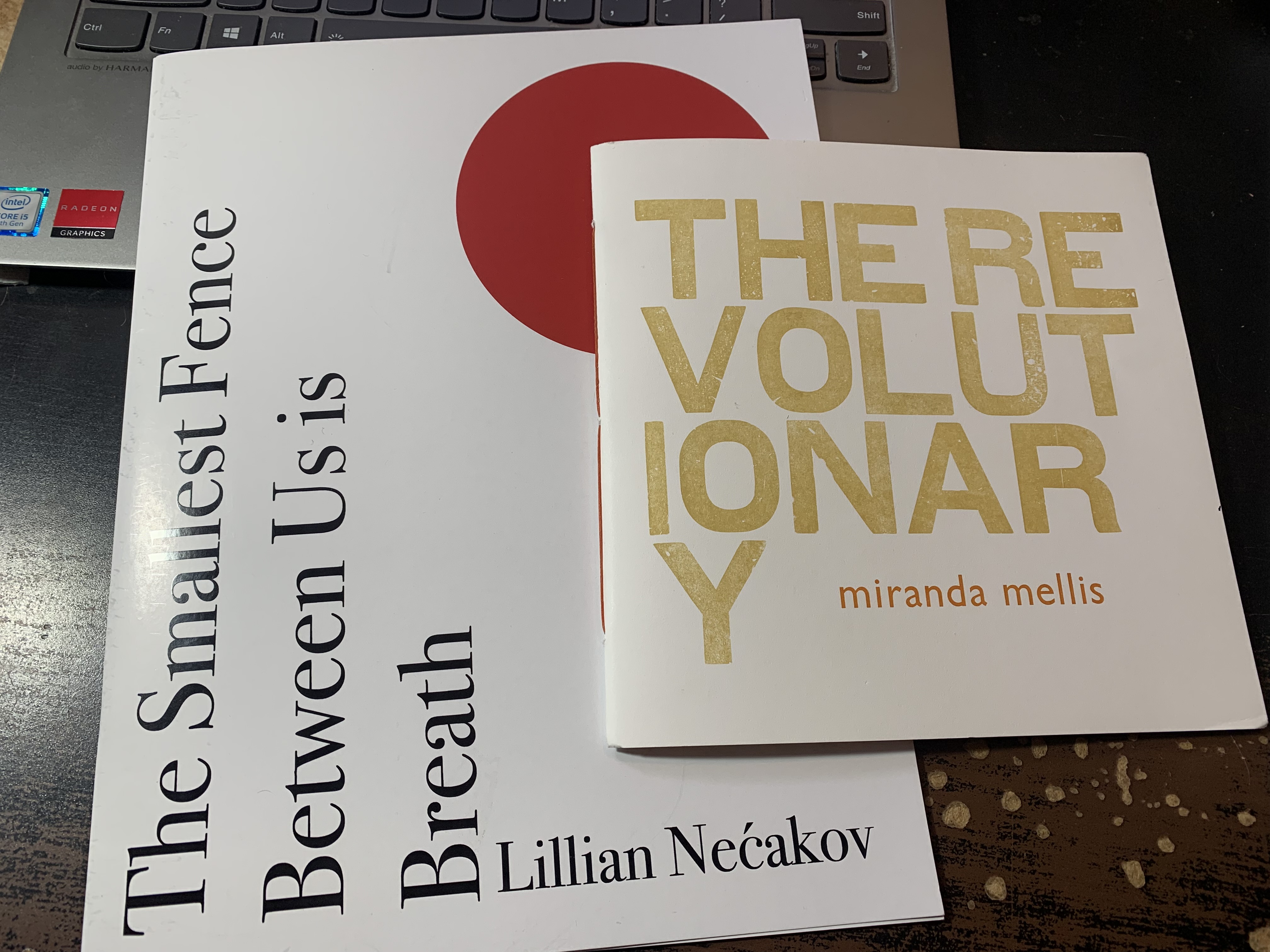
this interview
was conducted over email in June 2021 as part of a project to document literary
publishing. see my bibliography-in-progress of Canadian literary publications, past and present here
Lillian Nećakov is the author
of six books of poetry, numerous chapbooks, broadsides and leaflets. Her new
book il virus was published in April 2021 by Anvil Press (A Feed Dog
Book). In 2016, her chapbook The Lake Contains an Emergency Room was
shortlisted for bpNichol chapbook award. During the 1980s she ran a micro press
called “The Surrealist Poets Gardening Assoc.” and sold her books on Toronto’s
Yonge Street. She ran the Boneshaker Reading series in Toronto from 2010-2020.
Q: How did the Surrealist Poets Gardening Assoc. first
begin?
A: I blame Stuart Ross! I started SPGA in 1984 at
our kitchen table at 42 Maitland Street. Stuart and I were living together at
the time, he had already started Proper Tales Press and was selling his books
on Yonge Street.
We were part of a circle of writers that included
small press publishers, Gesture Press [Nicholas Power], The Front Press [Jim
Smith] and Curvd H&z [jwcurry]. I was buoyed by their enthusiasm and
dedication. It was a really exciting and creative period of my life.
It was relatively cheap and easy to make books
and send them out into the world. The whole process was completely hands on and
I loved everything about it. I had already been writing and creating collage
for a few years and this seemed to be a logical extension of that. There were
many nights spent at that kitchen table on Maitland Street, collating,
stapling, chewing the fat and dreaming up new projects.
Q: Where did the name Surrealist Poets Gardening
Assoc. come from?
A: Again, I blame Stuart! I think it was 1979,
Stuart had a package delivered to me (from the Italian Neo-Dada artist
Cavellini), it was addressed “Lillian Necakov, Surrealist Poets Gardening
Assoc.” Later, when I was thinking of starting my own small press, I thought
that would be the perfect name. It proved to be a whole heap of fun too. I used
to get mail from various horticultural groups and gardening societies, inviting
me to conferences and retreats. I really don’t know what they thought I was
growing! Bet, they didn’t think it was poetry!
Q: How were the first publications put together?
Were you soliciting work, or did you put out a call? How was work gathered?
A: Mostly, I solicited work from writers and
artists who I knew or knew of and whose work I admired. Remember, these were
the pre-internet days. There were no cell phones, no email, everything was done
in-person, by word of mouth or through post. l solicited work for Elvis Car
(the collage magazine) from artists like Cavellini, who lived in Italy and
Steve Byram, who lives in the U.S. Those queries had to be sent by post, and it
took a while. It was a labor of love.
Q: What were the print runs for these
publications? How were they distributed, and what kind of responses were you
receiving?
A: Print runs were anywhere from 100-300 maximum,
depending on the publication and materials used. For example, The
Schwarzenegger Poems by Jim Smith had a clear acetate cover, so that was a
bit more expensive to produce, that book had a print run of 200.
The publications were distributed on a local
community level, at readings, get togethers, word of mouth and through Charlie
Huisken and Dan Bazuin’s incredible independent bookstore This Ain’t the
Rosedale Library. Charlie and Dan were great supporters of small press and
local writers and artists.
For a while I joined fellow writers Crad
Kilodney, Stuart Ross, Mark Laba, and Michael Boyce and sold my own books on
Yonge Street. It was a great way to get books into the hands of people who didn’t
read poetry or who didn’t have access to the world of small press. But it could
also be crazy dangerous and weird. There certainly were moments....
And of course, there was the Toronto Small Press
Book Fair, which was co-founded by Nicholas Power and Stuart Ross in 1987. That
was the mecca of small press, a great place to buy and sell books, meet
writers, artists, readers and spend all your money. That was the place I really
got feedback from people about SPGA and it was really positive. I sold a bunch
of books and magazines and people seemed genuinely excited about the press and
the writers and artists I was publishing.
Q: How did the collage journal Elvis Car
originate?
A: I have been creating collage since I was a
young teen, always loved it. Some early influences include Hannah Höch, Kurt
Schwitters and Raoul Hausmann.
When I started the Surrealist Poets Gardening
Assoc. in 1984, there were no small press publications dedicated solely to
collage (in Toronto) that I knew of. I wanted to create a space for collage
artists to showcase their work. I wish I had had the means to produce the
magazine in full colour, and I regret not producing more issues.
Q: What held you back from producing more?
A: Honestly, I didn’t think that producing the magazine
in black and white did the work justice. The original collages were so much
more rich and nuanced and I wasn't happy with the outcome in black and white.
Producing a full colour magazine, back then, was just too expensive.
Elvis Car no. 113 was produced in full colour, but I was only able to put out 25
copies of that issue and it was physically much smaller than the first issue
(1/4 the size). It just wasn’t sustainable.
Q: Is this why you began moving into producing
chapbooks?
A: Mostly, yes. I was still really excited about
publishing and putting out books. I find so much pleasure in making things.
Those early chapbooks were typeset, then the copy was pasted down on paper,
assembled into a “mock” book, then taken to the copy shop. After that, you had
to assemble each copy of the book, fold and staple each one and then you had
your finished chapbook. I mean, you know how much goes into producing
chapbooks. I loved the entire process from start to finish.
Q: How were those first titles received? What did
you learn through the process of book-making, and becoming both published
author and publisher?
A: Within the small press community, the books
were really well received. They were affordable, alternative, collectable, a
welcome change from mainstream publishing. For those very same reasons, people
outside of the small press literary community didn’t know what to make of these
chapbooks. I was often told, “but, that's not a real book”. It didn’t fit into
their concept of what books were supposed to look or feel like, these were not
the kinds of books they were used to seeing at their local Coles bookstore. I
would say, “but they are real books, they even have an ISBN and everything”, at
that point they would shut up because they had no idea what that meant.
I quickly learned that my love of writing and
making books was completely separate from distribution. It was easy – well
relatively easy – to write and be a small press publisher, but when it came to
getting books to the “masses”, that was another story. It seems that only poets
read poetry. It was nearly impossible to get the books reviewed outside of a
few small press magazines.
Q: Did taking control of production shift the
ways in which you saw your own work?
A: Not so much the way I saw my work, rather the
opportunities I saw. If SPGA and other small press publishers were willing to
take risks, my writing could find a place outside the mainstream. I have always
written against the confines of the audience, I never think about what will
appeal to the reader or the publisher when writing. I go off on all kinds of
tangents, I have fun, I write first and foremost for myself. Maybe that’s
selfish or arrogant, I don’t know, I just know that I have to be as honest and
authentic as possible.
Q: Given the occasional aspect of the press, how
did titles emerge? Were you approaching writers, or were they approaching you?
A: I approached writers.
Q: I get the sense from your bibliography that
the press ran on a case-by-case basis, focusing on and producing one item at a
time, with often months or even years in-between. What prompts you to approach
someone for a manuscript?
A: What prompted me to approach writers for
manuscripts was always their work. If I connected to the writing and was
excited about publishing it, I would go for it. To be clear, SPGA hasn’t been
publishing for quite some time now.
There were major changes in my personal life in
1989 and I was out of the loop, so to speak, for several years after that. I
was focusing my energies on other things, and then, I decided to focus on my
own writing. So the last book SPGA published was Richard Huttel’s The Be
Seeing You Variations in 1993.
I sometimes think about resurrecting the press,
but I think there is a time and place for everything. I think I might just
stick to being a surrealist poet who gardens.
Surrealist Poets Gardening Association
bibliography:
Elvis Car #1: Collage
Magazine. 1984. collages by: Bill Bissett, Stephen Byram (NYC), Guglielmo
Achille Cavellini Brescia (Italy), Mark Laba, Ward Maxwell, Lillian Nećakov, Jim Smith and Steve Venright.
Lillian Nećakov,
A Cowboy in Hamburg. 1985
Brian Dedora, A Table of Contents. 1985.
Kevin Connolly, Wither,. 1985.
Jim Smith, The Schwarzenneger Poems. 1988.
3 postcards (collages by Lillian Nećakov). 1989.
Elvis Car no. 113: Spring
1988. collages by: Lillian Nećakov
Clint Burnham, the and that cane forgot.
1991.
Richard Huttel, The Be Seeing You Variations.
1993.