Showing posts with label Kate Siklosi. Show all posts

Tuesday, December 02, 2025

new from above/ground press: Cahill, Earl, Cavaleri, Niespodziany, Comay/Fagan, Birchard, Chernoff, la Rocque, carisse, Hill, Nećakov, Siklosi + Bjerg/Jung,

BAD TEMPOR, Jimmy T Cahill $6 ; SOCIALLY AWKWARD GHOST, Amanda Earl $6 ; Studies, Micah Anthony Cavaleri $6 ; The Man, a sequence of foolish men, Benjamin Niespodziany $6 ; The Sun Will Bleach It Away, Rebecca Comay / Cary Fagan $6 ; DIDIKUY, Guy Birchard $6 ; SLOPTIMISM of the WILL, MLA Chernoff $6 ; Circling the Black Sun, Lance La Rocque $6 ; That H uman E ffluence A nd P lastic, russell carisse $6 ; a nest, a burrow, a lea stone, Jeremy Luke Hill $6 ; The World is Beautiful, Lillian Nećakov $6 ; household: meadow, Kate Siklosi $6 ; eyesore, Johannes S.H. Bjerg and Charlotte Jung $6

published in Ottawa by above/ground press

October-November 2025
a/g subscribers receive a complimentary copy of each


And did you see my report on this past summer's above/ground press 32nd anniversary event?


To order, send cheques (add $2 for postage; in US, add $3; outside North America, add $7) to: rob mclennan, 2423 Alta Vista Drive, Ottawa ON K1H 7M9. E-transfer or PayPal at at rob_mclennan (at) hotmail.com or the PayPal button (above). See the prior list of recent titles here, scroll down here to see a further list of various backlist titles, or click on any of the extensive list of names on the sidebar (many, many things are still in print).

keep an eye on the above/ground press blog for author interviews, new writing, reviews, upcoming readings and tons of other material
; and you know above/ground press has a substack now? sign up (for free!) for announcements, and even new features! catch recent/forthcoming interviews with Guy Birchard, Jill Stengal, Lillian Nećakov, Cary Fagan, Renée Sarojini Saklikar, Ken Norris, Michael Sikkema, Ben Ladouceur, Nathanael O'Reilly, Micah Ballard, Lydia Unsworth, Amanda Earl, Buck Downs, russell carisse etc.

With forthcoming chapbooks by: Glenn Bach, Travis Sharp, Sonja Greckol, Frances Cannon, Stuart Ross and Jason Camlot, David Gaffney, Kevin Spenst, Jill Stengel, Mrityunjay Mohan, Buck Downs, Salem Paige, Robert van Vliet, David Phillips and probably others! (yes: others,

AND 2026 SUBSCRIPTIONS ARE NOW AVAILABLE (but you probably already know that,

Tuesday, July 01, 2025

Canadian Poets Series : Peripety and/or Tronies

Happy Canada Day! A while back, American writer Olivia Cronk invited me to participate in her Peripety and/or Tronies blog, a site that includes, as she offered via email, “established writers with whom i’m friendly & student writers & others who like to think in writing, etc. not fancy, no gate-keeping.” I was curious at the suggestion, a thread I could offer in-between all the other notices of readings, new publications, interviews and the like. In the end, I thought it would be interesting to offer Cronk’s students, already attempting to pay attention to writing and readings and new publications, a glimpse into some of the amazingness of Canadian poetry, especially during the current climate. The “Canadian Poets Series” offers short biographies on contemporary poets working in various corners across the country, each featuring a healthy-sized author biography with links to publications, and poems and interviews online. I like the idea of these posts as being introductory, able to catch a good sense of what each poet has done and is in the midst of, through these rather straightforward biographical posts. We should be celebrating ourselves, after all, with all the self-reliance, self-reflection and dignity our sovereignty provides.

The first six posts in this ongoing series have landed online since the beginning of March—ryan fitzpatrick, Renée Sarojini Saklikar, Kate Siklosi, Jake Byrne, Tolu Oloruntoba and Maggie Burton—with forthcoming posts featuring Armand Garnet Ruffo, Ellen Chang-Richardson, Jen Currin, Mark Goldstein and Jessi MacEachern. We are Canadian! And we are amazing. Elbows up!

Tuesday, April 11, 2023

Kate Siklosi, SELVAGE


my nagypapa was an immigrant and immigrant children without a mother are dangerous. they had settled in a small oil town and he started to build a small house with his own hands. all i know of that night is that it was dark and there was screaming. i’m drinking tea when my aunt recalls looking back on her father falling to his knees. she was old enough then to know that the axis of their lives and those to come had shifted. an inverted arch crouching in concavity. each child a coordinate clinging to a dead line. one took his life one destroyed others. the rest have done their best to keep grounded. the fact of the matter is they all grew up against a backdrop of negative space. each a stellar burst a collapsed star in a hellbent universe. notwithstanding, here. i. (“reasonable grounds”)

Toronto poet, editor and publisher Kate Siklosi’s second full-length collection, following the stunning visuals of leavings (Malmö, Sweden: Timglaset Editions, 2021) [see my review of such here], is SELVAGE (Toronto ON: Invisible Publishing, 2023). Set in four sections of stitch and carve, Siklosi writes of new motherhood against intergenerational trauma, leaves and immigration, edges and a blurred centre. Whereas leavings focused on images of physical objects set with text, SELVAGE focuses instead on the text itself, while still offering an extension of the visuals and visual elements presented in that full-length debut. She writes of stitch and vein, a blend of images (including full colour), offering text on seeds and leaves, and weaving in elements of language from the Canadian Charter of Rights and Freedoms through examining a family history of devastating losses and their rippling effects. “leafing through the charter,” she writes, as part of the opening sequence-section, “i am a loss. when things shall be deemed it can both protect and threaten at once.” As the press release offers: “Kate Siklosi grew up in a family shrouded in a veil of mystery of how they came to be: the scant facts about her grandparents and how they came to live in Canada after escaping Hungary under the Iron Curtain in 1956; her nagymama (grandmother) dying in childbirth; her nagypapa’s (grandfather’s) grief at finding himself alone without his family in this new country (subsequently taking out his grief by setting fire to the Children’s Aid building and then dying in jail); the mysterious ‘neighbour’ who sexually abused Kate’s brother and cousins.”

The online Merriam-Webster offers that “selvage” refers to “the edge on either side of a woven or flat-knitted fabric so finished as to prevent raveling. specifically : a narrow border often of different or heavier threads than the fabric and sometimes in a different weave. : an edge (as of fabric or paper) meant to be cut off and discarded.” The poems in SELVAGE are stitched together as four sequences of prose blocks, lyric fragments and image—“reasonable grounds,” “field notes,” “lockstitch” and “radicle”—that quilt a larger narrative of crumbles, holds, breaks, language patters and splinters, able to entirely smashed to pieces but held together by thread, across, one might say, that narrow border; of how, near the end of the opening sequence, “drought tolerance is passed / from parent tree to child.” There is something quite fascinating, also, in how Siklosi seeks, through a blend of image and text, to examine a story that begins with her Hungarian grandparents, forced to leave home to emigrate to Canada during the same period as Calgary poet Helen Hajnoczky’s grandparents, something Hajnoczky worked to examine in her own way through the blend of visuals and text of her own second collection, Magyarázni (Toronto ON: Coach House Books, 2016) [see my review of such here]. Accumulating into a book-length poem, Siklosi’s scraps, threads and fragments pull at those buried elements of family lore, seeking the story to see what pulls apart, simultaneously held together by the determination and a story, notwithstanding. “being is a maze.” she writes, as part of “lockstitch,” “the sky is stitched in. cut the selvage by taking the people upon entry. you can create laws, like that bush and that corner and how high. You can even manage it so it appears like a living thing from space: branches and limbs with people roaming through. the thread is of course the word that holds it together: five hearts searching taxed land held down with pins.” Or, as part of the third section:

Everyone has the following fundamental freedoms:
what if i told you nothing dropped.
every citizen of Canada has the right to
a landmine made our calves burn with
in time of real or apprehended war,
coming home. handful of roots explode
the right to enter, remain in and leave
into light. skylarks on a pond.
pursue the gaining of a livelihood
look, the year is now gone.
life, liberty, and security of the person.
i have my dad’s waves.
compelled to be a witness in
he made me a constellation to swing from.
law recognized by the community of nations
i don’t have his hands so can’t build myself
not to be tried for it again
a country but i have enough ink to sink
not to be tried or punished for it again
us into a river, bone and mind, and with
time of commission and the time of sentencing,
this i’ll dive in and give you everything but
a witness who testifies
the currents to remain inside his
freedoms shall not be construed as
rattled lungs and mistake
treaty or other rights
his ribs for home.

There is something, of course, quite natural to having one’s first child that prompts a particular look back at one’s history, one’s foundations; to attempt to reconcile particular elements of the past for the sake of being able to move forward. In this way, one could even point to comparable titles, such as Jessica Q. Stark’s recent Buffalo Girl (Rochester NY: BOA Editions, 2023) [see my review of such here], as Siklosi writes through the limitations and effects of a document, of a story, upon the body, utilizing text and stitch as a way to unfurl both family and archive, stitching one word immediately upon and following another. “as if,” she writes, as part of the fourth and final section, “to survive was a baseline / life blossoms from a wound / how does one escape a cycle?”

Sunday, January 09, 2022

Kate Siklosi, leavings


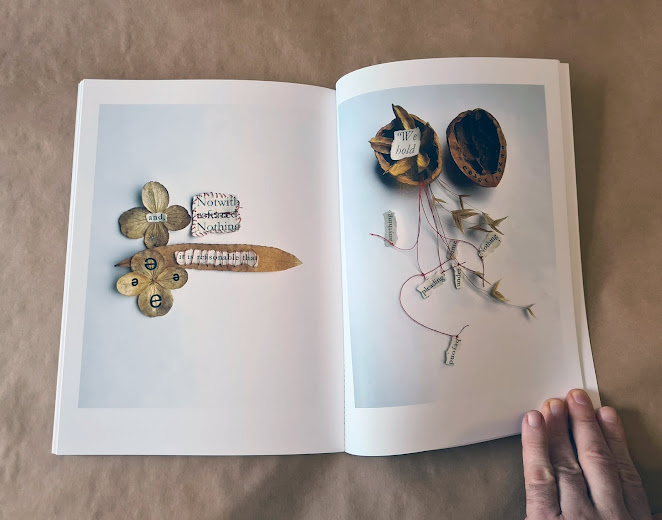
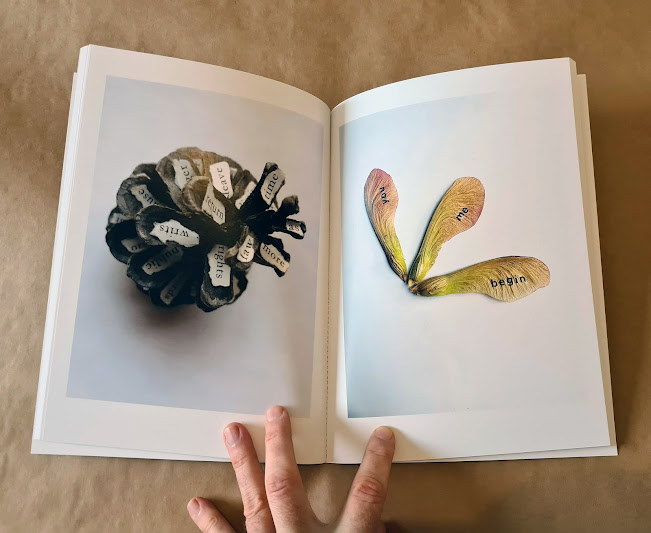
Comprised of seventy-three large full-colour photographs of visual poems comprised of a combination of object (leaf, bark, branch) and text, is Toronto poet, editor and publisher Kate Siklosi’s full-length debut, leavings (Malmö, Sweden: Timglaset Editions, 2021). leavings is a collection of visual pieces composed through a combination of printed text, visual poems and letraset combined with leaves, twigs, branches and fir to reveal, in close detail, the physical interactions between nature and language, and the impact of absolute brevity. In her piece “Hot and Bothered: Or, How I Fell In and Out of Love With Poetic Conceptualism” at The Puritan (posted May 1, 2017), she writes on “the trajectory of my personal love affair with conceptualism” through looking at M. NourbeSe Philip’s Zong! (The Mercury Press, 2008) [see my review of such here] and Jordan Abel’s Un/Inhabited (2014) [see my review of such here] and Injun (2015) [see my review of such here], writing that “Sure, in some sense, it is ‘enough’ to screw around with language and create art that floats inside a beautiful ether. But in the face of the continuing projects of settler colonialism—to which we are all subject, to lesser or greater degrees—I could no longer ignore the ways in which authors consciously use and abuse poetic material in their work.” Through such, she writes of both the requirements of properly acknowledging the materials with which she works, as well as a deeper purpose than simply messing about with language. As she writes: “in revealing the (mis)use and arbitrariness of language, and of his-tory writ large, social activism and aesthetic praxis are fused. Their poetic labour combines conceptualism’s interrogations of language and symbolic representation with a persistent concern for equity and social justice.” She writes of, as her endquote by bill bissett offers, a “shared fragility,” as well as a particular kind of interconnectedness. One side of her work could not exist at all without the other.

The pieces are structured in four titled sections, with a single large image per page: the twenty works of “a leaf,” the twenty-three pieces of “a leave,” the eleven pieces of “a left,” and the nineteen pieces of “a mend.” By section titles alone, Siklosi’s quartet hints at an echo of bpNichol’s infamous eight-line poem etched into the concrete of the Toronto lane that now shares his name: “A / LAKE / A / LINE / A / LONE [.]” Just as in Nichol’s poem set in concrete, Siklosi’s poems are uniquely physical, and deliberately temporal; the delicate nature of some of these pieces suggest that most, if not all, might no longer exist in the forms shown in the photographs, leaving the photograph as both framing and document of an object that can’t easily, or ever, be archived. Is her purpose, then, through the exploration, the object or the documentation? There is something fascinating in the way the pieces in leavings also suggest an approach in tandem with her found materials. These pieces exist, one might say, in collaboration between Siklosi and her materials (leaves, branches, etcetera), as opposed to her simply dismantling and repurposing whatever materials she may have found as part of her walks (her acknowledgments include a “Thank you to NourbeSe for our ravine walks, on which many of these leaves and thoughts were collected.”). Instead, Siklosi appears to respond, from her collaborative corner, as a way of shaping to and around the materials-at-hand. It is no accident, I would think, that her dedication reads, simply: “for the land, our wisest poet [.]” As she writes to preface the collection:

a life is composed of leavings: the remains of crusts and skins, the remnants of night in a dawn sky, the residue of mourning, loves too deep and too shallow, the hard words left unsaid, the time taken, the dust in our tracks. in our tiny expanse, things pass and things grow. we kill and we cultivate. we hurt and we mend. we pick up the pieces and create. we do better and we fail. we thread ragged beginnings from the trodden decay of our pasts. beginnings still. we collect, windswept and tired, in piles against a fence. in our shared fragility, we quilt a being, warm and enough.


Over the past few years, Timglaset Editions has emerged as one of our most important, and even most visible, publishers of concrete and visual poetry, producing numerous bits of ephemera along more substantial trade editions, including Amanda Earl’s landmark anthology Judith: Women Making Visual Poetry (2020) [see my review of such here], a book that Siklosi’s work was also included in, and this book is stunning for the delicate care clearly evidenced through productions. After seeing Siklosi’s work for so long in smaller publications, such as her wealth of chapbooks and pamphlets over the past few years—po po poems (Ottawa ON: above/ground press, 2018), may day (Calgary AB: № Press, 2018), coup (Calgary AB: The Blasted Tree, 2018), fragile armies (England: Penteract Press, 2018), 1956 (above/ground press, 2019), She Bites (Wilmington, NC: Happy Monks Press, 2019) and 6 feuilles (Toronto ON: nOIR:Z 2019)—it is interesting to see her work stretch itself across such a larger and broader canvas. Given she has a further collection forthcoming in 2023 with Invisible Publishing, a manuscript combining text and image, one can only imagine this as simply our introduction as readers to a range of thinking that she has been engaged with for some time, merely hinted at through all she has published so far.


Thursday, July 01, 2021

Judith: Women Making Visual Poetry, ed. Amanda Earl


The challenge of reception remains. How to make such work – by women in particular – visible within the general clutter of literary publishing and the larger field of cultural noise. But as gender politics in publishing meets the fertile graphical-poetic imagination of so many talented and engaging writers, these issues will resolve themselves. The terms ‘visual’ or ‘concrete’ seem less and less necessary as identifiers that separate one category of works from the larger field. All works of written poetry are graphical, but only some take advantage of that in interesting ways. The wonder is that such a varied and prolific outpouring is taking place – and being given the kind of notice signalled by this anthology. For someone of my generation, whose work was systematically denigrated, or, alternately, merely ignored, this is an excellent development to witness. Perhaps it will also serve to remind women of what is at stake in being in control of our own language – since that is where the political efficacy of our subjectivity resides. The politics of gender are not diminished in these days, only transformed, and the polymorphous approach to authority is intimately bound to questions of self-determination. If I cannot speak myself in terms appropriate to the symbolic presentation of my being, then how am I to act with the full warrant of citizenship in the linguistic world? The question can only be answered across the broad spectrum of gendered positions, beyond binarisms and oppositions, but also, cannot ignore the legacies structured into our language and the visual presentation of our selves. (Johanna Drucker, “(In)Visible Women or Gender in Concrete”)

It would be hard not to be amazed by Ottawa poet, editor, critic and publisher Amanda Earl’s incredibly expansive, inclusive and long-awaited anthology Judith:Women Making Visual Poetry (Malmö, Sweden: Timglaset Editions, 2021), a book funded, in part, through an impressive crowdfunding campaign earlier this spring. Subtitled “A 21st century anthology,” Judith is named for Vancouver poet Judith Copithorne, who is known as the first woman in Canada to engage (in a sustained, ongoing way) with visual and concrete poetry, appearing in such important early Canadian concrete/visual poetry anthologies as the four author Four Parts Sand (Ottawa ON: Oberon Press, 1972), John Robert Colombo’s New Directions in Canadian Poetry (Toronto ON: Holt, Rinehart and Winston, 1971), bpNichol’s The Cosmic Chef (Ottawa ON: Oberon Press, 1970) and bill bissett’s THE LAST BLEWOINTMENT ANTHOLOGY VOLUME 1 (Toronto ON: Nightwood Editions, 1985), as well as in more recent volumes such as The Last Vispo Anthology: Visual Poetry 1998-2008 (Fantagraphics, 2012) and The New Concrete, Visual Poetry in the 21st Century (Hayward Gallery Publishing, 2015). For years now, Ottawa writer/publisher/bookseller jwcurry has been referring to Copithorne as “our first lady of concrete,” and Copithorne has actively been producing and publishing since the late 1950s. Earl’s acknowledgment of Copithorne is wonderfully appropriate, although it is curious to note that the first volume of concrete and visual works produced in Canada was actually (as jwcurry once offered) Lozenges: Poems in the Shapes of Things (London ON: Alphabet Press, 1965) by poet Colleen Thibaudeau (1925-2012), a title that appeared mere months prior to the first publications by bpNichol himself, who spent an entire career working, among other forms, concrete and visual poetry. In the context of Thibaudeau’s own work, her experimentation with visual forms through Lozenges, published by her husband, the poet James Reaney, appears to have been an outlier; a line of experimentation set aside for her eventual and lengthy career focusing on more narrative forms of poetry.

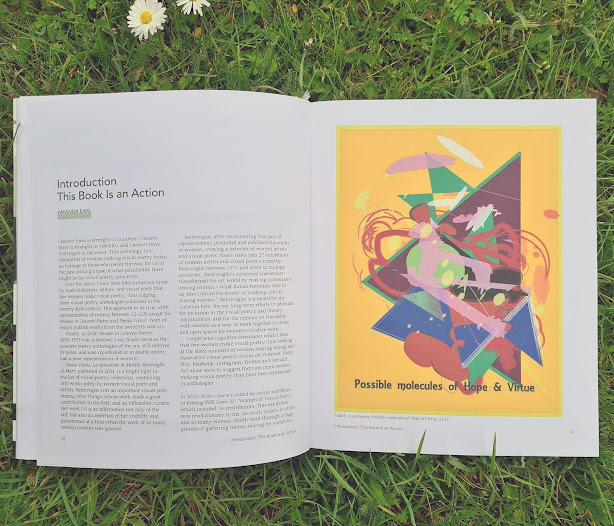
Judith includes a foreword by Johanna Drucker, “(In)Visible Women or Gender in Concrete,” and introduction by Earl, “This Book Is an Action,” and the two trace the reasonings and arguments for examining these kinds of works, and theories for why so much of this has been historically overlooked. As Earl writes: “Over the years, I have been told numerous times by male publishers, editors, and visual poets that few women make visual poetry. And judging from visual poetry anthologies published in the twenty-first century, this appears to be true, with representation of women between 12-21% except for Women in Concrete Poetry and Poesia Visiva both of which publish works from the twentieth century.” As a response to that repeated assertion, Earl offers a comprehensive list of “1181 Women Making Visual Poetry” (a list that has grown since to more than 1200 names in her ongoing Google doc). The list of so many historical and practicing artists simply add to the heft and very essence of this collection: how could so many artists be overlooked, and for so long? As Earl introduces the list of names:

Beginning in April, 2019, Joakim Norling and I began to record the names of women making visual poetry in a shared spreadsheet in order to select potential contributors for the anthology. We easily reached 100 names and began inviting contributors to the book by the summer. The list kept growing. I asked for more names from our contributors and through social media. This list is the work of a community, many communities, with a shared goal to increase the visibility of women making visual poetry. we received names from editors, publishers and visual poets. Our list expanded to include Arabic calligraphers, Native American Ledger artists, quilters, word painters, photographers, sculptors and more. I found even more women sharing their visual poetry in the form of embroidered texts, collages, wearable art. We have included only the names here, but many of the women listed are easy to find on Google.
At the core of the collection sits works by a selection of artists from around the world working in visual and concrete forms: Rosaire Appel (USA), Viviane Rombaldi Seppey (Switzerland/USA), Kimberly Campanello (USA/Ireland/UK), Iris Colomb (London, UK), Amanda Earl (Canada), Judith Copithorne (Canada), Cinzia Farina (Enna, Italy), Ankie van Dijk (Netherlands), Satu Kaikkonen (Finland), Mara Patricia Hernandez (Mexico/USA), Dona Mayoora (aka Don May and Donmay Donamayoora, USA), Terri Witek (USA), Astra Papachristodoulou (UK), Karenjit Sandhu (UK), Mado Reznik (Argentina), Lenora de Barros (São Paulo, Brazil), Petra Schulze-Wollgast (pws) (Rostock, Germany), Ruth Wolf-Rehfeldt (Germany), Kate Siklosi (Tkaronto/Dish with One Spoon Territory/Toronto, Canada), Ines Seidel (Munich, Germany), Hiromi Suzuki (Japan), Erica Baum (USA) and Audra Wolowiec (New York, USA). The large format, as well as so many stunning, full-colour images give the collection the physical sense of a coffee table book, and each author’s section includes artist’s statements, a note on another artist that influenced their work, and a recent discovery, all of which provide context and further information on these artists and their works. As part of such, it is interesting to see the cross-influence between contributors: Kate Siklosi offers Ines Seidel’s work, for example, as her influence, and Astra Papachristodoulou as her discovery. As Siklosi writes on Seidel:

Ines Seidel’s work further instills in me a poethics of care, and of finding strength in fragility, that carries me through my poetic practice and beyond. In her work, she painstakingly sews paper and other materials together into wonderfully intricate sculptures – and in this delicate practice, she has taught me the creative value of patience and of ‘staying with the trouble’ while creating work that commands such acute attentiveness and care. This care-ful mindset toward the work has also been an incredibly sustaining ethos for me personally – and throughout 2020, it has been a critical tool for me in terms of working through and responding to the complexities of the world. Her work also informs my object work in terms of illuminating the constructed fabric of our reality, and the powerful and necessary role of creative intervention in that fabric to showcase both the resilience, transience, and beauty inherent in our being.

One of the elements interesting through this list, and this anthology, is the way in which Earl has really provided an expansion of the term “concrete and visual poetry” to include such forms as “embroidered texts, collages, wearable art” and multiple other ways in which artists explore text, a number of which were long dismissed, I might suspect, as merely being “women’s work” and not as any serious, sustained form. There are examples of more traditional considerations of visual and asemic writings in the collection, but Viviane Rombaldi Seppey, for example, works three-dimensional pieces with source materials including maps and phonebooks, and Kate Siklosi works with images of print on leaves and bark. Astra Papachristodoulou works with three-dimensional pieces, and her works in the collection include a puzzle, test tubes and candles. Her statement reads: “My work explores the confluence of poetry and art through a range of diverse sculptures that hopefully outgrow their minimalist bounds. I mainly use ecologically friendly materials such as bio-resin, beeswax and wood to respond to the urgent ecological challenges we face today. My object poems often have an interactive element and present alternate ways for poetry that is not fixed to the page. Extrapolating from my work is a set of techniques and values characterized by the layering of meanings and materials.” Through Judith, Earl’s sense of concrete and visual opens wide to include elements that had already appeared on the periphery of a peripheral form, now set in an accumulated centre of an expanded form that connects not only to literary writing but to larger and multiple considerations of conceptual art (I suspect a fraction of this comes from the fact that the publisher was open to including works, including photographs, in full colour). This collection not only expands the conversation of concrete and visual works, but connects those conversations to multiple other conversations already in-progress. As London, England-based contributor, Iris Colomb, writes for her included statement:

I am interested in the materiality of language and the ways in which text can exist both visually and performatively. Most of my projects involve building different relationships between these two states and exploring possibilities beyond linear written and spoken text. My visual poems are usually the starting points or the results of performances; they either function as performance scores or as the alternative spatial outcomes of time-based works. I enjoy producing textual objects that allow poems to adopt independent and changing structures. Their delivery is often affected by aleatoric or material elements developing through a physical engagement with the text as a three-dimensional thing to be manipulated. The material and visual elements of these objects create a space for additional layers of meaning, which cannot be dissociated from their linguistic content. When a performative piece becomes the starting point for a visual poem the process involves both a form of translation between media and a second state of poetic composition. My projects can therefore be led to take on multiple forms, both visual and performative. This aspect resonates strongly with both my conceptual and aesthetic concerns.

Adding even further to the heft of this collection, Judith concludes with a handful of essays: “A World of Signs: Women of Asemic Writing” by Natalie Ferris, “Handle with Care: A Study in (Poetic) Fragility” by Kate Siklosi, “Interview: The Thread Between Craft and Language” by Amanda Earl, and “Light and Code: Digital Ecologies of Poetic Form” by Fiona Beckett. Judith explores far more than the ways in which individual artists have chosen to work, but the real nuts and bolts of literary creation in a wide range of possibilities, from sewing leaves and gallery space to digital creation. Judith explores creation, and the shifts within the form and the ways in which form opens, in ways not traditionally approached by male writers. This really is a remarkable collection, and deserves to remain in print for as long as possible. As Ferris offers as part of her essay:

            However, for women the gestural, indecipherable or encoded offered not only the opportunity to challenge language’s monopoly on expression, but to challenge the patriarchy’s monopoly on meaning. Throughout history and across cultures and continents, women developed writing systems for their own use; often excluded from educational regimes designed for men, women turned to expressive registers to devise their own, individual or collection, and often secret, means of communication.

This collection is masterfully put together, both in form and in concept, and even includes, at the very end, an “In Memoriam,” a list “to honour and remember women visual poets and artists who died in the 21st century.” What is lovely about this collection is the sheer expansiveness of it, allowing anyone interested in the form further information on the potential handful of names they might already be aware of, as well as a series of worthy introductions to an incredible array of artists, providing a spring-board for an incredible amount of potential further study, research and creation. The approach to this collection is reminiscent of the ways in which Canadian women were working to carve out a space for a different kind of writing, in terms of content, form and possibility, throughout the 1960s and 70s. One could point to writers such as Daphne Marlatt, Nicole Brossard and Betsy Warland, and publishers such as Women’s Press, Ragweed Press and Room of One’s Own (since evolved into Room magazine), although one wonders why it took so long for visual poetry by women to be acknowledged. Perhaps it couldn’t happen until someone as driven and articulate as Amanda Earl (who also happens to have become one of the most engaged and exciting contemporary practitioners of the form) to come along and finally put it together.