


And did you know that Winnipeg is the Slurpee Capital of the World? I had no idea! Although we did appreciate it, in the thirty-plus degree heat.

Thesis
It was something the
discourse got stuck on:
Where the eels came from.
No one had ever seen them
mate.
Maybe all I needed to
know
Was how they changed form
and why;
what question they were
answering when their bodies
adapted from freshwater
to salt.
How did the passage of
time move in a fluid cycle?
How could they continue
to make their pilgrimage
through so many man-made barriers?

Nebula poured her energy into advocating for the lives of
aquatic species. She was a primary organizer of the rally against Veil’s mining
expedition to Mars, after it was discovered there was life in the planet’s polar
caps. For her role in interrupting this project she was incarcerated for 6
months. All poetry she created during this time was destroyed.
After her release, we moved to her hometown, New Haywood,
Ontario, where we worked with her mothers and the community to take back the
land from Utopic Robotics, dedicating our efforts to creating community gardens
and supporting the young people and children above all else. Ensuring that they
could grow food and provide for their futures. We worked to make sure that the land
was accessible to everyone. We met with the Tyendinaga Elders Council, bringing
the hard-shelled automated agricultural beetles with us, and their individual stores
of seeds to decide what should become of
them. We pooled our seed libraries, made planting calendars, and learned how
the plants depended on each other to survive.
As both B-e and Kroetsch did, so too, Smith’s fictional editor, Dip Seshadri, helps frame this collection, providing a further step of distance between the Smith and the poems, offering an opening insight of the late author through the lens of not only as her editor, but as her partner (comparable to Kroetsch’s Raymond, although the archivist fell in love with Rita through her words). As the preface ends: “Nebula was the love of my life. I miss her with all my heart.”
Set in three sections, Nebula’s poems write of repeated layers of death and rebirth, technological advance and environmental crises, utopia and its failures. The narrative framework of this imagined future is curious, interesting; and I’m intrigued at why, specifically, Smith wrote out this future through the lyric as opposed to prose; wondering, perhaps, if there might be a novelization at some point from an alternate perspective around the same narrative this collection offers. Held together, the poems each provide narrative moments of lyrically-straightforward narrative sketches that together accumulate into a larger and broader concern with how technology interferes with repair, and has the potential to interfere with utopia itself. Nebula’s poems offer depictions of days and networks, beetles and histories, and fingers through dirt; as a warning, a look at and through where we might land from the perspective of having been through it.
A Young Automated Beetle
Writing Home
My mummy had soft hands
and strong bones.
She was the one who put
my solar-powered energy-cell
in my core. The one who
whispered
my purpose to me as she
brought me and my siblings
to our little runway.
Be generous with your seeds and your water, please.
I am happy when I work
because I think of her.
Sometimes I send her
little messages just to tell her where I am.
I don’t hear back, but I keep
letting her know that I’m ok.
I look at the sky and the
dry dirt and my little scooped feet;
She would probably like
to see these heavy hills,
of limestone; iron; and
quartz;
fragments of mammalian
skeletons and disconnected roots
I think about how I want
to renew this place
and make it special for
her.

And you know the above poem from Robert Kroetsch, don’t you? Strange for me to consider that I am now at the age where he was then, part of his Letters to Salonika (Toronto ON: Grand Union Press, 1983) (an edition gifted by dear half-sister a couple of years back), the poem-sequence he wrote about his then-wife, Smaro Kamboureli, being away, while Smaro was away and working on her in the second person (Edmonton ON: longspoon press, 1985). Not a solo birthday, but they leave soon enough: Christine and our young ladies head to hang out with father-in-law and his wife in Boca Raton, Florida for four days, starting Sunday. I remain here, working on festival publicity and other such details. We hadn’t been to father-in-law’s condo there since 2015, attempting an annual February/March trip that we haven’t managed since Aoife was born [see my report on that 2015 trip]. Had a different timing been possible, perhaps. I shall be home.
And, regarding Kroetsch: I’m still amused at the book he wrote about Smaro being away, as Smaro wrote a book about Smaro being away. While Christine was attending her two weeks at Banff Writing Studio in January of last year, I played my version of same, writing a poem sequence via Kroetsch’s own structure of dailyness about Christine being away, which I produced last summer as a chapbook, edgeless : letters, (2023). Be aware that the book she was working to finish during that period (the same project she turned from mound of paper to manuscript during her time at Sage Hill in 2019), Toxemia (Book*hug Press), is out this fall, and already up for pre-order.

Distracted enough these days, that I’ve so far been unable to even consider a potential birthday poem this year. Might this be the first year I skip? We shall see what next week brings, hoping to get a couple of afternoons in a tavern somewhere, with notebook and pen and mound of books, attempting to catch my breath a bit. Perhaps the option remains. But let’s get through the weekend. Although, really, there have been little to no poems for quite some time, focusing the past eighteen months on larger prose (fiction and non-fiction) projects; still, there were pages upon pages upon sketched-out notebook pages from our Florida jaunt last fall [see my report on such here], but none of which I’ve been (as yet) able to return to. One project prompted by the work of Laynie Browne, another prompted by the work of Barry McKinnon. I keep hoping: soon.

I work to further dismantle my home office, what I’ve been a month already working on, moving myself into the finished basements. Our young ladies have become too big to share a bedroom anymore. I’ve already moved multiple bookcases and at least fifty to sixty boxes of books out of my office either downstairs or into storage. The fact that neither child has even noticed what I’m doing yet might say something of them, but just as much the state of my office, I suppose. It would be nice to have completed this task by the time they land home. I’m not sure such might be possible, but we shall see. I only started this process on February 6th.
Birthday, a check-in: in my note last year I mentioned an extended period of breathlessness, currently feeling I’ve been in a version of same since, what, last July? Pushing edits on my short stories, working on my genealogical creative non-fiction project, “the genealogy book” [posting excerpts to substack, naturally], the household taking turns across two weeks with flu at Christmas (every day a new cancellation of social gatherings, and a Christmas dinner at least four days late) and now my copy edits, which are actually due today. On my birthday? Come on.
Hoping once the non-fiction a bit further along or even completed I can return to the novel I began during the onset of Covid; a handful of short stories-in-progress, as well as further essays on fiction writers. At least three poetry projects begun but on hold (as I said), including one that I’ve excerpted for the tenth anniversary issue of Touch the Donkey [a small poetry journal], which lands in another month. And don’t I have a chapbook soon with Montreal poet James Hawes’ Turret Press? And another full-length poetry title en route as well, recently accepted for most likely 2026 publication (but we aren’t talking about that yet).
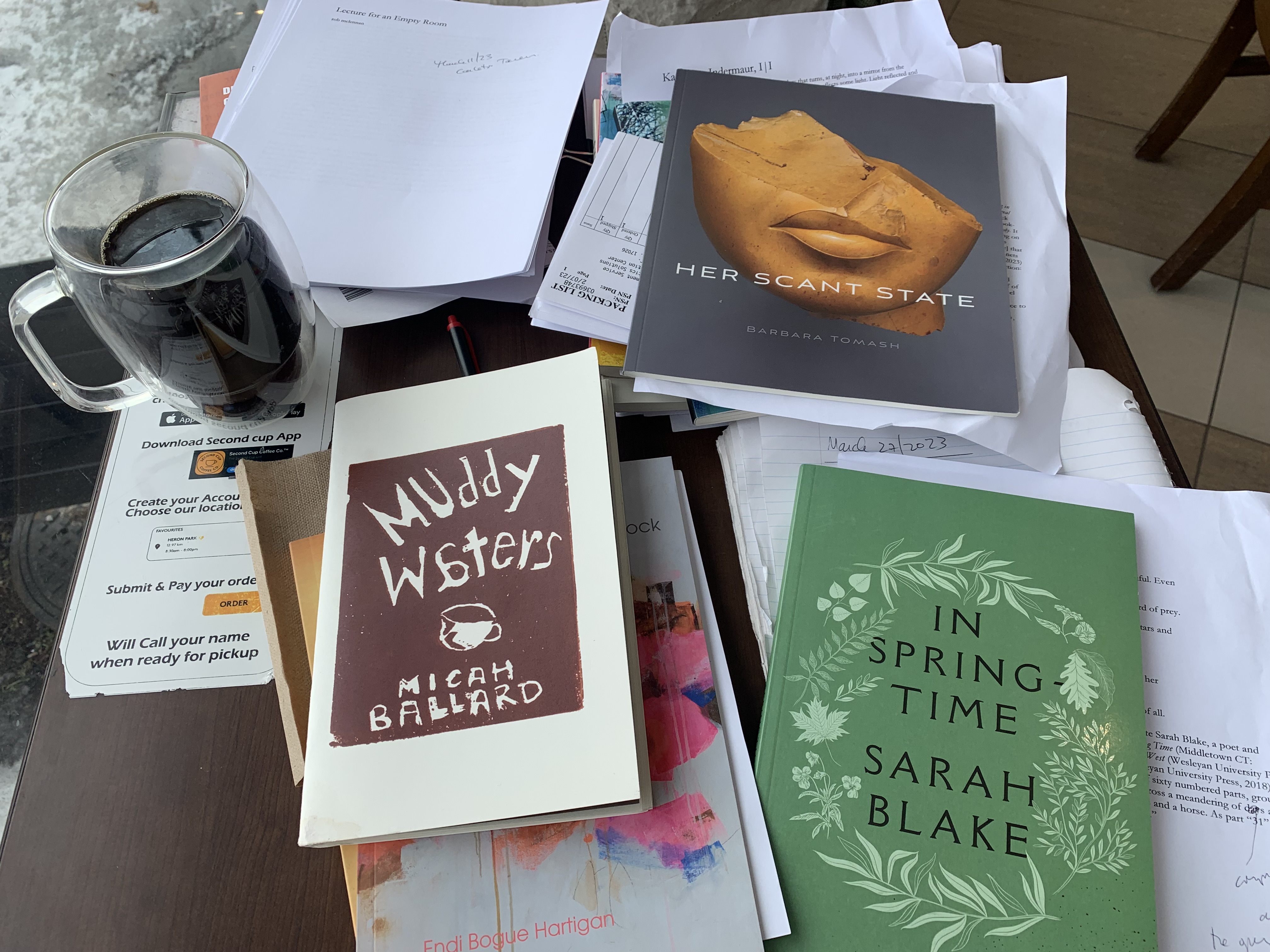
For those unaware, I’ve been posting weekly-or-so over at a substack I began back in November, constructed to prompt further thinking into a potential book-length essay, “Lecture for an Empty Room.” I had started scratching note-fragments somewhere across those first two years of Covid-19 lockdown, thinking upon literary community, reviewing, notions of work, connection, responsibility and various other scattered thoughts. I’m attempting to post something weekly, with every third or so as a paid-subscription-only piece, with the rest offered gratis to anyone who signs up (free subscriptions are the bulk of the subscriptions, which is fine also). I’m aiming to post self-contained fragments of this work-in-progress as I attempt to move forward, interspersing these with occasional other pieces, whether short stories, possible fragments of this novel work-in-progress as well as a chapbook-length essay I worked across the same original lockdown period, a kind of notebook on a call-and-response poem collaboration that Denver poet Julie Carr and I were working on. I had thought back to an essay I saw once by George Bowering, composed as journal entries during a period he was working a novel (I can’t recall which book this was in, or which novel, naturally; was this an essay on/around composing Caprice?), or even Robert Kroetsch’s The Crow Journals (Edmonton AB: NeWest Press, 1980), a book-length journal composed around the composition of his novel, What the Crow Said (1978). I’d always envied that particular form, wishing to echo an element of it somewhere, somehow, and there are some wonderful observations through that particular non-fiction work (I would recommend you find a copy and go through it, even if you haven’t read that particular novel of his, which is actually still in print, by the way).
Here's one of the recent fragments of “Lecture for an Empty Room” I posted over at my clever substack (sign up here for free (or for a wee bit of coin), if such interests). I am curious to see where this project might end up, myself.
* * * * * * * * * *
A conversation. All these little echo chambers.
At the end of December, 2022, Matthew Walther’s “Poetry Died 100 Years Ago This Month” appeared in The New York Times. Why is it so important for opinion writers to return, once again, to declaring the death of poetry? Perhaps they wish to claim credit, whether through a kind of critic-assisted end of literary suffering, or wishing to be seen to have the clarity of childlike wisdom, akin to “The Emperor’s New Clothes.” Walther speaks of modernism, a contemporary dearth of MFA programs churning out literature professors, and an endless array of chapbooks. Nothing useful since TS Eliot; remember TS Eliot? TS Eliot was cool, right?
Circa 2001, Ken Norris suggested to me that MFA programs throughout the United States had caused the death of American poetry. Given my broader reading experience since, I’d say I disagree with that statement, but I don’t know what he might have seen since 1985, the year he landed to teach at the University of Maine. I’m sure writing programs everywhere churn out an array of unremarkable writers producing semi-publishable work that later end up littering the landscape of journals, chapbooks and trade collections, but I don’t see American programs doing this with any greater percentages than their Canadian counterparts. It might simply be a matter of scale. Layli Long Soldier emerged from a program. Megan Kaminski emerged from a program. Sarah Mangold emerged from a program. Jericho Brown emerged from a program. I don’t think the issue, if there is one to be discussed, is that of the MFA program.
But still: given so much activity, productivity and production, why declare the state of the union, as it were, past tense? Oh, Matthew Walther, literature isn’t there to do what you think it should, or you heard once that it might have. It isn’t there to obey your rules. Literature remains in constant motion. It evolves, just as much as language and culture, from pop to human. We should never think of any of these as absolutes, or fixed. Stagnation, not evolution, is what causes the death you are in such a rush to declare. But I want things to be as they were, they say. This creature is already dead. Instead of bothering to understand the art on its own terms. Matthew Walther, have you a difficulty with an art that includes both Rupi Kaur and M. NourbeSe Philip?
Every article on the death of literature, whether poetry or the novel, exists as a variation on the same: the misunderstanding that any art is not a fixed point, nor is it meant to do, whether solely or otherwise, what it is that you wish. Adaptability, for both the reader and the practitioner, remains key. What was American poetry before Walt Whitman? What was Canadian poetry before bpNichol? What was literature before Dionne Brand? Each of these changing the very foundation of how the literatures they lived in was heard, written and seen. Arguably, every poet writing shifts the foundations and boundaries of literature, even if only a little, so the very notion of the fixed point. Declare your intentions! the traditional poets blast at the avant-garde. They counter: We can’t declare what won’t stand still.
Alice Notley, Jordan Abel. Lisa Robertson. Fred Wah. Anne Carson. Margaret Christakos. Andrew Suknaski. Stephen Collis. Jack Spicer, Lorine Niedecker or Robert Creeley. Ron Silliman. And then those in the nebulous between-states, working experimental texts across more subtle landscapes: Judith Fitzgerald, Kathleen Fraser, David Donnell. The long sentences of between of Monty Reid.
Call this a mantra, if you wish: my literature includes difficult work. To comprehend the centre one has to examine the edge.
Rupi Kaur: she seems an easy and lazy target for literary archers. I don’t care for the lyrically uncomplicated statements of her poems, but she might have allowed more young readers into literature than most of us combined. Maybe?

Birthday: a check-in. [see last year’s here; see the year before that] Honestly, I’ve felt breathless since the beginning of the year, pushing to work in numerous directions simultaneously. Christine was poem-ing at Banff Writing Centre for two weeks in January, as well, which had me solo with our young ladies; she worked on the edits for her next-year forthcoming third Book*hug title (a non-fiction blend of prose and poetry), and attempting to feel out the beginnings of what might come next (her fourth book, and third poetry title). On my end, I’ve been pushing on feeling out a book-length essay on literary citizenship, community and reviewing, etcetera, “Lecture for an Empty Room,” having first made scattered notes across those first two years of lockdown. The project was structurally prompted by a series that Wave Books has been publishing the past few years through The Bagley Writing Lecture Series, specifically Joshua Beckman’s 2018 duo Three Talks and The Lives of the Poems (Wave Books). I was seeking a form through which to articulate some thoughts I’ve had kicking around for years, and Beckman’s paired titles (which I’ve found enormously generative and influential since I first encountered them) allowed me the prompting through which to begin. Last fall I even started a substack to help prompt me further through the process (as well as post the occasional other non-fiction entry, including fragments of a fortyish-page essay on collaborating with Denver poet Julie Carr). I’ve already more than a half-dozen entries from the work-in-progress posted through such (among other entries) with another few still in-progress. I am curious to see where the project ends up.
I’ve been poking, as well, at what might be the ends of a poetry manuscript, “Autobiography,” following a thread that goes back as well, this one to the book of smaller (University of Calgary Press, 2022). And did I mention that the manuscript prior to that appears this fall? World’s End, (ARP Books, 2023): I signed a contract not that long ago, although I haven’t really told too many folk about it yet. I’m looking forward to seeing how it turns out. I’ve also been working the past few months on a third ‘best of’ anthology to celebrate thirty years of above/ground press, out this fall with Invisible Publishing to celebrate the third decade’s worth of publishing. Thirty years, as of this July. And today, the third anniversary of the first post over at periodicities: a journal of poetry and poetics (I’ll be posting an anniversary editorial over there in an hour or two).
But poems, as I said. I’m circling what might be the ends, but also distracted by other projects the past couple of months. I spent a few weeks attempting a chapbook-length daily sequence of journal poems across the two weeks Christine was away at Banff, taking a following two weeks after she’d returned to get the whole of that sequence polished in a way I was finally pleased with. I liked the idea of playing a bit off Robert Kroetsch’s Letters to Salonika (Grand Union Press, 1983), composed during a period that his wife, Smaro Kamboureli, was away in Greece, visiting home and her mother. As she wrote what became the journal-poem in the second person (Edmonton AB: Longspoon Press, 1985) about being in Greece, Kroetsch wrote his own poems about Smaro being away. Otherwise, the manuscript of “Autobiography” moves, albeit through delay: by holding off, might I therefore extend it? A la Kroetsch himself, a perpetual delay that might allow the manuscript a further, extended life.

And our young ladies, of course. They are smart and clever and ridiculous, of course. I can’t even fathom where most of their thinking comes from, but they are utterly delightful. Rose is in the middle of the Percy Jackson novels at the moment, which she’s really enjoying. Aoife regularly makes slime from a kit she has, and I have discovered that I hate slime (messy, gross, always leaving little bits upon every surface) more than I’ve ever hated anything in my entire life. But she loves it.
Birthday, birthday. What is fifty-three? Gadzooks. Even if I live to one hundred and five (which has been the plan all along), I still have less ahead of me than behind. I’ve so much more to do.
As part of that annual checking-in, I’ve been scratching at a birthday-esque poem over the past few weeks, still feeling it out; here’s where a few of the fragments sit so far:
from : condition report
First you feel it. Then you
bear :
the ache
of musculature, a tendon
pull. Go back, eurythmic,
into ether,
certitude. Loud when I dissonance.
A light falls, clatter. The slightest structure.
Could scratch my tibia. The
white face, powdered.
Eyebrows ,
grift. They seek
escape.
An ache. Synchronic: one dream
at any given time.
Earth ,
to earth. I am scratching this
from anecdotes,
as my desire for
echo.
What might this hold. What substance.
Amid suspicion, reserve. Happy
birthday. An engine
of extrapolation. Mirrors
instances. Repurpose
facts
to suit the language. The
composition
of dictated terms, whether
to capture
or contemplate.
To manoeuvre beyond fault.
* * * * * * * * *
Oh, and be sure to catch me zoom-reading today with Calgary poet Kyle Flemming: noon Pacific time / 3pm Ottawa time: a zoom-reading I’m doing from my house (as Kyle from his) for Vancouver’s Lunch Poems at SFU. Might we see you (virtually) there? And Ottawa’s thirteenth annual poetry festival VERSeFest begins this weekend!

Basically, pieces-as-posted are emailed directly to your in-box, and I'm aiming to post one a week or so, attempting to treat the project as a kind of weekly column. There are paid and free options, and I'm aiming possibly for every third piece to go out only to paid subscribers (given I have to make an income at something, I suppose). I already have nearly fifty subscribers signed up, including three of which that are paid, so it will be curious to see how this all evolves. Given the positive response I've been getting to my essays in the face of uncertainties (Mansfield Press, 2022) (launching in Toronto tonight, by the way), which is itself a book-length essay, a book-length thought, I'm curious to see where else I can go with the form. What else is possible?

