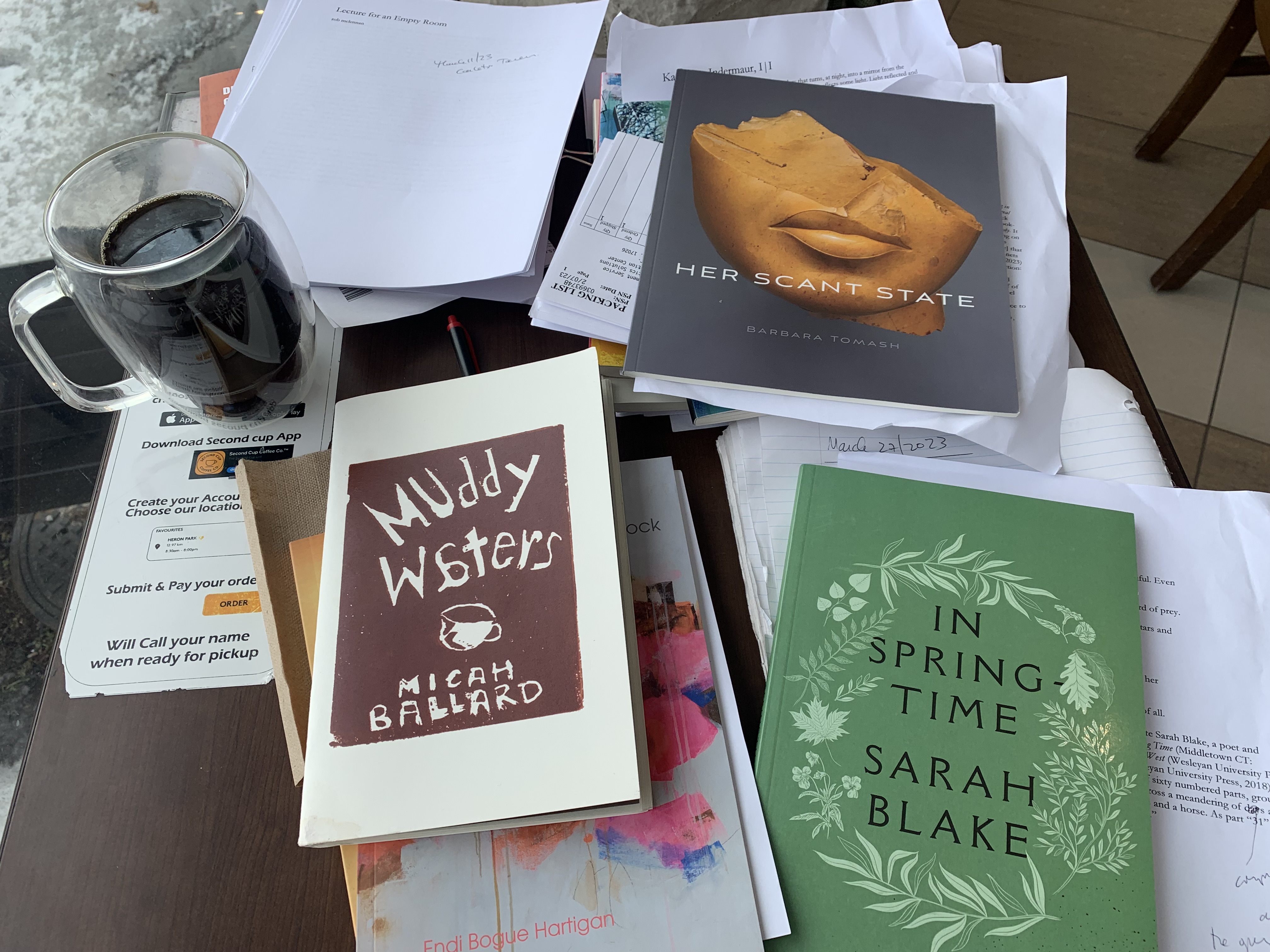
For those unaware, I’ve been posting weekly-or-so over at a substack I began back in November, constructed to prompt further thinking into a potential book-length essay, “Lecture for an Empty Room.” I had started scratching note-fragments somewhere across those first two years of Covid-19 lockdown, thinking upon literary community, reviewing, notions of work, connection, responsibility and various other scattered thoughts. I’m attempting to post something weekly, with every third or so as a paid-subscription-only piece, with the rest offered gratis to anyone who signs up (free subscriptions are the bulk of the subscriptions, which is fine also). I’m aiming to post self-contained fragments of this work-in-progress as I attempt to move forward, interspersing these with occasional other pieces, whether short stories, possible fragments of this novel work-in-progress as well as a chapbook-length essay I worked across the same original lockdown period, a kind of notebook on a call-and-response poem collaboration that Denver poet Julie Carr and I were working on. I had thought back to an essay I saw once by George Bowering, composed as journal entries during a period he was working a novel (I can’t recall which book this was in, or which novel, naturally; was this an essay on/around composing Caprice?), or even Robert Kroetsch’s The Crow Journals (Edmonton AB: NeWest Press, 1980), a book-length journal composed around the composition of his novel, What the Crow Said (1978). I’d always envied that particular form, wishing to echo an element of it somewhere, somehow, and there are some wonderful observations through that particular non-fiction work (I would recommend you find a copy and go through it, even if you haven’t read that particular novel of his, which is actually still in print, by the way).
Here's one of the recent fragments of “Lecture for an Empty Room” I posted over at my clever substack (sign up here for free (or for a wee bit of coin), if such interests). I am curious to see where this project might end up, myself.
* * * * * * * * * *
A conversation. All these little echo chambers.
At the end of December, 2022, Matthew Walther’s “Poetry Died 100 Years Ago This Month” appeared in The New York Times. Why is it so important for opinion writers to return, once again, to declaring the death of poetry? Perhaps they wish to claim credit, whether through a kind of critic-assisted end of literary suffering, or wishing to be seen to have the clarity of childlike wisdom, akin to “The Emperor’s New Clothes.” Walther speaks of modernism, a contemporary dearth of MFA programs churning out literature professors, and an endless array of chapbooks. Nothing useful since TS Eliot; remember TS Eliot? TS Eliot was cool, right?
Circa 2001, Ken Norris suggested to me that MFA programs throughout the United States had caused the death of American poetry. Given my broader reading experience since, I’d say I disagree with that statement, but I don’t know what he might have seen since 1985, the year he landed to teach at the University of Maine. I’m sure writing programs everywhere churn out an array of unremarkable writers producing semi-publishable work that later end up littering the landscape of journals, chapbooks and trade collections, but I don’t see American programs doing this with any greater percentages than their Canadian counterparts. It might simply be a matter of scale. Layli Long Soldier emerged from a program. Megan Kaminski emerged from a program. Sarah Mangold emerged from a program. Jericho Brown emerged from a program. I don’t think the issue, if there is one to be discussed, is that of the MFA program.
But still: given so much activity, productivity and production, why declare the state of the union, as it were, past tense? Oh, Matthew Walther, literature isn’t there to do what you think it should, or you heard once that it might have. It isn’t there to obey your rules. Literature remains in constant motion. It evolves, just as much as language and culture, from pop to human. We should never think of any of these as absolutes, or fixed. Stagnation, not evolution, is what causes the death you are in such a rush to declare. But I want things to be as they were, they say. This creature is already dead. Instead of bothering to understand the art on its own terms. Matthew Walther, have you a difficulty with an art that includes both Rupi Kaur and M. NourbeSe Philip?
Every article on the death of literature, whether poetry or the novel, exists as a variation on the same: the misunderstanding that any art is not a fixed point, nor is it meant to do, whether solely or otherwise, what it is that you wish. Adaptability, for both the reader and the practitioner, remains key. What was American poetry before Walt Whitman? What was Canadian poetry before bpNichol? What was literature before Dionne Brand? Each of these changing the very foundation of how the literatures they lived in was heard, written and seen. Arguably, every poet writing shifts the foundations and boundaries of literature, even if only a little, so the very notion of the fixed point. Declare your intentions! the traditional poets blast at the avant-garde. They counter: We can’t declare what won’t stand still.
Alice Notley, Jordan Abel. Lisa Robertson. Fred Wah. Anne Carson. Margaret Christakos. Andrew Suknaski. Stephen Collis. Jack Spicer, Lorine Niedecker or Robert Creeley. Ron Silliman. And then those in the nebulous between-states, working experimental texts across more subtle landscapes: Judith Fitzgerald, Kathleen Fraser, David Donnell. The long sentences of between of Monty Reid.
Call this a mantra, if you wish: my literature includes difficult work. To comprehend the centre one has to examine the edge.
Rupi Kaur: she seems an easy and lazy target for literary archers. I don’t care for the lyrically uncomplicated statements of her poems, but she might have allowed more young readers into literature than most of us combined. Maybe?
 rabbits, rabbits, rabbits; supposedly if that’s the first thing you hear in a month, yr to have a good month; I don’t remember where that came from; do you know?
