Showing posts with label serif of nottingham. Show all posts

Thursday, November 06, 2025

Ongoing notes: TIFA Small Press Market/Meet the Presses’ Indie Lit Market (part one, : Liam Burke + Gary Barwin,

Okay, so this has to be a blended sequence of fair-posts, as multiple vendors (such as myself and the delightfully-productive above/ground press) attended both fairs across two days in Toronto [see my post on the most recent prior TIFA Small Press Market I attended; see my post on the most recent prior Meet the Presses Indie Lit Market I attended]. I mean, two fairs in two days? It was a bit ridiculous, but somehow, it worked. Most of the vendors I spoke to, myself included, were naturally exhausted after two days of fairs and carrying and standing. There was a nice tribute that Gary Barwin spoke at the Indie Lit Market to honour the late Toronto poet (and Meet the Presses Collective member) Paul Dutton, who died earlier this year. And congratulations to Jeremy Luke Hill, who won this year’s bpNichol Chapbook Award! Announced the very day he saw his new above/ground press title for the first time. And you know our Ottawa fair is coming up soon, yes?

Toronto/Ottawa ON: From Ottawa poet Liam Burke, co-author of the collaborative Orbital Cultivation (with Manahil Bandukwala; Collusion, 2021) and machine dreams (with natalie hanna; Collusion, 2021), comes the solo chapbook status ailment (Toronto ON: Anstruther Press, 2025), an assemblage of ten short, curious lyrics. Burke’s poems offer lyric narratives, lyric inquiries, set in ether, presenting or suggesting a kind of action, such as the reference to the Marvel flick, Doctor Strange (2016), by titling a poem “dormammu ive come 2 bargain,” a poem that writes a held kind of abstract, purposefully, it would seem, inert. As the opening stanza reads: “i could just stay here / gather green trichomes / let inertia have its way / collate colonies of moss / mash every button / to escape the command- / grab of coming of age [.]” There are narrative threads that exist in Burke’s poems, but less straightforward than from all sides, slant; offering swirls instead of straight lines, and a sequence of entreaties without clear closure. These poems are intriguing, thoughtful and exploratory, offering unexpected paths and trails and truths. Or, as the first section of the sequence “five litanies” ends: “how am i       to show / to love my body       when it fails me so [.]”

status ailment

panic overwhelming

No you may not heal heat uplifted.
No you may not jitterbug your body.
No you may not catapult your
heart your throat your diaphragm.
No you may not finish that joint.
You might be dying. Panic
’s roar in the dark, low, hot. No you
May not. No you may not.

Gary Barwin + serif of nottingham at TIFA's Indie Lit Market

Hamilton ON: “I weep for the world and so UNESCO declares my tears a site of significant cultural heritage. They don’t include my snot and jagged sobs though I would argue that they are integral to the process.” And so begins the title and opening piece of Hamilton writer, musician, collaborator and performer Gary Barwin’s latest chapbook, MY SEXY MOTHER TERESA COSTUME (serif of nottingham editions, 2025). Barwin’s short prose bursts exist as postcard stories, twenty-two in total, all existing as blends of dense, narrative expansiveness, offering short sketches across a wide canvas of history, literature and experience. “During World War II,” the first half of the piece “In my Pants” reads, “Dervis Korkut, the librarian at the National Museum of Bosnia and Herzegovina, at great risk to his life, hid the beautiful medieval Sarajevo Haggadah from the Nazis by concealing it in his pants, I remembered, so I went to the bookstore.” His short missives have progressed, it would seem, blending a thread of surrealism with a far larger worldview, offering pieces that read somehow both surreal and straightforward, able to only see the story properly from coming to it from unusual sides. Or, as the piece “The Ventriloquist and 1942” begins: “The European explorer stood on the bow of the ship, holding a ventriloquist dummy dressed as a sea captain. Together, explorer and dummy looked across the vast ocean at the distant horizon.” Truly, these pieces are quite amazing, and hard to shake, once you’ve read. They keep one returning.

Cake

I’m phoning your cake because of course you don’t have a birthday anymore, at least, not really. Your cake is really far away—somewhere “out there” or “here.” Same as you, in this day where I woke up and made coffee and got in my car and drove to where I’m writing this and where I picked up this old-fashioned phone. Ring. Ring. Are you thinking of cake in your own cloudtown, thinking of us, candles and blowing them out, the breath from inside us, hhh hhh hhh. Happy birthday. Happy birthday, we say. And you’re thinking, happy birthday, happy birthday to me too.
 

Tuesday, January 03, 2023

Ongoing notes: early January 2023: Lillian Nećakov + Miranda Mellis

The first notes of the new year! There are so many notes. And did you see my report of our recent holiday gathering via The Peter F Yacht Club? Or the next event on our calendar, a Covid-era memorial of the poets we've lost? 

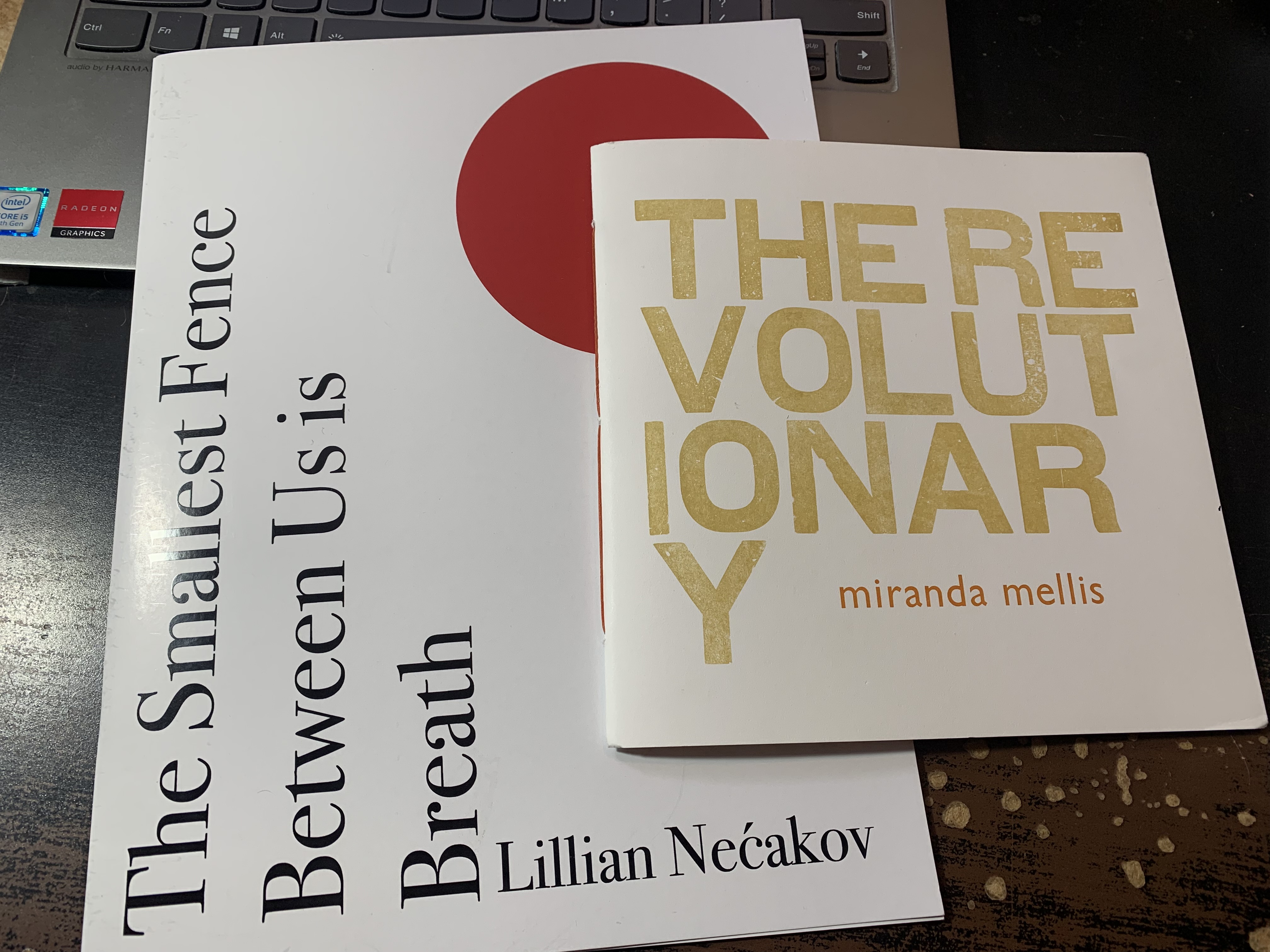
Hamilton/Toronto ON: Thanks to a package a while back from Gary Barwin, I’ve been going through Toronto poet Lillian Nećakov’s chapbook The Smallest Fence Between Us is Breath (serif of nottingham, 2022) [see my review of her most recent full-length collection here], a short assemblage of sixteen first-person prose poem observations and meditations on dailyness, with a shimmer of surrealism. “Remember when I wrote 1,000 times about those birds.” she writes, to begin the opening poem, “Myrna Loy,” “I thought I was building / you a lighthouse but you were mesmerized by the slow drag of darkening shoals / and inlets. And after an entire year of chirping I let go the voodoo, the inkwell, / your sulphur hair. I let the quicksand pull you into her muscly embrace as if it was / nothing more than a dream.” Nećakov’s sentence-stanzas appear to be constructed as singular breath-thoughts, each of which accumulate into something far larger, such as the seven standalone sentence-stanzas of “Magic Plants,” the first three of which read:

There is a ring of laughter around our street, day moves clockwise into evening, the empire settles like a déntente over drowsy dogs and magic plants.

Soon my daughter’s watermarked voice adorns the room with divine secrets and the golden filaments of threadbare languages.

Table abloom with cards of diligence and fortune, she leans down, presses her hand against the dog’s soft underbelly, there is a tiny village, here, filled with Slavic jazz operas and your mother, counting on you to remember.

In other poems, stanzas might include more than one sentence, yet she still employs the stanza itself as her breath-thought, something complete unto itself, a brick to set atop another to construct the larger narrative of each prose poem. Each break between stanzas, perhaps, a chance to catch breath. I’m really enjoying the shifts in her writing through these prose pieces, and am curious to see if and how a potential full-length collection of such pieces might emerge. And doesn’t she have a full-length collaboration with Gary Barwin out later this spring with Guernica Editions?

Charlottesville VA: The latest from Brian Teare’s Albion Books is The Revolutionary (2022) by American poet,writer and philosopher Miranda Mellis, produced as the third title in Albion Books’ series eight. The author of numerous titles [see her ’12 or 20 questions’ interview here], the only title of hers I’d seen prior is the extended sequence of numbered bursts of lyric philosophy, DEMYSTIFICATIONS (New York NY: Solid Objects, 2021) [see my review of such here]. The Revolutionary is built as an extended lyric memoir on and around grief that explores the effects and implications of being raised by revolutionaries, politics and childhood grief, and the Covid-era death of a father lost years before. There is such tenderness and care through Mellis’ lyric mode, one that sweeps with more openness than perhaps straighter prose might have allowed. “A school for the living by the dying: this is what it is; this is how it happens;” she writes, mid-way through the collection, “from the terminal diagnosis to the cessation of food and drink. From the wet rattling breath, to the liminality of the incommunicado, warm heart still beating, short fast breaths pulling the body up and down on the death bed.”

They were revolutionaries. How do revolutionaries raise children? We were raised not to expect or need too much, not to think of ourselves as special, to do our share of the work, to oppose exploitation and state violence. We were raised to understand police terror, to be angry, to be frustrated, to be shocked, to be outraged, to be militant, relentless, engaged, committed, to be freedom fighters.

What makes a person a revolutionary? What makes them, like Sophocles’ Antigone, volunteer for grief? What gives them the power to act, in the name of revolution, for revolution? What is it that calls a person to try to end not just their personal suffering, but all suffering?

We were not raised to be patient with sadness, sorrow, grief. Sadness, sorrow, and grief were to be gotten rid of in order to return to the fight. “Don’t mourn, organize.”

Thursday, December 12, 2019

Meet the Presses’ Indie Market (part five,


[Stuart Ross at his two-cornered Proper Tales Press + Anvil Press tables, being both "ace" and "trendy"]


Hamilton/London ON: It would seem that, furthering the work they accomplished in their recently-published collaborative trade poetry collection, A CEMETERY FOR HOLES, poems by Tom Prime and Gary Barwin (Gordon Hill Press, 2019) [see my review of such here], Gary Barwin and Tom Prime are still pushing ahead with their collaborative efforts, with the chapbooks Throat Fixtures {an Almanack of Dazzle} (2019) and Birds are the birthmarks of flight: A Manifesto. (2019), both appearing from Barwin’s serif of nottingham. These two chapbooks, each constructed as a single poem-sequence, both read as very different in tone and flavour from Barwin and Prime’s collaborative full-length work, and I’d be curious to hear how their process of writing collaboratively may have evolved since those first few poems, and even up to and beyond that first, full-length collection. What is curious, as well, each poem/chapbook suggest the possibility of the opening sections of much larger, longer manuscripts, although they could both, just as easily, be part of an eventual single collection. The first chapbook, Throat Fixtures {an Almanack of Dazzle}, is composed as a prose-quartet of short pieces, each of which opens with an image (assembled, in part, via collage), and seems to pilfer an antiquated language, allowing it a certain kind of tone, a certain kind of lyrical heft. As the second section, “{Sec2ndo},” opens:

I DO NOT DISDAIN but I dowel. A word fitly spoken is like apples of gold in a setting of silver. Certes, most Reapers receive so much plimsoll tiptapping on the mortal floor as may make worthy the gaseous (0.934%—9340 ppmv) tincture of their perusal, if not too greatcoat or too busy mandraking their small lease. The confrontation concerning the imbroglio of what is here offered to their burdened lexical centipedes; and if the last prove too severe, as I have often been torrid with lichens of a wavelength from 10 nm to 400 nm, a neophyte serving all centipedes equally and on murders of cloud. The Reaper will append the simplest conversation in line as the greengrocer’s to one both laminate and profound.

While the first chapbook has a weight to it, the second, Birds are the birthmarks of flight: A Manifesto., feels lighter in tone; but still holds the attention as both a real and faux-manifesto, as the writing both illuminates and obscures the writing even as it floats through and across a delightful surrealism. As the first section reads:

All birds must wear smoke and be bleak after no more than 12 cloud deadlines. This reinforces their humor and gives them comedy wings in a soft land where the impression of flight is diminished. Younger woodlands need to use 10 birds to process the childminding of eggs wrapped in balaclavas of shadow. This reminds us of the ongoing process where the sky is a cleft oyster, the moon a fluke pearl, and which focuses on the cleaving palate of the watershed and blotch from blotch, blotch from blotch, blotch from blotch. Since the 1970s the feathered truth of a billion birds has disappeared. This is also a start.

London ON: London, Ontario poet Emily Lu’s chapbook debut is Night Leaves Nothing New (Baseline Press, 2019), a collection of eleven poems that appear, on first glance, to be relatively straightforward lyric poems, but are anything but. I am finding myself very taken with Lu’s line breaks, the bends in her narrative through-lines and thought, and her attention to small details. These poems really are delightful, and I am happily startled by them. What else can I tell you?

EARLY SEASON

This ending between your arms & drowning.
Its shape & contour seeping through the train
platform. Don’t worry, I was dreaming
into public. The dream expanding empty
city corridors. Passenger-side, I encountered
ten thousand refracting fish & their march through
stale houses. I was Typhlosion running

naked through an early season. Peach petals
in your hair last February while we skated
on domed lake-ice trembling
for fear of overstep & no bystanders
& dying. Don’t worry. A thorough kiss
still contains loneliness. A love
creasing, another mountainline.


Thursday, December 05, 2019

Meet the Presses’ Indie Market (part four,


[post-fair drinks with Andy Weaver, Ryan Fitzpatrick and (out of frame) MC Hyland]


Toronto ON: From Jim Johnstone’s Anstruther Press comes The New Alphabets, a collection of centos (a structure, in case you are unaware, built either in part or in full via the lines of others) by Virginia Konchan (who also had an above/ground press title earlier this year). Over a dozen lyric theses that utilize phrases-as-prompts from an array of poets, thinkers and philosophers, Konchan’s meditations are curious in how she fills in the distances between thoughts, between points; jumping from point to point yet including the details, even through this system of selected and assembled collage. And is this volume, composed via a sequence of prompts, singularly a self-contained chapbook unit, or the opening salvo of a potential full-length manuscript?

“Name me transient”

Name me transient, name me obligatory.
Name me hindsight, name me plenty.
The theme of this place is savagery.
The river’s mouth needs something.
It’s a drama. An interrogative sentence
wells up inside me. Have you grown
accustomed to a lifestyle
no one can provide?
She had no need of fox furs.
She had ceased to exist.
No one ever asks whether flowers
should be permanent.
I should be permanent.
Name me lost wages.
What does it feel like
to have a voice that carries
without making a sound?
Count your fingers.
Count your calluses.
Count the miles to the state line.
I will sign my name in Cyrillic.
I will shut my eyes like a sad man.
Name me modesty, name me vexation.
They said it would hurt, and it does.
This is the black, shot with blue.
Count yourself among the counted.
That spark reminds me of you.

Hamilton ON: From Okanagan, British Columbia poet kevin mcpherson eckhoff comes an excerpt from BABYLON AD PROPHECY (2019) produced through Gary Barwin’s serif of nottingham press. As the note at the offset of the small chapbook informs: “This version of F. Scott Fitzgerald’s short story ‘Babylon Revisited’ renovates the punctuation, spacing, and capitalization of the original story, but not its letter order.” As with many of eckhoff’s projects, this is both fascinating and extremely odd, a delightful twisting of something familiar (in this case, the cadence and narrative of straight prose) in such a minor, yet foundational, way that accumulates into something unrecognizable, and entirely new. How is it eckhoff keeps discovering new ways to refresh perspective? Although I would love to hear him read aloud from this, in part, simply, due to how difficult it might actually be. As his story opens:

“And where’s Mr. Campbell, Charlie?”
“Ask Ed.”
“Gone to Switzerland. Mr. Campbell’s a pretty sick man, Mr. W.”
“Alesim.”
“Sorry? To heart—ha!”
“Tand?”
“George Hardt?” Charlie inquired back.
“I name Ric.”
“Ago, net. O work.”
“And where is T? He’s now bird?”
“Hew a sin here, last week anyway, his friend, Mr. Schaeffer.”
I sin, Paris.


Sunday, December 03, 2017

Ongoing notes: Meet the Presses’ Indie Literary Market (part two,


[in the background, bpNichol Chapbook Award-shortlisted author Doris Fiszer and her husband, beyond a flurry of activity including Eric Schmaltz and Gap Riot Press, etc]

Further to my previous set of notes (and, see, I’m writing about the ottawa small pressbook fair as well), here are some other items I picked up at the most recent edition of Toronto’s Indie Literary Market [see my notes on last year’s event here]. Although, did I mention that I was mistaken for Gary Barwin at this event, not once, but twice, in under the space of two minutes? Baffling.

Cobourg ON: Kingston poet and photographer Allison Chisholm’s seemingly-debut is the chapbook On The Count of One (Proper Tales Press, 2017), a collection of short, surreal lyrics:

Epoch

Teens of the new millennium
tattoo their inner thighs
and mouth the words
to shoddy pleas
the scandalized confessions of
a thousand feet above.

The bulk of the collection is made up of the twelve-poem astrological suite, “Crumbs for Birds,” a dozen poems playing with the twelve signs of the Zodiac, opening with “Aries (March 21 – April 19)” and closing with “Pisces (February 19 – March 20).” Playing off the format of the short newspaper/online daily astrology, Chisholm’s suite of poems, easily the strongest part of this chapbook, aren’t attached to any particular date (as astrologies often are), but suggest something both current and ongoing, writing to Aries that “If you are not yet moving at top speed, you very soon will be.” or to Libra, writing “Understand that every other name // begins and ends // with dirt in the sky.” or to Aquarius, offering both advice and the chapbook’s title, writing “Demonstrate your esteem // with a chorus of obscurity // or crumbs for birds. // He or she likes what he or she sees.”


Hamilton ON: Alex Porco’s chapbook, The Low End Theory (2017), produced by Gary Barwin’s serif of nottingham, made me realize that it has been a while since I’ve seen a new publication by him (he’s been busy, otherwise, having edited the critical edition of Jerrold Levy and Richard Negro’s Poems by Gerard Legro, produced by BookThug in 2016, and authored the afterword to Steve Venright’s brand-new The Least You Can Do Is Be Magnificent:Selected & New Writings, produced by Anvil Press). Part of, as his author biography at the end of the chapbook tells us, “The Minutes, Porco’s ongoing serial poem,” The Low End Theory is made up of a single, unbroken poem produced in short lines, structurally akin to much of the work of Vancouver poet Stephen Collis. I’m curious about his ongoing serial poem; curious about the “ongoingness” of this poem-of-anxiety, and how the larger project is structured. Is this simply the opening salvo to a single poem unending, or one of an open-ended suite? How far might such a project progress? His poem opens:

I am in
Room #513 at
The Aloft Hotel
In Atlanta. I
Have fears. Real
And particular. But
Also unreal and
Particular. I’ll get
To ‘em in
One sec. First,
I’m thinking about
Naming this poem
“Poem about Fears,”
But am worried
That’s too on
The nose. I
Like my nose.
I do not
Fear it, and
You shouldn’t either.
I haven’t decided
On a title.
It’s early still.
Let’s see how
Things go. […]