Showing posts with label bibliography. Show all posts

Tuesday, November 01, 2022

MODL Press (2000-2009): an interview with ryan fitzpatrick, and a bibliography,

this interview was conducted over email from March to October 2022 as part of a project to document literary publishing. see my list of interviews and bibliographies of literary publications past and present here

ryan fitzpatrick is the publisher of Model Press, a revisioning of MODL Press (the thing you just read about). He is also the author of four books of poetry, including the recent Coast Mountain Foot (Talonbooks 2021) and the forthcoming Sunny Ways (Invisible 2023).
Q: How did MODL Press first start?  

A: Okay, so, if I were to choose an inaugural moment, I might pick the view onto the stage at the year-end reading of the University of Calgary’s creative writing classes in, what, 1999 maybe? I had just worked with my classmates to put together a class chapbook for Nicole Markotic’s intro poetry workshop, sitting for hours in a computer lab at SAIT where we could use a photocopier for free. I was pretty proud of the book we put together, but when I got to the reading, I was amazed to see an array of very different chapbooks laid out on the top of the piano at the BeatNiq Jazz Club at the bottom of the Grain Exchange building on 1st. Fred Wah had challenged his class to build chapbooks of their own and I was inspired by the way they were self-publishing and organized. I bought copies of chapbooks by Tillie Sanchez and Jill Hartman, who were members of the short lived Phu collective with Natalie Simpson, Trevor Speller, Darren Matthies, and Lindsay Tipping. I later ended picking up Darren’s and Lindsay’s chapbooks at the campus bookstore. 

Inspired, I decided to self-publish the project I had written in Nicole’s class – a weirdo narrative long poem titled revised notes. Self-publication allowed me, to put it in the corniest terms, to control the means of production. I imagined revised notes as something scrappy, printed on a messy mix of paper types with handwritten chunks. I sat at the inkjet printer in my parents’ basement and fed pages through individually to get the effect I wanted. It was an immense pain in the ass.

When I needed a name for the press, I riffed on the name of a band I was in – The Mod Factor – and called it mod1press. Later, I realized that this name was incomprehensible, so I changed it to modl press. When I realized that the lowercase made the name inscrutable, I changed it again to MODL Press. My current online press is basically the same, except I’ve corrected it one more time to Model Press.

Q: I feel as though I have a copy of that around somewhere. Is revised notes the full-sized chapbook? And what kind of print runs and distribution were you doing for such? I would presume you were handing out copies, most of the time. What was the response to these first publications?

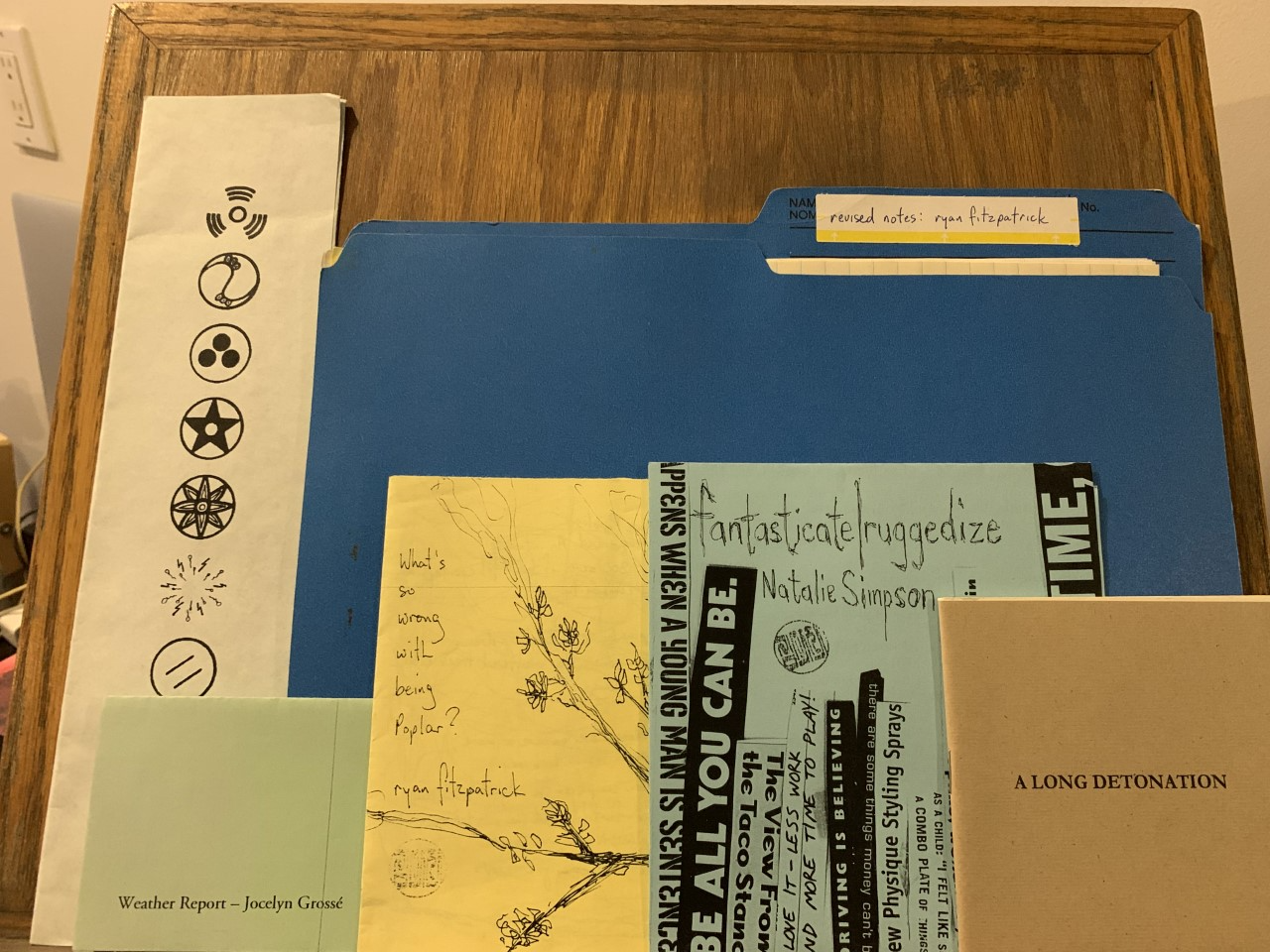
A: revised notes is the larger format one bound in the blue file folder. My overcomplicated first attempt to play with book format. 

Print run and distribution were something I was continuously changing as I went, but most of the books settled around 50 copies. That felt like a magic number to me, because it was an amount that allowed me to give a decent amount to the author (usually half of the run), still be able to sell or give away a few, and feel like I wasn’t holding onto books forever. Any time I printed more than 50, I felt like I ended up sitting on a ton of copies. I really wasn’t interested in keeping books in print. For me, one of the strengths of chapbooks was their ephemerality. It was all about circulating work that was new to whoever was around.

I think my approach to distribution was shaped by this, though I wouldn’t claim to be consistent about it. I slowly drifted from charging a little for books, usually enough to recoup some of the costs, until I got a review that called out the price of one of my books that made me fed up with the process of trying to sell things. The books I made over the last couple years of the press were printed super cheap and handed out at readings to whoever I ran into. It was completely haphazard and absolutely the best way to circulate poetry.

Q: The notion of the ephemeral, I would think, would also allow for the immediacy of presenting new work that an author might still be feeling out. Did the possibility of publishing, and self-publishing, shift the ways you saw or even presented your own writing? 

A: Definitely. The speed and ephemerality of chapbooks and self-publishing gave me this permission to think about poetry as an ongoing process. Work could be scrappy, unfinished, unpolished, and still make meaningful connections. The speed allowed for content that was too timely or obscure for poetry’s slow temporalities - political jabs, pop culture references, community in-jokes. I think that fast publishing is an important part of the poetry ecosystem and I wish more writers would embrace ephemerality in their approach to both publishing and their work, though I get the appeal of working slowly as well. Personally I found the speed of chapbook publishing really freeing. I could write something and quickly circulate that draft to a small group of people. 

For me, it’s also been tied to posting work on my blog and later on social media. Sharing work online was central to the boom in poetry blogs that happened in the 2000s and I was absolutely drawn to that because it felt more immediate and, to be honest, it felt more possible than publishing in magazines or books. It definitely shaped my approach to poetry and I’m probably still too in love with sharing my own in-progress work online. 

Q: You mention the original impulse and prompts for beginning the press, but what else was happening around you at the time? I suspect what Derek Beaulieu was doing, for example, through his housepress might have influenced some of your publishing structures. What other influences were in play for the press?

A: It was about an upswell of activity that I came into in the early 2000s. A lot of that energy was driven by folks coming out of the creative writing program, but not all of it. My feeling is that Calgary was going through a bit of a transition point in the poetry community. People’s aesthetics and investments shifted over the course of the decade. In the early 2000s, it seemed like everyone was doing something: starting a press, a magazine, a reading series. A lot of it was ad-hoc. Some of it was more professionalized (meaning there was money involved). I was inspired less by the work of any one person than a suite of publications, groups, and happenings: filling Station, Dandelion, Yard, Bemused, Three Blind Mice, Haus and The Ranch, Single Onion, Semi-Precious, (Twat) Team, The Sabbath, Flywheel, In Grave Ink, (orange), Nod, Mutton Busting (I’m forgetting a lot). This in addition to all the writers I was engaging with online, at first through the Buffalo Poetics listserv and afterward through the brief explosion of poetry blogs. I found this rush of activity energizing and inspirational. I wanted in so I joined filling Station after being invited by Tom Muir and started publishing - first, self-publishing in a very scuffed imitation of Jill Hartman, then publishing other folks.

I suspect that some of my feelings come out of a nostalgia for that early-2000s moment, a nostalgia for the improvisational energy of young people who have some faith in culture’s ability to make community, especially in a regional city like Calgary where we had to learn to make our own fun. But it’s not a coincidence that MODL petered out when it did, because it seemed like by the end of the decade the energy of the city and its literary spaces had mutated into something different, something that, to me at least, felt more antagonistic and invested in a cult of celebrity around a handful of figures in the scene. I drifted toward the music and art scenes which at that moment were more invested in diy community strangeness.

Q: What role, if any, did your work with MODL direct the ways in which you engaged with communities beyond Calgary? Were you aware of much of small publishing beyond Calgary’s borders during those early days?

A: My guess is other folks who were around will give you a different answer, but I was pretty strongly connected to the local, at least as a publisher. I don’t think I published anyone who didn’t have a Calgary connection, but I do remember doing a few sales and swaps over the Buffalo Poetics Listserv. I slowly became aware of what was going on outside of town as people from other cities came to give readings, as I talked to other poets in town who had moved from other places, and through the growing network of blogs that were popular in the early to mid 2000s. But in terms of publishing, I was more likely to invite those out-of-town writers to submit to filling Station than to publish them with MODL, maybe because filling Station felt like a professional enterprise with a longer history, even though fS was constantly at threat of shutting down.

Because I did small press in a very local way before jumping into the wider world of it, I find I’m always a little too aware that there is way more activity going on than is apparent in the dominant promotional cycles of poetryworld, where everything is keyed to specific presses and cities. I kind of wish I was more involved with communities outside of Calgary, but also I’m grateful to have focused so much time with the strange particularities of the local. Local spaces are really where poetry bubbles over and gets interesting, if there’s room for them to develop.

Q: How did producing and distributing small chapbooks through MODL affect the ways in which you approached and considered community? Or even your own writing?

A:  I mean, if I put this in the corniest way possible, doesn’t taking the means of production into your own hands underline the way that publishing should primarily be about circulating material that members of your community (however you define that word) is invested in and excited by? That’s maybe why the local appealed to me as a site for circulation, because I could honour one person’s work by picking it up and passing it down the line. It’s like delivering the news!

If it’s affected my own work, it’s probably made me pretty strident about poetry not having to be so polished all the time, because there can be stages to publication. You should be able to put out in progress versions of your work through the scrappy channels of small press. Because small press is ephemeral and local, it can support writers where they’re at in a particular moment. Writing and publication can be quick as well as slow. I think the recognition of that has made my work too timely sometimes. And if my experience with book publishers and the literary magazine industrial complex has taught me anything, it’s that timeliness is not always a valued quality.

Q: What was behind the decision to end the press? Was it a decision deliberately made, or one through circumstance? Were there any frustrations that drove the decision, or did you simply run out of energy, time or even enthusiasm?

A: It was a lot of things: the shifting of the local writing community, my own move into academia from being a kind of literary townie, years of working multiple jobs. Ultimately, it was an increasing lack of energy paired with the reality that I had to focus what energy I had elsewhere. I still feel bad about a few publications closer to the end of the press that just never got finished because I couldn’t find time or energy to finish them. The press just kind of ended without me being deliberate about it. There was the possibility that I might publish something for years after I had actually stopped. Though much later, I did think about making a big splash out of ending the press by selling the name (plus my long-arm stapler) for $5!

Q: Finally, what prompted you to restart the press under a new name and online? How does the new MODEL relate, at all, to MODL? Apart from the obvious differences in production, what are the differences you are finding to running a press now to running a press then? What has changed, and what remains the same?

A: Well, Model relates to MODL in that it’s still me doing the work. And there’s a continuity in the design. But why bring it back now? Well, I was feeling increasingly disconnected from poetry world between moving to a new city and the general anonymity of publishing (especially magazine publishing). The social distance of the pandemic was kind of the final straw and I felt like I needed something that would reconnect me to the community elements of poetry in a positive way. I juggled a lot of possibilities like an online magazine or some kind of newsletter. 

Eventually, I landed on the chapbook but decided to make it leaner and quicker to produce. Rather than the adhoc approach of MODL, the “model” of Model became quite deliberate. I’ve been producing the books in batches in such a way that the press acts a little like a magazine where the individual pieces are released over weeks or months. The design of each book is deliberately minimal and the biggest decision I make when building each book is the page size. The online element came out of pandemic necessity, but I like the way it focuses me on circulation rather than aesthetics. The goal is to get pieces in front of as many eyes as I can, which has a limit, but less of a limit than the material one of an analog small press. Admittedly, I pay for this with the loss of the analog thrills of the paper chapbook and every once in a while I think I’ll eventually go back to making print books. But right now, this approach is working for me and I’ll keep it up as long as people are interested and I’m having fun with it. 


MODL Press “Bibliography” (spotty bc I didn’t keep good records and didn’t have enough spoons in my 20s to even think to do something like that)

pre-2000
a couple of self-published chapbooks I made that I am too embarrassed to admit to

2000

revised notes – ryan fitzpatrick

(Class project for Nicole Markotić’s intro poetry workshop. I spent hours feeding different kinds of paper through my parents’ inkjet printer because I thought it would look cool. This book is the source of confusion about the press’ name because it started as mod1 press—a reference to the band I had been in—and was changed to modl press and then to the more deliberate MODL Press. For the record, it’s meant to be Model not Modal. I always liked the joke that the press wasn’t a model press and then made it clear by misspelling the press’ name.)

2002

PyongTaek – ryan fitzpatrick

2003?

Pamphlet Series (all w/ art by ryan fitzpatrick)

            “What’s so wrong with being poplar?” – ryan fitzpatrick

            “fantasticate|ruggedize” – Natalie Simpson

            “Fylfot” – Jill Hartman

            “Weather Report” – Jocelyn Grossé

            “vanilla” and “a step in June” – Chris Ewart

            “Pass the Doughnuts, Please” - Jason Christie

            “Pitt Graphic 4” – derek beaulieu 

(I was living with my parents and my dad had bought a shitty old photocopier, so I started experimenting with pamphlets because I could put them together quickly and make them on the cheap. I mostly asked folks who were around, friends and local folks whose work I admired. The accompanying artwork solidified the design aesthetic for the first couple years, which was cut up, photocopier mess, handwritten stuff—anything I could throw together that looked vaguely cool and didn’t give away that I was a shitty artist.)

2004

“Hey Mom, I’ve Been Censored”filling Station collab for Freedom to Read week ft. Chris Ewart, J Alary, Jason Christie, Carmen Derkson, Jocelyn Grossé, ryan fitzpatrick

A Long Detonation – ryan fitzpatrick

(The last gasp of my failed first manuscript The Ogden Shops. After this I really focused on publishing other folks work rather than my own.)

welcome to asian women in business a one stop site for entrepreneurs – Larissa Lai

Cover Art by ryan fitzpatrick

(Produced in two editions, the second for Yasmin Ladha’s ACAD class, I think? Published because Larissa approached me at a reading and said she was experimenting with Flarf too. This piece is probably too serious to be Flarf, but it’s still great.)

2005

Pirate Lore – Brea Burton, Jill Hartman, and Cara Hedley

Cover Art by Sandy Ewart (credited as Sandy Lam)

(Probably the nicest looking book I produced thanks to Sandy’s artwork. This is one of the only places that Brea, Jill, and Cara had their work published together as a collaboration, even though they were regularly performing as a group at this time.)

Asian History Month chapbook ft. Crystal Mimura, Sandy Lam, Dale Lee Kwong, Weyman Chan

ffllj – derek beaulieu

Cover Art by ryan fitzpatrick

blert – Jordan Scott

Cover Art by Sandy Ewart (credited as Sandy Lam)

(Maybe the second nicest looking book I produced thanks to Sandy’s artwork, but marred by a couple weirdo design decisions on my part.)

2006

Nascent Fashion – Larissa Lai

Cover Art by Travis Murphy

(Published because I was erroneously credited in the anthology Post-Prairie with publishing a book Larissa had self-published. This book took forever to produce because Travis took his time with the cover. I stopped including cover artwork after this book. I received a review in filling Station that belaboured the fact that I was charging $10 for the book. I stopped charging for books after that review. Both of those things were detracting from something that was supposed to be fun and not feel like work, especially in a moment for me where I was working seven days a week at two jobs.)

2007

Pamphlet Series ft/ Helen Hajnoczky, Aaron Giovannone, Emily Carr, Bronwyn Haslam, Weyman Chan, Laurie Fuhr, Ian Kinney

(published for the 2007 Blow Out reading? This is probably my favourite MODL publication. I showed up to the book-selling table at the event with a box of these really plain looking pamphlets and people seemed really annoyed that I was asking them to “dig through the box” and “take some for free.” Between Larissa’s book, which took forever to produce and wasn’t received very well, and my general inability to do the things a professional press would do, I felt freed by the fact that I could show up with this cleanly designed but otherwise messy “book object”—a strange “shuffle anthology”. I doubt anyone other than me has the full set, though maybe I’m wrong.)

2007/2008?

Big Vocabulary – Nicole Markotić

(I don’t have a copy of this anymore, but I remember it took too long to put together, so I hand crumpled a bunch of interoffice mailers to make it look like it had been “floating around the department for a while”)

2008

Governor Jangles – Christopher Blais

Doors and Enemies – Natalie Zina Walschots

Magic For Yr True Love (reprint) – Kiarra Albina

Poems – ryan fitzpatrick

(comp + CD produced for “Future Fest” at Springbank Middle School)

2009?

Ghost – ryan fitzpatrick

Stray – ryan fitzpatrick

Faint – ryan fitzpatrick

(produced as a series w/ similar design)

Unpublished/Unfinished (because I couldn’t get my shit together)

a collaborative piece by derek beaulieu and Christopher Blais

Stephen Harper Magazine collab co-edited w/ Natalie Zina Walschots

Palliative Care – Meghan Doraty


Thursday, January 20, 2022

(orange) (2000-2002): bibliography, and an interview

this interview was conducted over email from June 2021 to January 2022 as part of a project to document literary publishing. see my list of interviews and bibliographies of literary publications past and present here

Nikki Reimer is a poet, artist, and non-fiction writer living in Southern Alberta. Published books are My Heart is a Rose Manhattan, DOWNVERSE and [sic]. Work has appeared on stages, billboards, public art exhibits, pop-up bistro menus, and in various magazines, journals and anthologies. Visit reimerwrites.com.

ryan fitzpatrick is the author of three books and over fifteen chapbooks of poetry, including Coast Mountain Foot (Talonbooks 2021) and Fortified Castles (Talonbooks 2014). Over the last twenty years, he has been involved in the poetry communities of Calgary, Vancouver, and Toronto. Currently, he is the editor of Model Press, an online poetry micropress founded during the pandemic. You can find him at ryanfitzpatrick.ca.

Chris Patrick Carolan is an author, editor, and hovercraft enthusiast, originally from Glasgow but currently based in Calgary, Alberta. He writes science fiction, fantasy (urban and epic), and steampunk, though he has also been known to turn to crime to make ends meet. Crime fiction, that is. THE NIGHTSHADE CABAL was published by Parliament House Press in 2020 and was a finalist for the Crime Writers of Canada Awards of Excellence 'Best First Novel' award. He can be found on Twitter as @cpcwrites but consider this fair warning… it’s mostly wisecracks about McNuggets and Simpsons memes.

Q: How did (orange) first start? 

NR: It started when the UCalgary English department convened a meeting to see if anyone was interested in reviving Grove, the previous department undergraduate literary publication. The faculty advisor Frances Batycki may have been in attendance. A bunch of us said we were keen, and off we went. I think ryan and I took the leads because we were the keenest, but ryan’s memory may be sharper than mine.

rf: Yeah, I think that's right. Grove was the most recent in what was a chain of undergrad literary journals in the department. There was another one before Grove called Sanskrit. Frances Batycki called a meeting that was held in the English department lounge in Fall '99 maybe. Was it called because there was some leftover money from Grove? It was attended by quite a few people, but it ended up being Nikki, me, and Michael Thome who were the most interested. Michael was more vocally interested in being involved than I was. For me, at least, joining the undergrad journal felt more possible than joining something like filling Station, which might as well have been on the moon even though it was being run by people who were only a few years older than us and also didn't know what they were doing.

Q: I don’t know anything about Grove. What was Grove? And where did the title (orange) come from? It had always been my impression that it had been lifted from that prior Calgary journal, Secrets from the Orange Couch, yes?

NR: I must have a copy of Grove -- it was my very first publication credit -- at home; I will look and report back. I believe Micheline Maylor may have been an editor? And nope, we -- at least, I -- had no knowledge of Secrets from the Orange Couch when we began. I think we were riffing off “grove” and ended with “orange”... as in grove. A wee bit cheesy. 

rf: Well, I might’ve known about Secrets from the Orange Couch, though I think I stumbled across it in MacKimmie Library right after we named the magazine. We named the magazine (orange) as a play on Grove for sure. I vaguely remember conversations about not wanting what we were putting together to be like Grove, which was maybe not experimental enough for our tastes, but we still wanted to nod to the continuity. It also reminded me of the joke that nothing rhymes with orange. I do remember finding Secrets from the Orange Couch and thinking that we had somehow chosen the perfect name, since both Nikki and I were in Nicole Markotic’s intro poetry workshop and Nicole was one of the editors of Secrets

NR: I just found my Grove, and the editor’s note from Micheline does mention a previous journal called Sanscrit. Someone should make a lineage of journals associated with the UCalgary English department. 

rf: For sure, Sanscrit then Grove then us then Nōd.

Q: Honestly, it is blowing my mind a bit that (orange) wasn’t deliberately a furthering of Secrets from the Orange Couch (as I’d been presuming for years now). In hindsight, how do you see (orange) in relation to those other journals, both prior and what came after?

NR: I don’t know if I can give a satisfactory answer to this question, rob. I’ll admit that I haven’t studied what came before or after thoroughly enough to make any claims. ryan is the more intellectual of the two of us, and may have more to say. I did feel some jealousy at how professional Nōd appeared to be. I remember trying to figure out how to get sponsorships and ads so that we could become a grown-up magazine; I could have used a mentor. 

rf: Hmm. I think that if we were picking up on the earlier vibes of Secrets from the Orange Couch (or Absinthe, or even filling Station), it had something to do with what Nicole and Fred were putting into the air as our teachers even though they weren’t pumping up their own small press histories. It’s not like Fred was bringing copies of Tish or Scree into class or anything. Instead, he and Nicole would nudge folks into producing things and then those folks would nudge other folks and so on. I remember someone (maybe tom muir) telling me that filling Station started because Fred put the idea into the head of a few students and they ran with it. As for Nōd, I remember feeling some annoyance at how professional they seemed to be, maybe because I felt (and still feel) that poetry should be a little unprofessional. I like that (orange) was kind of unpolished. After (orange), the scene seemed to get more professional across the board. Not just Nōd, but Dandelion became a bigger fixture in the community and filling Station was getting squeezed by funding bodies to professionalize. 

Q: How was the argument for the journal formed? Was it seeking to be a repository for the kinds of work that was being produced around Calgary during that time? Were you seeking a particular aesthetic or poetic?

NR: It wasn’t intended to be Calgary-centric. I think we had some inklings of wanting to publish work that pushed back against what was at the time a more dominant lyric movement, but we also really had no idea what we were doing. I do admit some jealousy towards journals like PRISM that are more embedded within the institutions they are part of, and where folks start as volunteers, and gradually learn how to run a magazine. We were just a bunch of scrappy kids photocopying our little magazine at Staples and trying to figure out what we thought was good. On the other hand, that’s pretty punk rock of us, which was very much in line with the Calgary I remember from that time.

Q: I think the “scrappy kids” aspect is what gave the journal character. How was work gathered for that debut issue? Were people solicited or was a call put out? 

rf: Did we put out a call? I just remember asking people. Half the writers in the first issue are just people who were in our class.

NR: Gosh, I don’t think we put out a call for the first issue, no, we must have asked folks we knew. I do remember a later call for submissions poster ryan made with the line “submission is necessary”. Our vibe was pretty cheeky. 

rf: I probably have a copy of that poster somewhere.

Q: Do you remember the response to those first few issues? And how were issues distributed? You say you didn’t want the journal to be Calgary-centric, but how did you get the word out, especially to anyone beyond the city’s borders?

rf: I always thought we were very local. This is probably a better question for Nikki.

NR: I thought we were too, though when I flipped through the issues for this discussion I saw quite a few contributors from other parts of the place we call Canada. But some of those people were friends, or friends of friends. We may have tried to get a call for submissions put onto some of the literary listservs that were active at the time. I think either Natalie Simpson or Jill Hartman wrote to a number of “big name” writers who were kind enough to submit as a favour to us -- Erin Moure, Nicole Brossard. 

I seem to remember walking around to the used bookstores in town and trying to get them to carry us. The UCalgary Bookstore stocked us. I wrote a brash press release that got our inaugural launch party onto A Channel. Our activities made it into FFWD magazine a few times, which had been one of my goals for us. Otherwise, yeah, we mostly spoke and responded to what was happening locally around us.

CPC: I remember a lot of hand-selling copies to anyone who came to our events. I always preferred to lurk in the background at the readings, so I spent a lot of time at the table trying to get people to buy the latest issue. It felt like a very DIY punk rock way to get literature into people’s hands! I don’t know what percentage of our circulation came from selling at those readings and launch parties, and I don’t think we ever sold out a print run, but it was certainly fun.

Q: What else was happening during that time? Who else was around?

NR: filling Station was around and established at that time, and the Single Onion reading series. derek beaulieu was running house press. Jill Hartman, Ian Samuels, Tom Muir, and Natalie Simpson were all local writers I looked up to. Rajinderpal S. Pal and Richard Harrison were older, established writers and good folks who were mentors to me in the art of literary event organizing and hosting. We were all involved in the UCalgary writing classes, so literary events the department hosted were a part of the milieu, and our writing instructors Fred Wah and Nicole Markotic. I seem to recall a joint event with Single Onion at a warehouse in Bridgeland? ryan, what am I forgetting? 

rf: Are you talking about that one reading at that place right on Memorial? The Emerald Cafe? I vaguely remember something like that. Couldn’t tell you anything else about it. Anyway, it felt like there was a lot going on, some of which in retrospect was pretty short lived. filling Station was around, but I was only vaguely aware of it when we started. Nicole gave us all an issue of it in class one day, I think. Dandelion was just about to be folded into the English department at that point, but wasn’t really a presence around town until after that. I found the microstuff more compelling. Jill and Natalie were in a writing group called the Phu Collective with Lindsay Tipping, Darren Matthies, Trevor Speller, and Tillie Sanchez (and Julia Williams, who seemed like a non-member of the group). I remember being really impressed by them because they had gotten an article in ffwd. And they had chapbooks in the University bookstore! Really, they were all just folks who were a year or two ahead of us in the English department. Single Onion had just recently started and maybe Ian Samuels was involved in it at that point, but it was pretty focused on lyric work and spoken word centered on a crew of Sheri-D Wilson, Kirk Miles, Fred Hollis, and some other folk. Some folks from our circles moved in and out of Single Onion a little later--I remember getting to read for them at different points because André Rodrigues and Jocelyn Grosse were on their collective. I think tom and derek were starting EndNote with russ rickey at that point, maybe? There was House Press of course, but there was a ton of other chapbook publishing going on too. I remember a class reading at the Beat Niq jazz bar in the basement of the Grain Exchange and the piano on the stage was covered in chapbooks that people had made. That was mind-blowing to me.

NR: No, it was called the Daniel Sponagle Centre for Contemporary Art & Mischief; the space i Bridgeland. That was closer to when we folded; maybe you were in Korea at that point ryan? I agree with you about the energy and excitement around the microstuff that was happening. Nicole Markotic had Jill Hartman come to our poetry class to show off the tiny perfect chapbooks she was making, and it blew my mind that it was possible to create in that way. EndNote was so great!

rf: Okay, the Sponagle place rings a bell, but maybe only from an email or something.

Q: From the outside, at least, this really did seem like an explosive period in Calgary poetics, with a huge array of writing and publishing and just general literary (and small press) activity. How did it seem from the inside? What did Calgary have at that time that other centres didn’t?

rf: I’ve given this a lot of thought and, at the risk of riling up some different folks in Calgary, I think, at least for me and maybe for (orange) in general, the central thing defining the shape of Calgary poetry is the University and its creative writing program. In many ways, good and bad, the scene has been defined by the pitches and shifts brought about by the program and the way it created a shifting ground for creative production. I didn’t realize this until I moved to Vancouver, where the poetry scene I was involved in was deeply multigenerational. I’m sure Nikki can speak to this difference too, but for me it threw Calgary’s scene into relief. In contrast, Calgary felt like it had a revolving door. People were constantly arriving and leaving and, in one way, this made it easier to get involved in things and to work yourself up to being a bigger fish in a very small pond, especially if you could adjust quickly and knew how to make your own fun, because there were fewer big institutions and small presses than bigger centers. There was a lot of room to try things. That said, the lack of institutional root work in the early 2000s also created this effect where small arrivals - a new prof, a writer-in-residence, a crew of undergrads, a motivated local - could also shift what was possible as a writer in the community. The scene I remember in 2000, when I started writing and going to readings, was completely transformed by the time I left in 2011. I imagine it’s very different now.

NR: I 100% agree with this take. I felt like it was my job to be a shit-disturber, back in the day. Calgary had and has what gets variously termed the cowboy ethic or the maverick (as in Aritha van Herk’s book, not as in the fledgling separatist political party), where anything is possible if you’re audacious enough to attempt it. There’s something kind of great in that. But there’s also a decontextualized now in that, which misses the importance of legacy. I spent nearly a decade in Vancouver before returning to Calgary and I deeply miss the intergenerational community in Van, and wish Calgary could have something similar. I didn’t recognize the Calgary lit scene at all when I returned in 2012, and I’ve seen it shift and morph again over the past nine years, very much driven by connections to the UCalgary writing program. Calgary has some phenomenal and groundbreaking writers living and working here now, but I don’t so much get a sense that there is any one or two singular, cohesive communities. The writers and artists working and curating out of Shelf Life Books are the closest thing to community for me. Though it's possible I’m just an outsider now, so I don’t see what exists. I remain committed to my own writing practice, and to supporting community when I can, but one has different energies and availabilities in midlife. 

CPC: I think I can speak to Nikki’s point about community, having always felt myself to be something of an outsider on the local lit scene. Back when we were working on (orange) and I was doing my undergrad, there wasn’t actually a whole lot of space in the literary community or academia for what I was interested in, and I didn’t realize at the time that there’s something of a gulf between literary writing and genre fiction. I didn’t find what I was looking for until several years later, but Calgary actually has a very healthy, active, and transgenerational genre fiction writing community. Science fiction, fantasy, horror, crime. We’re home to both the When Words Collide festival, which draws upwards of 700 attendees each year, and the Imaginative Fiction Writers Association, which has been going strong since 1988. We’ve got some strong genre small press stuff going here, too, with folks like Seventh Terrace, Coffin Hop, and Tyche Books regularly putting out great work. I think a lot of this comes back to what Nikki was saying about the cowboy/maverick “can do” attitude here, which is still very much a thing. Whatever you’re looking to start, Calgary remains a place where you can build something if you’re ready to roll up your sleeves.

Q: How did the journal evolve as the issues progressed? I suspect there were considerable shifts once certain editors left and others joined in, which is the very nature of a university-associated publication, but what did that mean for the journal itself?

NR: I think it changed flavour and tone a little bit with every issue, which I see as both a strength and a weakness. Had we carried on for another 16 or 32 or 64 issues, we may have settled into something like an editorial voice. I do think there was always an underlying playfulness to who we were and what we created together, though. And the through-line was me, come to think of it. Some issues were more traditionally narrative than others, but we did try to maintain a spirit of experimentation in who we solicited and published. It was also very cozy -- friends of friends joined the editorial team, family members and romantic partners of the editors contributed artwork.

rm: How did your experience working on (orange) alter the ways in which you saw your own writing, and writing practice (if at all)?

NR: I think it gave me a sense of the possibility of a writing life for myself outside my university classes, both in that writing could be a living breathing thing, that it could exist, and that it could be a thing that I could continue to do. Getting to publish interesting writers at various stages of their careers helped me see that I could continue and grow my own voice and practice.

CPC: I didn’t start submitting my own writing until years after (orange) had come to an end, but I do think being on the editorial side of the process definitely helped. I came away with insights into editorial decision-making I might not have picked up elsewhere. I’ve since been Managing Editor on two anthologies of prose fiction, and reflecting on it now I think I picked up a lot of the cat-herding skills I used on those projects from watching Nikki at the helm of (orange). So, thanks for that… and sorry for any of the times I may have made your job harder than it needed to be!

rm: How and why did the journal cease publishing? And now, all these years later, how do you feel about the experience?

NR: Like ryan mentioned earlier, people come and go, and I think those of us who were left just burnt out. Our tie to the university’s English department was never clear to me – they gave us an office space to work from, but what we really needed was mentorship that would have taught us how to be financially and organizationally sustainable. We had no governance models. We burned bright and fast and then we folded. I look back on it fondly, though. I’m glad I had the chance so early in my own publishing journey to learn things like how to organize and host readings, and read and select from submissions, build literary community, and work with excellent folks like ryan and Chris. 

CPC: I remember resources being very scant. Nikki mentions we had office space, but I don’t remember ever seeing it. I do remember editorial and production meetings at places like the Hop in Brew, our various apartments, and even my parents’ kitchen table. Lots of folding pages and stapling, and of course a lot of laughter. We did as much as we could as cheaply as we could, surreptitiously printing the issues on office photocopiers when no one was looking. Heck, I seem to recall someone – I want to say it was Christiaan van Blommestein, but don’t quote me on that – went out and bought an extra large stapler because we didn’t have one big enough to reach the spine of the folded pages. That was how little support we had from the English department. We bought our own stapler. Meanwhile, Dandelion was also affiliated with the UofC English department, and they were putting out a very professional-looking glossy magazine. I don’t want it to sound like there was bad blood between the two magazines or anything, because I truly do not believe there was, but maybe a little jealousy on our part. Or maybe that was just me. Sometimes it seemed like we spent more time trying to scrape together a little money to print our issues than we did working on the mag itself. I think that constant grind led to a lot of the burnout Nikki alludes to. But ultimately, in a lot of ways, I think Nikki was the heart and soul of (orange). She was certainly the throughline for the entire run. I don’t remember exactly how or why the decision to cease was made, but I can’t imagine our little magazine under anyone else’s leadership.


(orange) magazine bibliography:

No. 1. January, 2000. Editors: Nikki Reimer, Michael Thome, ryan fitzpatrick, Shauna Carson, Marta Samusz. Layout: ryan fitzpatrick, Karen Walker. Contributions by: Darren Matthies, Heather Edey, Chris Ewart, derek beaulieu, Jocelyn Grosse, Lindsay Tipping, Jason Patrick Rothery, Leah Laxdal. Cover drawing: Erin Fitzpatrick.

No. 2 [no date]. Editors: Nikki Reimer, ryan fitzpatrick, Shauna Carson, Michael Thome. Layout: ryan fitzpatrick. Contributions by: Craig Boyko, William Buchan, Rebecca Faria, rob mclennan, tmuir, Ian Samuels, Natalie Simpson, Leah Laxdal. Cover art: Gavin Geist. 

No. 3. [no date]. Editors: Nikki Reimer, ryan fitzpatrick, Heather Edey, Leah Laxdal, Michael Thome. Contributions by: Christiaan van Blommestein, Brea Burton, ethan cole, Paulo da Costa, Dean Heatherington, Andre Rodrigues, Tom Sweetland, Fred Wah, Julia Williams. Cover design: Heather Edey.

No. 4. [no date]. C. Patrick Carolan: Fiction Editor and Layout/Design. Dave Carruthers: Fiction Editor. Sarah-Joy Goode: Editor and Secretary General. Nikki Reimer: Managing and Poetry Editor, defender of the colour orange as a fashion accessory. Christiaan van Blommestein: Poetry Editor and Attorney at Large. Contributions by: Emma M. (trans. Erin Moure), Orides Fontela, Andrew Ross, Christopher Blais, Neil M. Hennessy, Louis Cabri, Nathalie Stephens, Matilde Sanchez Turri, Margaret Wilcox, Nicole Brossard.

No. 4.5. [no date]. C. Patrick Carolan: Fiction Editor and Layout/Design. Dave Carruthers: Fiction Editor. Sarah-Joy Goode: Editor and Secretary General. Nikki Reimer: Managing and Poetry Editor, defender of the colour orange as a fashion accessory. Christiaan van Blommestein: Poetry Editor and Attorney at Large. Delia Shand: Volunteer. Brandy Zimmerman: Volunteer. Harry Vandervlist:  Faculty Advisor. Contributions by: Diana Stokes, Mark Farrell, Andrew Wedderburn, Cheryl Sikomas, rob mclennan. Cover art: Jason Christie.

No. 5. [no date]. C. Patrick Carolan: Fiction Editor, Layout/Design. Dave Carruthers: Fiction Editor. Sarah-Joy Goode - Editor and Secretary General. Nikki Reimer: Managing and Poetry Editor, cute as a bug’s ear. Christiaan van Blommestein: Poetry Editor, Consigliere. Brandy Zimmerman: Fiction Editor. Contributions by: Ken Kowal, Matt Robinson, Susana Molinolo, ryan fitzpatrick, Jason Christie, Matt Santateresa, Salma Hussein. Cover art: Jason Christie.

No. 6. Summer 2002. C. Patrick Carolan: Fiction and Art Editor, Layout/Design. Rebecca Faria: Poetry Editor and Advertising Manager. Sarah-Joy Goode: Editor and Secretary General. Nikki Reimer: Managing and Poetry Editor. Christiaan van Blommestein: Poetry Editor. Brandy Zimmerman: Fiction Editor. Contributions by: Bradley Somer, Erin Lorenz, Rael Bischoff, Jaime Maddalena, Jocelyn Grosse, Janet Neigh, Ronnie R. Brown, Stuart Ian McKay, Heather Tisdale-Nisbet, Michael Saad. Cover art: C. Patrick Carolan. 

No. 7. Winter 2002. C. Patrick Carolan: Fiction and Art Editor, Layout/Design. Rebecca Faria: Poetry Editor and Advertising Manager. Sarah-Joy Goode: Editor and Secretary General. Stuart Ian McKay: Poetry Editor and Volunteer. Nikki Reimer: Managing and Poetry Editor. Contributions by: Eunice Johnston, Ian Whistle, Mike Dempsey, T. Anders Carson, Elana Wolf, Frances Kruk, Bradley Somer, Andrea Strudensky. Cover photo: Nikki Reimer.