this interview was conducted over email from March to October 2022 as part of a project to document literary publishing. see my list of interviews and bibliographies of literary publications past and present here
ryan fitzpatrick is the publisher of Model Press, a revisioning of MODL Press (the thing you just read about). He is also the author of four books of poetry, including the recent Coast Mountain Foot (Talonbooks 2021) and the forthcoming Sunny Ways (Invisible 2023).
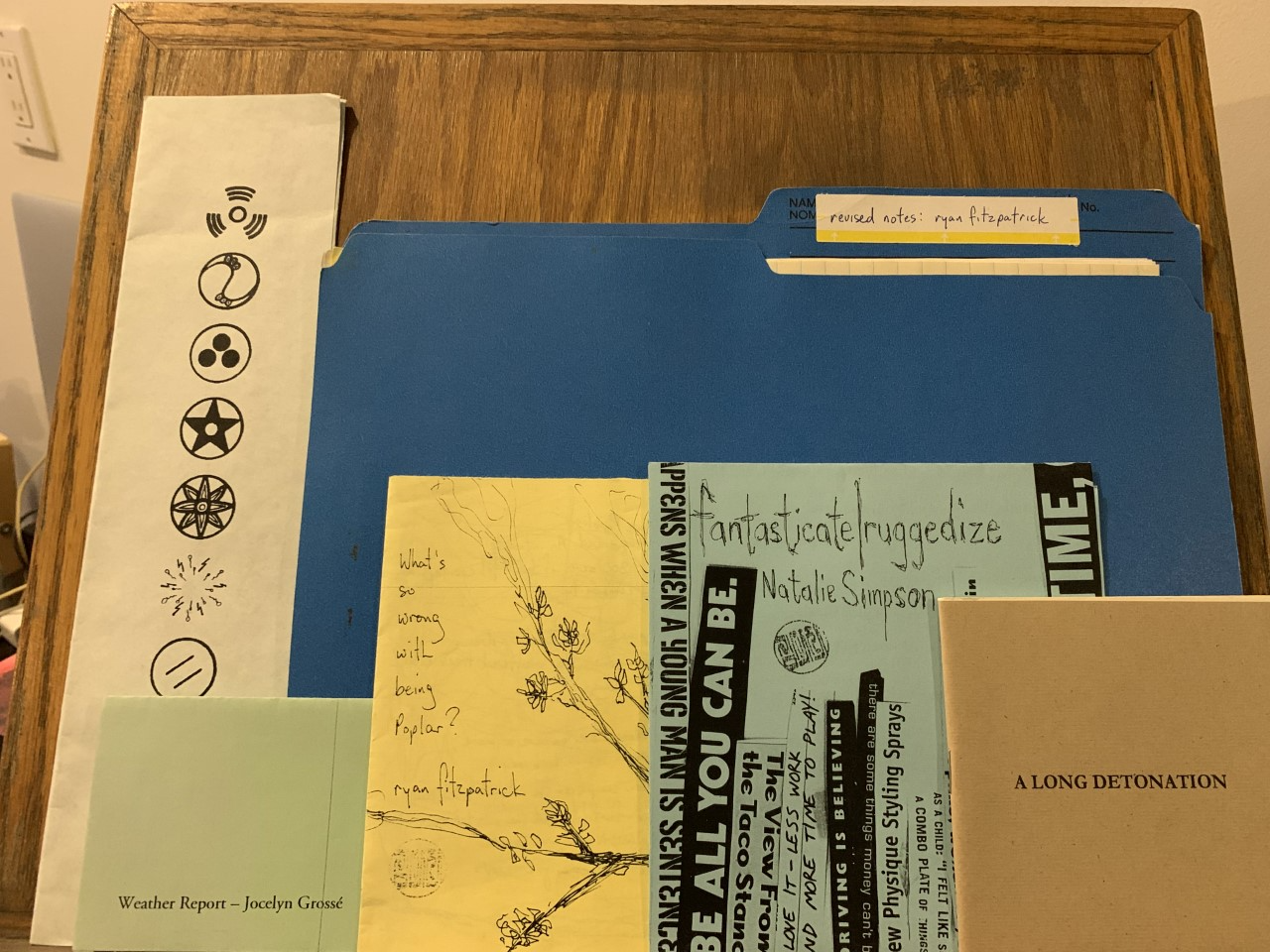
A: Okay, so, if I were to choose an inaugural moment, I might pick the view onto the stage at the year-end reading of the University of Calgary’s creative writing classes in, what, 1999 maybe? I had just worked with my classmates to put together a class chapbook for Nicole Markotic’s intro poetry workshop, sitting for hours in a computer lab at SAIT where we could use a photocopier for free. I was pretty proud of the book we put together, but when I got to the reading, I was amazed to see an array of very different chapbooks laid out on the top of the piano at the BeatNiq Jazz Club at the bottom of the Grain Exchange building on 1st. Fred Wah had challenged his class to build chapbooks of their own and I was inspired by the way they were self-publishing and organized. I bought copies of chapbooks by Tillie Sanchez and Jill Hartman, who were members of the short lived Phu collective with Natalie Simpson, Trevor Speller, Darren Matthies, and Lindsay Tipping. I later ended picking up Darren’s and Lindsay’s chapbooks at the campus bookstore.
Inspired, I decided to self-publish the project I had written in Nicole’s class – a weirdo narrative long poem titled revised notes. Self-publication allowed me, to put it in the corniest terms, to control the means of production. I imagined revised notes as something scrappy, printed on a messy mix of paper types with handwritten chunks. I sat at the inkjet printer in my parents’ basement and fed pages through individually to get the effect I wanted. It was an immense pain in the ass.
When I needed a name for the press, I riffed on the name of a band I was in – The Mod Factor – and called it mod1press. Later, I realized that this name was incomprehensible, so I changed it to modl press. When I realized that the lowercase made the name inscrutable, I changed it again to MODL Press. My current online press is basically the same, except I’ve corrected it one more time to Model Press.
Q: I feel as though I have a copy of that around somewhere. Is revised notes the full-sized chapbook? And what kind of print runs and distribution were you doing for such? I would presume you were handing out copies, most of the time. What was the response to these first publications?
A: revised notes is the larger format one bound in the blue file folder. My overcomplicated first attempt to play with book format.
Print run and distribution were something I was continuously changing as I went, but most of the books settled around 50 copies. That felt like a magic number to me, because it was an amount that allowed me to give a decent amount to the author (usually half of the run), still be able to sell or give away a few, and feel like I wasn’t holding onto books forever. Any time I printed more than 50, I felt like I ended up sitting on a ton of copies. I really wasn’t interested in keeping books in print. For me, one of the strengths of chapbooks was their ephemerality. It was all about circulating work that was new to whoever was around.
I think my approach to distribution was shaped by this, though I wouldn’t claim to be consistent about it. I slowly drifted from charging a little for books, usually enough to recoup some of the costs, until I got a review that called out the price of one of my books that made me fed up with the process of trying to sell things. The books I made over the last couple years of the press were printed super cheap and handed out at readings to whoever I ran into. It was completely haphazard and absolutely the best way to circulate poetry.

A: Definitely. The speed and ephemerality of chapbooks and self-publishing gave me this permission to think about poetry as an ongoing process. Work could be scrappy, unfinished, unpolished, and still make meaningful connections. The speed allowed for content that was too timely or obscure for poetry’s slow temporalities - political jabs, pop culture references, community in-jokes. I think that fast publishing is an important part of the poetry ecosystem and I wish more writers would embrace ephemerality in their approach to both publishing and their work, though I get the appeal of working slowly as well. Personally I found the speed of chapbook publishing really freeing. I could write something and quickly circulate that draft to a small group of people.
For me, it’s also been tied to posting work on my blog and later on social media. Sharing work online was central to the boom in poetry blogs that happened in the 2000s and I was absolutely drawn to that because it felt more immediate and, to be honest, it felt more possible than publishing in magazines or books. It definitely shaped my approach to poetry and I’m probably still too in love with sharing my own in-progress work online.
Q: You mention the original impulse and prompts for beginning the press, but what else was happening around you at the time? I suspect what Derek Beaulieu was doing, for example, through his housepress might have influenced some of your publishing structures. What other influences were in play for the press?
A: It was about an upswell of activity that I came into in the early 2000s. A lot of that energy was driven by folks coming out of the creative writing program, but not all of it. My feeling is that Calgary was going through a bit of a transition point in the poetry community. People’s aesthetics and investments shifted over the course of the decade. In the early 2000s, it seemed like everyone was doing something: starting a press, a magazine, a reading series. A lot of it was ad-hoc. Some of it was more professionalized (meaning there was money involved). I was inspired less by the work of any one person than a suite of publications, groups, and happenings: filling Station, Dandelion, Yard, Bemused, Three Blind Mice, Haus and The Ranch, Single Onion, Semi-Precious, (Twat) Team, The Sabbath, Flywheel, In Grave Ink, (orange), Nod, Mutton Busting (I’m forgetting a lot). This in addition to all the writers I was engaging with online, at first through the Buffalo Poetics listserv and afterward through the brief explosion of poetry blogs. I found this rush of activity energizing and inspirational. I wanted in so I joined filling Station after being invited by Tom Muir and started publishing - first, self-publishing in a very scuffed imitation of Jill Hartman, then publishing other folks.
I suspect that some of my feelings come out of a nostalgia for that early-2000s moment, a nostalgia for the improvisational energy of young people who have some faith in culture’s ability to make community, especially in a regional city like Calgary where we had to learn to make our own fun. But it’s not a coincidence that MODL petered out when it did, because it seemed like by the end of the decade the energy of the city and its literary spaces had mutated into something different, something that, to me at least, felt more antagonistic and invested in a cult of celebrity around a handful of figures in the scene. I drifted toward the music and art scenes which at that moment were more invested in diy community strangeness.
Q: What role, if any, did your work with MODL direct the ways in which you engaged with communities beyond Calgary? Were you aware of much of small publishing beyond Calgary’s borders during those early days?
A: My guess is other folks who were around will give you a different answer, but I was pretty strongly connected to the local, at least as a publisher. I don’t think I published anyone who didn’t have a Calgary connection, but I do remember doing a few sales and swaps over the Buffalo Poetics Listserv. I slowly became aware of what was going on outside of town as people from other cities came to give readings, as I talked to other poets in town who had moved from other places, and through the growing network of blogs that were popular in the early to mid 2000s. But in terms of publishing, I was more likely to invite those out-of-town writers to submit to filling Station than to publish them with MODL, maybe because filling Station felt like a professional enterprise with a longer history, even though fS was constantly at threat of shutting down.
Because I did small press in a very local way before jumping into the wider world of it, I find I’m always a little too aware that there is way more activity going on than is apparent in the dominant promotional cycles of poetryworld, where everything is keyed to specific presses and cities. I kind of wish I was more involved with communities outside of Calgary, but also I’m grateful to have focused so much time with the strange particularities of the local. Local spaces are really where poetry bubbles over and gets interesting, if there’s room for them to develop.

A: I mean, if I put this in the corniest way possible, doesn’t taking the means of production into your own hands underline the way that publishing should primarily be about circulating material that members of your community (however you define that word) is invested in and excited by? That’s maybe why the local appealed to me as a site for circulation, because I could honour one person’s work by picking it up and passing it down the line. It’s like delivering the news!
If it’s affected my own work, it’s probably made me pretty strident about poetry not having to be so polished all the time, because there can be stages to publication. You should be able to put out in progress versions of your work through the scrappy channels of small press. Because small press is ephemeral and local, it can support writers where they’re at in a particular moment. Writing and publication can be quick as well as slow. I think the recognition of that has made my work too timely sometimes. And if my experience with book publishers and the literary magazine industrial complex has taught me anything, it’s that timeliness is not always a valued quality.
Q: What was behind the decision to end the press? Was it a decision deliberately made, or one through circumstance? Were there any frustrations that drove the decision, or did you simply run out of energy, time or even enthusiasm?
A: It was a lot of things: the shifting of the local writing community, my own move into academia from being a kind of literary townie, years of working multiple jobs. Ultimately, it was an increasing lack of energy paired with the reality that I had to focus what energy I had elsewhere. I still feel bad about a few publications closer to the end of the press that just never got finished because I couldn’t find time or energy to finish them. The press just kind of ended without me being deliberate about it. There was the possibility that I might publish something for years after I had actually stopped. Though much later, I did think about making a big splash out of ending the press by selling the name (plus my long-arm stapler) for $5!
Q: Finally, what prompted you to restart the press under a new name and online? How does the new MODEL relate, at all, to MODL? Apart from the obvious differences in production, what are the differences you are finding to running a press now to running a press then? What has changed, and what remains the same?
A: Well, Model relates to MODL in that it’s still me doing the work. And there’s a continuity in the design. But why bring it back now? Well, I was feeling increasingly disconnected from poetry world between moving to a new city and the general anonymity of publishing (especially magazine publishing). The social distance of the pandemic was kind of the final straw and I felt like I needed something that would reconnect me to the community elements of poetry in a positive way. I juggled a lot of possibilities like an online magazine or some kind of newsletter.
Eventually, I landed on the chapbook but decided to make it leaner and quicker to produce. Rather than the adhoc approach of MODL, the “model” of Model became quite deliberate. I’ve been producing the books in batches in such a way that the press acts a little like a magazine where the individual pieces are released over weeks or months. The design of each book is deliberately minimal and the biggest decision I make when building each book is the page size. The online element came out of pandemic necessity, but I like the way it focuses me on circulation rather than aesthetics. The goal is to get pieces in front of as many eyes as I can, which has a limit, but less of a limit than the material one of an analog small press. Admittedly, I pay for this with the loss of the analog thrills of the paper chapbook and every once in a while I think I’ll eventually go back to making print books. But right now, this approach is working for me and I’ll keep it up as long as people are interested and I’m having fun with it.

MODL Press “Bibliography” (spotty bc I didn’t keep good records and didn’t have enough spoons in my 20s to even think to do something like that)
pre-2000
a couple of self-published chapbooks I made
that I am too embarrassed to admit to
2000
revised notes – ryan fitzpatrick(Class project for Nicole Markotić’s intro poetry workshop. I spent hours feeding different kinds of paper through my parents’ inkjet printer because I thought it would look cool. This book is the source of confusion about the press’ name because it started as mod1 press—a reference to the band I had been in—and was changed to modl press and then to the more deliberate MODL Press. For the record, it’s meant to be Model not Modal. I always liked the joke that the press wasn’t a model press and then made it clear by misspelling the press’ name.)
2002
PyongTaek – ryan fitzpatrick
2003?
Pamphlet Series (all w/ art by ryan fitzpatrick)
“What’s so wrong with being poplar?” – ryan fitzpatrick
“fantasticate|ruggedize” – Natalie Simpson
“Fylfot” – Jill Hartman
“Weather Report” – Jocelyn Grossé
“vanilla” and “a step in June” – Chris Ewart
“Pass the Doughnuts, Please” - Jason Christie
“Pitt Graphic 4” – derek beaulieu
(I was living with my parents and my dad had bought a shitty old photocopier, so I started experimenting with pamphlets because I could put them together quickly and make them on the cheap. I mostly asked folks who were around, friends and local folks whose work I admired. The accompanying artwork solidified the design aesthetic for the first couple years, which was cut up, photocopier mess, handwritten stuff—anything I could throw together that looked vaguely cool and didn’t give away that I was a shitty artist.)
2004
“Hey Mom, I’ve Been Censored” – filling Station collab for Freedom to Read week ft. Chris Ewart, J Alary, Jason Christie, Carmen Derkson, Jocelyn Grossé, ryan fitzpatrick
A Long Detonation – ryan fitzpatrick
(The last gasp of my failed first manuscript The Ogden Shops. After this I really focused on publishing other folks work rather than my own.)
welcome to asian women in business a one stop site for entrepreneurs – Larissa Lai
Cover Art by ryan fitzpatrick
(Produced in two editions, the second for Yasmin Ladha’s ACAD class, I think? Published because Larissa approached me at a reading and said she was experimenting with Flarf too. This piece is probably too serious to be Flarf, but it’s still great.)
2005
Pirate Lore – Brea Burton, Jill Hartman, and Cara Hedley
Cover Art by Sandy Ewart (credited as Sandy Lam)
(Probably the nicest looking book I produced thanks to Sandy’s artwork. This is one of the only places that Brea, Jill, and Cara had their work published together as a collaboration, even though they were regularly performing as a group at this time.)
Asian History Month chapbook ft. Crystal Mimura, Sandy Lam, Dale Lee Kwong, Weyman Chan
ffllj – derek beaulieu
Cover Art by ryan fitzpatrick
blert – Jordan Scott
Cover Art by Sandy Ewart (credited as Sandy Lam)
(Maybe the second nicest looking book I produced thanks to Sandy’s artwork, but marred by a couple weirdo design decisions on my part.)
2006
Nascent Fashion – Larissa Lai
Cover Art by Travis Murphy
(Published because I was erroneously credited in the anthology Post-Prairie with publishing a book Larissa had self-published. This book took forever to produce because Travis took his time with the cover. I stopped including cover artwork after this book. I received a review in filling Station that belaboured the fact that I was charging $10 for the book. I stopped charging for books after that review. Both of those things were detracting from something that was supposed to be fun and not feel like work, especially in a moment for me where I was working seven days a week at two jobs.)
2007
Pamphlet Series ft/ Helen Hajnoczky, Aaron Giovannone, Emily Carr, Bronwyn Haslam, Weyman Chan, Laurie Fuhr, Ian Kinney
(published for the 2007 Blow Out reading? This is probably my favourite MODL publication. I showed up to the book-selling table at the event with a box of these really plain looking pamphlets and people seemed really annoyed that I was asking them to “dig through the box” and “take some for free.” Between Larissa’s book, which took forever to produce and wasn’t received very well, and my general inability to do the things a professional press would do, I felt freed by the fact that I could show up with this cleanly designed but otherwise messy “book object”—a strange “shuffle anthology”. I doubt anyone other than me has the full set, though maybe I’m wrong.)
2007/2008?
Big Vocabulary – Nicole Markotić
(I don’t have a copy of this anymore, but I remember it took too long to put together, so I hand crumpled a bunch of interoffice mailers to make it look like it had been “floating around the department for a while”)
2008
Governor Jangles – Christopher Blais
Doors and Enemies – Natalie Zina Walschots
Magic For Yr True Love (reprint) – Kiarra Albina
Poems – ryan fitzpatrick
(comp + CD produced for “Future Fest” at Springbank Middle School)
2009?
Ghost – ryan fitzpatrick
Stray – ryan fitzpatrick
Faint – ryan fitzpatrick
(produced as a series w/ similar design)
Unpublished/Unfinished (because I couldn’t get my shit together)
a collaborative piece by derek beaulieu and Christopher Blais
Stephen Harper Magazine collab co-edited w/ Natalie Zina Walschots
Palliative Care – Meghan Doraty


