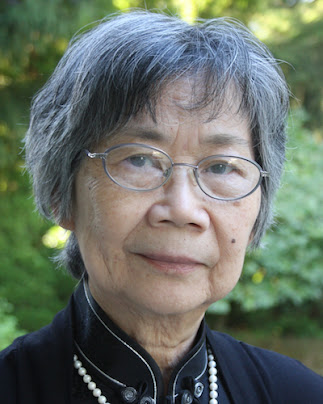
Caroline Wong is from a
blue-collar immigrant family. A graduate of Simon Fraser University’s The Writer’s Studio, she
writes fiction and poetry. Her work has appeared in a number of Canadian
literary journals. Primal Sketches, her first book of poetry, was
published (Signature Editions) in the spring of 2021. She lives in Burnaby, BC,
with her family.
1 - How did your first book change your life? How does
your most recent work compare to your previous? How does it feel different?
When I first started writing, sending my work out, I
thought that having my first book published would mysteriously change my life
in some way. It hasn’t.
After the initial surprise and great excitement, life is once again back to its
old routines, allowing me to move on to new writing projects. I always enjoy
writing, creating; the only difference is that with one book out there, I now
throw myself at the task with more confidence and intention.
2 - How did you come to poetry first, as opposed to,
say, fiction or non-fiction?
I grew up with little nursery songs and simple chants
my mother and grandmother taught us when we were living in China, Later in
school we recited poems by the Tang poets Li Po, Du Fu, Wang Wei and others.
The magic and musicality of words stayed with me. When I started writing, it
was poetry I leaned toward, for its power to encapsulate thoughts, feelings and
emotions in a heightened language, with an economy of words I find harder to
achieve in prose.
3 - How long does it take to start any particular
writing project? Does your writing initially come quickly, or is it a slow
process? Do first drafts appear looking close to their final shape, or does
your work come out of copious notes?
Once I am inspired and have an idea for a poem, the
initial draft is written fairly quickly as my mind goes into that special place
of deep concentration. I do edit a bit as I write, but I’d generally let it sit for a while
before I go back to revise it. Usually the first drafts appear pretty close to
the shapes they finally appear, but sometimes a poem can end up looking
entirely different.
4 - Where does a poem or work of prose usually begin
for you? Are you an author of short pieces that end up combining into a larger
project, or are you working on a "book" from the very beginning?
For me, a poem always comes from the heart first.
Words come to me when I fall into a certain mood. I gather them into lines,
into short pieces. My first book is composed of poems I had written and put
aside, and poems I had recently generated. I’m now working on a new collection of
poems with a “book”in mind. So it’s more
focused and integrated.
5 - Are public readings part of or counter to your
creative process? Are you the sort of writer who enjoys doing readings?
I’m not a
public person, but when I have the opportunity, I do read my work in public as
a way to take my work out there. It helps to know that I’m not writing in a vacuum.
6 - Do you have any theoretical concerns behind your
writing? What kinds of questions are you trying to answer with your work? What
do you even think the current questions are?
The concept of art for art’s sake has always intrigued me. Do I
strive to create a kind of pure poetry that solely conveys beauty and gives
enjoyment? And if it has a social, humanistic, altruistic purpose, does it
lower the poem’s
poetic value? Mostly, I follow my own inclinations. If my writing can evoke in
the reader the same strong emotions and feelings and passions I have for my
subjects I would be more than satisfied.
7 –
What do you see the current role of the writer being in larger culture?
Does s/he even have one? What do you think the role of the writer should be?
I think every person has a role in making the world a
better place by speaking out against injustice, inequality, bigotry and
violence. Through the pen, writers can speak so much more loudly, their
messages more likely heard. By advocating tolerance, fairness, empathy and
compassion, a writer can contribute toward making a better future for later
generations.
8 - Do you find the process of working with an outside
editor difficult or essential (or both)?
It was wonderful working with my editor, Clarise Foster, on Primal
Sketches and a great learning experience for me.
9 - What is the best piece of advice you've heard (not
necessarily given to you directly)?
Never stop learning. The more we learn, the more we
know our own ignorance. Each new wisdom gained humbles us a little more.
Tolerance for and understanding of others’ faults and differences comes from knowing that no one
is born perfect.
10 - How easy has it been for you to move between
genres (poetry to short stories)? What do you see as the appeal?
What I write is mostly motivated by what I read, and
other times, by my reflections on the various personal and outside events
unfolding around me. Whether I’m
writing poetry, fiction, creative non-fiction, all three genres allow me to
explore subjects that are important to me: family history, our cultural past,
memories of my girlhood in China and in Vancouver’s Chinatown.
11 - What kind of writing routine do you tend to keep,
or do you even have one? How does a typical day (for you) begin?
When I’m
working on a project, I tend to keep a fairly regular routine. I’d write four to
five hours in the morning each day. Then I’d go out for a walk to clear my head.
Often though I find the writing continues in my head: reviewing, editing, even
when I’m away
from the my desk.
12 - When your writing gets stalled, where do you turn
or return for (for lack of a better word) inspiration?
I usually re-read what I have written before I
continue with more writing. I find this process opens up other possibilities,
points to different approaches.
13 - What fragrance reminds you of home?
This may sound strange. The smell of moth balls takes
me back to my grandfather’s old
desk at home, opening drawers, rummaging through bits of string, old bronze
coins, rags, to find a yellowed, string-bound, picture book depicting gruesome
tortures that the wicked suffer in Hell. It was the only book I ever came
across in the house when I was a child.
14 - David W. McFadden once said that books come from
books, but are there any other forms that influence your work, whether nature,
music, science or visual art?
Because I spent my early years in a rural setting with
open fields, orchards, hills, streams, themes of Nature, memory, journey occupy
a large part of Primal Sketches.
15 - What other writers or writings are important for
your work, or simply your life outside of your work?
Impossible to name the long list of great writers I
admire over the years, but all great writings, whether in English or in
Chinese, have a great influence on my work. When I’m not writing, I read, hike, garden,
lunch with old friends, travel (before Covid-19).
16 - What would you like to do that you haven't yet
done?
Learn to speak Mandarin fluently so that when I travel
in China, I would feel less out of place, more at home, if only to fool myself.
I know one can never step into the same river twice.
17 - If you could pick any other occupation to
attempt, what would it be? Or, alternately, what do you think you would have
ended up doing had you not been a writer?
I was at one time working as a Medical Laboratory
Technologist. If I hadn’t become a writer,
I would probably have gone back to the lab. I liked the the investigating,
testing and analyzing aspects of the work.
18 - What made you write, as opposed to doing
something else?
Writing enables me to get my stories out and share
them with others, as a way to have my voice heard, and also as a means to
discover their underlying significance. What they mean to me. Why I feel they
are important to me.
19 - What was the last great book you read? What was
the last great film?
The Men Who Killed Me. Reading the women’s stories shocked
me out of my complacency and narrowness. The world is not getting better and
better as I’d
thought. Human nature never changes. For the voiceless and defenseless, their
stories become a means for them to speak out against violence and abuse, to
have their voices heard.
Gravity.
Although it takes place 600 kilometers high above Earth, the story’s central theme is
very much grounded: a young mother’s
journey from grieving for the loss of her daughter to final acceptance.
20 - What are you currently working on?
A collections of elegiac poems on Vancouver’s Chinatown: its scandalous
beginning, its heartbreaking decline, personal family history, stories of the
girls and women whose lives and mine had briefly commingled in Chinatown.
12 or 20 (second series) questions;