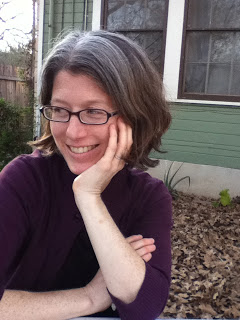
Sunday, November 18, 2012

12 or 20 (second series) questions with Julia Bloch

Julia Bloch grew up in Northern California and Sydney, Australia, earned an MFA at Mills College and a PhD at University of Pennsylvania, and is the author of Letters to Kelly Clarkson (published by Sidebrow Books in April 2012). She is the recipient of the San Francisco Foundation’s Joseph Henry Jackson Literary Award and the William Carlos Williams Prize for Poetry, is an editor of Jacket2, and recently moved to Los Angeles to teach literature in the Bard College MAT program.

1 - How did your first book change your life? How does your most recent work compare to your previous? How does it feel different?
I started writing Letters to Kelly Clarkson a long time ago, when KC was competing in the first season of American Idol (2002), although it didn't come out until 2012. I've worked on other books before and since, so this book feels less "first" and more like its own animal, or something that has accompanied other projects and come in and out of prominence for my writing practice. We've both gone through a lot since I started those poems: new albums, new hair, new jobs, new cities. My most recent work is different; I left the prose poem and am working in lines again. I use less first person. I'm more interested in syntax, playing with and distorting sentences. I still care about pop culture and music and representations of women's bodies. I still care about address. Laura Splan's amazingly beautiful artwork is on the cover of the book, and I couldn't be more grateful for that: having the book finished and out there feels to me very much like what she calls "perceptions of beauty and horror, comfort and discomfort." It's an artifact now of that perception - an artifact rather than an ongoing process/thing.

2 - How did you come to poetry first, as opposed to, say, fiction or non-fiction?
I came to poetry after writing and producing plays and writing fiction when I was younger. My teachers told me my stories sounded like poetry. I loved writing dialogue, though, especially in the plays; I think the turn to poetry had a lot to do with the way I was hearing language and writing it down. I'm still interested in the way we hear speech in poetry.

3 - How long does it take to start any particular writing project? Does your writing initially come quickly, or is it a slow process? Do first drafts appear looking close to their final shape, or does your work come out of copious notes?
I do a lot of sketches, note-taking, and free writing. I then spend a lot of time cutting, condensing, and recombining. I think a lot about Lorine Niedecker, who wrote, "I love to delete and eliminate." I strip everything down pretty severely. My first drafts look very little like the poems do after many months of redrafting. I'm an obsessive editor of my own poems, in part because I spent many years working as a professional proofreader and copy editor.

4 - Where does a poem usually begin for you? Are you an author of short pieces that end up combining into a larger project, or are you working on a "book" from the very beginning?
I think a lot in sequences; I've written a lot of series poems that themselves are short but that together make up sequences of 10, 20, 50, etc. I love very short lines, very short stanzas, and short poems that pile up on top of one another. I'm intrigued by the way some poems can stand on their own and the way others mean the most in relationship to other poems that surround them in a sequence.

5 - Are public readings part of or counter to your creative process? Are you the sort of writer who enjoys doing readings?

Especially now that I've been teaching for quite some time, I think about poetry readings as having a pedagogical aspect to them: kind of like teaching your readers something new about the work, a new way to hear and experience its action on the page. I learn a lot from poets who read their work aloud. I curated a reading series in Philadelphia for several years (http://writing.upenn.edu/pennsound/x/Emergency.php) that was committed to creating an ongoing dialogue among working poets on how they think about poetic lineage, theoretical stances, and aesthetic practice. So, we heard the poems, and then we had dialogue about the poems, about connections between the poets, and about what the poets think about community, practice, and so forth. To me that was much more interesting and generative than hearing poets read and then calling it a night. Interacting with poets as part of a community feels really essential to my practice.

6 - Do you have any theoretical concerns behind your writing? What kinds of questions are you trying to answer with your work? What do you even think the current questions are?
In LKC, I was pretty interested in gender theory and exploring representations of female celebrity, the female body as a spectacle, reality TV as a profit machine that we feel emotionally attached to, our relationship to pop culture, our desire for and fear of intimacy. As an academic I think a lot about theories of language; some of that comes up in my poetry, intentionally and accidentally.

7 – What do you see the current role of the writer being in larger culture? Does s/he even have one? What do you think the role of the writer should be?
There needs to be more funding for art. Other than that, I don't have much interest in determining the role of the writer in the larger culture; I think things are more interesting when writers occupy all sorts of different roles inside, outside, and on the margins.

8 - Do you find the process of working with an outside editor difficult or essential (or both)?
Totally essential - I think all writing happens in dialogue with others.

9 - What is the best piece of advice you've heard (not necessarily given to you directly)?
"Take Fountain." - Mae West, to aspiring starlets in Hollywood.

10 - How easy has it been for you to move between genres (poetry to critical prose)? What do you see as the appeal?
I'm really interested in blurring the boundaries between genres. My favorite critical works are doing the work of poetry; my favorite poetry is theorizing. In my own work, I feel like I'm using different muscles to write criticism and to write poetry, but the issues, arguments, problems are the same.

11 - What kind of writing routine do you tend to keep, or do you even have one? How does a typical day (for you) begin?
I work really well in the mornings, usually before sunrise. I can't work in the same place every single day. I need lots of books around.

12 - When your writing gets stalled, where do you turn or return for (for lack of a better word) inspiration?
I start reading again. I'll write in response to a word or phrase I find, or rewrite a line that feels flat. I'll take notes, make sketches, think on paper, watch a video clip, look at art.

13 - What fragrance reminds you of home?
Eucalyptus. This isn't a fragrance, but hearing western scrub jays.

14 - David W. McFadden once said that books come from books, but are there any other forms that influence your work, whether nature, music, science or visual art?
I take notes in galleries and at concerts. If I ever live near nature again I'll probably do something in response to it. Maybe I'll imitate Stephen Ratciffe's Temporality blog (http://stephenratcliffe.blogspot.com/).

15 - What other writers or writings are important for your work, or simply your life outside of your work?

Right now I'm spending a lot of time with Jena Osman's book The Network and Eleni Sikelianos' The California Poem.

16 - What would you like to do that you haven't yet done?
Play more instruments. Finally learn how to draw.

17 - If you could pick any other occupation to attempt, what would it be? Or, alternately, what do you think you would have ended up doing had you not been a writer?
Vegan chef?

18 - What made you write, as opposed to doing something else?
I liked it too much.

19 - What was the last great book you read? What was the last great film?
Last truly great book was William Carlos Williams's Spring and All, which I just taught for the second time. Last great film was Kurosawa's Yojimbo.

20 - What are you currently working on?
A MacBook Air.

12 or 20 (second series) questions;

Saturday, November 17, 2012

Ongoing notes: mid-November, 2012


This is one of our honeymoon photos, taken in the village of Coton, on one of our last days. Aren't we lovely?


So much going on I can barely keep track. My upcoming January – March poetry workshops at Collected Works Bookstore and Coffeebar have a few spaces left. And keep an eye on The Factory Reading Series, whether via the sidebar on the top right, or the above/ground press blog for a number of events and new publications over the next few weeks. And then, of course, the 2013 above/ground press subscriptions are available. Why not sign up?

Ottawa ON: Ottawa poet Marilyn Irwin produced a small chapbook in an edition of eighteen copies for the sake of her Hallowe’en reading at the In/words reading series, little nothings (2012). This is her third poetry chapbook, after her self-published for when you pick daisies (2010; quickly re-issued by above/ground press) and the recent flicker (above/ground press, 2012). In little nothings, Irwin hones her tightly-packed poems into a finer sharpness, boiling down into incredibly compact poems. There is such a lovely quality of her ending poems before they end, writing just short of giving away enough or even too much, leaving entire spaces between for the reader to fill in. The chapbook of ten small poems might be dedicated “for quiet moments,” but the suggestion is deceptive, less quiet than sharp, or flare-lit.

another butterfly tattoo

fresh ink flares flesh
ruby lick wing whisper
another  butterfly tattoo
arctic breath lash dance
suckle sweet
soul secrets
insect small

The tumbling tongue-twister of the final poem, “sea sent,” is reminiscent of some of another Ottawa poet, Christine McNair’s, own works, from her trade collection Conflict (BookThug, 2012) or chapbook Notes From A Cartywheel (AngelHousePress, 2011). The words flip and twist but never trip. The words and phrases of Irwin’s short piece highlights a near-gymnastic series of turns, collisions and compactness that spark connections that could never have occurred, otherwise.

sea sent

in the sick thistle left to wither
weathered clover fills a parcel
Sunday stamp bottle wrapped
soaked notions orphaned oceans
flying narwhal hush

In/words reading series host David Currie suggested during his introduction of Irwin that she is one of the Ottawa poets worth watching over the next year or two. I’ve already been saying that for a couple of years.

England: It seems that British poet/publisher Rupert Loydell is still producing his smallminded books, as another small packet of publications appeared in my recent mailbox. The editor/publisher of Stride magazine and the late-lamented Stride Books, these works are deliberately produced as a series of quick handouts. Previous publications through this series were single-author works, with three to five poems per publication, but the new publications, a dozen in total, each hold a poem by Rupert M Loydell, and another by Paul Sutton.

UNDEAD NETWORK DRAFT

Darkness comes in a loop of dreams,
black paint over the wrong colours.

What lies inside the circle of sleep?
Winter singing and gestures without plot.

Did you see me woolgathering? Did you?
There is one thing missing: love’s true hoop.

Deleted photos linger on social network sites,
ghosts of lost battles and letting you go. (Rupert M Loydell)

I’m intrigued at the distinction, and wonder if the two authors are working their ways up to a particular project, whether collaboratively or otherwise? Is this work a collaboration or is the publication simply side-by-side? Still, the poems are wildly uneven, but the subtleties persist, and the quick publications nearly read as works-in-progress, quickly written, and quickly produced and distributed. I look forward to seeing what form(s) this might next take.

HAUNTING OF THE SECOND HOMER

Washed up onshore. I lay there for a week,
then removed the seaweed and bladderwrack.
Delightful, criss-crossing the town unseen,
sitting in converted chandlers, sipping white wine,
stealing from tables, pushing children over seawalls.
The place I stayed was an old lighthouse,
glowering over the salt marsh. I launched
from the top-rail, landing in mud suction:
hysterical owner screaming as she woke.
The woman wrote a novel, based on my
bullshit messages: copperplate letters
from a wronged housemaid, deflowered,
abandoned – drowning herself in black mud.
I enjoyed the book-launch, hurling pigshit
at the pony-tailed publisher. The granary
location went up like a vodka factory.
Oh Norfolk, you need the arts industry,
my hate destroyed this opportunity. (Paul Sutton)


Friday, November 16, 2012

rob mclennan's Miss Canada International (Bywords) now available;

Miss Canada International
by rob mclennan

I was fortunate enough to win the 2011 John Newlove Poetry Award (this year's winner is Jenna Jarvis), which means Bywords.ca produced a chapbook of mine a year later, and copies are now available. Here are the judge's comments from my original win:
"From the department of curious Canadiana arrives a poem in conversation with the ecopoetic and disjunctive narrative fixations of writers countrywide. The poet nods to Legris nods to MacEwen. Left-aligned stanzas are interwoven with indented asides – or perhaps a poem within a poem. Both. Drenched and stretched, aurality translates what is not quite read. The text itself finishes mid-thought, or does not finish, or does not. Any. Either. All."

a.rawlings
2011 John Newlove Poetry Award Judge

Another chapbook from the same "Miss Canada" manuscript, Miss Canada (Corrupt Press, 2012) is still available, and my essay for the entire project is now online.
 
Check the link here to order copies of the new title, or come this weekend to the ottawa small press book fair!

Thursday, November 15, 2012

new from above/ground press: new titles by mclennan, eckhoff, Poe + Cochrane


Notes, on the subject of marriage;
rob mclennan
$2

their biography
kevin mcpherson eckhoff
$4

Keep
Deborah Poe
$4

Cat.
Mark Cochrane
$3

published in Ottawa by above/ground press
September/October/November 2012
a/g subscribers receive a complimentary copy of each

To order, send cheques (add $1 for postage; outside Canada, add $2) to: rob mclennan, 402 McLeod St #3, Ottawa ON K2P 1A6 or paypal at www.robmclennan.blogspot.com


See previous batches of above/ground press items listed here or keep scrolling down here. Check www.abovegroundpress.blogspot.com for regular updates, and sidebar links for chapbooks, “poem” broadsides (includinga new sub-series curated by Phil Hall!), author interviews and recent reviews of various titles, and a couple upcoming readings through The Factory Reading Series, which turns twenty years old in January! Review copies of any/all titles available (as supplies last).

Wednesday, November 14, 2012

Daily offerings: a note on “Songs for little sleep,”


Lyn Hejinian described to me her work in progress, The Border Comedy, as being instigated by the notion of a collaboration in which one sends one line to someone else and the other person adds to it; yet in The Border Comedy she writes one line, then allows time to pass and comes back to it. She couldn't get a line sufficiently unfamiliar, so began to work on all fifteen books of The Border Comedy (it is intended to be modeled on the fifteen books of Ovid’s Metamorphosis) at the same time, perhaps only returning to one spot in the work a couple of weeks after it was written and only looking at a few lines on the computer at once (in order not to ‘remember’ the background). “In order to keep writing fresh the memory of it has to fade. Unfamiliar, it is ‘of the moment.’”
            In language horizontal and vertical time can occur at the same moment. Hejinian says that the unfamiliarity of the writing is a prompt; it prompts the future.
Leslie Scalapino, “The Radical Nature of Experience [on Philip Whalen, Lyn Heijinian, Susan Howe, and Leslie Scalapino],” How Phenomena Appear to Unfold

The sequence of poems that make up “Songs for little sleep,” feel different in tone from much of what I’d written previously. Different, but part of a logical progression of poetry manuscripts over the previous eighteen months, from “Miss Canada” (closing out the “wild horses” quintet) to “If suppose this is a fragment” and “The underside of the line,” the last pieces of which were completed just before the beginning of this new work. Composed between July 5th and September 1st, 2011, “Songs for little sleep,” is a series of quick texts composed in moments once taken up by certain other activities, and coincides entirely with the weeks I shared Christine McNair’s tiny apartment in Old Ottawa East before we finally moved into a shared space more appropriate to our newly-combined requirements. During this period, house-sitting replaced television and travel replaced house-sits. What would I do without my nocturnal hours of television? There was the way her apartment was so different than mine, and other (positive) disruptions, shifting a daily routine: the displacements of co-habitation that writing occupied. For this particular manuscript, I attempted to directly utilize and engage the distractions; poems were composed quickly, one per sitting, using collaged words or phrases skimmed, misread, lifted, carved, twisted and/or mashed-up with other fragments, and inserted into the fray. The musical cadence of the line continues but more a sweep, a wave or even flood. Many of the triggers for particular poems come from a longer work, from which a quoted fragment appears at the beginning of each piece, often with additional fragments from (where applicable) the dedicated, slipping quick on lines broken, shattered, and re-formed into new shapes, as twisted as possible. In various pieces, tenses and genders deliberately don’t meet up, and meanings alter. Skimmed and mis-readings were essential. Accidents and mis-communications were encouraged, if not downright celebrated.

Our dear friend, the late Robert Kroetsch once asked, How do you make love in a new country?

In the mid-1980s, Vancouver writer George Bowering crafted a collection of what he subtitled “late night poems,” his Delayed Mercy & other poems (Toronto ON: Coach House Press, 1986). Supposedly composed in his home office, at the end of his long day of teaching, the poems in his collection were composed from his Kerrisdale point-on-a-grid. I don’t mean to suggest that “Songs for little sleep,” is exclusively a “late night poems,” but one created out of stolen moments – early morning and later night – that circle other projects in an environment slightly foreign to my writing day: various reviews, essays, a creative non-fiction manuscript and one or more fictions. These poems were composed directly on the laptop, as opposed to sketched out longhand, as so much of my writing has always been. Notebooks fill my study, two-and-a-half decades worth. Unlike so much that came before, these poems were quickly formed during periods once caught up with summer repeats, instead television-less in a small apartment in Ottawa’s Old Ottawa East, a visit to Toronto’s Old Mill, a housesit in Ottawa’s Lindenlea, and her mother’s cabin in the Laurentian Hills. Shattered routine began to reform, congeal into other shapes. My days and shifted nights. Books were pulled near-random from foreign bookshelves for the sake of the unfamiliar, as Scalapino writes of Heijinian. I rejoiced in the differences. What occurs when the familiar and the unfamiliar continually meet?

rob mclennan
Ottawa ON
October 2012

[photo credit: Lary Bremner]