Showing posts with label Tim Bowling. Show all posts

Friday, February 15, 2019

What the Poets are Doing: Canadian Poets in Conversation, edited by Rob Taylor


Thammavongsa: Describe an image of a place you’ve travelled, and why it’s important to you to have been there.

Brand: The Atacama Desert. It was the quiet of it as soon as I arrived. This quiet settled everything I had been experiencing before; it quelled several years of disturbance.

Thammavongsa: Deserts are examples of maximalism. The quiet can be so large, so weighted, it is louder than any disturbance. I say this because it’s how I like to think of my writing. The quiet, the silence, the nothing there is maximized. I make things bare and I amplify that.

Brand: It’s wonderful that you say deserts are examples of maximalism. I had strangely thought minimalism! I wanted to go someplace empty of noise. You are right, the silence crowded out the disturbance.
            You’ve been to a desert; what was it like for you?

Thammavongsa: Yes. In Marfa, Texas. The land was so flat. All I noticed was sky. It made me feel seasick. It was too much. And I loved the tumbleweeds. I was so happy to see them. I know that tumbleweeds began somewhere and they take the shape they have because nothing stood in the way of their tumbling-toward.

I’m impressed with the interviews (more specifically: the conversations) in the collection What the Poets are Doing: Canadian Poets in Conversation, edited by Vancouver poet and critic Rob Taylor (Gibsons BC: Nightwood Editions, 2018). This book is self-described as a response and follow-up to another Nightwood title, Where the Words Come From (2002), edited by Tim Bowling, as Taylor explains in his introduction:

            The structure of this book mirrors the last, with a few key adjustments. We’ve added poems to the book—poems which, for the most part, are mentioned in the conversations themselves—in hopes they will deepen the reader’s experience. We’ve also set out to have these be true conversations as opposed to interviews, with both poets posing questions to one another and contributing equally. Tied to that, while the book does adhere to the structure of pairing established and up-and-coming poets, the qualifications for who fits in which category were amorphous and largely ignored while finalizing a pairing. There are poets in the up-and-coming slots who have published as many books, or are nearly as old, as some of the “established” poets. Oh rule sticklers, it’s a mess! Fortunately, you’re entering a party and not a coronation.

What the Poets are Doing: Canadian Poets in Conversation includes ten conversations between an intriguing array of paired currently-active Canadian poets—Steven Heighton and Ben Ladouceur, Armand Garnet Ruffo and Liz Howard, Sina Queyras and Canisia Lubrin, Dionne Brand and Souvankham Thammavongsa, Marilyn Dumont and Katherena Vermette, Sue Goyette and Linda Besner, Karen Solie and Amanda Jernigan, Russell Thornton and Phoebe Wang, Tim Bowling and Raoul Fernandes, and Elizabeth Bachinsky and Kayla Czaga, as well as an afterward co-written by Nick Thran and Sue Sinclair—running quite the range of engaged contemporary writers from emerging to established, and lyric to the more experimental. The highlights abound, but some of what struck included an utterly charming and illuminating sequence of seeming non-sequiturs between Dionne Brand and Souvankham, the conversational topography between Steven Heighton and Ben Ladouceur, and a fascinating conversation between Armand Garnet Ruffo and Liz Howard, two poets of similar heritage; born a generation apart, they were both raised in the village of Chapleau in Northern Ontario. As their conversation includes:

Howard: I think you’re exactly right that there is this all-too-steady gaze on the traumatic Indigenous experience. I also often wonder about what might be called Indigenous “futurisms,” or futures or possibilities, aesthetic potentials as you have said. I think I have made a way toward that in my work. At least that was the intention, the necessity. The fracturing, the hardship, the wound, whether within oneself and/or within one’s lineage as an Indigenous person is a fact. The question is what to do? Ultimately for myself as a writer, I discovered the figure of the infinite citizen of the shaking tent. Perhaps I am a kind of slippery, in-between, trickster spirit. I suppose this is the figure of myself as a writer that could compose in so many formally inventive and generative ways, pulling in neuroscience, the bush, Western philosophy, Nanabozho, dreams, calling down the sky, Toronto streets, ecological concerns and so on, and compressing them all together into my account, my gift, my book. The trauma, the silence, the absence is there too. But I think it is an ultimately joyful text. I see your work on Norval as being along the same lines. You don’t leave him with us as either a tragic or revelatory figure. He’s deeply human. I see the possibilities for Indigenous work as being an open and variegated as each of our stories.

Honestly, while going through this collection, I’m a bit surprised that there hasn’t been more talk around just how strong this assemblage of conversations actually is. This is, I would say, one of the examples of the follow-up surpassing the original, moving beyond the limitations of a particular aesthetic into a possibility of subject matter, one that is incredibly far-ranging and timely. Part of what this curated list of poets allows for is also the possibility for multiple conversations around race, representation and how a variety of violences have impacted individuals and communities, as well as writing, and how writing has been forced to adapt in response. Over the past decade or so, conversations around diversity, colonialism, #MeToo, #IdleNoMore and other topics that had long been bubbling under the surface have risen to the mainstream, and a series of shifts in publishing and possibility have allowed the same to emerge in writing as well, and this book does well to allow for those conversations, some of which might be seen as long overdue.

Friday, June 03, 2016

U of Alberta writers-in-residence interviews: Tim Bowling (2010-11)


For the sake of the fortieth anniversary of the writer-in-residence program (the longest lasting of its kind in Canada) at the University of Alberta, I have taken it upon myself to interview as many former University of Alberta writers-in-residence as possible [see the ongoing list of writers here]. Seethe link to the entire series of interviews (updating weekly) here.

Tim Bowling’s 13th collection of poems, The Duende of Tetherball, will appear in the fall of 2016, and his 5th novel, The Heavy Bear, will appear in the spring of 2017.

He was writer-in-residence at the University of Alberta during the 2010-11 academic year.

Q: When you began your residency, you’d been publishing books for about fifteen years. Where did you feel you were in your writing? What did the opportunity mean to you?

A: Time. Time to think, to write, to feel validated as a working author (and a big part of the validation, of course, was the cold, hard cash). At the time, I had a number of projects on the go, was highly motivated creatively, but also highly stressed financially. So the opportunity was an absolute godsend.

Q: Were you solely working to further and complete various projects, or did you see your time as more of an opportunity to expand your repertoire?

A: Both, really. I’m usually finishing projects while others are incubating. That’s been my process from the start, but it’s intensified over the past decade. During the U of A residency, I was completing a book of poems and writing the draft of a novel (mostly, though, I was working with other writers on their work – that’s usually what a WIR does, as you know).

Q: How did you engage with students and the community during your residency?

A: Invitations to classrooms (including at a high school), but mostly writers with manuscripts contacted me by e-mail to arrange a meeting in my office.

Q: Was this your first residency?

A: My third, but my first of such length.

Q: How does your experience there compare to other residencies you’ve done?

Q: What do you see as your biggest accomplishment while there? What had you been hoping to achieve?

A: A great deal more money. Otherwise similar.

Q: Looking back on the experience now, how do you think it impacted on your work?

A: It bought me time to write without the usual level of financial anxiety.

Q: The bulk of writers-in-residence at the University of Alberta have been writers from outside the province. As an Edmonton-based writer, how did it feel to be acknowledged locally through the position?

A: Yeah, that was a fantastic part of it. But, to be really clear, Edmonton has been incredibly welcoming and supportive of me as a writer right from the beginning. And the U of A is a big part of that. I owe this city and its institutions a great deal.

Thursday, May 10, 2012

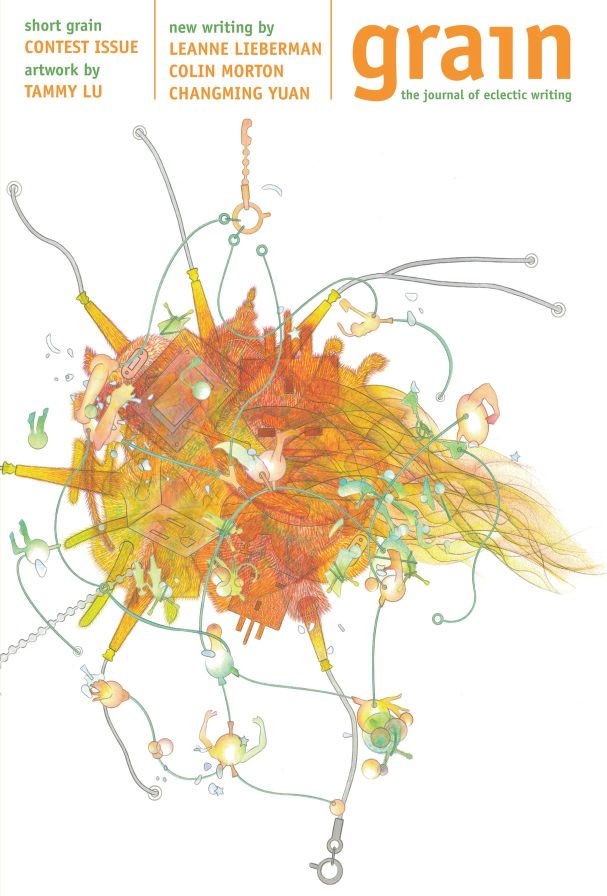
grain magazine 39.2: short grain contest issue,


PENELOPE BEFORE MARRIAGE

There are no mermaids in Lake Ontario,
but I’ve heard you singing. The girls

leaned in, legs wobbling onboard,
their footing unsure. Before the ferry

crossed our path we tacked, taking our time
with the racing done and the jib sheets slack.

The wind flirted with their feathery hair,
and they shivered as if feeling your eyes

comparing their bare arms, tempting
and harmless. One among us will be your

true wife. Across the inner harbour, hotels
lure and wink, waiting for your gamble.

Prince of this pleasure craft, you sighed
and looked away from the western gap

and the squalls beyond these sheltered waters.
Soon we’d be motoring back for supper.

Flaking the main, I hugged the mast.
I never stopped my ears against your suit

nor strained against what bound me. Our
greatest hardships are those closest to home. (Phoebe Wang, 2ND PRIZE POETRY)

Arrived in my mailbox recently was Saskatoon’s grain: the journal of eclectic writing, Vol. 39.2 (winter 2012), their “short grain contest issue,” as poetry judge Jeramy Dodds awarded three prizes (in order) to Tim Bowling, Phoebe Wang and Vincent Colistro, and fiction judge Zsuzsi Gartner awarded three to (in order) Pete Duval, Zack Haslam and Zoey Peterson. It’s interesting to see, especially given that the issue that appears a year from now will be holding my own choices in the poetry category (apparently a mound of poems appear for me to judge in May), thanks to previous editor Sylvia Legris. As Dodds writes about the winning poem, Bowling’s “Gedding Wilder”:

What catches the eye, in this poem, soothes the ear, tweaks the mind. The movement and disposition of this piece shows a cool hand at imagery and complete control of tone. We are treated to language that both jokes and loosens our grip on narrative, while the leaping cinematics sequester any hopes we may have of coming out the same. We are stared at by “every crow / in a photographer’s cloak,” “and all the dark drops of rain / left fingerprints at the scene / of the crime” while there are “totemic salmon / swimming jerkily by.” But if we think this is just a list of acute imagery we are mistaken, for the entirety of the poem’s structure feeds its lyricism, “this cut jumps like that, like life, / life jumps like life.”

To judge, and then to judge. During a comedy awards show last year, Tina Fey said something along the lines that all award shows “are bullshit,” and I mostly agree, but understand also the benefits of highlighting certain works and artists, or even the simple matter of getting money into the hands of poets who are doing interesting works. 

The Bowling poem doesn’t do it for me, but then again, I wasn’t the judge for last year’s competition (I much preferred the second place piece).

But there are other pieces in the issue as well. Partly because the story is set in Ottawa, I’m intrigued by Robert Lake’s short story, “The Delphic Embroiderer,” an odd tale that can’t quickly be described, but can easily be the exception to the rule that all fiction set on Parliament Hill has to be political. 

Perhaps it might be best to simply give you the opening paragraph, and let you be your own judge:

The shooting of a bewildered moose on Parliament Hill provoked considerable media coverage and, of course, forced me to correlate this unexpected event with chaos theory, which asserts that nature is neither mindlessly orderly nor chaotic. Nature fluctuates predictably, yes predictably, between pattern and random movement. Is moose murder random or a human pattern? If both, in what proportions has Nature blended order and chaos, a statistical challenge worthy of John Nash, perhaps even of Euclid, the triangle guy? Why had the moose strayed from the herd? Most important: what does blood gushing from the moose’s jugular fifty metres from the Prime Minister’s Office portend, if anything?