Showing posts with label Jeramy Dodds. Show all posts

Friday, September 22, 2017

Jeramy Dodds, Drakkar Noir


THE INFANTA MARGARITA ENTOURAGE

My daughter starts dating a dwarf.
They attend a Bergman retrospective;
she gets home after midnight, every night.
My child is nine; the dwarf is ancient,
but short. I recall my child as an infant,
I could talk to her for hours. I can’t quite
remember or quit remembering the dwarf.
He rendered her a pickaxe pendant
from plunder hoarded from past times.
As though a pigeon’s leg only likes love
letters, I let myself think what I think
I should. Last night they saw The Silence
at a drive-in together. The dwarf
made the Sun’s front page. A photo of him
in the back of a squad car tossing
its lasso of cherries around the night.
He was wearing one of my shirts, taken in:
‘Time Traveller Caught with Miner,’
they had obviously made a mistake,
‘To Be Executed at Dawn.’ My child’s
voice is like leaves gnawing on light,
‘Will you be heading to the beheading?’

Montreal-based poet, translator and editor Jeramy Dodds’s second trade poetry collection is Drakkar Noir (Toronto ON: Coach House Books, 2017), a follow-up to his award-winning Crabwise to the Hounds (Coach House Books, 2004) and The Poetic Edda (Coach House Books, 2014), a translation from Old Icelandic into English. “Drakkar Noir” translates to “black longship,” suggesting both a Gothic and Nordic influence, perhaps gathered from the extended period he spent living in Iceland. His poems reference the grimoire, ambrosia, minstrel and burlap; angels and minstrels populate these pieces, poems that suggest twisted and surreal campfire stories, tales whispered in dark corners or warnings presented to fellow travellers. “What is French for ‘beneath veneer,’” he writes, to open the poem “SOUVENIR,” “this title or my marriage?” There is something curious about the shift in his poems, blending some of what he’d done with his first collection with ancient folk tales or fables. As well, there are dark and almost sensational critiques/commentaries, such as those presented in his poem “CANADÆ,” that include: “Canada, I refuse to take / medication for this depression when we could just / talk about it.” He continues:

I can’t be the way you want me to be every time
Clifford Olson dangles some summer-schooler over
Niagara Falls, or scientists have cloned Robert Pickton
to man our missing persons’ helplines, or Bernardo and
Homolka have Tupperwared the all-you-can-eat buffet,
or Russell Williams becomes the Colonel of Truth, his flak
jacket packet with panties at IUDS. I can’t sail out of a Bell
booth with a six-pack and pecks.


Thursday, May 10, 2012

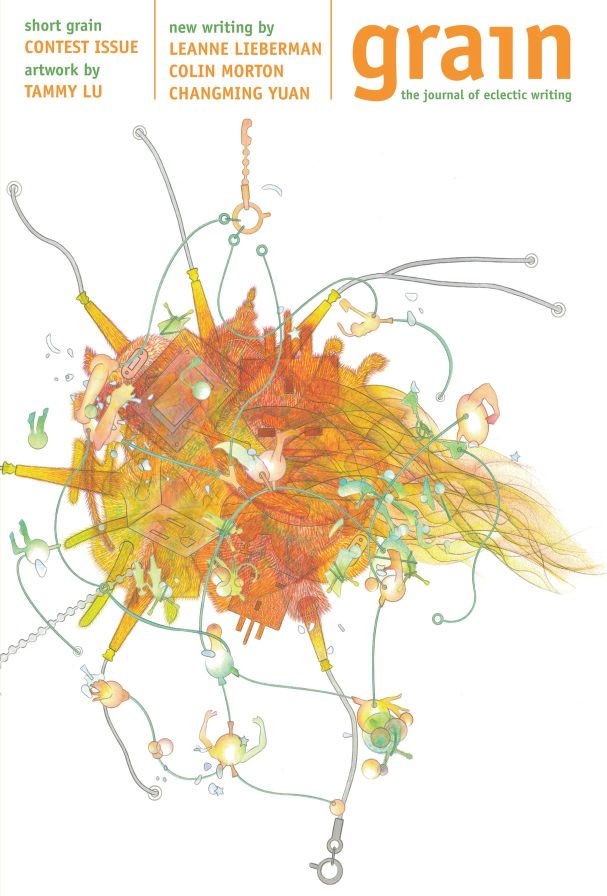
grain magazine 39.2: short grain contest issue,


PENELOPE BEFORE MARRIAGE

There are no mermaids in Lake Ontario,
but I’ve heard you singing. The girls

leaned in, legs wobbling onboard,
their footing unsure. Before the ferry

crossed our path we tacked, taking our time
with the racing done and the jib sheets slack.

The wind flirted with their feathery hair,
and they shivered as if feeling your eyes

comparing their bare arms, tempting
and harmless. One among us will be your

true wife. Across the inner harbour, hotels
lure and wink, waiting for your gamble.

Prince of this pleasure craft, you sighed
and looked away from the western gap

and the squalls beyond these sheltered waters.
Soon we’d be motoring back for supper.

Flaking the main, I hugged the mast.
I never stopped my ears against your suit

nor strained against what bound me. Our
greatest hardships are those closest to home. (Phoebe Wang, 2ND PRIZE POETRY)

Arrived in my mailbox recently was Saskatoon’s grain: the journal of eclectic writing, Vol. 39.2 (winter 2012), their “short grain contest issue,” as poetry judge Jeramy Dodds awarded three prizes (in order) to Tim Bowling, Phoebe Wang and Vincent Colistro, and fiction judge Zsuzsi Gartner awarded three to (in order) Pete Duval, Zack Haslam and Zoey Peterson. It’s interesting to see, especially given that the issue that appears a year from now will be holding my own choices in the poetry category (apparently a mound of poems appear for me to judge in May), thanks to previous editor Sylvia Legris. As Dodds writes about the winning poem, Bowling’s “Gedding Wilder”:

What catches the eye, in this poem, soothes the ear, tweaks the mind. The movement and disposition of this piece shows a cool hand at imagery and complete control of tone. We are treated to language that both jokes and loosens our grip on narrative, while the leaping cinematics sequester any hopes we may have of coming out the same. We are stared at by “every crow / in a photographer’s cloak,” “and all the dark drops of rain / left fingerprints at the scene / of the crime” while there are “totemic salmon / swimming jerkily by.” But if we think this is just a list of acute imagery we are mistaken, for the entirety of the poem’s structure feeds its lyricism, “this cut jumps like that, like life, / life jumps like life.”

To judge, and then to judge. During a comedy awards show last year, Tina Fey said something along the lines that all award shows “are bullshit,” and I mostly agree, but understand also the benefits of highlighting certain works and artists, or even the simple matter of getting money into the hands of poets who are doing interesting works. 

The Bowling poem doesn’t do it for me, but then again, I wasn’t the judge for last year’s competition (I much preferred the second place piece).

But there are other pieces in the issue as well. Partly because the story is set in Ottawa, I’m intrigued by Robert Lake’s short story, “The Delphic Embroiderer,” an odd tale that can’t quickly be described, but can easily be the exception to the rule that all fiction set on Parliament Hill has to be political. 

Perhaps it might be best to simply give you the opening paragraph, and let you be your own judge:

The shooting of a bewildered moose on Parliament Hill provoked considerable media coverage and, of course, forced me to correlate this unexpected event with chaos theory, which asserts that nature is neither mindlessly orderly nor chaotic. Nature fluctuates predictably, yes predictably, between pattern and random movement. Is moose murder random or a human pattern? If both, in what proportions has Nature blended order and chaos, a statistical challenge worthy of John Nash, perhaps even of Euclid, the triangle guy? Why had the moose strayed from the herd? Most important: what does blood gushing from the moose’s jugular fifty metres from the Prime Minister’s Office portend, if anything?

Sunday, January 08, 2012

Arc Poetry Annual 2012: prize poems & bookish brawls

“Poet vs. Poet,” as we’ve dubbed this year’s Annual, seems an appropriate theme for me to find myself enmeshed in at this time. This is to be my last issue as editor of Arc after seven years in the post—seven demanding, fulfilling years that amount to my literary education. Before falling into this role—“fall” is the most accurate way I can think to describe how it happened—I did not think deeply about the competitive aspects of poetic life. I preferred to view the writing of poetry as a singular engagement with one’s world: a private effort undertaken in the hopes of honing a creation worthy of sharing with a reader (or a few), should such opportunity arise. (Anita Lahey, “The poet versus who or what?”)
I’m not entirely sure the difference between a journal that moved from two to three issues a year, or a journal with two issues a year that also issues an “annual” between, especially since the distance between issues seem to be increasing. With their 2012 annual issue, Arc Poetry Magazine, subtitled “Prize poems & bookish brawls,” also marks Anita Lahey’s final as editor after seven years, replaced by incoming editor Katia Grubisic, a Montreal poet and co-editor of Penned: Zoo Poems (Montreal QC: Signal/Vehicule Press, 2009). Alongside the announcements and publications of their 15th annual “Poem of the Year” competition and 10th annual “Diana Brebner Prize” (won by Jenny Haysom, by the by), the issue includes a “Gallery of Prize Emponyms,” various essays and interviews/conversations, “How Poems Work,” a selection of “Editors’ Choices,” and, of course, poems. Who can keep track of it all? In her “Steel toes and stilettos,” self-described “succeeding editor” Katia Grubisic writes:
This Arc considers poetry contests, competitors, laureates, and what those caprine trophies have morphed into today. Fittingly, this is the so-called Kanita issue, part cyborg, part gentle editorial transition. Big shoes to fill—33 years of steel toes and stilettos. More important is the path: knowing where we have come from, yes, as Machado wrote, shaping the path as we walk it. Of yellow brick or diverging in a yellow wood, small steps as it rises to meet us—here is the awe, the boldness, the fortuitous encounters. We want it to be good, we want you to read it, we want it to change our lives.
The Arc Poet vs. Poet Annual raises more questions than it answers, with interviews and essays that mull over contest ethics, slash through shark-infested waters and value the ineffable; reviews of those who wear our versey garlands; new poetry that strifes; and Arc’s own contest winners—come walk with us, we’ll show you where to land the blows.
Obviously, not lacking in confidence, this issue is one of competition, “Poet vs. Poet,” as well as one of transition, overlapping editorial concerns, perhaps, between the outgoing and incoming, and seeing just how compatible the new blood sits inside the already-existing body. Is this competition, or transfusion? As Aislinn Hunter writes in her essay, “On the impossibility of competition in poetry”:
As poets we understand competition: there are only so many pages in the literary magazine, so many books published, space for reviews, dollars for grants, so many spots on the shortlist—and only one winner (or two if the jury is hung). Certainly the idea of competition and its de facto presence in literary culture is widely evident. It may begin in the creative-writing classroom (oriented, despite its desire not to be, on grades), or in the form of back-page contests advertised in magazines; it might rear its head annually in Canada Council grant tussles, or be broadcast into our kitchens. Competition in the literary sphere is so ubiquitous that, in 2002, when Tim Bowling edited a series of interviews between poets in Where the Words Come From, he requested that each interviewer ask, amongst their own queries, “is competition healthy or unhealthy for a poet?”
The particular kind of competition Hunter discusses is certainly an aspect of literary culture, but I’m not sure it’s ubiquitous; Bowling suggesting the question doesn’t argue it so. Still, competition takes a wide array of forms, and one of the prevailing aspects of “competition,” whether self or with others, is the push for improvement through comparison, which can be enormously healthy, as opposed to the potential for self-abuse that comes with frustration over prize-monies and increased attention. The conversation is a worthy one, and the “Gallery of Prize Emponyms” highlights but a small selection of poetry-specific prizes across various parts of Canada (oddly, the Griffin Poetry Prize, is a curious absence), including Acorn-Plantos Award, Nick Blatchford Contest, Diana Brebner Prize, Bliss Carman Award, A.M. Klein Prize, Archibald Lampman Award, Pat Lowther Memorial Award, P.K. Page Founders’ Award, E.J. Pratt Poetry Award, Stephan G. Stephansson Award and the RBC Bronwen Wallace Award. Other awards that could easily have been added to the list include the BC Book Prizes, Bywords.ca’s John Newlove Prize, the Governor General’s Award for Poetry and Concordia's Irving Layton Award, among others.

Still, with the amount of talk on poetry in this issue, some of which is quite compelling (the conversation between Monty Reid and Nadine McInnis, for example, as well as the piece by Jeramy Dodds), why does so little of the actual poetry in this issue actually strike?
House of Fame

After whom is the king of Israel come out? after whom dost thou pursue? after a dead dog, after a flea.
- 1 Samuel 24:14

How do we move from eros to
caritas? By being sartorially
correct, by wearing a penguin
suit to accept the prize? By

doing somersaults? John Keats died
of an open window, Rainer
Maria Rilke of a poisoned
thorn, John Milton of staring

too long. Virginia Woolf died of
a sea wreck, Jane Austen of a
bad egg-salad sandwich. Sylvia
Plath of a fallen soufflé. Like

kittens to milt, lapping it up,
like waves to brackish water, like
highlanders to their brose,
even educated fleas do it. (Mary Kathryn Arnold)
One feature of the issue I particularly enjoyed was the “Sonnet vs. sonnet” conversation between poets Stephen Brockwell and Peter Norman, referencing and discussing sonnets generally, and their frustratingly-out-of-print collaborative chapbook, Wild Clover Honey and The Beehive: 28 Sonnets on the Sonnet (2004). Frustrating, because this small and brilliant publication, written as an argument/essay on sonnets in sonnet form, infamously launched at the Ottawa International Writers Festival, has possibly now been read about more than it has actually been read. As Peter Norman begins their conversation:
Peter Norman: Here’s how I remember the genesis of our battle: On a searing summer day in 2003, my wife and I were strolling in downtown Ottawa. We spotted you and rob mclennan enjoying a beer on the patio of a pub, so we pulled up a couple of chairs. Conversation turned to sonnets. Like Chris Jennings, whose polemic on the subject in Arc recently provoked discussion among us meter geeks, you were no longer sure the form had much value.

Stephen Brockwell: We were at D’Arcy McGee’s on Sparks Street. I think my sonnet objections were a ruse to seize your attention. I was trying to out-nerd you. I did—and still do—wonder about how such imported forms fit with our byte-sized cultural microverse. And I have to prod the earnest man at every opportunity because an earnest fella is lurking in me somewhere.

PN: So I guess you probably already knew I had a longstanding sonnet fetish. I liked writing sonnets. The restrictions acted like a sculptor’s tools, uncovering shapes inside the raw material.

SB: I think you know I agree with you on the sculptor’s tools. Hear, hear. To what end? What business does the hoity-toity sonnet have swiffering up our messy culture? (I need an emoticon here to wink.)

PN: Well, the question riled me at the time. I was a novice poet, having just launched my first chapbook. You were well established, a few books under your belt. I admired your writing and was excited by the ideas you’d expressed in conversation. (We’d recently discovered that we had both written, without any knowledge of each other’s doing so, poems about Pythagoras ordering his pupil killed for mathematical heresy. Mine was a sonnet; yours was not.) It would be daunting to face you in a war of wits.

Wednesday, September 17, 2008

Crabwise to the Hounds, by Jeramy Dodds

When I read Jeramy Dodd's poems a few months ago in an issue of EnRoute magazine for his CBC Literary Award win in 2007 (he also won the Bronwen Wallace Memorial Award in 2006), it was one of the few times I actually wanted to keep a copy of the issue, to be able to reread them. Finally available in a first trade collection, those poems appear in Crabwise to the Hounds (Toronto ON: Coach House Books, 2008). Still, the only part of this wise little poetry collection by the Orono, Ontario author is the title, otherwise containing short, sharp and surprising small poems that grasp and grapple with the fine-lined restraint of just how the thread of a poem can resonate.
THE SHOWER CAPER

I had come to brush my teeth.
You had been in here for some time,
standing in the corner shower.
Splay of toothpaste speckling the mirror
with constellations, snowpoints.
The water circles above the drain,
brings its buffaloes to the cliffs.
Your toes squint on the lime stains
left from the pouncing of the taps.
I missed you turning to me,
or maybe you didn’t, hands up
on the shower wall as if some water-cops
had you frisked. And me moving in
to interrogate just as they
were beading away.
His preferred structure seems to be the little narrative, bringing in the abstract, but its in the execution, in the leaps and fierce tightness where he creates and sometime excels, writing small, where the shorter the poem, the finer the piece. This is a fine and graceful little book, an impressive first collection. Where do they all come from, these kids with first books that immediately strike? I'm already afraid for where he will go next.
RABBIT

Yank your habit from the hat,
temper-up it on the rump, tell it,
naughty little bastard. There he is
at the tail of a trail of look-alike
chocolate-covered raisins, that's him,
the effin' ticker of his clock pounding,
teasing Alice through a haze, just to dry-hump
her shiny shoe. Near dawn he's at a cabbage grab
in your English garden. Tell him what we do
to thieves in this town: lop off that unlucky foot,
that sawdust-filled necromancer, perpetually on point,
teeth tocking to his jackalope cousin while wolves
tear through the kitchen, he jigs in the tall grass
when St. Jean's head is lopped into a whisker basket.
In your child's room, Bunnicula sits fanged
in a chicken-wire cage. Not a good idea
to set him on your lap, heavy-pet his ears back,
better let him drown in the well of a hat,
next to the tricks we've done
when we're all thumbs.