Showing posts with label Joanne Kyger. Show all posts

Tuesday, January 18, 2022

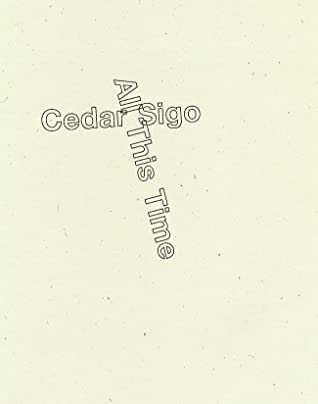
Cedar Sigo, All This Time


Like Someone in Love

Presenting—Star Time—David Meltzer
and the Famous Flames, lovely healer and
hologram, avenger of the blood who could

read for hours, when the children’s faces
                       
followed him upstairs, the dog would bark

The fire spit funerary songs
                       
A smoke of tiny feathers

that we know nothing and gladly say so (smiling)
that a prince is sometimes left to trace and dig and paste

asking after my poems, qualities of transmission
                       
and who had I been listening to? I might say

Lady or The Misty Miss Christy
Carmen meaning McCrae or Leontyne

                       
Price, either way, he was always
right there and shot through,
 

                        Wide wreath in flames

The latest from Lofall, Washington poet, critic and editor Cedar Sigo is the poetry title All This Time (Wave Books, 2021), following close on the heels of the remarkable collection of essays (that I’m still working through) Guard the Mysteries (Wave Books, 2021). Sigo’s poems are first person examinations and explorations on living, thinking, reading and being. The press release compares Sigo to a contemporary Frank O’Hara (via a quote by Ron Silliman), composing an “I did this, I did that” kind of first-person lyric, one that engages with the writers and artists within his immediate circle, and there is certainly that, but Sigo’s poetic is one that engages deeper with those poets he references. The references aren’t set simply as references or simple interactions, but composed as deep, and even foundational, engagements with the work of those he cites, including Diane di Prima, Larry Eigner, Tom Clark, Amiri Baraka, Charles Olson and Joanne Kyger. “Larry Eigner’s words,” he writes, to open the poem “Surface Waves,” “Like golden / flies / stuck in / a loom—made / to fall / with sudden / strumming / they sound, separate / distinct [.]” These are poets clearly important to his reading and ongoing poetic. Sigo edited Joanne Kyger’s There You Are: Interviews, Journals, and Ephemera (Wave Books, 2017), after all, so the repeated instances of her name throughout are hardly one of name-dropping, but in openly engaging with the work of his mentors, forebears and influences, and there is very much the sense of both engagement and homage through these references. I would even argue there’s far more of a Joanne Kyger influence, and even Larry Eigner influence, throughout this collection than anything out of Frank O’Hara, especially through the accumulation of staggered, first-person journal-entry short lines. Not that one needs to know of the source material to enjoy these poems; Sigo’s offerings are truly his own, although it does open a window into his thoughts on these other writers. Paired with this, as well, are poems composed as dedications to some of his contemporaries (including Joy Harjo, John Godfrey, Ed Berrigan and Julien Poirier); any writer’s work exists in conversation, or at least response, to the works of those around, so I’m simply pleased to see Sigo’s engagements acknowledged so directly. He is, as any good writer is, writing from within a particular and uniquely blended melange of books, writers and community interactions.

Mind control takes hold after four poems.

Elaine should be the poet in a cage (booth) at the LA art-book fair
or better yet, bill her as a prizefighting Jean Harlow

in a slightly bloodied V-neck blouse
and green-gold pyramid cuff.

*

Rereading the first Joanne interview in our new book (There You Are)

“Just write what’s going on around you. Outside and inside.”

I think of this as a statement on sustaining a viable rhythm within the poem.

The poem is the only hem (the only field?) that Joanne has to land upon. (“Six Lines Missing”)

There are times these poems read akin to journal entries or quick sketches, almost Creeleyesque, perhaps, but clearly worked and thought carefully through. There are some sharp insights caught in Sigo’s lyric (and I would highly recommend his collection of essays, the first title of his I’d actually seen; a book I clearly haven’t dealt with properly yet via review), one paired with, and even strengthened through, a lovely, easygoing craft that engages clearly and thoughtfully through the prose sentence and lyric form. And yet, this book refuses any consideration of showy or performative, allowing itself, akin to the work of his fellow Wave-poet, Joshua Beckman, a clarity of pure ease of meditative thinking: a poetry that simply and beautifully is.
Thursday, June 15, 2017

Slow Poetry in America, A Poetry Quarterly: #4-6


CHASE SCENE

we’re playing chess on the unfinished concourse to nowhere. you take off your gas mask and look at me. a train slides under us, the heart flutters, the homeless who sleep in waves around us. are we homeless, you say, the city unridden in your face, the lines unbuilt. you want to organize the ocean. unwrap the fish, i say. you unwrap the fish, and the fish squints. we begin where we are. the king is dead, and the queen is dead, and the night is fat with pawns. (Ryan Eckes)

Produced in Toronto by poets Dale Smith, Hoa Nguyen and Michael Cavuto [they even have a facebook page], the Slow Poetry in America pamphlet series [see my review of the first three here; see my Queen Mob’s Teahouse interview with Dale Smith on the series here] continues with “Eight Poems” by Joanne Kyger (Issue #4: February 2016), “Storm Work, An Icarus Opera in Three Movements” by Fan Wu (Issue #5; July 2016) and “5 Poems from General Motors” by Ryan Eckes (Issue #6; January 2017). Given that timeline, one might expect a new issue to appear over the next few weeks. Subscriptions and contact can be made through slowpoetryinamerica.wordpress.com or mcavuto@gmail.com

I put my son in his body. His mother,
gracious waif of bountiful giving,
gave my son his form or flesh, yet
never put him in his place. Soup
and quilt. Laundry and porcelain.
One lifetime of ill-fitting delicacies.
To put a body to a son is precise
work: less a question of upbringing than
the transmission of synapse & false start. (Fan Wu)

There is something ultimately graceful about a small pamphlet, larger than the single poem, yet more compact than a chapbook, allowing for a pocket of work by a single author. The simplicity of the pamphlet form allows for a good enough selection of work to get a sense of what the author is doing. I’ve been aware of the work of Ryan Eckes for some time now, and have been curious about what he’s been working on lately; Fan Wu is an entirely new discovery, and a delightful one. And then, of course, there is the tug that comes through reading a small selection of previously unpublished poems (all dated 2014, but for a single 2015 poem) by the now-late Joanne Kyger:

This “I” is a Very Suave Guy

with a quicksilver ear
Super pensive darkly dense but casual lines

Now you hear it, now you see it
on the threshold glaring
through eternity’s open door policy

Who was it told you all this?

We have lots of mourning doves over here
if you want to borrow some

                                                                                                  August 15, 2014 (Joanne Kyger)


Tuesday, February 28, 2017

Queen Mob's Teahouse: Hailey Higdon interviews Joanne Kyger


As my tenure as interviews editor at Queen Mob's Teahouse continues, the twenty-second interview is now online: Everyone Counts: Some Questions for Joanne Kyger, by Hailey Higdon. Other interviews from my tenure include: an interview with poet, curator and art critic Gil McElroy, conducted by Ottawa poet Roland Prevostan interview with Toronto poet Jacqueline Valencia, conducted by Lyndsay Kirkhaman interview with Drew Shannon and Nathan Page, also conducted by Lyndsay Kirkhaman interview with Ann Tweedy conducted by Mary Kasimoran interview with Katherine Osborne, conducted by Niina Pollarian interview with Catch Business, conducted by Jon-Michael Franka conversation between Vanesa Pacheco and T.A. Noonan, "On Translation and Erasure," existing as an extension of Jessica Smith's The Women in Visual Poetry: The Bechdel Test, produced via Essay PressFive questions for Sara Uribe and John Pluecker about Antígona González by David Buuck (translated by John Pluecker),"overflow: poetry, performance, technology, ancestry": kaie kellough in correspondence with Eric Schmaltz, and Mary Kasimor's interview with George FarrahBrad Casey interviewed byEmilie LafleurDavid Buuck interviews John Chávez about Angels of the Americlypse: An Anthology of New Latin@ Writing and an interview with Abraham Adams by Ben FamaTender and Tough: Letters as Questions as Letters: Cheena Marie Lo, Tessa Micaela and Brittany Billmeyer-Finn, Kristjana Gunnars’ interview with Thistledown Press author Anne Campbell and Timothy Dyke’s interview with Hawai’i poet Jaimie Gusman.


Further interviews I've conducted myself over at Queen Mob's Teahouse includeGeoffrey YoungClaire Freeman-Fawcett on Spread LetterStephanie Bolster on Three Bloody WordsClaire Farley on CanthiusDale Smith on Slow Poetry in AmericaAllison GreenMeredith QuartermainAndy WeaverN.W Lea and Rachel Loden.

If you are interested in sending a pitch for an interview my way, check out my "about submissions" write-up at Queen Mob's; you can contact me via rob_mclennan (at) hotmail.com