Monday, October 26, 2015

Eyewitness: From Black Mountain to White Rabbit, Carolyn Dunn interviewed by Kevin Killian


SHE APPEARS IN FULL COLOR, with her then husband, the young Boston poet Joe Dunn, on the jacket of the biography Lewis Ellingham and I published in 1998 (Poet Be Like God: Jack Spicer and the San Francisco Renaissance, Wesleyan University Press). As Carolyn Dunn, she was one of the central figures in a pivotal moment in Spicer’s life, his removal from Berkeley and San Francisco, where he had spent his twenties trying to carry on the dreams of the “Berkeley Renaissance” he had enjoyed in the immediate postwar period with his peers, gay poets Robin Blaser and Robert Duncan. It was a fellowship which, once broken by cold war politics and emerging aesthetic disagreements, could never be totally mended, and it was to New York, and then to Boston, to which Spicer hurled himself in the summer of 1956. New York had its own circle of poets and artists, but Spicer couldn’t or wouldn’t ingratiate himself to Frank O’Hara, John Ashbery, Schuyler, Guest and the rest. But in Boston, where Blaser found him a job at the main branch of the Boston Public Library, he found a camaraderie and alliance with some talented, Black Mountain-inflected poets – among them John Wieners, Steve Jonas and Joe Dunn.

When Lew and I were writing the life of Spicer, it became clear that this Boston year was the hinge in Spicer’s life, and yet who was there to tell us what it was like firsthand? Blaser was generous with his memories, but Jonas was long gone (he died in 1970), while Wieners and Dunn gave only partial accounts of their movements in the group. Spicer fell in love with the 21-year-old Joe Dunn, already a married man when the two met, and eventually persuaded both Dunns to leave Boston with him and seize the moment in a revitalized San Francisco, in late November 1956. Thus Carolyn Dunn was an eyewitness, and probably the only living one, to two defining moments in what was soon to be called The New American Poetry – the so-called “Boston Renaissance” and the world created by Spicer’s “Poetry as Magic” workshop in San Francisco [in] the spring of 1957. I remember saying to Lew, wouldn’t it be great if Carolyn Dunn was alive and we could track her down and meet her? But it was not to be, and our book came out without any direct input from her. (Kevin Killian, “Eyewitness”)

I’ve been intrigued by Eyewitness: From Black Mountain to White Rabbit, Carolyn Dunn interviewed by Kevin Killian (New York NY: Granary Books, 2015), a project that even Killian himself in his introduction describes as a piece of unfinished business from the incredible biography of the poet Jack Spicer (1925-1965) he wrote with Lewis Ellingham, Poet Be Like God: Jack Spicer and the San Francisco Renaissance (Wesleyan University Press, 1998). Fortunately for Killian, and for the interest of attempting to track a period of Spicer’s life that has yet to be fully explored, they were able to talk to Carolyn Dunn, who had reached out to Ellingham after the publication of the Spicer biography. Seemingly constructed out of a single phone conversation, Carolyn Dunn comes off as delightfully charming, highly attentive and feisty, able to describe numerous scenes in generous detail, from her own life and knowledge of Joe Dunn, to Dunn’s White Rabbit, publisher of so many of those early poets (including Spicer and George Stanley, among others), to Jack Spicer specifically and other scenes involving their time at Black Mountain College.


KK. So you and Joe were reunited in Boston, living once more on Beacon Hill, and reconnecting with the Boston poets. And that’s about the time Jack Spicer, defeated by New York, scarred by the New York poets’ indifference, arrived in Boston to make a new start in poetry. Can you remember how it was that you came to meet Jack Spicer?

CD. When we first returned to Boston, Robert Duncan was in town also. He had been teaching at Black Mountain briefly and Joe had studied with him there. So Duncan introduced Joe and me to his old San Francisco buddy, Jack Spicer, and through those two we met their other good friend Robin Blaser, who also was in Boston at that time. Our close pal John Wieners was back there too. Steve Jonas had been in Boston all along, and John and Joe had met him before going to Black Mountain. Duncan soon returned to SF, but the rest of us (except for Blaser) ended up living quite near to each other, in adjoining buildings on Grove Street. All of Beacon Hill was covered with adjoining brick apartment buildings. There was a ritzier side of the hill, which may have been to some degree inhabited by the owners, but our area was all rentals as far as I know. The population there included many students and artists, so it was sort of a bohemian community.
            I can see why Jack would have been reinvigorated by hanging out with the Boston poets. They were younger, but every one of them was talented and serious about his work and appreciated all of his most generous help. Jack, in turn, was very patient and […] encouraging. I can’t imagine how the New York poets could mock a man who was so intelligent, well-read, and wickedly witty.

Produced in an edition of three hundred copies, it will be curious to see if the publisher was correct in their assessment of potential interest, or if this interview will be seen in the context it appears to have been created out of: as a direct extension of the work Killian did on Jack Spicer’s biography. One can only hope that there is an interest a bit higher than three hundred. For some time now, Granary Books has worked hard to produce a great number of very attractive, large and short run titles focusing on acknowledging and expanding our knowledge of a variety of literary histories (my first awareness of the press came from their 2001 title, The Angel Hair Anthology, collecting a ‘best of’ Anne Waldman and Lewis Warsh’s legendary and influential 1960s magazine Angel Hair, along with their subsequent small press publishing), and this title shines a curious spotlight on a less-known period of American writing generally, and Jack Spicer specifically. I only wish it might have been longer.

Sunday, October 25, 2015

Phil Hall, My Banjo & Tiny Drawings


Kinds of Poetry

1.
2. I miss it…
3. I’ve had it!
4. Lampoon. Inherit. Bestow.
5. It: big hitching-post / little church
6. eye tea
7.

(1 & 7 are not the same)

Produced in a beautiful hardcover edition of two hundred and fifty copies is poet and editor Phil Hall’s My Banjo & Tiny Drawings (Toronto ON: Flat Singles Press, 2015). Flat Singles Press, resurrected after an extended dormancy by incoming editor/publisher Joseph LaBine, is a press originally founded and run by Hall himself; producing small broadsheets and chapbooks very occasionally, many of the items were by Hall, but also included publications by Bronwen Wallace and others in Hall’s extended network of writers. Having produced a small handful of limited-edition chapbooks and other ephemera, continuing what Hall began, this is LaBine’s first foray into a full-sized title and the results are stunning. This is actually the second title of Hall’s to release lately, after the ‘selected poem’ Guthrie Clothing (WLU Press, 2015) that I helped see through their Laurier Poetry Series.

The short collection is constructed in two sections—“My Banjo” and “Tiny Drawings”—the second of which is made up of extremely condensed poems:

:

  a colon says

both my holes
  want the staple back

The poems collected within further Hall’s exploration of language, sound and meaning, as he picks at the minutae, working to see where the logic of such small explorations might lead. As the second section of the two-part poem, “My Banjo,” reads:

  Out of tune     his dusty     shelves

& instruments      tell
  Only who   he pretended     he was

this magnifying glass    —O

  goes with his boxed     tiny-print     2 vol
OED     Music Is Everything

  says a sticker     on his banjo-case

Given the liveliness of Hall’s sketches, rendered as specific and quick as the finest shorthand, I’m a bit disappointed to see that the book doesn’t actually include any. Even the cover image, a sketch, one might presume, of Hall himself on banjo, is by Stuart Kinmond, and not by Hall. Still, the idea of the quickly-rendered sketch is an intriguing one, set up, one could presume, as another one of Hall’s killdeer-esque distractions; it suggests a compositional process that is far different than Hall’s patiently and delicately carved fragments, each carved and carefully set to accumulate into something far broader in scope. “When the tap turns at full,” he writes, in “Eigner,” “why does Narrative have to stand / on the garden-hose in its skates // wearing a giant dollar-bill costume [.]”

Copies are selling for $22; requests by email to flatsinglespress@gmail.com

Saturday, October 24, 2015

To Live and Die in Groningen (The Netherlands,

Saturday, October 17, 2015: We flew the hour to Amsterdam from Berlin [you've already read the report of our week in Berlin, haven't you?], before catching a two-hour train to Groningen, where Christine's friend (and bookbinder) Natasha Herman lives. She, and Netherlandic husband and two sons, lived in Ottawa a couple of years back, and we even house-sat for them when they lived on Sunnyside Avenue, in Old Ottawa South (the square house with all the windows: if you know the street, you already know the house).

After a two-hour train, Rose was really losing her patience. "I no want ride train anymore," she repeated, after a small series of meltdowns, before she finally crashed out cold, some fifteen minutes before we landed in Groningen. Natasha was good enough to pick us up at the train station, so we didn't have to (yet) learn where anything was, in a strange city with sleeping toddler and too many bags.

And at the train station: more bicycles than I could even understand. I saw a three-storey bike stand filled with bicycles, and that might have been only a third of what I saw once we landed.

After all the rest went to bed, Natasha and I stayed up late discussing politics, education and Canadian history, and how not nearly enough is taught in schools.
Sunday, October 18, 2015: A quiet day. Our hosts' youngest, Casey, turned five, so we sat in on his birthday party, which involved about eight or nine children tearing through the house, while a couple of the adults drank wine (a-hem).

Christine drank tea, obviously.

Despite the howls of multiple children, napping Rose was out cold for nearly two hours.

They have a trampoline outside, and once the older children became bored with it, we set Rose loose into the yard. After an hour of taking turns watching her bounce around, we finally had to drag her back into the house (outside was cold, rainy, etc) kicking and screaming. No, she screeched, more yard! But boy, she slept well.

After all else went to bed, Natasha and I stayed up late and later, discussing music (bluegrass, etc), and taking turns plucking at ukulele and guitar. Of course, I introduced her to the Elvis Costello ukulele track I like, and Nellie McKay's ukulele Ted Talk.

Monday, October 19, 2015: A day in which we attempted an outing. Did we? Postcards, a couple of groceries, and a walk to the park. A park which ended up being a school playground; apparently the Netherlands in the midst of their week-long fall break, which meant the school closed, and Rose could run around the otherwise-school equipment (she likes to slide down backwards, upon her belly).

Found postcards. Mailed a package of things, including Touch the Donkey, over to Megan M. Garr in Amsterdam; she runs Versal, a magazine I've appeared in (but not for some time; I should really send some more work at some point). If only we'd had more time in Amsterdam. The benefit of staying with friends is the possibility of a few quiet days, which I think we've required, but it also means I haven't seen a thing in the Netherlands. Oh, but for the bicycles. So many bicycles.

After all else went to bed, Natasha and I stayed up less late, and she played Gillian Welch's lovely song "Tennessee" on guitar (a piece I wasn't familiar with). We discussed mutual friend Anik See, who lives in Amsterdam (why didn't I attempt to plan to visit? ugh). I attempted to remain up to catch a glimpse of Canadian election news, but the polls weren't even going to start reporting from Newfoundland until midnight or so where I was sitting. Ugh.

Tuesday, October 20, 2015: Woke up to a red wave across Canada; our dawn coming in at just around 1am Ottawa time. Relief.

Rose insisted on starting the day in the yard, upon trampoline.

Today we travelled from Groningen to Utrecht, where Christine was doing her talk through an organization Natasha is a part of. Apparently Christine's talk the first in a new series they're starting on such. We trained the two hours to Utrecht with Natasha, before figuring out our wee Bed and Breakfast. Christine and Natasha then wandered off to meet another bookbinder (so Christine could meet, and also see their studio), and Rose and I wandered the street immediate to our Bed and Breakfast.

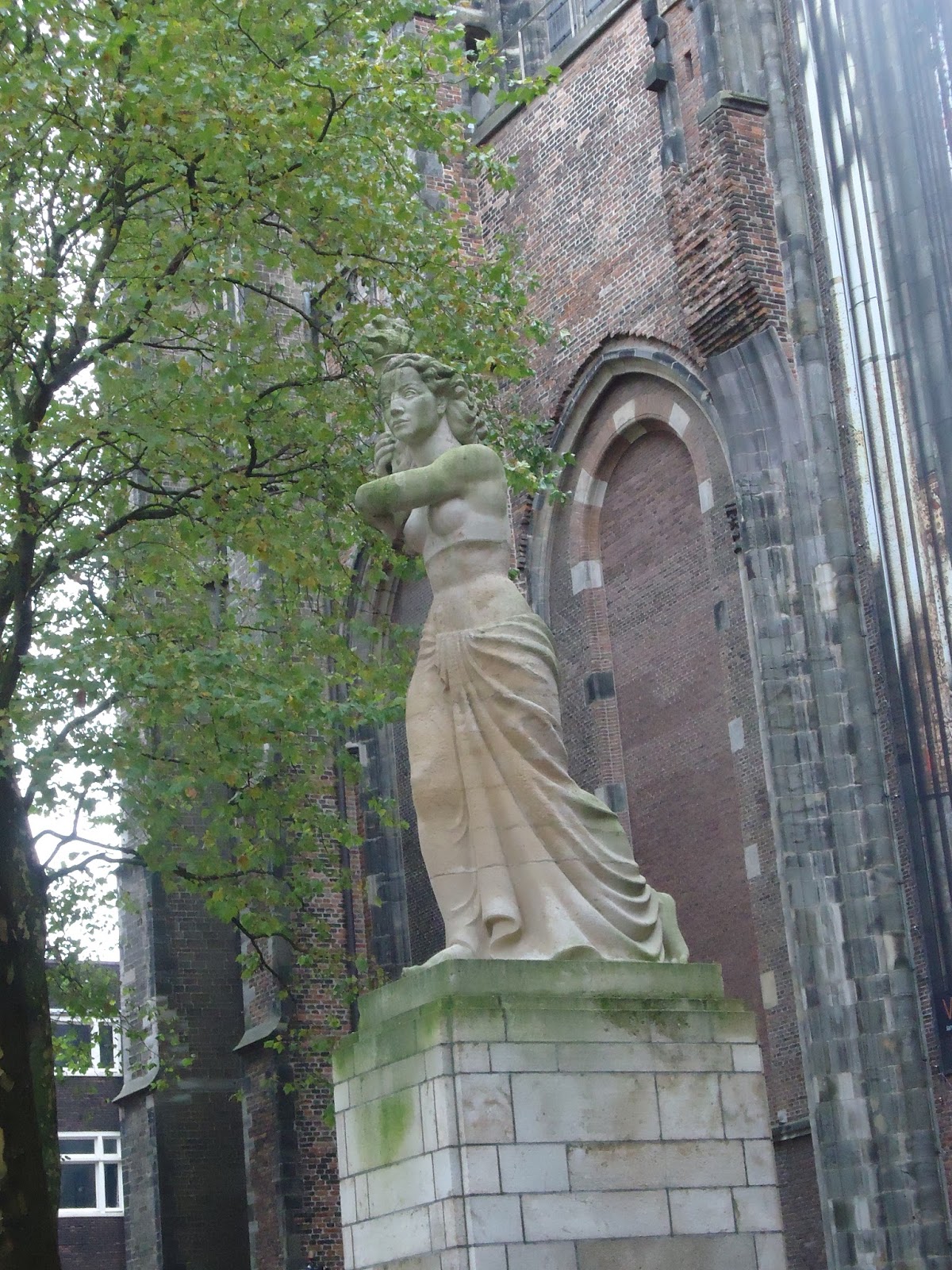
Utrecht is a delightfully quaint city, and one I know absolutely nothing about. Cobblestones, old buildings and bridges over a winding canal. Rose and I picked up postcards, a music box and other tourist charms. We visited an antiquarian bookseller, and saw a Dutch edition of an Anne Carson title. We looked at statues, and followed the paths of birds. We picked up ginger cookies, which Rose enjoyed before passing out cold in the stroller.

There are so many bicycles. Ottawa, are you listening? Although, as Natasha reminds, the Netherlands is flat (Ottawa is not). The same thing Donna Stonecipher said about Berlin.

We met up again for a quick dinner, before Christine and Natasha ran off to the lecture, leaving Rose and I finishing up in the pub. She made a mess with Christine's soup and spoon (although she ate quite a bit). I had another drink (Rose was in no hurry to finish eating).

Rose and I eventually retired up to our room. I stripped her down, and co-showered (the soup required it). And it took some time (and some convincing), but she eventually slept. It was a quiet evening, after a short sequence of (required) quiet evenings.

Christine returned with reports of a successful lecture. Natasha wandered the two hours back to Groningen.

Wednesday, October 21, 2015: We woke, and enjoyed the second 'B' in the 'B&B' label. Small items: bread, meat, jams. A delightful breakfast before we wandered over to the Dom Tower, built on the site where Utrecht was invented some two thousand years ago (why do I know nothing about this country? We have a Tulip Festival thanks to their Princess born in Ottawa during the War...).


And then, of course, our noonish train back into Amsterdam, and our flight to Berlin.

At our hotel by the airport, what was most likely the worst hotel in all of Berlin. We were amazed there were no bugs (that we could see).


Thursday, October 22, 2015: An early, early, early-morning flight from Berlin to Frankfurt, from Frankfurt to Toronto, from Toronto to Ottawa. Home mid-afternoon. I'm exhausted even thinking about it. Alarm for 4:15am for a 4:45am cab pick-up for our flight back to Frankfurt, where we would pick up our flight to Toronto, and another to Ottawa.

Of course, our Toronto flight delayed, which meant we had to take a slightly later flight to Ottawa. Home in our house by 5pm Ottawa time, thanks to a pick-up by our incredible house/cat-sitter, Carmel Purkis (we owe her much, we have decided). Exhausted, we opened our mail, threw laundry into machines, and crashed. And slept twelve hours.

Friday, October 23, 2015

12 or 20 (second series) questions with Ali Blythe

Ali Blythe is the author of Twoism, which was published in the fall with icehouse poetry at Goose Lane Editions. Blythe completed a residency at the Banff Centre and a writing degree at the University of Victoria, receiving the Candis Graham Writing Scholarship from the Lambda Foundation for excellence in writing and support of the queer community. Poems from Twoism have been published in literary journals and anthologies in Canada and Germany.

1 - How did your first book change your life? How does your most recent work compare to your previous? How does it feel different?
Oh, Twoism is my life. I don’t really believe in past lives, though I sort of hope for future ones.

2 - How did you come to poetry first, as opposed to, say, fiction or non-fiction?
Poetry made sense in my 4-yr-old brain and it stayed that way.

3 - How long does it take to start any particular writing project? Does your writing initially come quickly, or is it a slow process? Do first drafts appear looking close to their final shape, or does your work come out of copious notes?
The shape. That’s interesting. The position of the struggle, frozen there on the page. Jacob and the angel. Look at that angel’s back foot.

4 - Where does a poem usually begin for you? Are you an author of short pieces that end up combining into a larger project, or are you working on a "book" from the very beginning?
I try very hard not to say the word “poem” or “book” aloud in that context.

5 - Are public readings part of or counter to your creative process? Are you the sort of writer who enjoys doing readings?
I love readings. The feeling of camaraderie with fellow poets.

6 - Do you have any theoretical concerns behind your writing? What kinds of questions are you trying to answer with your work? What do you even think the current questions are?
I much prefer the practical applications of things. For instance, would you rather theorize about Jacob and the angel or would rather choose one of those bodies to jump into. Maybe the answer to my current question is: both please, at once.

7 – What do you see the current role of the writer being in larger culture? Does s/he even have one? What do you think the role of the writer should be?

To make the souls drop out of the bottoms of our feet.

8 - Do you find the process of working with an outside editor difficult or essential (or both)?
Essential. I abide in that relationship. Phil Hall edited Twoism. So I’ve been very lucky. One for one.

9 - What is the best piece of advice you've heard (not necessarily given to you directly)?

“You should send that to Dave Seymour at icehouse-Goose Lane.”

10 - What kind of writing routine do you tend to keep, or do you even have one? How does a typical day (for you) begin?
I wake up with a slight pinching headache, thankful for last night and the poems in my head.

11 - When your writing gets stalled, where do you turn or return for (for lack of a better word) inspiration?

When I am stalled, I am busy looking at the view and digging around in my jeans' pocket for that thing I left there.

12 - What fragrance reminds you of home?
Her pheromones and a wet dog.

Though I like Eileen Myles answer, circa November 17, 2013.

13 - David W. McFadden once said that books come from books, but are there any other forms that influence your work, whether nature, music, science or visual art?
Yes, all of the above, with music coming last. No wait a minute, I forgot about Boards of Canada.

14 - What other writers or writings are important for your work, or simply your life outside of your work?
Melanie Siebert, Garth Martens, Anne-Marie Turza.

15 - What would you like to do that you haven't yet done?
Live dusk and sunup ad infinitum.

16 - If you could pick any other occupation to attempt, what would it be? Or, alternately, what do you think you would have ended up doing had you not been a writer?
A male ballet dancer. Living in the desert. Thinking of the city.

17 - What made you write, as opposed to doing something else?

100% joy, 100% sadness, at all times.

18 - What was the last great book you read? What was the last great film?
Maggie Nelson’s The Argonauts. Can’t think about a film after I think about that book.

19 - What are you currently working on?
Waking up with a slight pinching headache, thankful for last night and the poems in my head.

12 or 20 (second series) questions;

Thursday, October 22, 2015

Juliana Spahr, That Winter the Wolf Came


My body is unremarkable, not at all singular, as I walk up to join these other bodies, and it remains unremarkable, not at all singular, as it walks with others, takes off into the street when others do, usually after someone yells block up block up into a megaphone. Then we walk together and yet unevenly out into the street, darkly clad because the facebook invitation said to wear black, in small groups, some faster, some slower, some holding hands, some on bikes, some with canes, sometimes someone in a wheelchair. There is always a megaphone at the front. And then a second later, someone usually on a bike, off to the side, blocking traffic until we cross the intersection. This person calm, smiling.

I have a tendency to anxiously slow down. I also stay to the side. I am nervous, anxious. I want to keep saying this. I am an anxious body. Shortly after we step out into the street, the white vans, which have been idly waiting nearby, pull out and the motorcycles drive up from behind. Engines then and bright directed lights. (“Brent Crude”)

American poet, editor, collaborator and critic Juliana Spahr’s most recent title is That Winter the Wolf Came (Oakland CA: Commune Editions, 2015), a collection that furthers her engagement in social justice, environmental concerns and political anxiety, as well as her use of repetition, chant and unrelenting accumulation. Really, to call Spahr’s poetry books “collections” is a bit of a misnomer: her poetry books are created very much as book-length works, and less a “collection” of scattered pieces that somehow group together, whether deliberately or accidentally, into a theme. That Winter the Wolf Came is a direct result of, and response to (as the inside flap informs), “this era of global struggle.” The blurb continues: “It finds its ferment at the intersection of ecological and economic catastrophe. Its feminist and celebratory energy is fueled by street protests and their shattered windows. Amid oil spills and austerity measures and shore birds and a child holding its mother’s hand and hissing teargas canisters, it reminds us exactly what we must fight to defend with a wild ferocity, and what we’re up against.” Spahr is both author and co-editor/publisher of Commune Editions [see their collaborative “12 or 20 (small press) questions” interview here], a press founded to produce works very much in keeping with the kinds of poetry Spahr writes around global social and environmental issues. Over the past couple of years, I’ve become far more aware of poets across North America working such social and political issues into their works (some of whom have been working in such veins for years), from Canadian poets Stephen Collis and Christine Leclerc to Jordan Abel and Marie AnnHarteBaker, and Shane Rhodes and nikki reimer (among others), as well as Commune Editions Spahr and Joshua Clover [see my review of his recent Commune Editions title here]. It seems a number of the language poets have reclaimed what was once referred to (neither enthusiastically nor complimentary) as “political poetry,” allowing the language to enhance and beautifully articulate what had been done so rarely well, and far-too-often presented as dogmatic.

It was all good and it was all fucked while it lasted. But eventually Non-Revolution and me were over. It was not that one day I woke up and knew it was over. What we had, Non-Revolution and me, was like all relationships, built to last. But unlike many relationships, everything was against us. Yes, we cared for each other. Yes, we learned to tend to each other’s wounds too, to medicate and to bandage. But we suffered from a larger social lack of care or worse a relentless disdain. We were together but we were in it alone at the same time. Except the state was there with us in all sorts of ways. And we suffered from too much of a different sort of care from the state. And we knew history. We knew we would not be together long. (“It’s All Good, / It’s All Fucked”)

In nine extended poems, including prose-poems, Spahr is adept at pulling apart an idea and stretching it across a wide canvas, composing pieces out of a staggering amount of small detail. Hers are incredibly complex, complicated and straightforward poems made of multiple working parts towards a single purpose. One element I’ve always admired about Spahr’s poetry is the way in which she uses the direct statement (akin to Canadian poet Lisa Robertson), pushing the use of accumulation and repetition so relentlessly that the poem reads as a kind of chant, or mantra. Her cadences are hypnotizing, and hold such incredible beauty.

I am waiting.
Said this out loud.
Said to no one in particular.
Said we are waiting.
Some of us are waiting.
Waiting for the assembly of fish.
Waiting to be complete.
Waiting to storm the waters.
Also waiting for the assembly of trees.
Waiting to be complete.
Waiting to be infiltrating the land.
And waiting for the assembly of animals.
Waiting to be complete.
Waiting. Waiting.
Waiting for the assembly of birds.
Waiting to be complete.
Waiting to fly the sky dark.
Waiting for the impossible.
Said waiting.
Meant waiting.
Waiting to fly the sky dark.
Waiting to be complete. (“If You Were a Bluebird”)