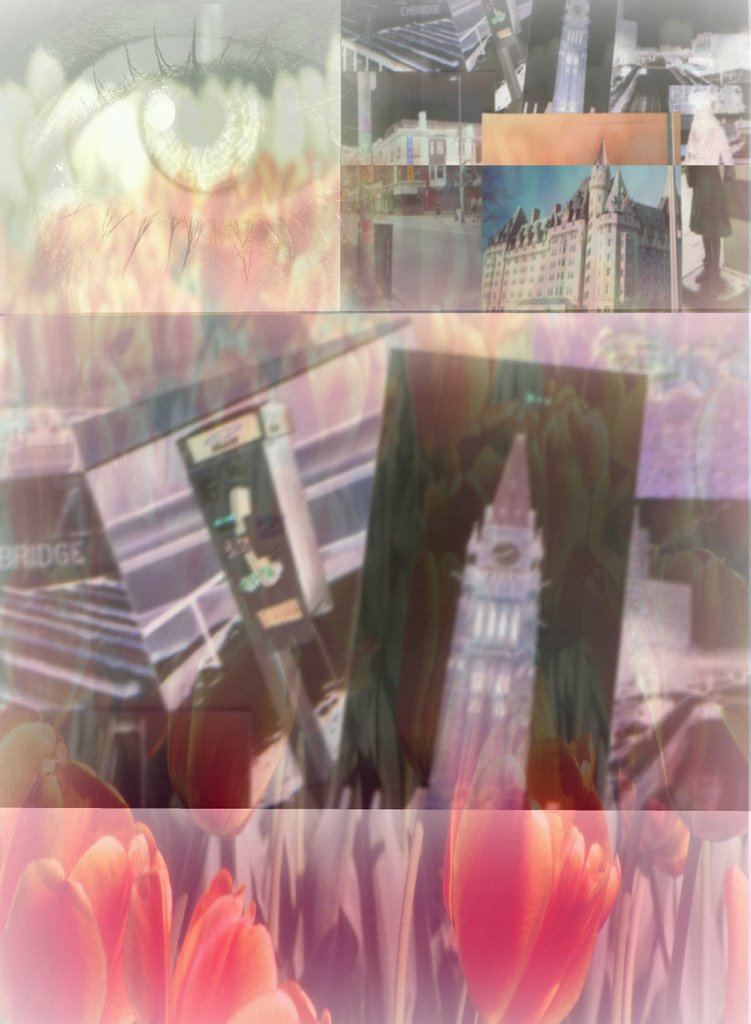
you are sleepingCurator Emily Falvey describes the exhibition Evidence: The Ottawa City Project as a "lacework of absence, or maybe it would be better to say negative presences."[1] As many of us living in Ottawa already know, our city is a multi-layered community, not just a civil-service/high-tech hybrid built on the remains of a Victorian lumber town. Unfortunately, outside Ottawa, and sometimes even within, this fact is frequently overlooked and even dismissed.
in ottawa
it’s another hot night
after the fashion
of steam and tendrils
— Judith Fitzgerald, "ottawa," lacerating heartwood
If you can confidently say you know a city, you are probably talking about a town.
— Peter Carey, 30 Days in Sydney
The curatorial trigger for Evidence came from my own poetry collection, The Ottawa City Project (2007), a book that shaped an image of Ottawa through references and fragments, and not as a single representation or unified whole. This is something that Falvey’s exhibition seeks to replicate, presenting a series of alternative views and perspectives of the city. There are no stereotypical images of the Peace Tower or tourist shots of Sparks Street here. Instead, Evidence asks how any single text or image, however iconic, could possibly represent a whole geographic centre, especially one that has been inhabited for thousands of years.
To paraphrase Socrates, it’s not worth living in an unexplored city. Sadly, the idea of Ottawa has become so presumed, so foregone, that it is no longer even considered. Even before amalgamation, Ottawa was never a place with a single idea, history or name, but an interconnected series of overlaps in constant flux, continuously expanding and troubling the definition of the Nation’s Capital. This is the city that nineteenth-century Governor Generals cursed; that Ozzy Ozbourne once kept as home base for a Canadian tour; and that the Confederation Poets called home. It was one of only three locations outside the United States where Elvis Presley performed, and, in the 1840s, it was called “the most dangerous town in the Commonwealth.”
Poet Judith Fitzgerald once wrote an insightful poem about Ottawa. It contains a fragment of the story of Paul Chartier, also known as "the mad bomber of Parliament." In 1966, Chartier (Canada’s Guy Fawkes) went into the Parliament Buildings and attempted to blow up a sitting House of Commons. On the way he ducked into the women’s washroom to fiddle with his bomb, and succeeded in blowing up himself. Then only thirteen-years-old, Fitzgerald was on a school trip from Toronto to visit the Parliament Buildings, and actually witnessed the event.
Ottawa is always glossed over for being the Capital City, but Fitzgerald, an outsider, managed nonetheless to write a poem about what official Ottawa tour guides refuse to discuss: the downside of the Capital—the things that Ottawa has always had but never acknowledges, such as bohemian tendencies or the immutable heat of July and August, “after the fashion/of steam and tendrils.” Sometimes the most interesting works about our city are produced by those just passing through.
Ottawa is the Nation’s Capital, they tell us, but then most refuse to consider anything that falls past the shadow of Parliament as a national concern. Take for example the Ottawa Art Gallery. Now twenty years old, OAG should be the physical and financial equivalent of the Vancouver Art Gallery, the Winnipeg Art Gallery, and the Musée des beaux-arts de Montréal. But it isn’t, despite the talent, dedication and hard work of a community that is constantly overshadowed by national institutions, such as the National Gallery of Canada, the National Arts Centre, and the National Library and Archives. The fringes of Ottawa demand, nonetheless, to be heard. The artists in this exhibition, like so many others exploring the detritus of landscape and of the individual, are exploring what gets lost or overlooked. They are exploring histories that are part of the larger fabric of Ottawa, providing alternative perspectives on what is all too often whitewashed or discarded.
Ottawa is a city that often claims almost no history or occupants, other than temporaries passing through on their way somewhere else. Yet there have been world-class artists here in just about every field, many of them born and raised here. I was born here, and my mother before me. This sense of history and place informs my poetics, which follows what Sina Queyras once called “a long diagramming of the self in the world.” I see this kind of diagramming in the work in this show, which reminds us that there is no single piece of evidence, no single conversation, no final word about Ottawa.
—rob mclennan, Writer
[1] Emily Falvey, correspondence, November 2008.