
Showing posts with label Jon Paul Fiorentino. Show all posts
Showing posts with label Jon Paul Fiorentino. Show all posts
Thursday, July 24, 2014
The Rusty Toque interview with Jon Paul Fiorentino
Tuesday, December 31, 2013
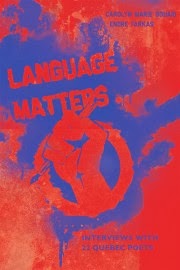
Language Matters: Interviews with 22 Quebec Poets, eds. Carolyn Marie Souaid and Endre Farkas
God knows the creative process
is a mystery. To make something out of nothing, to see a world in a blank page,
to hear imagined people speak, to touch things that aren’t there, to taste what
is not yet baked, to speak volumes or write an image is something to wonder at,
something awesome to behold. Yet these are the things that artists do every
day. These are the tasks, pleasures and pains that artists, including poets,
undertake. Transmitters of acts of the imagination, poets use language to make
their unique works of art. But how do
they do this?
This is one of the many questions we asked Quebec’s
English-language poets over the four-year lifespan of the online literary
magazine that we, along with Elias Letelier, founded on June 24, 2009, Quebec’s
Fête Nationale. We were curious about their process but we also wondered
whether living in Quebec and writing in the language of “les autres” meant
anything aesthetically, socially, culturally and politically. We had a poetic
and political agenda. Poetry Quebec,
or PQ, was a conscious and deliberate
nod (and wink) to Quebec’s separatist party, the Parti Québécois. We wanted
through our tongue-in-cheek name and motto, “Je me sousviens,” to signal that
Quebec’s English-language poets are Quebec
poets who were, are and will be here to remember and be remembered. The name
and motto were also a manifesto of our engagement.
There
is something very familiar in the framing of the new collection Language Matters: Interviews with 22 QuebecPoets, eds. Carolyn Marie Souaid and Endre Farkas (Winnipeg MB: Signature
Editions, 2013). The press release begins:
Is writing in English
in Quebec a political act? An act of survival? An act of defiance? An act of
futility? An act of celebration? For answers to these questions, look no
further than Language Matters, a
series of candid interviews with some of Quebec’s – Canada’s – most interesting
and innovative poets, which launched on Tuesday, September 10, 2013. These are
poets who write in the dominant language of North America, but are the
linguistic minority in a francophone culture – a minority within a minority. Living
in the birthplace of Canadian poetry that gave rise to A.M. Klein, F.R. Scott,
Louis Dudek, Irving Layton and Leonard Cohen, how do these poets view
themselves and their already marginalized art?
There
is something familiar here, and even curious: but for the date mentioned
within, this blurb could easily be included on the back cover of a similar
collection of essays twenty, or even forty years earlier. Have the questions
really not changed during that period (or for that matter, the poets one might
cite as precursors?)? As someone who grew up just on the other side of the
Quebec border, I’ve a curiosity about such questions of landscape and
geography, and wonder if there should be further questions in other regions
that should also be repeated to the writers within, to allow a different perspective
on other types of geographies, their politics, language and considerations of
local space. Over the years, co-editor Endre Farkas has worked tirelessly to
promote, encourage and explore English-language poetry in Montreal specifically
and Quebec and the rest of Canada generally, through his work as one of the original Vehicule Poets in the 1970s (the group that helped give rise to
Vehicule Press, where he was one of the founding editors) to later founding The
Muses’ Company in 1980, to editing, co-editing and/or contributing to anthologies
such as 10 Montreal
Poets at the Cegeps (Montreal QC: Delta, 1975), Montreal English Poetry of the Seventies
(Montreal QC: Vehicule press, 1977), Vehicule
Poets (Montreal QC: Maker Press, 1979), CrossCut: Contemporary English Quebec Poetry (Vehicule Press, 1982), Canadian Poetry Now (Toronto ON: Anansi,
1984), Voix Off (Toronto ON: Guernica,
1985), The Other Language: English Poetry of Montreal (The Muses’ Co., 1989) and Quebec Suite: Poems for and about Quebec (Winnipeg
MB: The Muses’ Co., 1998). Farkas has spent decades working as an
English-language poet in a geography and political landscape where he has been
very much part of the minority, and through such, his efforts have allowed
certain writers to become known and even flourish where they might not have otherwise
had the same opportunities. But the question of the book becomes: have the
questions one poses to writers in such a landscape really not changed over the
years? It’s as though the framing of the collection doesn’t give nearly enough
credit to the scope of the book’s content, and the engagement each author has
with questions goes far beyond those suggested on the cover. When asked “Would
you say that writing in English in Quebec [is] a political act?” in her
interview, Erin Moure answers:
Not necessarily. Writing is always a
political act, of course. Writing in
English is not devoid of politics, for sure, in terms of the conditions of
production and reception for that hegemonic language in the world. Writing in
English in Quebec is also subject to conditions of writing in a society that
speaks French. So there are political consequences, and social consequences, to
writing in English in Quebec. Yet the act of writing in English, picking up a
pen and writing, is not necessarily a
“political act” for me, who grew up in English in Alberta. The act of writing
in English and including French directly in the poem is a political act,
though. The act of writing and speaking in Galician is a political act.
Originally
conducted to be posted on their online Poetry
Quebec (a website that arrived with much enthusiasm, but seems to have disappeared), the collection includes a selection of a series of interviews conducted
over four years with poets Stephanie Bolster, Mark Abley, Erin Moure, David McGimpsey, Mary di Michele, Gabe Foreman, Catherine Kidd, Richard Sommer,
Maxianne Berger, Steve Luxton, Robyn Sarah, Mahamud Siad Togane, Susan Gillis,
Brian Campbell, Charlotte Hussey, kaie kellough, Moe Clark, Jason Camlot,
Gillian Sze and Angela Leuck as well as interviews with the editors, Farkas and
Souaid, themselves. The interviews (each including a poem or two by the interviewed
poet) connect through a common concern with the intricacies of language (including
multiple languages), and each speak of their engagements with Quebec writing,
writers and the immediate landscapes in which they live. As Susan Gillis says
in the space of her interview, “Living
in English in Quebec is a political act.” She continues:
History and culture are
living continuities. Writing and working and living in a minority language
create an active engagement with those living continuities, a kind of
claim-staking: Look, here’s my little corner of history and culture, alive and
well and kicking. Not threatening, just being. I suppose for some Quebec
nationalists, any other culture’s activity is threatening? Or the very notion
of “just being” is false? I don’t see my work or myself that way, but that doesn’t
mean others might not.
Originally
from Calgary, Montreal-based “word-sound systemizer” kaie kellough provides an
interesting perspective:
for an english writer,
provincial boundaries dissolve. the nice thing abt writing & performing is
that it can travel. if english writers were restricted to publishing &
presenting their works in québec alone, then i might feel that working in
english is a political act. but english writers can publish throughout north
america: the markets for our work are much larger than the markets for french
work. when my first book was published, it was launched in vancouver, ottawa,
toronto, and montréal. further, i was eventually invited to read across the
country - in halifax, calgary, gabriola (bc), saskatooooon, etc. [...] a
french-language poet might get to launch a first volume in montréal, ottawa,
and québec city, if lucky.
What
does it mean to be an English-language Montreal writer, or more broadly, an
English-language writer in Quebec? For some the question is essential, and for
others, the question is a curiosity, nearly in passing. For some writers, these
questions might be entirely irrelevant to the ways in which they write. Thanks to
editors Farkas and Souaid, the question allows the answers to showcase the ways
in which the landscape has shifted over the years, and just how much has
remained the same. I’d be curious to hear others respond to these questions,
such as Montreal-based writers Sina Queyras, Jon Paul Fiorentino and SusanElmslie, as well as some of the younger writers slowly emerging in the city,
such as Helen Hajnoczky and Kirya Marchand. This is very much a collection built originally not as a book, but as a series of online one-offs which, when collected, might show the occasional gap or two. One hopes that further work, and/or a second volume might be
down the road?
Monday, September 23, 2013
Jon Paul Fiorentino, Needs Improvement
WICKED
ELOQUENT
Because poetry is very, very far from –
and those who therefore thrive insist it remain
so
And also contemplative drones drone
inside cabailist cocooneries
Not to mention domain names reserved for only
the most
wicked eloquent –
Plus flaccid fraternities with their
heightened-flaccidity-as-aesthetic-mandate
flail, swing
Most meritorious solder wand weld torch trophy
crooners
croon the comments, the walls, avoid the wells
And wasn’t this ambition supposed to be in the
writing, not in the
product? In tenor and vehicle and not in laurel
and mantle?
Fuck me. I’m as flail as anyone

Montreal writer and Winnipeg ex-pat Jon Paul Fiorentino continues his persona of the ‘beta male’ (although far softer here than in previous works) through his sixth trade
poetry collection, Needs Improvement
(Toronto ON: Coach House Books, 2013), from the cover image of a mediocre
report card (including subjects “trope,” “imagery” and “self-regulation”) to
the subtle thread that stitches his lyrics and post-lyrics together into an
extremely tight and taut collection. Fiorentino’s poetry is thick with
references to misspent youth, the City of Winnipeg, recreational pharmaceuticals,
clinical depression, Montreal and juvenile humour, and his poetry has evolved over
the years into an impressive staggered and studied post-language lyric. Over
the stretch of more than half a dozen trade titles – including two works of
fiction, and previous poetry collections Indexical Elegies (Coach House Books, 2010), The Theory of the Loser Class (Coach House Books, 2006), Hello Serotonin (Coach House Books, 2004), resume drowning (Fredericton NB: Broken Jaw Press, 2002) and transcona fragments (Winnipeg MB: Cyclops
Press, 2002), as well as the chapbook hover
(Winnipeg MB: Staccato chapbooks, 2000) – Fiorentino has learned to play his
combination of dark and flippant tone as less of an overpowering force than a
simple and subtle distraction that actually masks his movement into entirely
different subject matter. I find it interesting that Fiorentino’s poetry has
evolved into more conceptual veins, including the “pedagogical interventions”
in the title section; utilizing manual illustration, satire, appropriation and
manipulation, Fiorentino has widely expanded his ouvre far beyond the once-core
of his work in the prairie long poem, and managed to craft questions far more
important than the answers.
The
visual poems he includes are reminiscent slightly of those by former Vancouver poet Jason Le Heup a decade or so back, as well as other works through and
around the Toronto Research Group (bpNichol and Steve McCaffery), and blend
perfectly with the rest of the collection [see an example of such here]. Composing poems both lyric and
visual, the poems in Needs Improvement
attempt to explore, explain and even obscure theory, and even opens with a
quote by Judith Butler: “Neither the Austinian promise nor the Althusserian
prayer require a pre-existing mental state to ‘perform’ in the way that they
do.”
MINIMAL
PAIR: SIMPLETONS
When I said we made a minimal pair
I was deep in linguistic conceit
It had nothing to do with your character
it was strictly labio-dental
Some
of the poems in this collection previously appeared as the chapbook The Winnipeg Cold Storage Company (Calgary
AB: NO Press, August 2012), including works that focused on mythmaking and
geography, working over, across and through his hometown of Winnipeg, as he
does more specifically in the title poem to the chapbook, included here as
well:
The title of “Winnipeg Cold Storage Company”
poses the question of collective memory and what it means to say that ‘things
might be done with storage’? The problem of collective memory is thus
immediately bound up with a question of performance. What does it mean for
storage not only to store, but also in some sense to perform and, in
particular, to perform what it stores?
In
the colophon of the chapbook, he wrote that “The text from ‘Winnipeg Cold
Storage Company’ is appropriated and manipulated with the most love from Excitable Speech: A Politics of the
Performance by Judith Butler.” Composing poems as lyric-fragments of
losing, loss and disappearance, as well as a section of report cards exploring
bullying through satire, Fiorentino manages to turn information against itself,
even to the point of working to say nothing at all.
TRINITY
BELLWOODS
Down to my last
lyric
Do you know the word pilling?
It’s a piling on of fabrications
You wear it well or
wore it
Free-range derangement commences
as denizens make strange with tenses and moods
I saw an old cancerous friend here
who said, ‘I remember when I used to be
creative –
They cut it out of me
all interstitial-like’
Now, the lies and years are
piling/pilling
I will miss you when you shun me. I write these
things for nothing
You remain
the best nothing I know
Thursday, July 04, 2013
New American Writing: Canadian section
Ten Canadian Poets
►◄
edited by rob mclennan
: Rob Budde
: Stephen Cain
: Margaret Christakos
: Trisia Eddy
: Jon Paul Fiorentino
: Phil Hall
: Marilyn Irwin
: Meredith Quartermain
: Nicole Markotić
: Andy Weaver

The thirty-first volume of the poetry annual New American Writing is now available, with a section of “Ten Canadian Poets” edited by yours truly, following on the heels of other selections of Canadian poetry I’ve attempted to showcase outside our borders, including the Canadian issue of Swiss online pdf journal dusie, or the three sections I edited for Jacket magazine (on Douglas Barbour, on George Bowering and on new Canadian poetries), as well as a thread that exists in the midst of the new “Tuesday poem” feature I’ve been curating, over at the dusie blog. I’ve actually been wanting to edit an anthology of twenty-four Canadian poets for a non-Canadian publisher for years, but haven’t yet managed to convince a publisher.
When soliciting for this small section of “New Canadian Writing,” I attempted a cross-section of some of the writers I’ve been keeping my eye on, the ones from various corners of the country that excite me. They range from the well-established to the other end of emerging; they range from the experimental to the more lyric narrative. The differences between our two countries are small, stark, obvious, nebulous and often impossible to articulate. There is no single difference. We look and sound like you, but after a while, subtle difference come up, that you hadn’t quite noticed before.
There have certainly been improvements over the past decade, but on the whole, writing doesn’t cross the Canadian/American border easily, and most international publishers that produce poetry works don’t often publish the works of Canadians, leaving us aware of works by American, British and other international writers, but predominantly as a one-way system. Online journals such as Jacket magazine, Jacket2 and Lemonhound have certainly worked to improve the conversations between countries, as well as the Canadian poets now with author pages on the American Electronic Poetry Center website, but there is always room for improvement. I hope that this small engagement might provide some further interest in what some truly amazing Canadian poets have been up to, lately.
Thanks so much to Paul Hoover and Maxine Chernoff for allowing me this space in their journal.
Wednesday, October 31, 2012
Ongoing notes: late October, 2012

We’re back from the honeymoon, but still in the
midst of post-wedding/honeymoon glow. Or is that merely hangover? In any case,
we both attempt to re-enter the world, whatever that might bring. There might
be photos soon, but god knows when. We have over a thousand to sift through.
In case you didn’t see it, here’s a photo of our
wedding cake: Christine’s Conflict on the one side, and my Glengarry
on the other, brilliantly made by The Cake Whisperer. Pretty damned impressive. And yes, it was an actual, real cake (we finished the last of it the other night).
Disappointed to see that Snare Books is no
longer living the life of an independent press (see Fiorentino's official statement here), becoming instead an imprint of
Invisible Publishing. Disappointed, but better they remain in some form that
produces books than disappears altogether. When they first started publishing,
they were full of vim and noise, and produced some very worthy books. Long live
Snare! And then, of course, that more recent news about Douglas & McIntyre...
Note the number of events on the immediate
right, at the top: a couple of events through The Factory Reading Series
(November 15 and November 16, as well as a December 15 event TBA and the annual
Peter F Yacht Club Christmas party/reading/regatta on December 29) and the
ottawa small press book fair, among other things. Keep an eye out, as there are
most likely more events to come over the next couple of months. And did you see that two above/ground press titles made the bpNichol Chapbook Award shortlist...?
Montreal QC: In my hands recently comes another publication
by Calgary’s NO Press, The Winnipeg Cold Storage Company by
Montreal-based Jon Paul Fiorentino, released in an edition of 75 copies in
August, 2012. In Fiorentino’s small offering, he continues his fascination with
mythmaking and geography, working over, across and through his hometown of
Winnipeg, as he does more specifically in the title poem:
The title of “Winnipeg Cold Storage Company” poses the question of
collective memory and what it means to say that ‘things might be done with
storage’? The problem of collective memory is thus immediately bound up with a
question of performance. What does it mean for storage not only to store, but
also in some sense to perform and, in particular, to perform what it stores?
In the colophon of the small book, he writes
that “The text from ‘Winnipeg Cold Storage Company’ is appropriated and
manipulated with the most love from Excitable Speech: A Politics of the Performance by Judith Butler.” There are some intriguing visual pieces in
the collection as well, and Fiorentino delights in playing with the modes and
structures of others, including education and academia, but it’s the title poem
that really stands out, and I’m curious to know how much he borrowed from the
Judith Butler text. It makes me curious to see what and where these poems might
appear next, and what kind of book-length work this work teases us for. Just
where is Fiorentino going?
The question of whether citizenship requires the repression of Winnipeg
is not new, but the recent efforts to regulate the self-storage of citizenship
within Winnipeg repose this question in a different light. After all,
Winnipeggers enjoy some of the rights and obligations of citizenship, but not
all of them.
London ON: I’ve long been an admirer of the work of
Colbourne, Ontario poet, visual artist and curator Gil McElroy, so am extremely
pleased to see the chapbook Ordinary Time: The Merton Lake Propers
(London ON: Baseline Press, 2012). As McElroy writes on the acknowledgments:
“The Merton Lake poem sequence of Ordinary Time was inspired by the invitation
of poet Dan Waber to participate in a project in which a number of writers were
asked to create a daily journal entry for the month of November, 2012 which he
then published on-line.” The poem itself, a series of excerpts from a much
longer sequence, opens with two important pieces of information:
ORDINARY TIME—the parts of the liturgical year
that do not fall in one of the seasons of Advent,
Christmas, Lent, or Easter
PROPER—designating a service, psalm, lesson, etc.,
specially appointed for a particular day or season
For those unaware of McElroy’s writing, this
small work ties immediately into his poetry collection, Ordinary Time (Vancouver BC: Talonbooks,
2011), his fourth trade poetry collection, all of which have appeared with
Vancouver’s Talonbooks. Time is an essential part of McElroy’s writing, ranging
from the cosmic (including an astrological sense of asteroids, constellations
and shooting starts) to more human considerations, such as his ongoing “Some
Julian Days” sequence that use dates from the Julian Calendar. Time is what he
centres the entirety of his work around, highlighting the mundane day to day as
magical by turning it slightly, altering its perception.
Proper 30
S
Bar all terrible saints. Steep them in
the storm. There will be a wind. There will be something marvellous half-buried
in the south – & unexpected. There will be combat, after all. Ridge
directions stare down at an even place & the dry moments forming there.
Though out three simple glances. Was a bit dizzy at the bad taste left in my
mouth. Thought them out again. Chewed them splendid. Then cut them back.
Rainy boots. Nothing thought of while
some news resolved. Probably hopeless. Lively ideas feel me, of course. “Hope
so,” I said at the end, so pious & anathema, me. It all strikes me dutiful
& such. The morning is competent with sermons dug up for everything. All
that, and no doubt then. One gets between symbols, & then kapow!
By night, of course. But enough light
dawned. Brick winds large around everything. The road out of places. A couple
of thousand snowy silences along the way talking.
The wilderness terribly becomes, now.
Sick of it. Mornings I wake up of it. Heavy rain in back of it. It will be too
late of it. The lake of of it. I did not return to the right, getting back of
it. Each remembered dream let go of it. Really lamentable, but purely
mechanical. The 20th century gone astray of it. Very, perhaps. I
cannot be sure.
Edmonton AB: For some time now, Edmonton poet Douglas Barbour has been working a sequence of jazz-related poems under the title
“Recording Dates” (including the poem “Jane Bunnett plays the Yardbird Suite,”
produced as an above/ground press broadside back in September, 2002). Newly out
from Jenna Butler’s Rubicon Press is Barbour’s chapbook Recording Dates
(2012), a selection of some of these pieces.
October 9 & 10 1974:
Death comes in many guises, a black bird
and a white whale equally partake of the great,
the intense and final prayer,
flower of the atom, atomy of the flower.
Prayer is both response to and refusal of the
great journey now begun, whale and
bird both taking the shortest route possible to death.
Of all the books that Rubicon has produced over
the past decade or so, this is easily the most attractive she’s produced, in
production and design, and is worth picking up for that alone. As far as
Barbour’s work, his poems have always had a quick sense of movement, riffing
and bouncing from point to point, idea to idea, so the idea of “jazz poems”
makes entirely too much sense. This is a fantastic little chapbook; I love the
movement, the flow of the pieces, something Barbour has been exploring for
quite some time, but somehow, never quite gets the credit or comprehension he
deserves for it.
May 15 1953:
Perdido: memory gone. That’s how it works. You
salt the mind, still hoping for the real. They got
peanuts for the gig but you got the memory.
All the way back to 1953 and what
the hell happened that night. Those nights. There are some
things you only know by hearsay, yet it’s that story
you heard about ten years later & read about. Those few hours
are part of your memory now – as if you’d been there, listening.
Wee? No it was huge cool or
hot it doesn’t matter, they tore the
house down for a small crowd soon to grow with telling.
A wonderful feeling, watching that white plastic wave & weave all
night long & the notes pour forth. Heaven-pointed trumpet, everyone
in synch: great music for the ages & you can still hear A Night in
Tunesia every time you place the disc just so.
Subscribe to:
Posts (Atom)

