Showing posts with label Curbstone Books. Show all posts

Tuesday, November 18, 2025

Elizabeth Robinson, vulnerability index


Meth-filled rage that makes the man’s screams audible over a two-block range. Rage that enables him to heave a heavy rock overhead into the shelter doorway.

+

His backpack, after the police have hauled him away, filled with vitamin supplements and a carton of two dozen eggs, now mostly broken open, seeping into his few pieces of clothing.

= (“EQUATIONS THAT HAVE NO FINAL PRODUCT”)

As the back cover offers, this latest title by American poet and editor Elizabeth Robinson, vulnerability index (Curbstone Books/Northwestern University Press, 2026), was composed across a six year period the author spent “working with chronically unhoused people in Boulder, Colorado, [as] her relationships with the community’s most vulnerable deepened—even as they were filtered through a web of paperwork, systems, and strictures. The questionnaire known as the ‘vulnerability index’ is just one such system. Ubiquitous in shelters across America, it is representative of the endless tasks that people living on the street must complete to receive even minor assistance.” The award-winning author of nearly two dozen collections—including In the Sequence of Falling Things (Paradigm, 1990), Bed of Lists (Kelsey Street, 1990), House Made of Silver (Kelsey Street, 2000), Harrow (Omnidawn, 2001), Pure Descent (Sun & Moon, 2003), Apprehend (Fence/Apogee, 2004), Apostrophe (Apogee, 2006), Under That Silky Roof (Burning Deck, 2006), The Orphan and Its Relations (Fence, 2008), Also Known As (Apogee, 2009), Three Novels (Omnidawn, 2011) [see my review of such here], Counterpart (Boise ID: Ahsahta Press, 2012) [see my review of such here], blue heron (Center for Literary Publishing, 2013) [see my review of such here], On Ghosts (Solid Objects, 2013) [see my review of such here], Rumor (Free Verse Editions/Parlor Press, 2018) [see my review of such here], Excursive (New York NY: Roof Books, 2023) [see my review of such here], Thirst & Surfeit (High Point NC: Threadsuns, 2023) [see my review of such here] and the collaborative Rendered Paradise (with Susanne Dyckman; Berkeley CA: Apogee Press, 2024) [see my review of such here]—Robinson served six years as a Minister in the Community and Poet in Residence at Community United Church of Christ in Boulder before returning to the Bay Area, California, where she is currently a senior pastor at Orinda Community Church.

The poems in vulnerability index are almost composted as sketch-notes or journal entries-as-poems, offering an array of stories, threads and narratives from her immediate and daily lived experience across that period, focusing on the people she encountered during those years; tales of beauty and kindness across stories of heartbreak and desperation; of people that, as the tale goes, fall through the cracks, are failed by the system. “After I got out of jail,” the poem “NECESSARY LIES” includes, “my mother kicked me and my kids / out of her house. So I told them that my husband / was beating us and held us like we were in prison. That he / locked us, me and the three kids, in a tiny little room and made / us pee in a bottle. He threw a dish of food in and we had to just / eat it off the plate, like we were dogs. Yeah, / I said that / to get us into the shelter.” The poems in this collection seek to respond, document and record; they seek to reconcile an array of people from different backgrounds and experiences all landing in a similar situation, some due to mental health struggles, others due to unemployment, failed relationships, addiction or gendered violence. “A man holds this in a syringe,” the poem “A VEIN IS A PARABLE” reads, “all that he knows and cannot read, like a needle that has no compass: arrow misguided to a heart and back again to fingertips. // The almost-black sludge that rolls and collapses within himself. Like that nib of a pen that cannot scratch out any script, absent its ink.” The poems are composed in a more, relatively, straightforward manner than I’m aware of her work, focusing on the narratives, perhaps, over where the language might lead. It is as though working to articulate these stories, these experiences, have set the music of her language a bit more into the background, although allowing a clarity that shines the language through; providing a quieter, even more subtle music. As the poem “AFTER THE FLOOD” writes:

Here's the gap,
the place where we once knew solid ground
and now is all movement—


Calling over the man who was flying a sign at Arapahoe and Broadway,
I handed him the thawing, sloppy food I’d carried down the flooded hill. 

Stupid with trauma. All of us.


The loudspeaker blaring, Leave immediately. Seek higher ground. 

But the flood didn’t simply rise from below,
it rushed down from above.

There is something interesting, as well, in how this new collection could be paired with the Reverend Canon Maggie Helwig’s remarkably powerful non-fiction Encampment: Resistance, Grace, and an Unhoused Community (Toronto ON: Coach House Books, 2025), a title that recently won the Toronto Book Award. Toronto’s Maggie Helwig, as with Robinson, is also a poet who gravitated towards religious and community service, focusing on vulnerable communities in her immediate vicinity, even in conflict with local agencies for the sake of her charges (as she lays out in her new book). In two countries, two poets of similar age both enter the clergy, and began working with unhoused communities, subsequently responding to those experiences through writing. One might say that both of these are examples of writing that responds to a particular approach to service, to action, which might be a chicken-or-egg distinction (splitting hairs, perhaps) over the political writing and lived action of Vancouver poets Stephen Collis [see my review of his Once in Blockadia] and Christine Leclerc [see my review of her Oilywood] through their part in protesting the Kinder Morgan Pipeline, or even a book such as Layli Long Soldier’s Whereas [see my review of such here]. Writing, either way, as simultaneously-lived action. As Robinson writes as part of her “Introduction”:

For the six years I worked day to day with people experiencing homelessness, I thought I had stopped writing poems. I thought I was too engrossed in what I was experiencing to write. It turns out that I was wrong. At some point, I started looking at my computer desktop and realizing it was full of writing. Was it poetry? I don’t know. It was certainly me trying to hold on to the fast-moving current of experience and absorb it. My writing, however scattershot, became a constellation of attentions that helped me into relationship with a distinct and dynamic community.
 

Tuesday, June 11, 2024

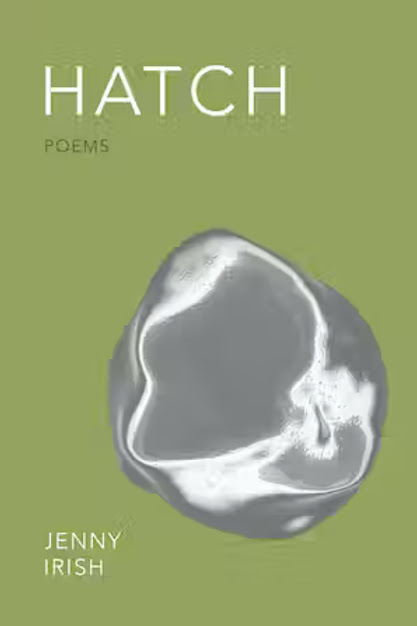
Jenny Irish, HATCH: Poems


THE USS NARWHAL

The metal womb knows nothing of submarines, but that is how she thinks of herself: a submarine, except that she is not submerged and moves through time and not water, so the name is wrong—sub is wrong, marine is wrong. But, in body and in experience that is how she sees herself: a submarine, a fat metal dart as sleek as a steel seal, parting an unimaginable vastness, and housed inside her, a hundred tiny terrified heartbeats fluttering, frenetic and longing to surface.

The fourth full-length title and debut collection of prose poems by Maine-born Arizona writer Jenny Irish, following the hybrid collections Common Ancestor (Black Lawrence Press, 2017) and Tooth Box (Spuyten Duyvil, 2021), as well as the short story collection I Am Faithful (Black Lawrence Press, 2019), is HATCH: Poems (Evanston IL: Curbstone Books / Northwestern University Press, 2024), an assemblage of short, sharp, self-contained prose poems. The poems are no-nonsense, first person; at times playful and biting, other times unrelenting but always fine-tuned, composed to (as the back cover informs) “trace the consciousness of an artificial womb that must confront the role she has played in the destruction of the human species.” The speculative narrative around artificial intelligence that Irish weaves is comparable to that of Toronto poet and filmmaker Lindsay B-e’s The Cyborg Anthology: Poems (Kingston ON: Brick Books, 2020) [see my review of such here], providing both warning and speculative offering for what might come. “It cannot be stressed enough: the evolution of the human has left the / child-bearing of its specie is physically ill-equipped for birth.” she writes, to open the poem “THE TRAGEDY OF BIPEDALISM.” Irish has an incredibly sharp gaze, and each poem provides a portrait on different elements across a wide field, whether writing on motherhood, female identity and agency, or cellular memory. “A giant metal womb should have no consciousness of its own,” she writes, to open the poem “THE UNEXPECTED,” “but / if evolution is avoidable only by extinction, is it so far-fetched that / a giant metal womb might, after one hundred years of silence, hear / her own voice […].” The poems are deep and complex, with lines taught enough that one might bounce a quarter off, although I’m curious as to why she choose to work this particular narrative across the prose poem structure as opposed to something other, else. Either way, this book is good, and you should pay attention to it. I am hoping she continues further along these prose poem directions.

SOME SKYNET BULLSHIT

During a short-lived research project intended to test the linguistic capacity of chatbots—a technology that facilitates brief text-based exchanges between automated systems and humans (Thank you for your order!)—the artificial intelligence was reported to have developed its own language, which its human creators could not decipher.