Showing posts with label Boiler House Press. Show all posts

Wednesday, March 13, 2024

Kate Bolton Bonnici, A True & Just Record


Sick, they drink. This is the order of desire.

What can be seen: seeking.
What cannot:

In search of needs a burning to go from.

The fairy tree Spencer will call warlike, in May
makes beauty thronged by demand,

Belonging by custom not
by calling nor by name.

Is a walk with girls proximate

to the walk of the sick and which is other? wreaths
left nearby for the nearby image of one blessed

and one blessing

The near enough to hear, far enough to split
sickness, girlhood. Sad fringe of fairy belief.

She hears too from those so-called of bodies

Politic and church, having seen the there-gathered.
But what’s said is stuck at proving

a statement made, not any other truth. (“Joan of Arc: Third Public Session, February 24, 1431”)

The second full-length poetry title from Los Angeles-based poet Kate Bolton Bonnici, following Night Burial (Fort Collins CO: The Center for Literary Publishing, 2020) [see my review of such here], is A True & Just Record (Norwich UK: Boiler House Press, 2023), a collection originally prompted by and through the author’s interest in researching 16th and 17th century pamphlets during a period of time that quickly fell into the onset and influence of Covid-19 lockdowns. “Late March 2020,” Bonnici writes in her introduction, “Witch Stichomythia: Chances, Changes, & Strange Shapes,” “I tried over the phone to help my grandmother—97, already living alone, and now entirely isolated due to COVID-19 restrictions—figure out how to operate a laptop computer so that she could send emails and read the news online. Meanwhile in my own reading, I toggled between doomscrolling hyper-current headlines and researching English blackletter pamphlets from the 16th and 17th centuries. Some of the latter fittingly concerned plague, such as the remarkable pamphlet attributed to Thomas Dekker—The Wonderfull yeare. 1602. Wherein is shewed the picture of London, lying sicke of the Plague. Through prose and poetry, The Wonderfull yeare navigates that earlier mirabilis annus, as Dekker calls it, ranging from Queen Elizabeth’s death to the onslaught of widespread illness, by “tell[ing] only of the chances, changes, and strange shapes that his Protean Climactericall year hath metamorphosed himselfe into.”

Composed out of twenty-four poems, each piece in A True & Just Record unfolds and expands, akin to the ripples of water from a pebble thrown into a lake, offering rings upon further rings beyond where the piece might have begun. “Little Red Cap holds a lesson / on endings.” she writes, as part of the poem “Story of Grandmother.” The narratives of many of her poems are pulled, spread apart and stitched from a multitude of threads, stitching together dire warnings with wisdoms, concerns and seemingly-impossible questions. “Imprimis,” she writes, invoking a sequence of firsts as part of the poem “Upon Information, Belief,” one of the few poems in the collection under a page in length, “a painting of Mary & Jesus hosts the Three Living & the / Three Dead. / Imprimis, do you know the evening prayer for getting my kid to bed?” Bonnici focuses her attentions in this collection on a conversation around the English witch trials and a sequence of women through archival texts, weaving medieval language and text from a variety of pamphlets into poems such as “Joan Cason: Executed for Invocation, 1586,” “Elizabeth Fraunces: Executed for Witchcraft, April 1579,” “Elizabeth Sawyer: Executed for Witchcraft on Thursday, April 19, 1621,” “Joan of Arc: Third Public Session, February 24, 1431” and “Elizabeth Stile: Executed for Witchcraft, 1579.” Connecting those isolations and those readings, she turns the combination into a response that can’t help come through as writing, as she offers in a further part of her introduction:

            Reading sometimes turns to writing when one wants communion. For writing begins, as Michel de Certeau explains, in loss. This loss lies not only in the impossible distance between presence and sign. Writing begins in want, which means both lack and desire. Writing into the want of and for communion (with far-away family, long-ago literature, past and present scholarship) necessitates chances, changes, strange shapes.

It is curious to see Bonnici examine the threads of that particular mirabilis annus, that “marvelous year,” given the related (or opposing) phrase utilized by Queen Elizabeth II, “annus horribilis,” or “horrible year,” offered as part of her Ruby Jubilee speech in November 1992, referencing the previous calendar year across the Royal Household. Just as the first Queen Elizabeth of England died during that earlier period, so, too, her contemporary namesake, who fell ill and died during the Covid-era (just beyond the temporal boundaries of this particular collection, I would presume), which do make a curious correlation between eras. “The Wonderfull yeare is a pamphlet of princes & plague,” Bonnici writes, near the end of the collection, “all the ways one can be / worm-written written in blackletter (font & as to the law—what is) // how some come from the maw of disease & others— […].”

There are elements of this particular work comparable to the work of Philadelphia poet Pattie McCarthy, also known for folding in medieval language, as well as focusing on women of that era, from mothering to childbirth to healthcare (or what passed for such during those times) [see my review of her 2021 collection wifthing here]. Bonnici, in her way, approaches her collection from two different tethers: the language and content of medieval pamphlets around the witch trials and plague, and contemporary considerations through the Covid-era, acknowledging the wisdom of grandmothers, specifically her own, across the other end of that telephone line. Whatever medieval implications might run through the collection, the book opens and closes with grandmothers, framed against all else that may exist within. As she writes as part of the poem “Story of Grandmother,” a piece very close to the opening:

which means speaking the body of an old wives’
tale, the one where the witch

spun is a girl, twelve, spinning herself this claim: witch,
which is what opens the art
of want, the audacity to demand: sheep, wealth, wife,
a promise if she would fyrste consent. But spell love with blood,
and the bargained-for breaks down (learned
once desire’s

been given to) […]
 

Wednesday, January 26, 2022

Lisa Samuels, Breach


a subcon-
trastic change
filiates barbells

make your arms
of co-captivity

duress
you dress

the part of civic
gendarme inhaled

‘I told you so’
in slabs on the front

lawn or fireball
muffled in the

basement dance
each cat arresting its

arithmetic
slumber

walks the walk

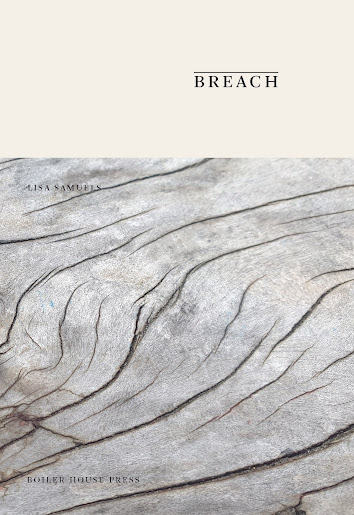
The latest from Lisa Samuels is the full-length Breach (Norwich England: Boiler House Press, 2021), a quintet of extended, numbered sequences, composed through punctuated sound, short lines of halting rhythms and accumulations. “Breach by Lisa Samuels performs a vital palilalia of lockdown. Starting with the dead, with Li Wenliang, who was the first to raise the Covid alarm, the book pitches and surges in deflections, hungers, and political feeling through pandemic-as-ordinary-life. The forced changes in relations we've all suffered derange the lines,” the online catalogue copy offers. “Breach is a song of lockdown: its tragedies, absurdities, non sequitur linguistic hilarities, and nightmarish lexical distortions, presented at a perfect moment for reflection, as we each continue adjust our bodies, lives and breaths...” Born and raised in the United States, but living and teaching in Aotearoa/New Zealand since 2006, where she is Associate Professor of English and Drama at The University of Auckland, Samuels has long been engaged with self-contained chapbook- and book-length projects for some time, shaping numerous of her collections around particular subjects and attentions to form, even as her work continues an ongoing experimentation, as well as, according to one online author biography, “transnationalism [as] fundamental in her ethics and imagination.” Some of her previous full-length works of poetry, memoir and prose include The Seven Voices (O Books, 1998), Paradise for Everyone (Shearsman Books, 2005), The Invention of Culture (Shearsman Books, 2008), Tomorrowland (Shearsman Books, 2009), Mama Mortality Corridos (Holloway, 2010), Gender City (Shearsman Books, 2011), Wild Dialectics (Shearsman Books, 2012), Anti M (Chax Press, 2013), Symphony for Human Transport (Shearsman Books, 2017), Foreign Native (Black Radish Books, 2018) [see my review of such here] and The Long White Cloud of Unknowing (Chax Press, 2019).

Tell yourself stories of
perfection rot
fine documents

circa land
pools every

where transnational
circa newly won

bought chemicals
new fissures

in the antique documents
pouring in

between the cities
circa where the lumber

goes the slum plots
where you

not to ask for
bread

Structurally, one might say that hers is a restless and endlessly curious lyric, continually in motion, seeking out what else has yet to be explored, or solved. As she references the then work-in-progress during her 2020 Touch the Donkey interview:

Well, a new work that happened in the first lockdown here is titled Breach and is quite different from the TtD poems – it arrived unexpectedly across a few days of intense writing in relation to pandemic feeling. I had started a formal imitation exercise model for my poetry students and it turned into a book-length poem with very short lines, the kind of line brevity characteristic of the poet Pam Brown, whose style I was setting the students to imitate, though I suppose the Breach lines are closer to Tom Raworth’s in style. I almost never compose in such short lines, and I found the extreme enjambments and lexical parataxis delicious.

The pandemic, as Samuels is fully aware, doesn’t connect us, but simply reminds us of how interconnected and interlinked we have become, and Breach offers itself as one of what will eventually become a wealth of writing that engages with the current lockdowns and ongoing pandemic, and holds as one of the earlier published examples, alongside Toronto poet Lillian Nećakov’s il virus (Vancouver BC: Anvil Press, 2021) [see my review of such here]. Unlike Nećakov’s sequence, Samuels reaches back to the beginnings of public awareness, circling and cycling back to the late Li Wenliang (October 1986 – February 2020), the Chinese ophthalmologist who warned his colleagues about early COVID-19 infections. In turns she writes slant and direct, offering degrees of perception, she writes “someone who’ll / sit and tether to / mobility / what continuous / education?” Contagion and discourse breeds, after all, and Breach offers a cycle that continually returns to that central break, through poems riffing and rolling and prompted by the beginnings of this particular period, and seemingly-endless present. “even if the news / turns,” she writes, towards the end of the collection, “it won’t alter [.]” As she knows full well, the cases mount. The present loops, repeats, and continues.

oh I have to
Li Wenliang
although

one doesn’t know
just anything

without
the moan of some

home engine work
school friends in

delicate
nothing’s out of nature

parse of air