Showing posts with label Sylvia Legris. Show all posts

Tuesday, September 29, 2026

Sylvia Legris, Sleep Gate


Subwake Palette, Fog

Saline flat of silvery saltbush,
scurfy, a twinflower’s tinny tone. 

A figment of sea-blite
in a spindrift of congested clusters. 

Umbrella plant in its gaseous form
consolidates into dense umbels, 

the air dangling grey note-stems,
a pink sundown glissando of suspension.

The latest from award-winning Saskatoon, Saskatchewan poet Sylvia Legris is the collection Sleep Gate (London UK: Fitzcarraldo Editions, 2026). A Canadian edition of the same is scheduled to appear with Thistledown Press in May 2027, the publication of which will mark her first Canadian-made book in twenty years [do you remember when Canadian Karen Solie had similar, a British publication prior to later publication in Canada?]. There’s a tonal quality I’ve long appreciated with Legris’ writing, one of intimate and very precise attention, detailing the science and study of garden technicalities through exacting lyric. There’s a distance to her attentions, also, able to articulate such intimate details exactly through the ability to step back and see fully, with the poems of Sleep Gate also exploring the further elements of dreaming and sleep. If plants have consciousness, might they, too, dream? This aspect of detailed phylum is one her work has been exploring with increasing depth since her debut collection, Circuitry of Veins (Winnipeg MB: Turnstone Press, 1996), a book I was immediately struck by, when it landed (I reviewed soon after it appeared, back when I wrote for a local entertainment weekly). Are an exploration of gardens Legris’ own variation on Kroetsch’s “Field Notes,” an umbrella under which all her writing sits? Since that long-ago debut, Legris has published an impressive array of collections, each of which step further into what has developed into an extended study of detailed plant life through the lyric: Iridium Seeds (Turnstone Press, 1998), the Griffin Poetry Prize-winning Nerve Squall (Toronto ON: Coach House Books, 2005), Pneumatic Antiphonal (New York NY: New Directions, 2013), The Hideous Hidden (New Directions, 2016), Garden Physic (New Directions, 2021) [see my review of such here] and The Principle of Rapid Peering (New Directions, 2024) [see my review of such here], with even a trio, at least, of chapbooks as well, along the way.

There has long been a meditative quality to the lyric responses around gardening, including collections across the past twenty years or so such as the poem-cycle meditations of Ottawa poet Monty Reid’s Garden (Ottawa ON: Chaudiere Books, 2014), New Jersey poet Emmalea Russo’s debut, G (Futurepoem, 2018) [see my review of such here], San Francisco poet Hazel White’s Vigilance Is No Orchard (New York NY: Nightboat, 2018) [see my review of such here] and Cole Swensen’s Ours: poems on the gardens of Andre Le Notre (University of California Press, 2008) [see my review of such here] and greensward (Brooklyn NY: Ugly Ducking Presse, 2010) [see my review of such here], to further works by Victoria poet Lorna Crozier and many, many, multiple others. On the surface, gardening lends itself easily to the meditative (see also: Virginia Woolf), with certain poets allowing different elements to shine through, whether instead or alongside the physical act of tending a garden. Legris, of course, is far less about meditative landscapes and cycles than a particular kind of close-look, leaning closer to the ways in which Michigan poet Jen Tynes and Toronto poet Jay MillAr have writ about mushrooms, from her Mushrooms Yearly Planner (above/ground press, 2021) to his Mycological Studies (Toronto ON: Coach House Books, 2002), as well as more recent further titles: Mycelial Person (Milwaukee WI: Vegetarian Alcoholic Poetry, 2021) [see my review of such here] by Queens, New York-based poet Amanda Monti, and Mycocosmic (North Adams MA: Tupelo Press, 2025) [see my review of such here], by Lexington, Virginia poet Lesley Wheeler. Legris’ meditative element of gardening digs deep into study and research, blending two ecological sides, one might say, of the same coin into something far more exacting. Her poems emerge from detailed language, writing of plants without getting all abstract or sentimental, offering, throughout her work as a whole, a deep reading of phylum and season, instead of any specific meditative means through to a separate end. As the back cover of this collection offers, how this new work focuses on “biological dreaming itself: the sleep beneath sleep [.]” Beneath the surface of gardening, the tendrils and runners of Sleep Gate articulate a further element beneath the surface of dreaming, and sleep.

With sections “NIGHTJARRING,” “BIRDSONG IN THE HEAVY SILENCE OF SLEEP” and “FIRST LIGHT OF ROBIN,” Sleep Gate offers an incredibly dense lyric, one with a lightness across line and an agile language that delights in sound and vigor through her array of detailed scientific language. “The deranged dream geography / is cellulose and connective tissue,” she writes, amid the poem “An Unzipping,” “exoskeleton and fascia, / the full floral, faunal collage.” There’s an element of her work comparable to seeing the familiar through an electron microscope: most have never seen plant material this close, and with such a lens, articulated across a lyric of unsentimental lushness. “The clock strikes 12-petal fatigue. / The clock strikes leaf discolorization,” she writes, as part of the thirteen-part numbered sequence “Portulaca O’Clock,” “widening stomatal pores, // tendrils of dream entangled / with the act of breathing.” As well, the opening five poems share the same title—“In the wake of”—offering echoes and repetitions, much in the way the final poems in the same opening section—each titled “Vegetable Mineral Sleep”—play a curious sense of bookends, each side of the collection buffered by gentle lyric echoes. These moments, in their own ways, showcase Legris’ ability to craft such precise and subtle nuance of meaning and sound, offering lines that blend scientific terminology with a bouncing sense of sound that she is entirely in control of. As a fragment of the extended title sequence offers:

A sketch of the nyctitropic movement of leaves,
of the so-called conspicuous sleep of leaves, 

a nightfall of lateral leaflets,
a smattering of delta and slow-wave rain,
a syncopated auditory blueprint. 

            — —

To wit furtive winter birds,
a downwind of embryonic leaves,
underground, a cotyledonary sound chamber,
the echo of non-photosynthesis.


Friday, May 10, 2024

Sylvia Legris, The Principle of Rapid Peering

My review of Saskatchewan poet Sylvia Legris' latest, The Principle of Rapid Peering (New York NY: New Directions, 2024), is now online at periodicites: a journal of poetry and poetics. See my review of her prior collection, Garden Physic (New Directions, 2021) here.

Friday, January 21, 2022

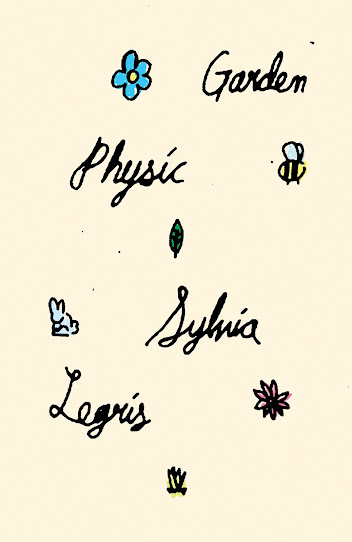
Sylvia Legris, Garden Physic


Equisetum hyemale (Rough Horsetail)
                       
after a photograph by Karl Blossfeldt

Let the fossil records show:

Green of two winters;
Small scale fluctuations;
Multi-tempoed scouring-rush;
 

Rough scrub-music horsetail;
Amplified 40-fold brusque bray;
Silica-encrusted corrugations;
 

A living fossil cross-section;
Reedy wetland habitat;
Pewterwort the sonorous tin-herb;
 

Cone an E-flat apiculate pitch.

Saskatoon, Saskatchewan poet Sylvia Legris' latest, following Circuitry of Veins (Winnipeg MB: Turnstone Press, 1996), Iridium Seeds (Turnstone Press, 1998), the Griffin Poetry Prize-winning Nerve Squall (Toronto ON: Coach House Books, 2005), Pneumatic Antiphonal (New York NY: New Directions, 2013) and The Hideous Hidden (New Directions, 2016), is Garden Physic (New Directions, 2021), her second full-length collection (and third title) to appear with American publisher New Directions. Structured in four sections—“The Yard Wants What the Yard Wants,” “Where Horsetail Intersects String,” “Floral Correspondences” and “De materia Medicia”—Garden Physic is very much a space through which she examines both botanical and the lyric through the lens of language, offering the perspective of “the natural science that studies matter, its fundamental constituents, its motion and behavior through space and time, and the related entities of energy and force” (Wikipedia) on a space considered simultaneously wild, natural and domestic: the garden. The garden as a space for poets is one well-trod (perhaps through both forms, gardening and poetry, seen as meditative), with recent examples including Ottawa poet Monty Reid’s twelve-month cycle, The Garden (Ottawa ON: Chaudiere Books, 2014), Montreal poet Stephanie Bolster’s examination of formal gardens in A Page from the Wonders of Life on Earth (London ON: Brick Books, 2011) [see my review of such here], New England poet and translator Cole Swensen’s exploration on the seventeenth-century French baroque gardens designed by André Le Nôtre in Ours (University of California Press, 2008) [see my review of such here] and California poet Hazel White’s exploration of the works of landscape architect Isabelle Greene and her iconic Valentine garden in Vigilance Is No Orchard (New York NY: Nightboat, 2018) [see my review of such here]. As the latter three titles wrote directly around the Victorian ethos of the shaped wild of crafted gardens, Reid’s collection might be a more apt connector, given Legris’ attentiveness to the shape and movement of growth and seasons, articulating the language of horticulture. As the second half of Legris’ poem “Ferns and Fern Allies” offers:

Bladder-fern. Adder’s-tongue.
Where horsetail intersects string.
Where tone color is quillwort.

Spiny-spored or large-spored?
Bristle-tips or conspicuous tufts?

Upper bout an upswept moonwort.
Lower bout a smooth woodsia.

Diminutive growing in low fronds.
Rhizomes erect to ascending in perfect fifths.

The cover-copy to the collection offers a comparison to Louis Zukofsky’s 80 Flowers (Stinehour Press, 1978), and her work is long-known for its foundational influence by another of the Objectivists, Muriel Rukeyser, but I would offer, also, that Garden Physic seems akin to a lyric exploration in the veins of the botanical books that Emily Dickinson used to put together for friends and family. These are poems that approach the minutae of flora and fauna, both through the plant itself and its descriptions through language, nearly set on the page as research notes, marking and remarking on movement, growth and the unfurling of speech. If Lorine Niedecker’s “Lake Superior” emerged out of the poet absorbing a study of nature and carving out her thinking directly to the page, so, too, as Sylvia Legris writing her Garden Physic. As her short poem “Violet” reads:

A garland to rend off the dizzies.
A garland to keep the quinsy at bay.
March closes the seeded umbilicus.

April opens the musty secundina.
Equinox the half-melt rot.

Easter the thin asquintable light.

“The yard wants what the yard wants.” she writes, as part of “The Garden Body: A Florilegium.” Garden Physic is a detailed study of wildflowers and herbs composed through the lyric, citing a multitude of possibilities, and her language is densely-specific. Legris explores the Latin names and intimacies of plants, and there is something comparable to Toronto poet Kate Siklosi’s recent leavings (Timglaset Editions, 2021) [see my review of such here] in a shared approach to plant life on its own terms, from the opening poem of Legris’ collection, “Plants Reduced to the Idea of Plants,” that begins: “The flourish, the fanfare, the febrifugic feverfew. // An oleaginous emplastrum—with horehound leaf, / olive over olive, the oily parts, the dry. // An antidote for the unblessed, the blistering, / the dourly flowering flora, the corpse flora. // Greek turned Latin turned inordinately / angled and filed.” There really isn’t anyone else working this kind of study, blending scientific language through a language-centred lyric. One could cite St. Catharines, Ontario poet Adam Dickinson, for example, who works a more straightforward metaphor-driven lyric, and Toronto writer Christopher Dewdney, who was at the forefront of this kind of writing throughout the 1970s and 80s, hasn’t produced a new volume of poetry since Demon Pond (Toronto ON: McClelland and Stewart, 1994). Her third section, “Floral Correspondences,” composes, as she writes, “an entirely invented exchange” between English author and garden designer, Vita Sackville-West (1892-1962) and her husband, the British politician and writer Sir Harold George Nicolson (1886-1968). They are know for, among other things, co-designing “the celebrated garden at Sissinghurst,” and Legris’ explores a floral call-and-response that bounces through a language of gardens, including the poem “Oh Darling,” that reads:

Midges and techiness.
A constantly muddy mood.

In my impatience for mail it strikes me that the perianth is a floral
envelope—a cloak concealing the reproductive organs …

Alas, I forbear. A capacity for waiting defines both the gardener and the
letter-writer (the growing season longer than my endurance). I throw
myself into work and diversion but progress so slowly I fear there will be

frost by the time this reaches you. snow on your salpiglossis.

– H.


Wednesday, April 26, 2017

m a n y _ g e n d e r e d _ m o t h e r s : f o u r _ r e c e n t _ e s s a y s

many gendered mothers is a project on literary influence featuring short essays by writers (of any/all genders) on the women, femme, trans, and non-binary writers who have influenced them, as a direct or indirect literary forebear.

This project is directly inspired by the American website Literary Mothers, created by editor Nadxieli Nieto and managing editor Nina Puro. While we hope that Literary Mothers might eventually return to posting new pieces, our site was created as an extension and furthering of their project (in homage, if you will), and not meant as any kind of replacement.

We've now sixteen essays posted! Our most recent include:
Doyali Islam on Sylvia Legris

Adrienne Gruber on Brecken Hancock

Ian Whistle on Judith Copithorne

Evelyn Deshane on Wendy C. Ortiz
Please check out our submissions page for more information.

Forthcoming essays include: Dorothy Palmer on Stella Young, Theresa Smalec on Aritha van Herk, Dawn Promislow on Nadine Gordimer, A.H. Reaume on Virginia Woolf and Terry Abrahams on Anne Carson.

Thursday, May 22, 2014

Natasha Sajé , Vivarium


Q

A Phoenician letter the Greeks discarded, having no use in their language for a Semitic sound. If the soul has a qualm, the body shows it. The body queries what it means to be true. Quilty! Humbert’s doppelgänger—a sack of feathers? Another name for the quill of a feather is calamus, from Greek, kalamos, reed. Who first filled a quill? The Phoenician Q meant qoph, monkey, its tail lingering in the language. I propose introducing some English words that use Q, but not U, naming new conditions that will kill Scrabble players, among others: qib, the eye disorder that results from staring too long at a computer screen; qell, the nausea that accompanies the mixing of incompatible therapeutic drugs; and qatch, the moment before the articulation of a sound, that split second when the brain tells the throat and tongue to speak.

I’m fascinated by American poet Natasha Sajé’s third trade poetry collection, Vivarium (North Adams MA: Tupelo Press, 2014), a collection built as a kind of lyric abecedarian. As the back cover informs, “A Vivarium is an enclosure for living things, which might likewise be said of a poem.” There is something quite compelling in the playful way in which Sajé’s poems stretch, bounce and lean, accumulating themselves into a kind of map-making structure, opening into parts both familiar and unknown. Poems are included alphabetically, titled either by single letters or phrases, and left to accumulate towards a structure that is held together with ease; a single unit that is playful, tight and almost bulletproof. As she writes in the poem “S”: “we say one thing is not another thing / and in this language every letter is pronounced [.]” One might say that terrain is all over the place, and it includes the Phoenician alphabet, Greek history, philosophy, Herman Melville, George Harrison, classical paintings and fairy tales, but she manages to weave both a complex and simple tapestry across great distances. “Easily the nicest bit I’ve read all evening,” she writes, to open the poem “Vanessa Redgrave Marries / Franco Nero After Forty Years,” continuing: “fine piece of frivolous / gossip that is also oddly gratifying.” This is a quietly smart, thoughtful and even mischievous poetry collection, and one that manages to end up in the most unexpected and playful places. The finest description I can imagine for Natasha Sajé’s Vivarium is that this is a book made up entirely of living things. And what wonderful things they are.

HAPPY AND SAD

come different way through the brain—
in one a feather is lofted on
warm currents. In the other, lead talons
drag you around a volcano’s rim.
One’s a beach resort
with sparkling pools and attentive staff.
The other’s a town in the interior,
hordes scratching dirt with rakes.
That one’s a deck of marked cards,
the other a blank book
of creamy pages. Back and forth
between windows, fort/da,
the fear of losing or the freedom of knowing
love remains. Two
spigots, one Chateau d’Yquem,
the other piss, the brain a bartender
trying to regulate
alternating or sometimes even simultaneous
spurts. You never know what
will fill your mouth.

I don’t know how she does it, but reading the poems in this book makes me enormously happy. And how often does that happen? Not often. I think of Elizabeth Robinson and Sylvia Legris, of Cole Swensen and Pattie McCarthy, and not too many others. And now: Natasha Sajé.

N

Normal: Latin, norma, a carpenter’s square

No, non, nein, na, no, nah, näo, nee, ne, nei, nil, no, no, nu, nope, nej, nyet, nnyaa, no, non, nay, never, nei, nie, nope, nou, negative, nenni, not on your life, nÃ¥, no, no, no …


Tuesday, October 22, 2013

The Capilano Review 3:21


Athena

I had not known it, but I lived
inside my mother’s head—her face God-like,
white, a cast. Neck coiled in a snake,

ready to strike. My own eyes
slits beneath the heavy chalked lids.

How did I come then,
to haul myself up the scaffolding she’d left,
fist after fist, to crawl and stretch—
the glowing oval of her mind
hanging like a moon above me.

I cracked the crown—
pressed out and through, black bird
singing in my chest,

no light, no breath, my voice
still clinging to her lips. (Emily Kendal Frey)

I try to keep away from discussing issues of journals I’m actually in, but the new issue of Vancouver’s The Capilano Review is too good to not at least say something, with new work by (among others) Sylvia Legris, Emily Kendal Frey, George Bowering and Jesse Grey, collaborations by Ray Hsu and Michael Park, as well as an interview Robert McTavish conducted with Charles Bernstein, “Undone Business: Charles Bernstein on the 1963 Vancouver Poetry Conference.” For those who might not be aware, documentary filmmaker Robert McTavish has been working on literary subjects for some time, including a documentary he did on the late poet John Newlove, as well as editing Newlove’s selected poems for Chaudiere Books. More recently, McTavish released a documentary he produced on the infamous 1963 Vancouver Poetry Conference, The Line has Shattered: Vancouver’s Landmark 1963 Poetry Conference (Non-Inferno Media, 2013), deliberately appearing just in time for the fiftieth anniversary of the conference. McTavish recently said that he had far more material than would ever fit into the documentary itself, and it seems that he’s started working to place some of that research in literary journals, which can only broaden any scope of articulating the significance of the historic conference (I can only hope that other interviews begin appearing soon in further venues). The interview opens:

Robert McTavish: You’ve got the 1963 Vancouver Poetry Conference recordings on the PennSound site. Does it have a profile, to people here in America?

Charles Bernstein: America! Sure, I mean, I think those interested in the New American Poetry know about the Vancouver conference. Don Allen’s anthology, The New American Poetry, came out just three years before the Vancouver conference. Famously, for those few for whom anything about poetry can be famous!, the anthology included different configurations of poets: the Beats, which would have included Ginsberg and Kerouac and Burroughs, who were represented at the conference by Ginsberg; the so-called Black Mountain Poets, which would have been Creeley and Olson, two very different poets but affiliated; and the San Francisco Renaissance, which would have been Duncan at the conference but also Jack Spicer and Robin Blaser, and Whalen too. Vancouver ’63 and Berkeley ’65 are milestones in the history of the New American Poetry. It’s also very important to me as somebody who was in Canada early on in my life and had a deep connection to Canadian poets and also who has a great interest in, and knowledge of, the relationship between the US and Canadian poets. Seen the other way around, of course, the Vancouver conference was pivotal to the reception of US poetry within Canada through the TISH group. It’s a crucial point of contact. From a US point of view its significance is more tenuous, but it is one of the key events of New American Poetry, along with the Berkeley conference, Black Mountain College, the first reading of “Howl” in San Francisco, and the like. It’s fascinating that these poets came together in Vancouver when they were so young and relatively unknown. A number of interesting Canadian poets came to the conference and as far as US poets go, it was important for Michael Palmer and Clark Coolidge, which makes it important for those of us who greatly admire their work. Coolidge and Palmer connected up to the New American Poetry in a more visceral way through that conference and remained connected to it throughout their lives, though I don’t have much evidence that they connected up to Canadian poetry.

The issue also includes a selection of works from an exhibit curated by Michael Turner, A Postcard from Victoria,shown at the Art Gallery of Greater Victoria, May 2 – July 7, 2013. Featuring Robert Morin and Lorraine Dufour’s video A Post Card from Victoria (1983), the show included new postcards Turner commissioned for the exhibit by artists Raymond Boisjoly, Geoffrey Farmer and Julia Feyrer, all of which respond in some way to the original sixteen-minute film. Turner’s introduction moves from the history of the postcard to the show specifically, “an immersive exhibition,” as he writes:

The final element in the exhibition, near the west wall, is a carousel that includes postcards that were for sale when Morin and Dufour made their video, interspersed with recently-commissioned postcards by artists asked to “interview” the video (just as the Northern English woman was interviewed by the owner of the cottage). The resultant postcards reflect the eerie quality of Morin and Dufour’s work (Did you notice that when the maid pours the cottage-owner her tea, nothing comes out?). Raymond Boisjoly provides a lurid image of the video scanned from his smart phone; Julia Feyrer a staged still-life that implicates an infamous Victoria-set book from 1980 on satanic cults and repressed memory (Michelle Remembers); and Geoffrey Farmer a drawing of a ghost-like figure seated “within” an appropriated drawing of Anne Hathaway’s Cottage at Warwickshire, England.

On top of that, there’s new fiction by George Bowering, and stunning new poems by Sina Queyras, Emily Kendal Frey and Sylvia Legris, and nearly too much to actually discuss in a single post. There is something about Sylvia Legris’ work that is getting richer, deeper and more complex. I haven’t seen much since her Griffin Prize-winning collection, save for a recent title through New Directions [see my review of such here], but her work, already incredibly dense and powerful, is somehow improving. How does that happen? She has three poems in this new issue, triggered by sketches by Leonardo da Vinci—“Details of Articulated Skeletons, c. 1510,” “The Anatomy of a Bear’s Foot, c. 1488-90” and “A Skull Sectioned, c 1489.” The second half of the poem “The Anatomy of a Bear’s Foot, c. 1488-90 / (after Leonardo da Vinci)” reads:

Metalpointed (the forager forget). The white-heightened tendons silver-
tipped—by rod by wire by claw (ditto the dito grosso del piede, ditto the stony
ossi petrosi). Oddly nodular,

the small-seeded sesamoid bones; the flat-footed marauder off-gait, bellicoso.

Terricolous, the pre-anatomized bear’s bearing toe-in, direct-register, a
stomp-walk to mark scent (the soul that dwells within that architecture … a
thing divine…).