Monday, January 17, 2011

Argos Books: Paige Ackerson-Kiely and bianca stone

THIS LANDSCAPE OF COLTISH RECIPROCITY

Out of the glove box comes whatever snack a passenger can hand you when you’re driving. So many years spent distilling head-nods, the occasional small wave off a steering wheel, brushing against a stranger in the dairy aisle, her heat & yours. Sometimes, fleeting eye contact with a wild bird, or loving a workingman without interrupting him. It has been difficult. A jetty quelling breakers; punching someone in the face then blowing on your fist. It has been difficult. Your 3/4ths coverage, the remainder of me shrugging away. All the trinkets I gave to you hidden in your dark desk. When I come right up to the edge, like this second to last line, I always retreat. Though I love the way it feels like drowning, your mouth against my legs, moving up.

As anyone who reads this with any regularity might suspect, I’ve been a fan of Vermont poet Paige Ackerson-Kiely since the appearance of her first poetry collection, In No One’s Land (Boise ID: Ahsahta Press, 2007), a book I carried on and off through my travels pretty much since, wearing down my copy nearly to the point of requiring a replacement. Her chapbook, This Landscape (Argos Books, 2010), a collaboration with artist Adie Russell, is part of Argos Books’ “SIDE-BY-SIDE SERIES,” meant to “create a space where contemporary poetry and art can intersect, making a third, undefined category. In viewing the work and forming a personal understanding of the resonance between language and image, the reader joins in the spirit of collaboration that makes this endeavor possible.” The collaboration exists as four images by Russell, and four prose-poems by Ackerson-Kiely, prose so tight and sharp you could bounce a quarter of it. What I’ve always admired about her poetry has been the sharp emotions, the clipped phrases and the damned strong insistence, poems that demand the reader live inside them for a while. Her bio at the end of the small collection even announces a second trade collection forthcoming, sometime this year, Misery Trail.

What I like about bianca stone’s someone else’s wedding vows (Argos Books, 2010) are the sharp turns, lines with flow made with such ease as to appear possible. Her poems have a subtle cadence that pushes, pounds, deep, and manage to repeatedly make their way into flesh. Who is this Bianca Stone? Part of the appeal of this small collection is its range, from tightly-packed pieces to a more open cadence of couplets and breath-space. Add to the mix that both small chapbooks are hand sewn with lovely letterpress covers produced at the Ugly Ducking Presse workshop in Brooklyn, New York. How can you ever resist?
Animatronic Singing Fish

The moon puts powder on its pocked face
and orbits the room.

And I think the moon says yes.

Yes, drive unto the brink
and have a beer.

But I can’t be sure.

The piano concerto from the little record player
on the floor

makes me feel
as if I am back listening

to the pathological beaver
gods slapping in the brown torrent of the creek.

And I am somewhat convinced. Though
the concerto says nothing,

and has no meaning.

When we talk of love
we think we are being talked into something.

We walk toward
a rubber fish with interest,

with envy, finding it takes in more
amphibian dust

we find we cannot bring ourselves
to be intimate with it,

when it bellows. Take me to the river.
Knock me down.

Sunday, January 16, 2011

House-sitting in Lindenlea


I recently ended a week-long housesit for Ottawa poet Stephen Brockwell in the Lindenlea neighbourhood, just north of Beechwood. Oh, what a difference a week makes. Writing poems, exploring the neighbourhood, learning new songs on guitar, even hosting a dinner party. Finally caught up inside the beginnings of the first season of re-vamped Battlestar Galactica. A stay-cation of sorts, but in a completely unfamiliar space, babysitting his dog. Just what was required. Originally, there were plans for December, financially-thwarted, when I’d hoped to train down to Poughkeepsie, New York to hang out with poet Lea Graham, swing through Montreal to see Wanda O’Connor en route. Not yet, it would seem.

Do you know anything about Lindenlea? One of Ottawa’s smallest neighbourhoods, upper Lindenlea dating back to the end of the First World War, designed by Thomas Adams. Large back yards and gardens, a children’s park, tennis courts and a bowling green, bordered by Rockcliffe Park, Vanier and New Edinburgh. I hadn’t even heard of, now enough poems to perhaps produce a small chapbook of such, “Linden lea.”

The dog, the dog. Like a distracted, mindless… what was that? What? Why was I here? Doesn’t even realize he’s not a small dog, my black jeans seemingly magnetic to his lackadaisical curls, shedding white. Every morning I re-christened him with new name, since he wasn’t listening anyway, from Neo to Larry to Telford to Biggles. What does it matter? Regularly dumped into backyard where he tore around, barked at all the invisible things in the driveway, or behind the big tree. Dumped. Friday night hosting a dinner party where we performed music until all hours, with two guitars, five voices, one autoharp. One guitar and voice short. Fantastic harmonies.

There was the opportunity to visit with Cathy McDonald-Zytveld of Dusty Owl at her job at the Scone Witch. I read my newspapers in-between making faces. Has anyone asked why the Scone Witch has a painting of John Lennon and Santa Claus on its wall, a framed souvenir from old Queen Victoria in the washroom? And did you know there’s a cupcake place down the street? A Second Cup too small to get anything actually done. A bookstore that actually carries my second novel. Afternoons of listening to Johnny Cash, Leadbelly, Woody Guthrie, the Stars. A bathtub you could fit more than a few people into. Probably. A week out of my usual routine, helping to clear some of the clutter from my weary, confused head. When might he have to travel again?

Wednesday, January 12, 2011

fwd; Call for Papers: Attending (to) the Party: Orientations and Simulacra of Public and Private Sites

Concordia University English Literature Graduate Colloquium
March 24-25-26, 2011


Attending (to) the Party: Orientations and Simulacra of Public and Private Sites
Everyone's alone — or so it seems to me.
They make noises, and think they are talking to each other;
They make faces, and think they understand each other.
And I'm sure they don't. Is that a delusion?
T.S. Eliot
Throughout history, the notion of ‘party’ has served as a site for exploring prevailing liminalities: from ideological display to decorous intimacies to social multitudes, the party has served as a means of further repressing or extolling self within private and public domains, projecting identity formations of the other, or combating the enigmatic reflections of the public world. The dialectic of inclusion and exclusion—who is invited into a space, a sphere, an identity—has been used as a social tool and political wedge while at once advancing the bounds of restraint within prescribed modes of behaviour. Distinctions and delineations of such orientations in literature have never been straightforward: least of all today, where boundaries of private and public are more blurred than ever. How is a performance of belonging or of ‘being private’ received within a crowd, a gathering, a nation, or in a culture of social networking—do reflections or simulations of the ‘party’ ever stop? Is artifice encouraged by the heteroglossia, the absurdities of the carnivalesque, inversions of decorum? Individuals and collectives both encounter and anticipate fusions of the expected and unexpected in their search to negotiate lines between indulgences, reasonable parts/parties, or embodiments of culture. The notion of the party is not—and has never been—confined to the limits of social space, but rather is a transitory site of individual and group. Both textual and inter-textual notions of ‘party’ may include cocktail gatherings, reflections on singularity, revolutionary mobs, the construction of online identities, or a middling of ‘inbetweeness’. It is a site of shared intersection—or collision. It is circuitousness, it is necessity; amid orientations of debauchery, protest, subsumption, or migration—singly or all at once.

We invite papers focusing on the following themes:
-Party of one: identity projections
-Figuring decorum: alterations & presentations of normalcy
-Simulacrum: masks, constructions & artifice
-Sites of (in)visibility: notions of exclusion and inclusion
-Block party: politics, affiliations, negotiating lines
Concordia University's English Literature Graduate Colloquium examines the dynamics of ‘party’, prompting dialogues from all gathering points: from the political to the bacchanal, from the physical to the philosophical. We invite graduate students to contribute to this interdisciplinary English Literature colloquium by submitting a 200-250 word abstract to attendingtheparty (at) gmail.com by January 31st, 2011.

Tuesday, January 11, 2011

12 or 20 (small press) questions: kemeny babineau on Laurel Reed Books

Laurel Reed Books first began publishing small editions of poetry during the mid nineteen nineties. Sometime during the beginning of the 21st century the literary rag mag The New Chief Tongue surfaced as an eclectic ensemble of mostly Canadian and American poets. Over the years LRB has published at least 30 different titles by as many as 20 different authors. The press also produces broadsides and pamphlets that sometimes appear under the title ‘Your In Samples’ which is a numbered series.

Laurel Reed Books is operated by poet Kemeny Babineau and roving editorial persona non-gratis Nic Coivert. Babineau’s latest work is After the 6ix O’clock News published by Bookthug. Coivert is best known for his series of mud-paintings and least for his infiltration of the Canadian literati, he also largely eschews the internet.

1 – When did Laurel Reed Books first start? How have your original goals as a publisher shifted since you started, if at all? And what have you learned through the process?
Laurel Reed Books began as a eureka. Back in the mid 1990’s I was still composing on a typewriter but I was short on paper so I was putting the same sheet into the typewriter but manipulating the page so I would have a clean space to type in. That was when I realized something everyone else already knows; if you arrange the words properly you can actually get 8 small pages out of 1 regular sheet of paper provided you do a little folding and cutting. That was my eureka, a discovery that was centuries old.  

2 – What first brought you to publishing?
Frustration with not getting published elsewhere.

3 – What do you consider the role and responsibilities, if any, of small publishing?
The role is to try and engage the public with poetry that is not mainstream, and to introduce authors and works to people who are already engaged in poetry culture.

4 – What do you see your press doing that no one else is?
Producing economical limited edition hand made chapbooks. The emphasis here is on the economical, my print runs don’t cost a lot, I save money with added labour and I use my off-cuts. Other presses are also doing this of course but I think Laurel Reed has achieved a look of its own.

5 – What do you see as the most effective way to get new books out into the world?
Personal sales. You need to go to small press and artisan fairs.

6 – How involved an editor are you? Do you dig deep into line edits, or do you prefer more of a light touch?
I don’t want to have to do a lot of editing. I do read texts over very closely and often offer small suggestions or spot typos but I find too much interference from an editor can ruin the terroi of the work.

7 – How do your books get distributed? What are your usual print runs?
I don’t have a distributor, obviously. Print runs are under a 100 and over 50.

8 – How many other people are involved with editing or production? Do you work with other editors, and if so, how effective do you find it? What are the benefits, drawbacks?
I mostly work alone. Nic Coivert lends a hand at times, and I have been known to press my daughters into paper folding or stapling.

9 – How has being an editor/publisher changed the way you think about your own writing?
Not sure.

10 – How do you approach the idea of publishing your own writing? Some, such as Gary Geddes when he still ran Cormorant, refused such, yet various Coach House Press’ editors had titles during their tenures as editors for the press, including Victor Coleman and bpNichol. What do you think of the arguments for or against, or do you see the whole question as irrelevant?
I find publishing my own work problematic because I either never finish, or I lose interest, or my plans become so complex I never begin. Consequently what I do produce through Laurel Reed is mostly of the impulsive nature.

11 – How do you see LaurelReedBooks evolving?
I’d like to hire someone more capable than myself to do set and design for a larger work at some point.

12 – What, as a publisher, are you most proud of accomplishing? What do you think people have overlooked about your publications? What is your biggest frustration?
I’m going to skip the first two parts of the question and answer the third part. Sales and marketing.

13 – Who were your early publishing models when starting out?

14 – How does LaurelReedBooks work to engage with your immediate literary community, and community at large? What journals or presses do you see LaurelReedBooks in dialogue with? How important do you see those dialogues, those conversations?
I basically just ask people whose work I’ve enjoyed to send me a manuscript for consideration, or sometimes they send me something out of the blue.

15 – Do you hold regular or occasional readings or launches? How important do you see public readings and other events?
I don’t do either, although I have in the past. I’m sure such activity is very important but I live in a fairly rural area so artistic ventures are a little like watering a dead plant.

16 – How do you utilize the internet, if at all, to further your goals?
The usual. Blog, website, facebook, emails.

17 – Do you take submissions? If so, what aren’t you looking for?
I prefer to ask for submissions, my publications are labour intensive and I can only do so many before the rest of my life begins to overwhelm me.

18 – Tell me about three of your most recent titles, and why they’re special.
Monty Reid In the Garden

Amanda Earl Kiki

Richard Stevenson Jazz Pops for Jack

I think they are all lovely arrangements of words and paper. Something for people to enjoy.

Monday, January 10, 2011

a new poetry collection by rob mclennan: kate street (Moira, Chicago)

kate street
a poetry collection by rob mclennan
published by Moira (Chicago; e-book available)
$14 US; order paper copies here;

cover photograph by John W. MacDonald;

Praise for Kate Street
Looking over Kate Street, over the rambling boulevard littered with "a permissible tryst", "a bedouin of shoes", the cagey tenderness of a father ushering his daughter into self-hood backlit by the "nuzzle-spent release of horror", one is compelled to trudge forward on the trail rob mclennan has generously broken, searching madly for "a pretty name for what we almost do." Love-worn, rage-prone, and intent upon reuniting with nature, these poems pick through the detritus of the contemporary conflagration without complaint, and deconstruct our flabby material acquisitions in search of real human connection. Never precious, these poems ask for forgiveness for their very existence in an oft-dismissive world, apocryphally offering: "I am at the end of the machine, extending whatever boundary of forgiveness that I would know too well." -- Paige Ackerson-Kiely

Saturday, January 08, 2011

The Dusty Owl Reading Series: Jan 16 + Feb 6‏

The Dusty Owl Reading Series, for the next couple of months, will be featuring special guest-hosts in place of Steve Zytveld, as we support his ongoing schooling at St. Paul's University. Learning is good!

The next two events at the Dusty Owl Reading Series are:

1) Sunday, January 16, 2011
featuring poet and fiction writer Anita Dolman
There is nothing as fun as starting the new year with a writer who is expanding their written universe into a new area of work. Renowned for her poetry, Anita Dolman will be taking the Dusty Owl stage to share short
fiction.

Anita Dolman is a writer and editor living in Ottawa. Her poetry and short short-fiction has appeared in numerous journals, chapbooks, e-publications and magazines, including The Antigonish Review, the Peter F. Yacht Club, Panoply, Grain Magazine, One Cent, Geist, Utne, The Fiddlehead, and Prism international. Her poetry can also be found in the anthology Decalogue: ten Ottawa poets (Chaudiere Books, Ottawa, 2006).

As part of Steve Zytveld's spring term at school, this event will be lovingly guest-hosted by rob mclennan;
2) Sunday, February 6, 2011
Bywords Warms the Night; launch of the new issue
of the Bywords Quarterly Journal
8th annual fundraiser for the Cornerstone Women's Shelter & launch of the winter issue of the Bywords Quarterly Journal; www.bywords.ca
Music by Marie-Jose Houle and poetry by Jason Abdelahdi, Joseph Hutt, John Kehoe, rob mclennan & Tim Mook Sang.

For more information on the Cornerstone Women's Shelter, please visit http://www.ottawa.anglican.ca/cornerstone/

cover photo by Stephen Switzer

As part of Steve Zytveld's spring term at school, this event will be lovingly guest-hosted by Christine McNair;

--------------------------------------------------------------
The Dusty Owl Reading Series, 1st & 3rd Sunday of every month
Swizzles Bar and Grill,
246-B Queen Street (downstairs; 1 block w of Bank), Ottawa ON
5pm with featured performer(s) and open stage by 6;
Admission is free. Donations will be lovingly accepted.

And watch for the triumphant return of "Dusty Owl" Steve Zytveld on May 1st!


---------------------------------------------------------------
For more information please contact: Steve Zytveld and/or Catherine MacDonald-Zytveld, Reading Series Coordinator + Media Coordinator Tel: (613) 230-7710 Tel: (613) 230-7710
E-mail: steve@dustyowl.com E-mail: media@dustyowl.com

www.dustyowl.com

Friday, January 07, 2011

Elizabeth Robinson’s (disputed) orphans

The loop itself has no beginning or end.

See this chair? It’s a place where you may sit.
See this wooden chair? It’s an object for you to dismantle and
convert.

It’s a piece of wood to be carved into a steering wheel.
See this: this is your durable wooden map.


It is not a chair. (“A Story About Chairs,” The Orphan & Its Relations)
Poems can no more live alone than we can, Michael Ondaatje once wrote, paraphrasing Jack Spicer’s Admonishions. In two recent poetry collections, The Orphan & Its Relations (Albany NY: Fence Books, 2008) and Also Known As (Berkeley CA: Apogee Press, 2009), Elizabeth Robinson’s poems, if orphans they might be, prove themselves to be a family created out of such. Poems that explore, as Patrick Pritchett wrote in his review of her Apprehend (Apogee Press/Fence Books/Saturnalia, 2002) in Jacket:
To grow apprehensive suggests a restlessness, a trembling before the other, whose approach is also the longed-for outcome. Throughout these poems the other approaches across great distances, at first like a monster, or a wolf, or a witch, to stand in a radical and plangent proximity. Nearness hurts these poems like a heartbreak of continuous affirmation. This is the source of the uncanny in these poems, the way they touch us to the quick, like a ghost with its nerves on fire and speaking the shadow tongue we know as our own hidden murmur. We are lost, we are found, then lost again, but we are never who we were before. Inside the story that is the word itself we make a way for ourselves, lighting a home, preparing its meals, dreaming the dream of shelter and exposure.

Robinson articulates the tensions and pauses, the sudden leaps and velocities at work inside the poem as smartly and surely as anyone now writing. Her attention to measure offers innumerable surprises, but does not make a fetish of it, as so many younger writers have, particularly those enamored of the more moribund aspects of the New York School. Surprise, in Robinson’s work, is more than a production of a frisson, of the delicious shiver of the novel. Rather, it inhabits a moral dimension, compelling the reader to see not so much the unexpected connection between X and Y, but to weigh the distance between them, and not as irony would either, but with a care for including everything that distance allows us to see.
In The Orphan & Its Relations, the poems explore and concrete the abstract, marking philosophies tangible in the way that bodies are, in the way that we live. What is her orphan, specifically? The poem, as the book could be called, goes back to the beginning, each piece returning to the first piece, “Critique of the Orphan,” and each section of two, three or four poems an ampersand. Here we have poems relating words and objects back to each other, objects and ideas; you cannot step twice, it seems, in the same idea, we already know, but how different are ideas?
A Version of the Alias

Robust, my ability to list. But I tattoo this litany
on the inside of a pocket, and I wear my trousers close

to my thigh. Like a billfold. Like my license, like it or not,
which permits me to go where I will.
If there is no body, how can there be an orphan? Robinson’s poetry collections, from how I understand, are all book-length explorations, each a book-length project in itself, and Also Known As (Berkeley CA: Apogee Press, 2009) is her exploration on the hetronym, as she writes:
These poems interact with the work of the Portuguese poet Fernando Pessoa. I have frequently quoted Pessoa’s work in these poems or employed quotations as titles or epigraphs to individual pieces. I was curious here to explore the opportunities and limitations of persona(e): it is widely known that Pessoa himself wrote under a series of “hetronyms.” Thus I undertook to write in the persona of an author who was himself writing under the guise of multiple personae.
It’s as though Robinson is opening up her craft, developing her poems to be set loose from the anchor of the particular author; these are poems set loose, but not and never adrift, held on by her steady, guiding hand.

Thursday, January 06, 2011

ottawater #7 reading + launch!

span-o (the small press action network - ottawa) presents:

ottawater #7 reading & launch;

Ottawa's annual pdf poetry journal
published every January at www.ottawater.com
with previous issues archived

lovingly edited, published & hosted by rob mclennan
lovingly designed by Tanya Sprowl, phivedesign.com


Friday, January 28, 2010

doors 7pm, readings 7:30;
with as many contributors as will fit in the building;
The Carleton Tavern, upstairs
223 Armstrong Street (at Parkdale), Ottawa

the seventh issue of ottawater will go live in late January 2011,
featuring new writing by Cameron Anstee, Michael Blouin, Jamie Bradley, Stephen Brockwell, Ronnie R. Brown, Faizal Deen, Monique Desnoyers, Rhonda Douglas, Amanda Earl, Laura Farina, Jesse Ferguson, Mark Frutkin, Katia Grubisic, Elisabeth Harvor, William Hawkins, a.m. kozak, Ben Ladouceur, Naomi K. Lewis, rob mclennan, Alcofribas Nasier II, Peter Norman, Roland Prevost, Monty Reid, Michael Eden Reynolds, Shane Rhodes and Chuqiao Yang, as well as interviews with Ben Ladouceur, John Lavery, Marcus McCann, Pearl Pirie and Sandra Ridley.

www.ottawater.com

Monday, January 03, 2011

12 or 20 (small press) questions: derek beaulieu on NO Press

Author of five books of poetry (most recently the visual poem suite silence), three volumes of conceptual fiction (most recently the short fiction collection How to Write) and over 150 chapbooks, derek beaulieu’s work is consistently praised as some of the most radical and challenging contemporary Canadian writing.

In 2007 beaulieu was named the Alberta Magazine Publishers’ Association’s Volunteer of the Year. He has also been nominated as part of The Calgary Herald / Calgary Public Library 10 Calgary Mavericks (2010), Avenue Magazine’s Calgary’s Top 40 Under 40 (2009) and Alberta Magazine Publishers’ Association Lifetime Achievement Award (2009). beaulieu is the youngest writer in Canada to have his papers collected in extensio by Simon Fraser University’s Contemporary Literature Collection.

Publisher of the acclaimed smallpresses housepress (1997-2004) and no press (2005-present), and editor of several small magazines in Canada, beaulieu has spoken and written on poetics internationally. Toro magazine recently wrote “using techniques drawn from graphic design, fine art and experimental writing, [beaulieu] vigorously tests the restrictions, conventions, and denotations of the letters of the alphabet.” beaulieu’s fractal economies includes a cogent and widely-discussed argument for poetry which works beyond strict meaning making, pushing the boundaries into graphic design, gesture and collaboration. 

His first volume of criticism, Seen of the Crime, is forthcoming from Snare Books. He currently teaches at Mount Royal University.
1 – When did NO Press first start? How have your original goals as a publisher shifted since you started, if at all? And what have you learned through the process?
no press started in 2005. I had shut down housepress in the Fall of 2004 after 7 years of publishing and was feeling disenchanted with the direction the press had been taking. Over the seven years, I had begun to feel that the press was no longer needed or desired by a poetic community as sales were extremely low and in many cases the authors themselves were no longer acknowledging the publications. So, I thought that the best way of putting some distance between that dissatisfaction and myself was to shut down the press. In the Fall of 2004 I announced the press’ dissolution and deposited all the materials relating to the press at Simon Fraser University’s Contemporary Literature Collection (which means that sfu has the only complete collection of the almost 300 publications by housepress).

By Spring of 2005 I missed publishing but wanted to continue that distance between the press and my own reputation. I had sworn when I shut down housepress that “no, I will no longer publisher”, and for the first few months (maybe even a year) no press was published anonymously. I’m sure that no one was particularly convinced that the press wasn’t me; but the break gave me a chance to refocus my energies and hone some of my design skills.

no press started with the mandate of no promotions, no sales, no isbns, no worries—and the direction of the press does now include modest bending or breaking of all of those rules (except no isbns), I still give away more copies than I sell.

Like housepress, no press reimburses authors with copies—for each edition the author receives 50% of the copies to give away, sell or keep as she sees fit (and can keep the proceeds) with the other 50% going to the press (I usually keep a few copies for myself out of that allotment). The average print run is between 30 and 75 copies, and sells between $1 and $15 (depending on the format), with prices rarely covering the cost of producing the books.

My mandate has always been to publish work that challenges my own reading practices—these days that means a concentration on concrete poetry and conceptual writing.
Poetry is the last refuge of the unimaginative. Poetry has little to offer outside of poetry itself. Writing—on the other hand—is a much more dynamic space. Poets chose to be poets because they do not have the drive to become something better. Readers are a book’s aphorisms.

2 – What first brought you to publishing?
My first publication was a collaboratively written piece entitled William S. Burroughs: Ghost of Chance. I was inspired by small presses I had encountered, most particularly bpNichol’s Ganglia/grOnk, Damian Lopes’s fingerprinting inkoperated, jwcurry’s empire of small editions (1cent, Industrial Sabotage, Spider Plots in Rat Holes, etc.) I had a collector’s mentality after having read and collected comic boosk for years, and the idea of making books was right up my alley. As I delved deeper into the small press community I started to discover more and more including your above/ground press, Jason Dewinetz’s greenboathouse books, Christian Bök’s Cr02 and lots of others (most of whom have fallen by the wayside).

3 – What do you consider the role and responsibilities, if any, of small publishing?
I see my own responsibility with no press as numerous; but above all should be a focus and a dedication to quality. Bob Cobbing once stated that there is more than enough bad poetry being published; if you are not going to add to the quality, then please do not add to the quantity. Coupling that opinion with Creeley’s dictum that “form must always be an extension of content’, I believe that the small press—in its ideal—must publish the highest quality work in editions which compliment and extend the poetic content of the work.

The small press is a great place for manuscripts-in-progress, for attempts and for event-related ephemeral publications but I think that what is also needed is a culture of reviewing and discussing small press editions—an opportunity for feedback and discussion. Quite a few of my early housepress and no press publications were ephemeral in form and content; brief missives meant to prompt discussion.

The small press is not something to be graduated away from as author’s become more established. It is a place for discussion, but also for mentoring.

The small press culture here in Calgary has shrunk somewhat—there used to be a great deal of ephemeral publications being handed-out and passed around the literary community here. I think that no press should not be the only voice here and I strongly encourage other writers to publish thru their own imprints.

If writing a poem is inherently tragic it is because it is hard to believe that the author had nothing better to do. It is inherently tragic because we still chose an outdated form as a medium for argumentation. If we had something to say would we chose the poem—with its sliver of audience and lack of cultural cache—as the arena to announce that opinion?

4 – What do you see as the most effective way to get new books out into the world?
Poets in ostrich-like ignorance of the potential of sharing—as opposed to hoarding—their texts, are ignoring potentially the most important artistic innovation of the 20th century: collage. What’s at stake? Nothing but their own obsolescence. If you don’t share you don’t exist.

5 – How involved an editor are you? Do you dig deep into line edits, or do you prefer more of a light touch?
I prefer a lighter touch. That said, I rarely solicit from people who I think will need a stauncher editorial stance. I tend to be very particular about who I publish, and shape the direction of the press by focusing on a tight mandate.

All bad poetry springs from genuine feeling. To be natural is to be obvious, and to be obvious is to be inartistic. Poetry, sadly, knows its poetry, while writing doesn’t always know its writing.

6 – How many other people are involved with editing or production? Do you work with other editors, and if so, how effective do you find it? What are the benefits, drawbacks?
no press (like housepress before it) is driven by my own (evolving) editorial focus. I would rather not share that responsibility. I have found that the benefits are that I do not have to compromise in my editorial stance (or acceptance/rejection policy) and I can make the books the way I want them to be. The drawbacks, of course, are the same.

Poets are now judged not by the quality of their writing but of the infallibility of their choices. Having been unpopular in high school is not just cause for book publications.

7 – How has being an editor/publisher changed the way you think about your own writing?
It has taught me that poetry has more to learn from graphic design, engineering, architecture, cartography, automotive design, or any other subject, than it does from poetry itself.

8 – How do you approach the idea of publishing your own writing? Some, such as Gary Geddes when he still ran Cormorant, refused such, yet various Coach House Press’ editors had titles during their tenures as editors for the press, including Victor Coleman and bpNichol. What do you think of the arguments for or against, or do you see the whole question as irrelevant?
I think the entire question is irrelevant. Would an architect only be respected if she did not build her own designs? A doctor if she refused to operate on her own patients? Ridiculous.

9 – Do you hold regular or occasional readings or launches? How important do you see public readings and other events? 
no press had its first launch in December of 2010 and featured Natalie Simpson (launching her chapbook Swish Sizzle Fizz), Paul Zits (launching his first publication Massacre Street) and Oana Avasilichoiaei launching her chapbook Spelles. The night concluded with a screening of Emma Rouleau’s short film 1115 / 2:47: Pages.

I do feel that public readings are important; especially for younger voices to hone heir skills at performance. As a community, the immediacy of reading/performance compliments small press endeavours as they share an ephemeral nature. We look to readings to create immediacy, especially when the text presents challenges for readers. Our audience, when confronted with challenging work, would rather be read to than read for themselves.

10 – How do you utilize the internet, if at all, to further your goals?
The internet is not something that challenges who we are or how we write it IS who we are and how write. Poets—being poets—are simply the last to realize the fact. At its base, the internet is a Borgesian library of perversions and pornography whose only redeemable feature is the card catalogue itself.

11 – Do you take submissions? If so, what aren’t you looking for?
I rarely take submissions—in fact I probably don’t take them at all. Now if something come up through conversation, sure – but direct unsolicited submissions? No. I’m not looking for poetry that looks and acts like “poetry,” work that doesn’t challenge or surprise me, plot-driven fiction, the unconsidered lyric, and—keeping Cobbing’s quotation in mind—anything that adds to the quantity without adding to the quality. I would much rather read and publish the conceptual, the feminist, the constraint-driven, the concrete and visual; abstract comics, essays on poetics; the collaged, the oulipan and the weird. Please, no more poetry.

We expect plumbers, electricians, engineers and doctors to both have a specific and specialized vocabulary & be on the forefront of new advancements in their field, but scorn poets who do the same. Immature poets imitate; mature poets steal. The worst thing about poetry is poetry. The true artist is known by the use he makes of what he annexes.

12 – Tell me about some of your most recent titles, and why they’re special.
Early 2011 brings Echo by Vanessa Place (a theoretical essay exploring the role of voice and gender in conceptual poetry, accompanied by a cd reading of the essay by the author), Lucid Clusters by Claude Gauvreau (a selection of Gauvreau’s statements on poetics, and the Automatiste’s first publication west of Toronto), The fun-house mirror stage by Jake Kennedy (a fictional biography of Madeline Gins, written with her permission), A Home on al Mutanabbi Street by Richard Harrison (a side-by-side English/Arabic edition of a poem intended to raise awareness on the destruction and restoration of the centre of Baghdad’s literary culture), Copys by Craig Dworkin (a re-issue of his rarely seen phrase-based shuffle text) and more …
In theory, there is no difference between theory and practice. But, in practice, there is. Rules are guidelines for stupid people. In poetry we applaud mediocrity and ignore radicality. Poets should not be told to write what they know. They don’t know anything, that’s why they are poets.

Thursday, December 30, 2010

jwcurry's Messagio Galore Take VII;

MESSAGIO GALORE TAKE VII;

an evening of sound poetry (& similar) focussing on extended works & miniatures
Sunday, January 23, 2011 ; Ottawa City Hall Art Gallery; 111 Laurier Avenue West

featuring the voices of
jwcurry, Lesley Marshall, Christine McNair, Alastair Larwill, Grant Wilkins


reading work by:
Antonin Artaud
jwcurry
Alastair Larwill
bpNichol
Tomahawk
Robert Ashley
don sylvester houédard
Sam Loyd
Michèle Provost
Richard Truhlar
bob cobbing
Ernst Jandl
Franz Mon
Rob Read
Frank Zappa

Doors open at 7:00 pm, reading at 7:30 pm. $15 at the door

Interview on December 23, 2010 with jwcurry about the upcoming performance (CKCU Literary Landscapes with Christine McNair): literary-landscapes-jw-curry

Links to other Messagio Galore notices/reviews here;

Wednesday, December 29, 2010

12 or 20 (small press) questions: Kyle Schlesinger on Cuneiform Press

Kyle Schlesinger writes and lectures on poetry, visual communication and artists’ books. For nearly a decade, he has been the proprietor of Cuneiform Press, a nonprofit publisher specializing in poetry, artists’ books and typography. His most recent scholarly book is Poems & Pictures: A Renaissance in the Art of the Book, published in conjunction with an exhibit of the same name. Two books of poems are forthcoming in 2011: What You Will from NewLights Press in Colorado and Picture Day from Electio Editions in Australia. Schlesinger is an Assistant Professor of Communication Design and English at the University of Houston-Victoria.

1 – When did Cuneiform Press first start? How have your original goals as a publisher shifted since you started, if at all? And what have you learned through the process?
Historically, printing preceded publishing, and that’s true of my own involvement with both activities. I’m not sure if I think of myself as a publisher, and I’m sure I didn’t think of myself as one ten years ago. Jeremy James Thompson once usefully remarked that a publisher’s job is essentially to pay the bills, deliver a product, oversee sales, and other aspects of the day-to-day operation of a business. That’s a big part of it. A publisher is sometimes an editor and less-often-than-sometimes a printer or bookmaker. In the small press world, James Laughlin, John Martin, Steve Clay, and even Jonathan Williams are wonderful publishers, but they don’t actually print or design their books. Charles Alexander, Alastair Johnston, Asa Benveniste, and Harry Duncan have a slightly different orientation. My interest has always been in how language comes to mean, particularly, how poetry works as a material, visual, and textual form of art. This manifests in many ways, from the more conventional codex to artists’ books as concept, archetype, and form. In that way, advertising, mail art, and text & image collaborations share a vocabulary.

I began printing in the ’90s when I bought my first press, a George Prouty and Sons platen, along with a bit of type and other necessities from a couple in rural Vermont. Inspired by the work of one of my teachers at that time who had served as the campus printer at Black Mountain College, I decided to teach myself how to set type and operate the machine. He had studied with Joseph Albers (and this is long before Charles Olson’s time as rector) and his printing from that period reflected the Bauhaus aesthetic: sans serif type; red, black, and yellow ink; all lowercase. No full stops—straight from Weimar to North Carolina! Friends and I tinkered with the press and printed all kinds of sloppy stuff: Julia Kristeva bookmarks; stationery for Gertrude Stein; instructions for using a compost toilet; as well as playbills; and posters for the school lecture series.

It wasn’t until 2001 that I ‘published’ a chapbook for a friend, just for the fun of it. I say that because there was no manifesto, no sponsorship, no business model, no ambition to overthrow the establishment, etc. I just had a great poetry manuscript and enough Bembo type to get the job done (Bembo was Larry Fagin’s idea). The book had some flaws in its design (including an upside-down ‘s’ on the cover!), but I still like the poems. Now that Cuneiform is coming up on ten years, I’m fairly certain that having fun is still the first priority. Printing books and ephemera is just a small way of contributing to the community of writers that are doing the most import work today, and I’m very humbled and happy to be a part of it.

2 – What first brought you to publishing?
I read books. I write books. I design books. I print and bind books. I write about books. I edit books. I teach books. I buy books. I sell books. I donate books. I study books. I blog books. I review books. I recycle books. I read and write books-about-books and even read and write reviews about books-about-books. I deface and destroy books. I’m not alone. One of the things I like most about being a bibliophile is that it’s a surprising social occupation: everyone has an opinion about books. A favorite book, author or library. A favorite font. Pro or anti-kindle. What about Facebook? An uncle who was a linotype operator, a cousin who mimeographed the church newsletter, a friend who wrote a novel and never published it. All of this interests me, whereas, when I introduce myself as a ‘poet’ to the guy sitting next to me at the airport, the conversation usually doesn’t go very far. I’m quite committed to the idea that theory is never more than practice, that the tradition of printing, design and publishing is never more than a history of innovation. Engaging with that history is essential if one really wants to try to do something new. Seeing and reading books by Johanna Drucker, Ed Ruscha, Dick Higgins, Graham Mackintosh, Clifford Burke, Jack Stauffacher, Wallace Berman, Jan Tschichold, Gelett Burgess, William Morris, William Blake, William Caxton, Gutenberg’s bible, and so much in-between set me off: the book itself is a form of research, a way of finding one’s self in one’s time. It’s a totally exhilarating, physically satisfying, and yes, totally monotonous, trivial and tedious occupation at the same time.

3 – What do you consider the role and responsibilities, if any, of small publishing?
Contributing to the growth of a community of thoughtful, intellectual, and engaged writers and readers is central. You do this all the time on your blog, through your readings and writings, and I appreciate it. One falls into a lifestyle. Producing books that are challenging, beautiful, and interesting is also important. The poetry world is usefully small, which is virtuous in its own way, but it also puts a cap on what we can do politically. This may be part of the reason I think it is important for printers, publishers and designers to volunteer to support organizations that will reach a wider audience, whatever the cause. I’m less committed to advancing the work of esoteric poets whose work is overtly concerned with advancing a particular social or political cause than I am to doing a little pro bono work for an organization that will reach a wider audience. Ginsberg, Dylan, Waldman, and Baraka are among the few American poets I admire who really had the ability to mobilize the masses.

That said, the small press is the only way the face of literature has, or will ever change. As the larger presses (and I mean digital too) continue to consolidate and become more homogenous the small presses continue to diversify and represent cultures and aesthetics that are underserved. Now that anyone with access to a laptop computer can technically become a ‘publisher’ using free, user-friendly online publishing software like Blogger or print-on-demand technologies, one has to wonder what, if any specialization is required of a publisher? What place does the publisher have in the world today? I guess I’m asking the same question as you.
 
4 – What do you see your press doing that no one else is?
Mimeo Mimeo is a periodical published by Cuneiform that I co-edit with Jed Birmingham. The focus is on artists’ books, typography, and the mimeo revolution. We wanted to create a space where Fine Print, Journal of Artists Books, and any number of poetry magazines of the latter-half of the twentieth century (Floating Bear, Fuck You, Adventures in Poetry, Big Sky, etc.) might intersect. We’re about to publish our 4th issue with a focus on the British Poetry Revival. So far as I know, no one’s ever done anything quite like this before, tho we’re totally indebted to Steve Clay and Rodney’ Phillips’s A Secret Location on the Lower East Side book and exhibition at the New York Public Library. We handle most of the distribution ourselves, so we’re always kind of shocked when we get an order from Iceland or Romania or a suburb of Des Moines, Iowa. Mimeo Mimeo is very much a part of our own research and collecting, while I also see it tied to the larger agenda of Cuneiform’s devotion to the intersection of poetry, typography, and artists’ books.

5 – What do you see as the most effective way to get new books out into the world?
Simon Cutts has written magnificently on the complicated subject of distribution in his book Some Forms of Availability and elsewhere. It’s an imperfect system, one that is always active, always changing. Look at any library and try to explain how it was assembled. Fascinating. I recently sent out at least 1,000 postcards for a new Charles Olson book to be published by Cuneiform, and Amiri Baraka was the only one who actually wrote a check for twenty bucks and put it in the mailbox. The postal system doesn’t work for advertising, but everyone loves getting goodies in the mail. Checkbooks are obsolete. FaceBook is an addiction, a good way to get information moving around, but it doesn’t serve as a medium for productive discussion. You ‘like’ it or you move on. The Poetics Listserv was a great source of conversation and information for some time, then attention began to move towards blogs, but of course a lot of people say the blog is obsolete. So is the Tweet. It’s all in flux now, as the ever-present debate whether or not to do away with analog entirely makes the question of buying a particular book an arbitrary decision at best. Sales of romance novels are booming on the e-book market because they can be bought, sold, and read in private—no boobs or biceps on the cover to distract strangers on the train! But poetry, as we’ve seen in the recent e-book version of Ginsberg’s Howl, has a long way to go before it’s legible online. That bugs me, so I may well take the press in that direction.

6 – How involved an editor are you? Do you dig deep into line edits, or do you prefer more of a light touch?
I give a manuscript my unconditional support or I don’t bother to comment on it at all. I never make editorial suggestions outside of basic proofreading or typographical inquiries. That said, I do ask a lot of questions of authors and try to learn as much about the manuscript as possible. I should also mention that I have a policy that I read everything (or as close to everything as possible) that an author has written and about that author before I publish one of their books. In addition to providing me with a better understanding of their oeuvre, it also gives me a sense of how their other books were designed. I line all of their books up on the shelf and consider how their Cuneiform title will sit with all the others in terms of the spine’s height, width, color, etc.

7 – How do your books get distributed? What are your usual print runs?
People can buy our books from Small Press Distribution or through our website. They are also available from a dozen very cool, very personal, independent bookstores in the US, Canada, and Europe. Vamp & Tramp sells for us, along with a handful of other dealers whose sales are primarily online or by appointment only. Most runs are between 250 and 1,000, tho if something is produced in my workshop by hand there might only be a couple copies. Do it and move on. Those go directly to friends, patrons of the press and a handful of special collections libraries.

8 – How many other people are involved with editing or production? Do you work with other editors, and if so, how effective do you find it? What are the benefits, drawbacks?
Informally, there have always been a lot of people involved with Cuneiform. I’ve taught dozens of letterpress workshops, seminars on the history of the book, guest-lectures, etc. and many of my friends and former students have gone on to set up their own presses. That’s not part of the nuts-and-bolts of the editing and production, but I consider quality dialogue and community to be at the core of Cuneiform’s mission beyond making books. Or better yet, that dialogue is an essential part of the making books. There’s a whole lot of conversation and correspondence always happening, so I don’t think I’ve really ever done anything alone, but at the end of the day, it’s just me. No board-of-directors, no staff, no hired hands aside from the folks in Michigan who print our trade editions. As I mentioned earlier, Jed and I edit Mimeo Mimeo together, where we both pitch in on ideas, editing, and design. My friends are always sending me books in the mail, links to new poems online, curating readings, attending conferences, circulating research, magazines, videos, and audio recordings. All of this helps to inform my decisions about what, when, and how to read.

In addition to running the press, I’m heading up a new graduate program specializing in publishing in Victoria, Texas. As part of the curriculum, students work with me on the Cuneiform books, which is a relatively new, but welcome change. I believe that consensus is the gateway drug to mediocrity, so we never design that way; but having a forum for discussion, research, and presentation is a wonderful opportunity to hash out our ideas. It certainly takes some of the isolation out of certain projects, and for the students, I think it’s a golden opportunity to move beyond the realm of dormant ‘exercises’ and an excuse to contribute to an actual publication.

9 – How has being an editor/publisher changed the way you think about your own writing?
It’s hard to say, since I’ve basically been an editor/publisher for as long as I’ve been a writer. I would imagine that if I wasn’t constantly looking at poetry and criticism from the inside out as an editor (books from the inside out as a printer), I might view it from the outside in as a reader. Nothing is ever finished. The book is never done. No work is complete. An old friend of mine, a painter, once told me that he can’t walk into a museum and not feel an urge to get back to the studio to paint, or the desire to take a brush to the work hanging before him on the wall. I can appreciate that.

10 – How do you approach the idea of publishing your own writing? Some, such as Gary Geddes when he still ran Cormorant, refused such, yet various Coach House Press editors had titles during their tenures as editors for the press, including Victor Coleman and bpNichol. What do you think of the arguments for or against, or do you see the whole question as irrelevant?
When Johanna Drucker sent me the manuscript From Now (Cuneiform Press, 2005), she explained that she produces her artists’ books independently, while she sends her texts to publishers. By drawing this distinction between ‘texts’ and ‘artists books,’ I think she meant that when she has an idea for a book where the form and the content are irrevocably intertwined, or somehow contingent upon the process of composing and/or writing, she pursues it on her own as an artist’s book under the Druckwerk imprint. Whereas, if there’s basically a text, a sequence of letters, words, sentences, etc. that don’t require a specific format or treatment, she turns it over to a publisher. That would certainly be true of the scholarly books of hers that have been published by academic presses. I tend to think similarly about my own work. Her statement clarified something important that I had been trying to articulate at the time. I’ve produced and distributed a number of artists’ books through Cuneiform that contain my own writing, images, design, etc. but I send my ‘texts’ out to publishers I respect. In those cases, I really don’t have a very strong opinion about the presentation of the work. Actually, my next book is called What You Will and it will be brought out by NewLights Press in 2011. Knowing that the manuscript was going to a printer and artist I like very much, ‘do what you will’ was my only thought on the design, and seemed like an appropriate title. I’ve seen some of the proofs, which are out of this world. Aaron Cohick is as good as they come. I certainly don’t think there’s anything ‘wrong’ with self-publishing, in fact, many of my favorite books were self-published or published with the help of a friend, etc. Often, this is where the most ambitious and creative thinking gets done, so I’m all for it. Coleman and Nichol were doing the kind of ‘self-publishing’ I admire. My greater concern is the centralization of the mainstream news, major publishing houses, radio, film, and television. That kind of monopoly over our essential information that comes closer to the kind of ‘self-publishing’ I condemn.
 
11 – How do you see Cuneiform Press evolving?
We used to publish chapbooks by emerging poets, but we’re doing less of that these days. They cost as much as, if not more than trade editions to produce, but they rarely get reviewed. Nobody buys them, even if there’s only a few hundred copies produced from the outset. I’m not sure if there’s really even any reason to sit around sewing or stapling photocopies now that the first fully-computer literate generation of writers are well-established in and outside the academy. A lot of young writers have half a dozen books out by the time they’re thirty! I’m not opposed to that, I just don’t know if I have a place in it, aside from championing the work of the individuals I admire. Cuneiform has never been associated with any particular school or movement, and I think that must reflect the eclectic nature of my own reading as well as the small press at large. I’ve always thought it would be interesting to teach a class where we read the books of a certain press, rather than an author, movement or period. Could you imagine anything more disruptive and various? It could be wonderful.

Alan Loney’s The Books to Come was the first in our new series on typography. It was a huge success, the culmination of years of writing on the art of the book by one of the greatest contemporary authorities on the subject we have. This will be followed by Alastair Johnston’s collection of interviews with poets, typographers and publishers entitled Hanging Quotes, due out this spring. I will continue to publish at least one trade book of poems and one artist’s book a year. I had always scoffed at systems, but began using ISBN numbers and barcodes for the first time this year, obtained non-profit status, etc. so after ten years of more or less spontaneous production on a break-even-quick budget, a bit of regularity has taken shape.

I’m also really happy to have acquired Michael Waltuch’s Vandercook. This is the one he used to print Whale Cloth books. All letterpress, gorgeous early works by Kit Robinson, Alan Bernheimer, Bob Grenier, and others. Dan Morris at the Arm in Brooklyn helped me pick it up in Massachusetts, polished it up, and shipped it to me in Austin. Dan is the best. I’ve got new rollers, fixed the motor, fixed the trip, and have been staying up late this week sorting type while I wait for the guides and packing to come from NA Graphics via UPS. The new pressroom is almost ready—the first time I’ve had a private workshop.

12 – What, as a publisher, are you most proud of accomplishing? What do you think people have overlooked about your publications? What is your biggest frustration?
I couldn’t have done, or do anything without great manuscripts and great books to guide me. I don’t know if I’ve accomplished much, but I have been fortunate to access incredible people and resources. I don’t think there’s ever been a more interesting time to get into publishing.

13 – Who were your early publishing models when starting out?
Aldus, Aldus, and Aldus. That’s true, to some degree, but more to the point, it was a lot of trial and error. I sent the books, and continue to send the books, to the writers and publishers I like. Paul Romaine, now the president of the American Printing History Association, would send me detailed critiques of the books. His interest in poetry stopped at Milton or Pope, so he always had a completely fresh take on things. Terry Belanger at Rare Books School was also a great proponent of tough love. Same goes for Walter Hamady. I don’t know if these were models, but I was very moved by their work and words.

14 – How does Cuneiform Press work to engage with your immediate literary community, and community at large? What journals or presses do you see Cuneiform Press in dialogue with? How important do you see those dialogues, those conversations?
Gosh, that’s a tough one. But a good one. Today is December 13, 2010. On the Mimeo Mimeo blog I wrote about a new Kate Greenstreet poetcard with art by Cherie Weaver published by Cindy St. John’s Headlamp Press. I also wrote about the second issue of Ben Tripp’s side-stapled, letter-size, mimeo-ish mag called Gerry Mulligan, as well as a new broadside printed letterpress by Jon Beacham of The Brother in Elysium. Plus a beautiful book printed by Friedrich Kerksieck at the Small Fires Press by Emily Kendal Grey. It’s called Feelings Using Wolves. Scott Pierce of Effing Press came over for a bit to say hello and to check out the new paper cutter I bought last week. I emailed a bit with: Geoffrey Gatza at BlazeVox about Bill Berkson’s new book; Ryan Murphy (a letterpress printer who publishes under many different imprints); the Perdika Press out of the UK about Berkson’s new chapbook Lady Air; Michael Waltuch of Whale Cloth Press about an interview; and Michael Klausman, a poet of the highest order and record dealer who will be curating an exhibition of poets’ lps for the next issue of Mimeo Mimeo. At the post office, I sent some broadsides to David Abel in Portland, Anne Waldman in NYC, and Deborah Poe at Pace University. Postcards thanking Edric Mesmer for the most recent issue of Yellow Field and Les Figures Press for Mathew Timmons’s new The New Poetics were also sent. That’s a day, or an example.

15 – Do you hold regular or occasional readings or launches? How important do you see public readings and other events?
In New York, I worked at the Poetry Project as a curator. I enjoyed it, but since I moved to Austin, I haven’t gotten involved in planning readings, tho my family did host a house reading by David Abel on a whim when he came to town and it turned out to be a lot of fun. I’m attracted to the live reading in the same way that I’m attracted to the bookstore; I can listen to many of my favorite contemporary writers on PennSound or Ubu but I still enjoy a live reading, much in the way that I prefer the movie theatre to a DVD, a concert to the MP3. It’s really about the experience, and in terms of live entertainment, poetry is just about the cheapest date you can get.

16 – How do you utilize the internet, if at all, to further your goals?
Boy, what doesn’t happened online? In one way or another? Eventually? I’m doing more research on e-books and interactive design these days, so there’s a good chance that we’ll be distributing in analog and digital formats soon.

17 – Do you take submissions? If so, what aren’t you looking for?
No, no submissions. Most of the work is commissioned or casually solicited. I like Rich Owens’ claim that the word ‘submission’ suggests that the writer is inferior, lesser-than the editor or publisher. Contributor, on the other hand, suggests something of a symbiotic relationship between writer and publisher. Stone soup. I’ve never wanted to get involved with the world of prizes and awards, the business of creating false visions of affirmation that pray on writers’ insecurities. I can’t think of anything more damaging to the face of literature. A lot of small presses go that route to make a few bucks but I don’t think there’s much to be gained. Writing (and receiving) ‘rejection letters’ is a huge waste of everyone’s time. If you’re a good editor you’re paying attention, constantly asking writers you like what they’re reading, buying the new little magazines, supporting other small presses, going out to readings, taking it all in. I’d much rather go out looking for the work than stay in the office waiting for ‘something to publish’ to show up at the door.

18 – Tell me about three of your most recent titles, and why they’re special.
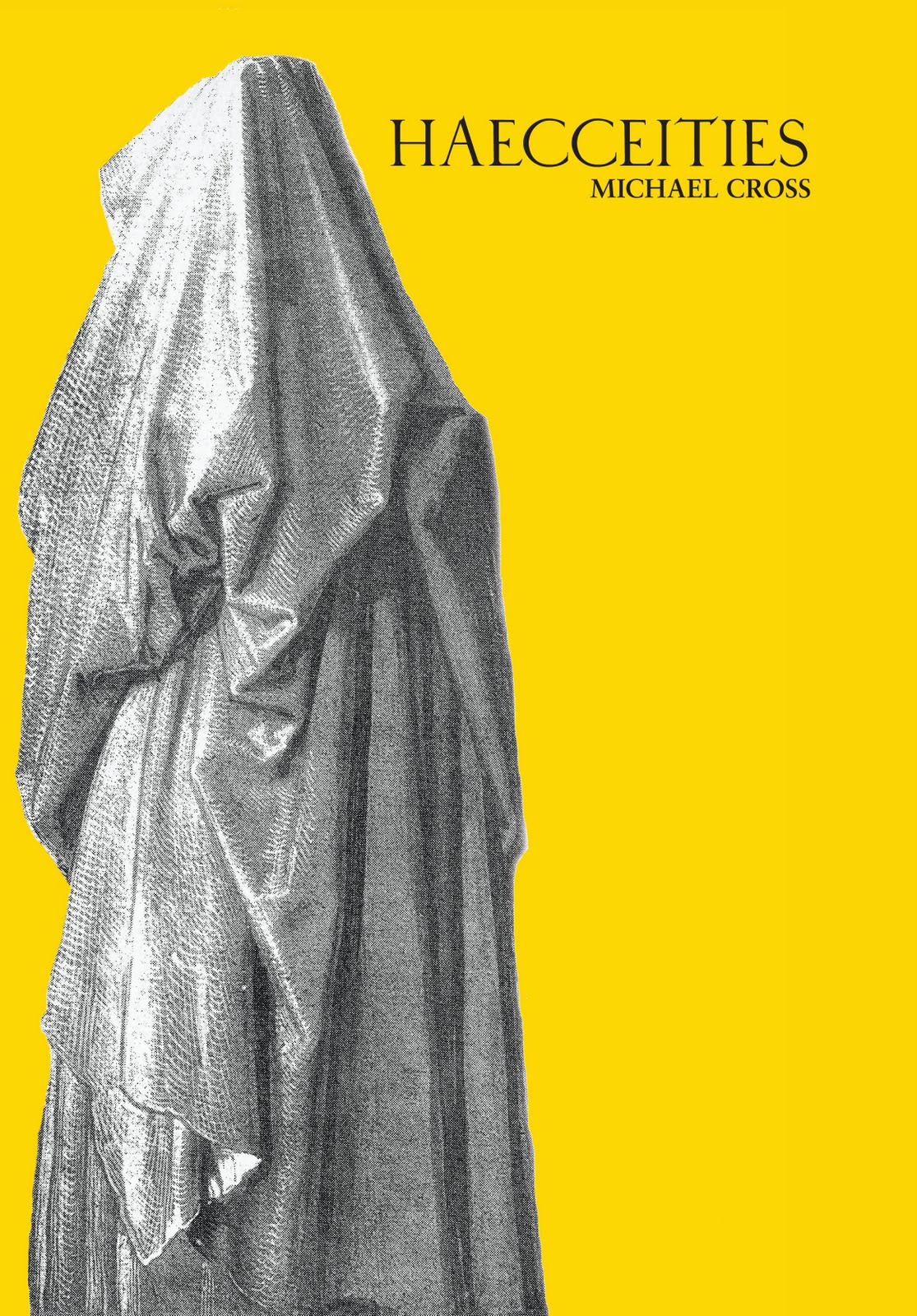
Cuneiform’s three most recent books are Kit Robinson’s Determination, Michael Cross’ Haecceities and Alan Loney’s The Books to Come. The latter gathers together, for the first time, Loney’s radical essays that eloquently speak to the relationships between philosophy, poetry, and the art of the book. His tone is calm and meditative, while on a formal level, the book resembles Olson’s Call Me Ishmael and Susan Howe’s My Emily Dickinson. Haecceities is also the culmination of many years of work by one of the most energetic, yet slowest, poets I know. Cross is a serious OED junkie, a poet who works with the syllable rather than the line or strophe as his primary unit of thought, or sound. The poems push against the edge of another language, reflecting the complex rhythms of Peter Brotzmann, metronome of Grandmaster Flash, and philosophical preoccupations of Badiou. Robinson’s book came in yesterday’s mail. It’s a juicy collection of poems from the last ten years or so, the first trade edition since The Messianic Trees. Robinson is among the writers I respect most these days. Perhaps it has something to do with my own age, but I have a growing respect for writers who have put out a dozen books or more with consistent integrity. There’s so much overproduction, so much misguided ambition in publishing today that it’s really satisfying to sit down with something that sticks. 35 years of publishing, and Kit keeps getting better. I could say the same of Michael Gizzi, who died too soon, writing his very best work.