Showing posts with label emergency flash mob press. Show all posts

Wednesday, April 09, 2025

Ongoing notes: early April, 2025 : Danny Jacobs + Caleb Jordan,

National Poetry Month! And you are following the daily poems I’m posting via the Chaudiere Books blog, yes? And you saw that Christine is doing a reading in Ottawa on April 15th? We’re reading together in Ottawa in June somewhere (I’ll let you know where/when that happens) and she even reads in Winnipeg at some point, also. And the updates via my own substack and the new above/ground press substack? There’s so much happening! And the above/ground press postal increase sale, naturally, is still going on (in case you missed that). Oh, and prepare yourself for the ottawa small press fair this June.

Fredericton NB: Produced as “No. 2 in the Entrepôt Series” is Riverview, New Brunswick writer Danny Jacob’s Dreamland: The Bishop House Fragments (Fredericton NB: emergency flash mob press, 2024), following a poetry chapbook, Sulci (The Hardscrabble Press, 2023) and the full-length Sourcebook for Our Drawings: Essays and Remnants (Gordon Hill Press, 2019) [see my review of his full-length debut here] (with a novel forthcoming this year, according to his author biography). For those unaware, the Elizabeth Bishop House is one associated with the late Pulitzer Prize-winning poet Elizabeth Bishop (1911-1979), now utilized as a space for occasional residency [Christine and I drove by once, if you might recall]. As Jacob begins:

My first night here and the Elizabeth Bishop House has kept me awake, the house or its ghosts, the creak and gastric inner workings, the oil furnace revving up like the gasping of the nearly drowned. I missed them, my wife and daughter. Sarah and I are separating so the missing is pressurized, gravitational. There is no devastating reason for the separation other than the sad fact of their being no devastating reason.

Which some might argue makes it more devastating.

There is an echo, of sorts, to this work composed during a residency to the late Robert Kroetsch’s chapbook, Lines Written in the John Snow House (Calgary AB: housepress, 2002), later included in his trade collection, The Snowbird Poems (Edmonton AB: University of Alberta Press, 2004) [see my note on such here], composed while Kroetsch was in Calgary as part of the University of Calgary’s Markin-Flanagan Distinguished Writers Programme. Unlike Kroetsch, Jacobs writes his as a journal of first-person fragments, observations and clarifications, working his way through the ghosts of that particular space, and of Bishop’s own writing, all through the lens of this imminent separation. He offers: “To write is to abandon surety.” He writes in this unknown space into, one might say, the unknown of what is to come, suggesting this work as a kind of pivot, a placelessness between where he was prior, to where he will be once he emerges. The uncertainty runs through this whole work, set as a foundation upon which the narrative fragments build.

I imagine Bishop wandering this house now, a vexed Crusoe brought back to her homeland, picking at what was kept, what was bought for old-timey ambiance. She pages through the giant family bible atop the upright piano with the clawfoot stool, presses a key on the Underwood – that familiar, mechanized resistance. She opens the red drawstring bag in which she used to smuggle roast beef on flights from Boston to Nova Scotia, now locked away behind a glass hutch, and asks – like Crusoe asks about his own stranded artefacts – “How can anyone wants such things?”

Rock Island IL/OK: I’m moving through Oklahoma poet Caleb Jordan’s Idylls (Rock Island IL: Stone Corpse Press, 2025), a sequence set as two sequences of fourteen numbered sonnets, reminiscent, slightly, of Stephen Brockwell and Peter Norman's magnificent collaborative essay in sonnet form, Wild Clover Honey and The Beehive, 28 Sonnets on the Sonnet (Ottawa ON: The Rideau Review Press, 2004), a collection I’d love to be able to see back in print. The sonnet is, as Brockwell himself has noted, an endlessly mutable form, and wild experiments around the sonnet have appeared for decades, with space enough for far more than what has already been produced.

I’m intrigued by Jordan’s sonnet-shapes, clearly feeling out the form throughout the entire paired sequence: “I emerge from the hollow horse corpse / into a desert in a box / and I cannot find the actual / door,” he writes, to open poem “XIII” in the first sequence, “even though / it is right there in front of me.”

This is a big project for what suggests itself as a debut, twenty-eight sonnets from a writer who offers little in his bio beyond the fact of his “PhD in Creative Writing from Oklahoma State University,” and that he “spends his free time as all Oklahomas do (searching for evidence of the existence of Bigfoot and other “cryptids”).” The internet doesn’t provide much more, but there is a curious interview with Jordan over at Black Stone/White Stone that provides this intriguing quote: “I do not want to be enjoyed but to be fleetingly experienced, like an immunization, and sting a day or two later.”

XIV

I am not reaching. In my mind
is a door and behind that door
is a name. Thucydides?
Pantagruel? Joe? The key to
the door is glowing blue
underneath unbreakable glass.
I claw, I curse, I dream
of opening the door and finally
saying the name aloud.
It hurts to brush freshly cut
grass with the tender palm
of my hand. The shapes
on my journal move themselves.
Unbidden, the door creaks open. (“1”)
 

Wednesday, March 26, 2025

Ongoing notes: late March, 2025 : Neil Surkan, Katherine Alexandra Harvey + Jamie Kitts,

You know that the fifteenth annual edition of VERSeFest: Ottawa’s International Poetry Festival began last night, yes? I know you’ve already purchased tickets for our remaining days. You wouldn’t believe the roster we have for this one. And the above/ground press Canada Post increase sale is still going on, don’t you forget. Did I mention forthcoming chapbooks by Meredith Quartermain and R. Kolewe, among others? That is pretty cool.

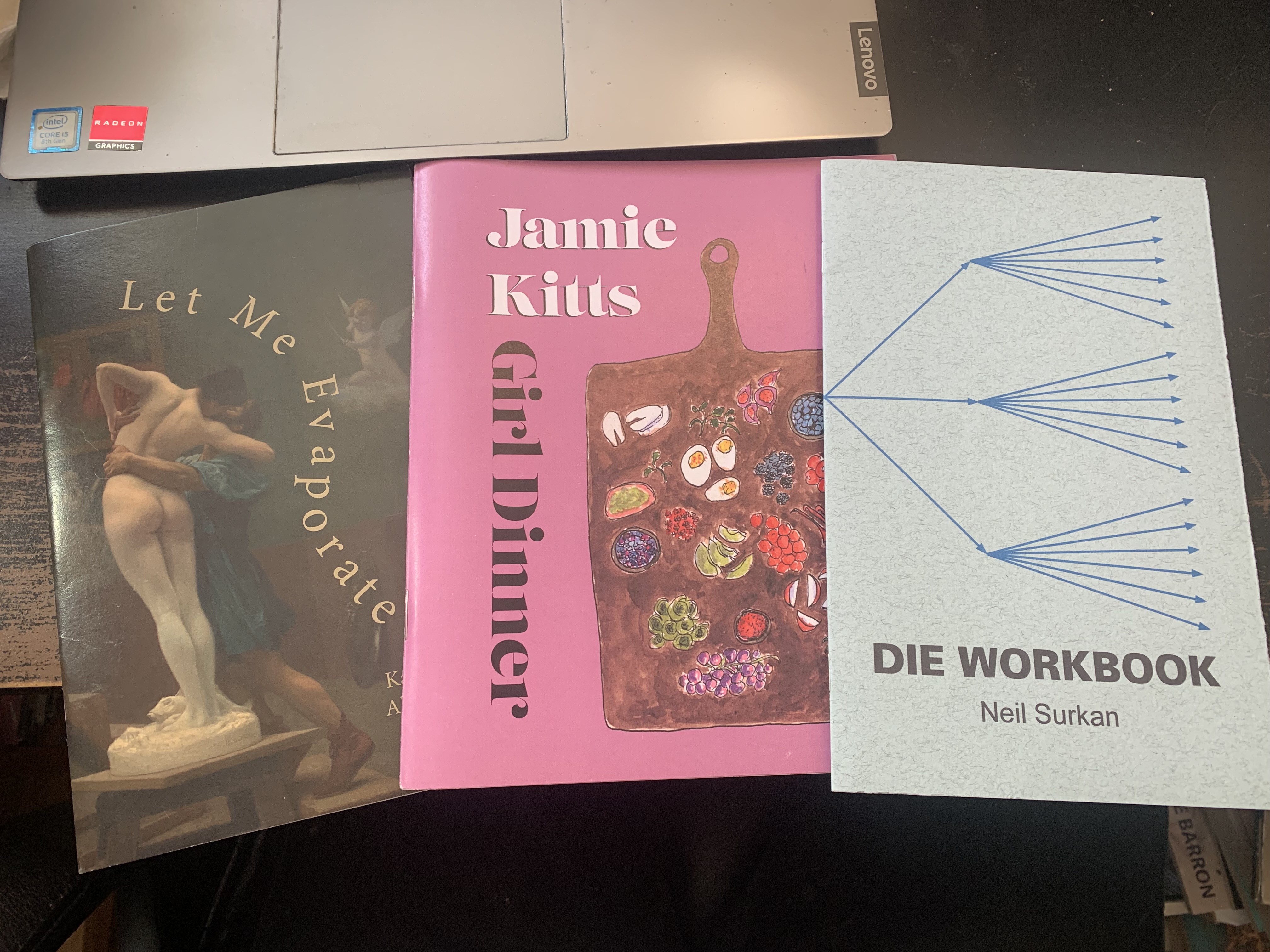
Calgary AB/Nanaimo BC: British Columbia poet Neil Surkan’s latest, following the full-length On High (2018) and Unbecoming (2021) [see my review of such here], both from McGill-Queen’s University Press, as well as three prior chapbooks [see my review of one of them here], is the chapbook Die Workbook (Calgary AB: The Blasted Tree, 2024), a short sequence assembled through self-contained and accumulated fragments. “Like a steaming cup in a shaking room,” the poem begins, “unmoored, your life belongs to chance. / Attend the damage. Our purpose is damage. / Once the earth reveals its restlessness, / the dead can’t protect you. / You mustn’t defend the dead.” The detailed sketch of his lyric is compelling, offering dense lines of lyric that extends into sentences, combining structures in a way I’d be interested to see him push further.

Drafting in my little shorts when I got home,” he writes, “my focus turned to a die: I began to experiment with corresponding each trapdoor with the die’s six sides, with precisely six options, so that a reader might roll a die and find one of six words filling in a given gap. In turn, they would come up with a particular poem in a particular moment (a riff, I suppose, on bibliomancy).” He writes of endings, of chance, writing a randomization process comparable to some of the sound work Ottawa poet Grant Wilkins has been doing lately, for example; he writes short bursts that assemble into something larger, more ongoing, one step after another.

The dead can’t protect you
once the earth reveals its relentlessness
like a brimming cup in a shaking room.
Sacred, your life belongs to chance –
you mustn’t defend the dead.
Accept the damage. Our lot is damage.

Toronto ON: Having heard her read a couple of years back through the Ottawa International Writers Festival, I was curious to see a copy of Let Me Evaporate (Toronto ON: Anstruther Press, 2024), the debut chapbook by novelist Katherine Alexandra Harvey, who, according to her bio, “splits her time between Newfoundland and Montreal,” working to complete a second novel and a full-length poetry debut. Harvey’s poems are first-person observational and gestural, comparable to monologues one might hear from a stage. “When you think of me in LA,” she writes, to begin the opening poem, “Hollywood Happened Differently For Me,” “think of Hollywood Hills // recovering from that death flu, my cough rattling across the wrap / around deck, how it was all painted white and I listened [.]” There is a clarity to these poems, these narratives, akin to lyric diary entries, working a narrator-character across a range of experiences. “All I really wanted,” she offers, as part of “Your Father’s Reputation Never Got You Anywhere,” “was for my father to know his lessons / resonated.” There are times I would like her lines to be a bit tighter, certainly, but I would be interested to see where she might land with a first full-length poetry collection; I suspect such an announcement isn’t that far off.

The Wake

I removed my belly button and paid attention to the healing process. No one believed I could feel the hole closing over, that it reminded me of being born. My mother was laid out on the kitchen table for a week. Formaldehyde high, you never noticed when my skin blackened. I felt undesirable. You called me a perpetual victim. I plucked out my eyelashes and pencil curled my hair so you wouldn’t see my edges. I watched them dig holes for all the women. Your only comment was that dress is too tight for a funeral put something else on for the love of God. My watery silhouette shadowed the tombstone. I swallowed dirt by the fistful. Found a worm and fed it crabapples for a calendar year. Get off on the cleanup. I pocketed ones all over town. I never bought the flowers after all this time.

Fredericton NB: From Ian LeTourneau’s Emergency Flash Mob Press [see their periodicities note on the press here] comes Fredericton poet and editor (qwerty magazine and Gridlock Lit) Jamie Kitts’ Girl Dinner (2024), an assemblage of poems composed as a curious mix of purpose, lyric styles and exploratory shapes. “I’m clay, sand, and limestone, / three parts,” Kitts writes, to close the poem “I’m at the Global Climate Crisis,” a piece subtitled “after a skeet by Juno Stump,” “three names / Bill and Blaine and Pierre / marked-up Sharpie my square body / the sudden nearest soonest violence / not the first, never / the last to serve cunt / at the global climate crisis.” There’s a swagger through Kitts’ explorations, politically and socially engaged and self-aware, composing poems attempting different elements around the first-person narrative lyric to see what works, what fits, what plays. There’s a confidence here, and an openness, seeking out what might be possible. “You over heaven, me in your eyes,” Kitts writes, as part of the playfully serious “This is not a poem, it’s a meme,” “Girl, I’m so fucking glad we’re not guys / Gender’s fake but we are not / IF SHE BREATHS, SHE’S A THOT [.]”