Showing posts with label Neil Surkan. Show all posts

Saturday, November 22, 2025

Ongoing notes: TIFA Small Press Market/Meet the Presses’ Indie Lit Market (part four, : Neil Surkan + Beverley Daurio,

Again, this blended sequence. [see my first post on such here; see my second post here; see my third post here]. Might we see you later today at the ottawa small press book fair? We’ve been doing this for more than thirty years now, if you can imagine.

Toronto ON/Nanaimo BC: From Nanaimo-based poet Neil Surkan, following the full-length poetry collections On High (2018) and Unbecoming (2021) [see my review of such here], both from McGill-Queen’s University Press, as well as the chapbooks Super, Natural (Anstruther Press, 2017), Their Queer Tenderness (Toronto ON: knife|fork|book, 2020) [see my review of such here] and Die Workbook (Calgary AB: The Blasted Tree, 2024) [see my review of such here] is Ruin (knife|fork|book, 2023), a title I clearly missed when it first appeared. One might think, with at least two chapbooks I’m aware of over the past couple of years, might a new full-length collection be on the horizon? These are short, rather tight, first-person lyrics that run through meditation, reflection and family, whether working a long, extended, poem-long sentence-thought or compact lyric. I’m curious to see how the poems here might fit with his work from, for example, Die Workbook, what the shape of that potential full-length might be.

Reflection

I’ve come to the mirror and seen
myself for the first time 

in years, not as I fear
others judge me mid-chore 

or with love, but as
a creature who peers 

frankly, knowing neither shame
nor the threat of heaven.

Toronto ON: I’m very pleased that Toronto writer Cary Fagan has been producing a series of reprints and reissues as part of his chapbook press, Found Object, with one of the more recent titles by Toronto writer, editor and publisher (of the late and legendary press The Mercury Press) Beverley Daurio, A Broken Cup (2025). A Broken Cup is excerpted from her full-length poetry collection If Summer Had a Knife (Toronto ON: Wolsak and Wynn, 1987), a book, obviously, long out of print. I’m curious if this particular selection exists as a kind of “selected poems,” akin to a “best” of what that particular full-length had to offer, nearly four decades on, or if an assemblage of poems salvaged into a form that felt self-contained (or a bit of both, really). Without knowing the source, it all becomes speculation. “I am a slow writer; the poems in A Broken Cup were composed over several years,” Daurio writes in her short introduction, “Thoughts from a 505 Dundas Streetcar,” “within this newly electric and alive city. These poems may not seem political, but their very existence felt to me incredibly daring. I love Basho and Hopkins and Thomas and Plath, but I was hungry for writing that breathed the air of this place and time.” Further on, she offers:

Re-reading these poems, I am reminded of these times with fondness, of the living and charmed world created by so many caring, brilliant, open-minded people, and the unwavering light that shines from the lanterns they carried.

Before this re-issue, I actually hadn’t been aware that Daurio wrote poems, far more aware of her as the author of fiction (and one of the finest editors of same, through her time as a publisher). The poems have a timeless quality to them, both of their time and immediately fresh, offering clipped narratives across distances, pointed phrases and descriptive patter. I keep hoping from further prose from her, aware that it has been years since she’s released any new work, and this appearance of a reissue does make me hope that there might be further work possible What other gems might be hiding in Beverley Daurio’s files?

driving into winter 

dear mom: just a note to tell you i missed you
by a few hours, went through stop signs,
cranked up the radio, but when i got in
there were three cars in the driveway
and dad was in the hall closet with his face
in your coats, he was hugging your coats.
the whole way up i was driving into winter,
not a slow or subtle winter, there’s just
snow
suddenly. 

not the heart of winter either though
the highway’s rather like a spike
and you can fancy somehow driving it
that there is such a thing as control. 

steven and gregg had eaten and nana poured me a brandy
which i didn’t spill, thanks to the shape of the glass.
the green walls were hung with your
natures mortes, also the painting of the empty
café. nothing really dead in any of them,
no acknowledgement of withered apples lying
useful on the grass, no presumption
of comparison.

dad said the nurses sat you up in bed and
combed your hair. i wish i had a picture
of that. otherwise, it’s so easy to pretend
otherwise.

Wednesday, March 26, 2025

Ongoing notes: late March, 2025 : Neil Surkan, Katherine Alexandra Harvey + Jamie Kitts,

You know that the fifteenth annual edition of VERSeFest: Ottawa’s International Poetry Festival began last night, yes? I know you’ve already purchased tickets for our remaining days. You wouldn’t believe the roster we have for this one. And the above/ground press Canada Post increase sale is still going on, don’t you forget. Did I mention forthcoming chapbooks by Meredith Quartermain and R. Kolewe, among others? That is pretty cool.

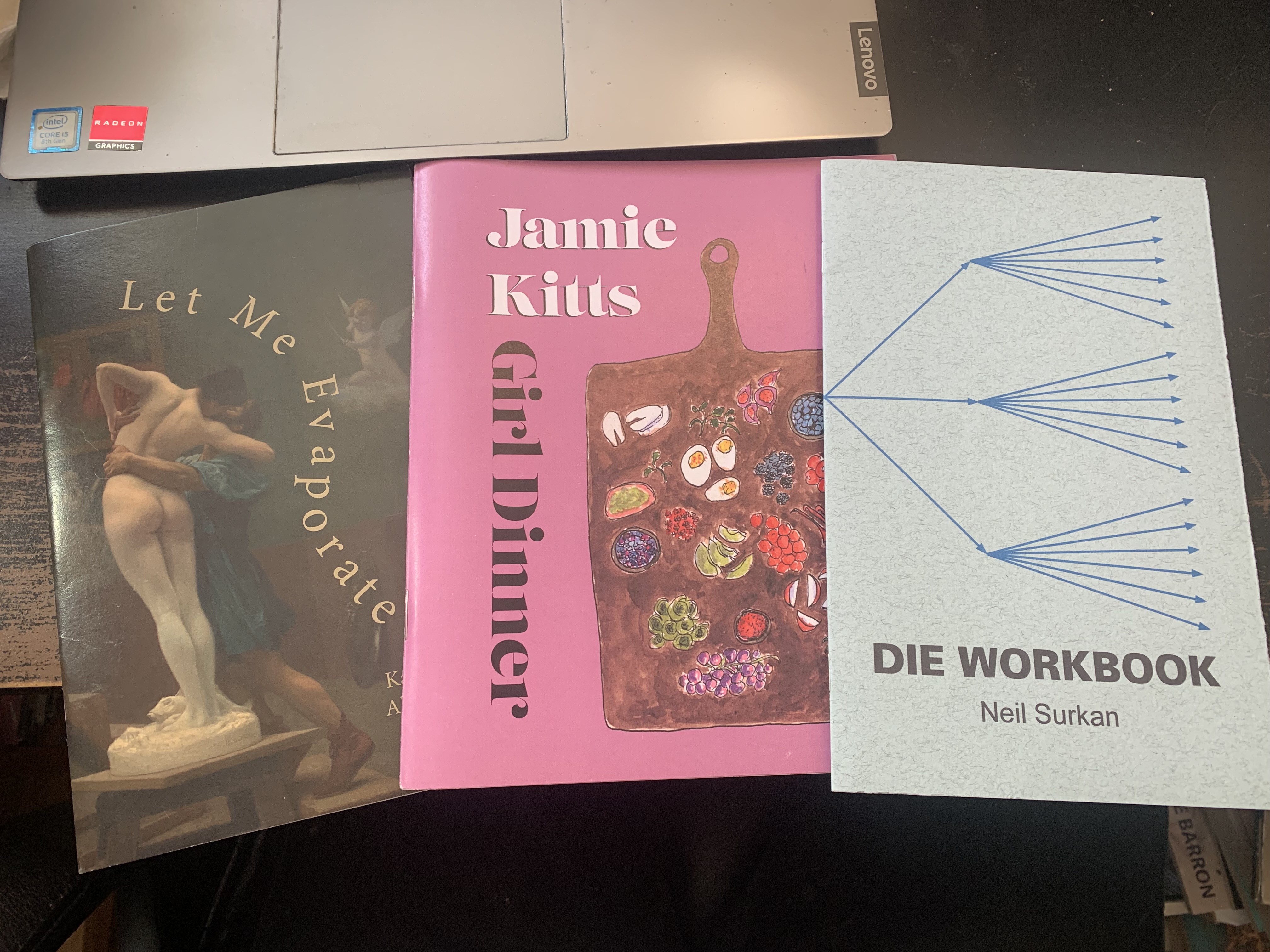
Calgary AB/Nanaimo BC: British Columbia poet Neil Surkan’s latest, following the full-length On High (2018) and Unbecoming (2021) [see my review of such here], both from McGill-Queen’s University Press, as well as three prior chapbooks [see my review of one of them here], is the chapbook Die Workbook (Calgary AB: The Blasted Tree, 2024), a short sequence assembled through self-contained and accumulated fragments. “Like a steaming cup in a shaking room,” the poem begins, “unmoored, your life belongs to chance. / Attend the damage. Our purpose is damage. / Once the earth reveals its restlessness, / the dead can’t protect you. / You mustn’t defend the dead.” The detailed sketch of his lyric is compelling, offering dense lines of lyric that extends into sentences, combining structures in a way I’d be interested to see him push further.

Drafting in my little shorts when I got home,” he writes, “my focus turned to a die: I began to experiment with corresponding each trapdoor with the die’s six sides, with precisely six options, so that a reader might roll a die and find one of six words filling in a given gap. In turn, they would come up with a particular poem in a particular moment (a riff, I suppose, on bibliomancy).” He writes of endings, of chance, writing a randomization process comparable to some of the sound work Ottawa poet Grant Wilkins has been doing lately, for example; he writes short bursts that assemble into something larger, more ongoing, one step after another.

The dead can’t protect you
once the earth reveals its relentlessness
like a brimming cup in a shaking room.
Sacred, your life belongs to chance –
you mustn’t defend the dead.
Accept the damage. Our lot is damage.

Toronto ON: Having heard her read a couple of years back through the Ottawa International Writers Festival, I was curious to see a copy of Let Me Evaporate (Toronto ON: Anstruther Press, 2024), the debut chapbook by novelist Katherine Alexandra Harvey, who, according to her bio, “splits her time between Newfoundland and Montreal,” working to complete a second novel and a full-length poetry debut. Harvey’s poems are first-person observational and gestural, comparable to monologues one might hear from a stage. “When you think of me in LA,” she writes, to begin the opening poem, “Hollywood Happened Differently For Me,” “think of Hollywood Hills // recovering from that death flu, my cough rattling across the wrap / around deck, how it was all painted white and I listened [.]” There is a clarity to these poems, these narratives, akin to lyric diary entries, working a narrator-character across a range of experiences. “All I really wanted,” she offers, as part of “Your Father’s Reputation Never Got You Anywhere,” “was for my father to know his lessons / resonated.” There are times I would like her lines to be a bit tighter, certainly, but I would be interested to see where she might land with a first full-length poetry collection; I suspect such an announcement isn’t that far off.

The Wake

I removed my belly button and paid attention to the healing process. No one believed I could feel the hole closing over, that it reminded me of being born. My mother was laid out on the kitchen table for a week. Formaldehyde high, you never noticed when my skin blackened. I felt undesirable. You called me a perpetual victim. I plucked out my eyelashes and pencil curled my hair so you wouldn’t see my edges. I watched them dig holes for all the women. Your only comment was that dress is too tight for a funeral put something else on for the love of God. My watery silhouette shadowed the tombstone. I swallowed dirt by the fistful. Found a worm and fed it crabapples for a calendar year. Get off on the cleanup. I pocketed ones all over town. I never bought the flowers after all this time.

Fredericton NB: From Ian LeTourneau’s Emergency Flash Mob Press [see their periodicities note on the press here] comes Fredericton poet and editor (qwerty magazine and Gridlock Lit) Jamie Kitts’ Girl Dinner (2024), an assemblage of poems composed as a curious mix of purpose, lyric styles and exploratory shapes. “I’m clay, sand, and limestone, / three parts,” Kitts writes, to close the poem “I’m at the Global Climate Crisis,” a piece subtitled “after a skeet by Juno Stump,” “three names / Bill and Blaine and Pierre / marked-up Sharpie my square body / the sudden nearest soonest violence / not the first, never / the last to serve cunt / at the global climate crisis.” There’s a swagger through Kitts’ explorations, politically and socially engaged and self-aware, composing poems attempting different elements around the first-person narrative lyric to see what works, what fits, what plays. There’s a confidence here, and an openness, seeking out what might be possible. “You over heaven, me in your eyes,” Kitts writes, as part of the playfully serious “This is not a poem, it’s a meme,” “Girl, I’m so fucking glad we’re not guys / Gender’s fake but we are not / IF SHE BREATHS, SHE’S A THOT [.]”

Thursday, March 24, 2022

Neil Surkan, Unbecoming


INFINITIES

At this sharp
crook in Beaver Point
Road, a cumulus

of blackberries
frizzes with ripe fruit,

veined leaves. Cars slip
past like swallows

in the throat while
three wild horses

tug drupelets
off the spiny

boughs, their wire-
twisting plier lips

tenderly efficient.

On this crisp
July evening,
they’re completely

ignoring me. Looking
down, I suddenly notice

the grasses teeming

with baby toads.

The second full-length collection by Calgary poet Neil Surkan, after On High (Montreal QC: The Hugh MacLennan Poetry Series, McGill-Queen’s University Press, 2018), is Unbecoming (The Hugh MacLennan Poetry Series, McGill-Queen’s University Press, 2021), a collection of delicately-carved portraits of attention, characters sketches and family stories, all held together by heart and hearth. Surkan articulates a sequence of restrained lyric bursts, composed as tightly-packed narratives that reveal spaces, scenes and recollections, and stories writing out all the words for silence. “Why are we taking these strands / of words so seriously?” his narrator is asked, at the offset of the poem “POETRY WORKSHOP / WITH MEDICAL STUDENTS,” writing a short scene of a seeming-difference of opinion between the workshop attendees and facilitator. The poem answers, ends, as the narrator/facilitator turns the question back: “Why are you so invested / in keeping us alive?” Through a poetics of attention, there is a curious way through which Surkan attempts to articulate the whys and ways we should care about such things, including lines of poetry, and the humans that surround us, utilizing a descriptive language that is as unusual as it is striking. “Third-generation firs,” he offers, to open the poem “GLOAMING IN A MONOFOREST,” “planted like barcodes, / repeat, scaly and bald / to their modest tops, where // smoky-green tufts sway. / The ground, needles and salal / around silo-wide stumps, // springs underfoot – or shrugs.”