Showing posts with label Tin House. Show all posts

Sunday, August 04, 2024

12 or 20 (second series) questions with Myriam J.A. Chancy

Myriam J.A. Chancy, award-winning author of What Storm, What Thunder, is a Haitian-Canadian-American writer, the HBA Chair in the Humanities at Scripps College in Claremont, California and a Fellow of the John Simon Guggenheim Memorial Foundation.

1 - How did your first book change your life? How does your most recent work compare to your previous? How does it feel different?

When you publish a first book, it feels like you'll never write another, but then you do. Life doesn't so much change as it gets bigger in terms of reaching readers and finding that what you had to say resonated with others. My first published book (not the first written), was on Haitian women's literature and created a subfield. It made it possible for others to do their work and established me as a senior scholar fairly early in my career. So, that was a great boost, but it took much more time to get my novels out. What I've learned in the process of publishing my books (ten in all at this point) is that what matters is writing the next book, and each one will have varying degrees of success but each will find their intended audience in time. So, it's not so much life changing as taking a step towards one's writing life, towards coming to terms with exposing one's inner self to a greater world through writing.

My most recent work, a novel, Village Weavers compares to the previous in that it depicts Haitian characters as connected to a complex culture and also to global affairs. It differs in that it has fewer characters than my previous work, which was narrated by ten characters, whereas Village Weavers has only two.

2 - How did you come to fiction first, as opposed to, say, poetry or non-fiction?

As a reader and professor of literature, I've always preferred the novel form for its complexity and breadth so I gravitate to fiction over other genres at the same time as I write academic essays and nonfiction pieces alongside the fiction.

3 - How long does it take to start any particular writing project? Does your writing initially come quickly, or is it a slow process? Do first drafts appear looking close to their final shape, or does your work come out of copious notes?

Each project is different in terms of the time it may take. Some works have taken me several years while others have only taken months. I think the time a project takes depends on external factors, whether I'm teaching full time or not, whether I have to undertake a great deal of research or not and how tired I may be at any given point. If the structure is particularly trying, that may also take me more time to work out. Village Weavers took me roughly a year and a half to write, whereas the previous novel, What Storm, What Thunder, took six to eight years. Having said this, the process is more or less the same each time: I begin with an idea and start writing, then I determine if I want to block out the book's structure or just want to write my way through. If I write my way through, I write several drafts before arriving at the version that will go out to an editor. The initial drafts I consider the writer's draft and can look very different from the final product. I take notes while I'm writing, usually on research and points of plot that I don't want to forget but I don't essentially write from notes; they're there to keep me on track as I write and revise.

4 - Where does a work of prose usually begin for you? Are you an author of short pieces that end up combining into a larger project, or are you working on a "book" from the very beginning?

I'm always working on a novel; it's the genre that interests me, the complexity of the relationships between the characters and the larger scope of their lives. It's what keeps me engaged. So, I'm definitely always working on the “book” rather than shorter pieces.

5 - Are public readings part of or counter to your creative process? Are you the sort of writer who enjoys doing readings?

I do enjoy doing readings. As a kid, I participated in French declamation contests and the objective was to bring someone else's piece alive for an audience. Readings from one's own work is similar in that it brings the work alive for the reader but it also marks the definitive end of a project for me as its writer. Public readings are a letting-go process: it's not an act of creation but an act of release - to give up the finished project and to free myself up to work on something new.

6 - Do you have any theoretical concerns behind your writing? What kinds of questions are you trying to answer with your work? What do you even think the current questions are?

Well, since I'm also an academic, I'm always animated by theoretical concerns having to do with the postcolonial condition, feminist issues, race, gender, and so on, and I think about the intersection of the theories developed in these fields with the themes I'm trying to bring out in my fiction. By the same token, I don't think there are particular questions I want to answer in the works generally. My creative projects also differ from my academic ones in that they address spiritual concerns that can't be addressed in the academic work. Each project brings with it its own sets of questions - or a particular question - that I then seek to work out through the arc of the novel and the relationships of the characters to one another. These questions from one project to another while the overarching issues having to do with the postcolonial and identity remain more or less stable: how does the history of colonization continue to impact individuals within formerly colonized nations? How do factors such as gender, race, clas and sexuality alter the scope of possibility for characters and color their perspectives?

7 – What do you see the current role of the writer being in larger culture? Do they even have one? What do you think the role of the writer should be?

To my mind, the role of the writer is to illuminate, whether that is to examine various aspects of human nature or to shed light on forgotten histories or communities. Literature exists in order to provide us with tools for examining ourselves, our beliefs, societies and to better understand others. It should serve as a means to sympathize with others on the human condition. Empathy might be the end goal but that might be too much to hope for.

8 - Do you find the process of working with an outside editor difficult or essential (or both)?

Editors have been key to my publishing life whether early in my career or at present. Earlier on, editorial feedback helped me to work out my strengths and weaknesses, helped me to make decisions about what aspects of the craft were valuable to me and which were not. At this point, editorial feedback has more to do with assisting me in reaching my goals as I've set them out in a given project. A good editor provides the necessary external perspective, especially when a project is complex or emotionally charged. In the revision process, an objective editorial eye is essential.

9 - What is the best piece of advice you've heard (not necessarily given to you directly)?

Read poetry. Raymond Carver (in a letter of response he sent me when I reached out asking for writing advice when I was a teenager).

10 - What kind of writing routine do you tend to keep, or do you even have one? How does a typical day (for you) begin?

No typical days. I write mostly when inspiration moves me to do so. When I'm deep into a project, my usual routine is to get up very early in the morning to write, usually between four and seven or seven to ten in the morning. I write. The cat joins me, then I go back to sleep or go teach. The earlier I can get some writing in, the more I can get out of my day. Then I just keep going until the full first draft is completed. Sometimes I revise as I go until I feel that I'm nearly done. It depends ont the project. I know the work is done when the characters no longer have anything to say and aren't waking me up to get to work! I also drink a lot of tea when I write and take daily walks.

11 - When your writing gets stalled, where do you turn or return for (for lack of a better word) inspiration?

Music. Always music. I usually have particular recordings I play related to each work. Sometimes I compile a playlist as I go, sometimes afterward. Music is a touchstone so if I get stalled or need to rethink some aspect of a project, music is always the way to go. And walks.

12 - What fragrance reminds you of home?

The scent of laundry. This always reminds me of my mother.

13 - David W. McFadden once said that books come from books, but are there any other forms that influence your work, whether nature, music, science or visual art?

I'm a very visual person and worked with photography when I was younger. I like to think of my novels as cinematic so thinking in terms of film sequences, lighting, mood, setting, all of that comes into my writing. Music too.

14 - What other writers or writings are important for your work, or simply your life outside of your work?

I'm inspired by the work of many contemporary writers and read widely. Historically speaking, the works of James Baldwin, Toni Morrison, Paule Marshall, Toni Cade Bambara, Margaret Laurence, Margaret Atwood, have been formative, among others.

15 - What would you like to do that you haven't yet done?

Create an alternative small press or run a creperie/bookstore.

16 - If you could pick any other occupation to attempt, what would it be? Or, alternately, what do you think you would have ended up doing had you not been a writer?

If I had a different constitution, I would have liked to have been a chef, or a painter. When I was in College, an aptitude test claimed that I would have been a good florist - that might still be something interesting to try.

17 - What made you write, as opposed to doing something else?

I really don't know. I've been writing since I was seven and publishing since I was a teenager so it seems I was always meant to be a writer. But, in the end, I think I'm an artist and if I weren't writing, I would have found another outlet for self expression.

18 - What was the last great book you read? What was the last great film?

The last great book I read was Jacque Roumain's 1946 classic, Gouverneurs de la Rosee (Masters of the Dew), in the original French.

The last great film - Jessica Lange in The Great Lillian Hall.

19- What are you currently working on?

A novel focusing on the entwined themes of race, gender and travel, and some essays.

12 or 20 (second series) questions;

Wednesday, April 12, 2023

12 or 20 (second series) questions with Kevin Sampsell

Kevin Sampsell is the author of a memoir (A Common Pornography), a novel (This Is Between Us), and a collection of collages and poems (I Made an Accident). He lives in Portland, Oregon and runs the influential small press, Future Tense Books. An award-winning bookseller, he has worked at Powell's City of Books since 1997. His collages have appeared on album covers, book covers, and in many publications like Kolaj Magazine, The Rumpus, The Weird Show, Chicago Quarterly Review, Little Engines, and Black Candies. His writing has appeared in Paper Darts, Southwest Review, Salon, Poetry Northwest, McSweeney's, Tin House, and elsewhere. He is the co-curator of Sharp Hands Gallery, a website featuring international collage artists.

1 - How did your first book change your life? How does your most recent work compare to your previous? How does it feel different?

Technically, my first book (that wasn't a chapbook) was a self-published collection of stories, poems, and word collages called How to Lose Your Mind With the Lights On (Future Tense Books, 1994). It's pretty wild to think about how long ago that came out. I think it changed my life because it was my first experience doing everything all on my own. I probably could have used an outside editor, but if I looked at that book now, I'm sure I'd still appreciate a lot of its goofy weirdness. My most recent book, I Made an Accident, is a collection of collages and poems. In some ways it feels similar to that first book because it's a hodge-podge of things meant to surprise, delight, and even confound you. 

And how does it feel different? The collages are a lot better this time around.

2 - How did you come to poetry first, as opposed to, say, fiction or non-fiction?

I started in high school. My best friend and I would write weird little poems, but we didn't even call it poetry. We called them pieces. We were basically just trying to crack each other up, which I think was the early mission of the surrealists too, right? I wanted to write poems that were more Monty Python than Robert Frost.

3 - How long does it take to start any particular writing project? Does your writing initially come quickly, or is it a slow process? Do first drafts appear looking close to their final shape, or does your work come out of copious notes?

Over the years, it's been all over the place. I think I was more focused and compulsive for the first ten years or so of my writing life. I'd write whole stories pretty quickly, and sometimes several poems a day. I'm much slower now and I edit myself a lot more. But I know that writing, and especially publishing, is a slow game. It doesn't bother me to go slow now. But I'm always working on something, and a lot of times copious note-taking is involved.

4 - Where does a poem or work of prose usually begin for you? Are you an author of short pieces that end up combining into a larger project, or are you working on a "book" from the very beginning?

Two of my books, the novel, This Is Between Us, and my memoir, A Common Pornography, were written in a non-linear fashion. I'd write chapters or scenes and then later spread them all out on the floor and figure out what order they needed to go. I finished a novel recently though that I wrote in a more traditional fashion, from the beginning to the end. And I challenged myself to write longer chapters for this book too. Off and on, it took about eight years. Who knows if it will ever get published.

5 - Are public readings part of or counter to your creative process? Are you the sort of writer who enjoys doing readings?

I do enjoy doing readings and I actually host about a hundred or more readings every year at my job (Powell's Books in Portland, Oregon). I think I'm a good reader and I'm good in front of an audience, so sometimes it helps sell a few more books when I can deliver an entertaining reading. I notice that at my job too–a great reading sells a lot more books than a mediocre one.

6 - Do you have any theoretical concerns behind your writing? What kinds of questions are you trying to answer with your work?

One of the main things I think about when writing is how people interact with each other and how relationships work. I don't think I could convincingly write something very engaging about nature or politics. I'm captivated by people in the world and all the strange things that can happen to them. I especially love writing about ordinary people who find themselves in unexpected situations they probably don't want to be in. More recently, I do find myself fixating on death, loss, and grief as central themes.

7 – What do you see the current role of the writer being in larger culture? Do they even have one? What do you think the role of the writer should be?

There are all kinds of writers and they all have different intentions or missions. I don't really think about what "role" they're trying to fill and I don't think they "should be" attempting to define the larger culture. I think questions like that feel too pointed and put too much pressure on writers to do something that others will see as "Important" (with a capital I). Writing is an art form that can do anything and be anything, and it shouldn't always concern itself with influence. 

8 - Do you find the process of working with an outside editor difficult or essential (or both)?

I love it for the most part. I want to know that my writing is making sense to another human. Most of the time, if I get a story or essay published somewhere, there is very little input from an editor. But the times when I've gotten notes from editors, it's been really helpful and eye-opening. 

As an editor myself, I love it when I can help a writer make their work better, whether it be through small edits, suggestions, or playful challenges. With Future Tense, I work alongside my co-editor, Emma Alden, and it's appreciable to have her input and notes. We usually work through a shared Google doc and seeing how our thoughts help shape the book we're working on, makes it really enjoyable. 

9 - What is the best piece of advice you've heard (not necessarily given to you directly)?

A publisher friend told me a long time ago that I should be writing off things for my tax returns each year. I found a good tax lady who helped me figure out what I can and cannot do, and frankly, it was life-changing.

10 - How easy has it been for you to move between genres (fiction to poetry to memoir to collage)? What do you see as the appeal?

I think it's been a natural progression. I mean, I don't intentionally say, I have to do this genre now. I've always liked to make different things depending on whatever I might feel most interested in. For a while, it was personal essays, and then it was flash fiction, and eventually it was visual art. I even had a haiku phase! And I admire other people who can express themselves in various forms as well–musicians who can write novels, poets who can write memoirs, actors who can paint. Having a range of interests and talents has helped me not get stagnant. It gives me a sense of creative freedom, and also permission to experiment.   

11 - What kind of writing routine do you tend to keep, or do you even have one? How does a typical day (for you) begin?

Ugh. I have such a bad writing routine most of the time. But the important thing is that I stick to it and I do have stretches when I can be focused and GSD. That stands for "Get Shit Done" and at the end of the day, that's what gives me satisfaction, whether it's writing, editing, collaging, stuff at work, etc. The name of the game is GSD.

12 - When your writing gets stalled, where do you turn or return for (for lack of a better word) inspiration?

Reading is the main kickstarter. It wakes up my brain and gives me ideas, especially poetry or a good disjointed lyric essay or something like that. Sometimes a good walk can do the trick too. Late night collaging can also inspire.

13 - What fragrance reminds you of home?

Sometimes, when my cat, Susan, yawns, I lean in to smell her cat breath, which I find so cute and comforting. I love her that much. 

The smell of baking brownies is probably a close second.

14 - David W. McFadden once said that books come from books, but are there any other forms that influence your work, whether nature, music, science or visual art?

Art for sure. Collages especially. I am obsessed with collage art and have made a whole new world of friends in that world over the past few years. You could look at some collage art and probably transcribe it into poems. And yes, I've always loved music. And movies too! Good, slow movies about people. I don't really like action or superhero movies. 

15 - What other writers or writings are important for your work, or simply your life outside of your work?

Early favorites like Richard Brautigan, Diane Williams, Garielle Lutz, Gordon Lish, Larry Brown, and Mark Leyner were key to my enthusiasm for writing and reading. There were also a lot of British music writers I enjoyed a great deal, before I was even a serious reader in my twenties. A lot of friends of mine are writers I am constantly inspired by as well: Kimberly King Parsons, Miriam Toews, Zachary Schomburg, Caren Beilin, Shane Kowalski. Plus the brilliant graphic novelist Daniel Clowes. 

16 - What would you like to do that you haven't yet done?

I'd love to have a book reviewed in Entertainment Weekly or record an album of Prince covers.

17 - If you could pick any other occupation to attempt, what would it be? Or, alternately, what do you think you would have ended up doing had you not been a writer?

I didn't go to college, so I always imagined myself working at a factory or something. I think being a mailman would be kind of cool. Or a third string quarterback in the NFL, so I could make a lot of money and probably never have to play in a real game. Working at a bookstore isn't bad though.

18 - What made you write, as opposed to doing something else?

I wasn't smart enough to go to college or brave enough to join the military. I wanted to be a radio DJ and I was for a few years before moving to Portland (in 1992). Working in the world of books was kind of an accident. I just ended up here and held on to it because it was rewarding in a nurturing and creative way. Not sure if that answered your question very well. What makes me write is the constant urge to create and make things.

19 - What was the last great book you read? What was the last great film?

I really loved Someone Told Me by Jay Ponteri. It was published by a Portland small press so it might be hard to find, but it's an outstanding book of thoughtfully probing and beautiful lyric essays. My favorite film of last year was Marcel the Shell With Shoes On. It made me weep.

20 - What are you currently working on?

I'm working on a couple of Future Tense projects and a new group show at my virtual collage gallery, Sharp Hands Gallery. As far as writing, I'm working on a couple of essays, or maybe they're more like long conceptual poems. One is about things in Portland turning into other things and another one is about things I don't remember–like the opposite of Joe Brainard's I Remember.

12 or 20 (second series) questions;

Sunday, February 13, 2022

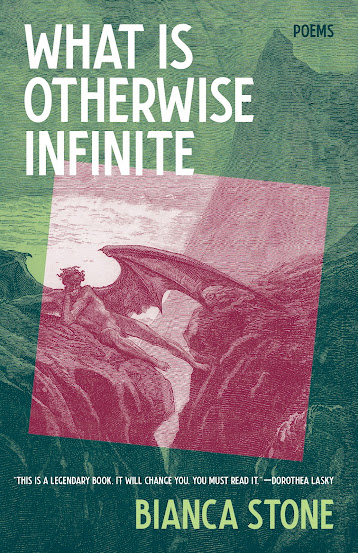
Bianca Stone, What is Otherwise Infinite


God Searches for God

Of my unclear and unimaginable self
I want none of it. There is nothing
higher than I. Only monks at my feet kissing warts.

I have nothing to give but tears, of which one
is too much and a whole sea

not enough. Do not fathom me here.
Do not touch this. Having laid the cosmic egg

who will take my eternal life in their hands?
It is said this planet came to be

when I was pulled apart.

It has been some time since I’ve seen a book by Vermont poet Bianca Stone, since her full-length debut, Someone Else’s Wedding Vows (Octopus Books and Tin House, 2014) [see my review of such here], having clearly missed out on Poetry Comics from the Book of Hours (Pleiades Press, 2016) and The Möbius Strip Club of Grief (Portland OR: Tin House, 2018), so I was curious to see her latest collection, What is Otherwise Infinite (Tin House, 2022). In sharp, first-person narratives working around (as the front flap of the collection offers) “how we find our place in the world through themes of philosophy, religion, environment, myth, and psychology,” Stone composes poems as threads connecting accumulating points; her narratives stretched as sequences of stunning lines and connective tissue. “Time does not go beyond its maiden name.” she writes, as part of “Does Life Exist Independent of Its Form?,” ending the stanza with the offering: “how uncomfortable we are with happiness.” I remember, years ago, Ottawa poet, publisher and archivist jwcurry describing the long poems of northern British Columbia poet Barry McKinnon: how every poem worked its way toward, and then away from, a singular, central point. In comparison, Stone isn’t writing with such length, nor with a single point, but up and away from multiple points-in-succession. It is as though she is composing poems as a series of communiques across telephone wires, connecting pole to further pole to build each poem’s thesis. Through What is Otherwise Infinite, the dense lyric structures of her debut have become far more complex, extended and philosophical; there is a further depth of attention here, one that could only be achieved through experience, as the second half of the poem “I’ll Tell You” reads:

my sister tells me things
that frighten me
what I mean is

how did we get here
made of gingerbread in the oven

eaten by the mother
eaten by the wolf

my little pale nephew standing on the porch
explaining lava in the netherworld

that if you fall in a certain hole
in his game

you keep falling forever
and you don’t get to keep

any of the things
you made.

There is something curious in the way Stone attends to the “infinite,” writing around and through Biblical stories and texts, illuminated manuscripts and other religious depictions, considerations and conversations. “Human nature is bifolios,” she offers, as part of the poem “Illuminations,” “versos, even blank pages / with preparatory rulings for the scribes, never painted upon. / Little books of suffering saints and resurrections. / That’s what we are.” A few lines further, offering: “On this sheet / the Evangelist dips a pen into an inkpot / and rests an arm on the side of a chair, / inspired, like Luke, by the dove, / preparing to set down an account of a life / on paper made from the skin of sheep.” There is a wit to these poems, as Stone offers both guidance and clarity through lived experience and wisdoms hard-won, articulating her takes on depictions of the spiritual from sources high and low. She writes from a world that includes faith, medieval texts and trips to Walmart, and both a sense of ongoing intellectual and spiritual pilgrimage alongside flailing, falling and being nearly overwhelmed. “A serious drama in a cosmic joke. / Scarred,” she writes, as part of the poem “The Way Things Were Until Now,” “masked, dangerous. / And what of the new Eucharist? / How hungry I always am. How I long to lack. / Though in Walmart / my heart beats a little faster. / I want the world to heal up.” Here, Stone becomes the pilgrim, and the composition of these poems-as-pure-thinking are, in effect, as much the act of pilgrimage as they are the articulation of that same journey. “I don’t know. What is it to be seen?” she writes, as part of “Artichokes,” “I can forget / it’s language I long for. Man and his ciphers / cannot save me.” This truly is a stunning collection, as Stone offers her narrator a chaos equally physical and metaphysical that requires balance, one that can only be achieved through a constant, endless and attentive search.

Tuesday, July 27, 2021

Two short story collections: J. Robert Lennon and Joy Williams,

Further to our time away in Picton, I went through recent short story collections by American writers J. Robert Lennon and Joy Williams. All the adults were two weeks-plus beyond double vaccination (and seeing anyone else, obviously), and everyone was super careful. The children spent the week in the pool.

I’ve previously only read one book by New York State fiction writer J. Robert Lennon: his short story collection Pieces for the Left Hand (Graywolf Press, 2005), and recently read through his Let Me Think (Graywolf Press, 2021). Whereas Pieces for the Left Hand was made up of one hundred very short stories organized into thematic section-groupings, the stories in Let Me Think are assembled via multiple shapes and sizes, from the short burst to the longer narrative. Lennon’s stories explore odd, small moments that can’t easily be explained, like droplets of magic sprinkled in to shift the narrative. His stories explore how certain experiences or interactions shift perception, from the repetition of a single day into infinity, the experience of a painful divorce or the seemingly-simple matter of sweeping up dust. As he writes to end the flash story “Unnamed”: “The road has no name. This is the commonest name in the world for a road.”

The stories in Pieces for the Left Hand were structural echoes of each other, offering twists and unexpected turns of perception, something that collection shares with this one, albeit through an equal exploration of form: a story might be propelled almost entirely by dialogue, for example, while another is composed closer to a flash, or even a prose poem. Listen to the story “Monsters,” that reads:

The blind man, who everyone agreed was exceedingly handsome and who had married a woman widely regarded, among their acquaintances, as extraordinarily beautiful, was chosen to participate in the trial of a new medical procedure that doctors  believed might fully restore sight to certain patients. The surgery was a complete success, but when the handsome man saw, for the first time, his own face and the face of his wife, he was horrified, and could not be dissuaded of the notion that they, and everyone around them, were hideous monsters; and when, six months later, the procedure’s efficacy unexpectedly faded, and the handsome man was plunged again into darkness, he said that he was not, as his friends might have predicted, relieved, but rather more horrified still, because now, and forevermore, he could not know with any certainty where the monsters were.

American fiction writer Joy Williams is someone I only discovered recently, thanks to catching a tweet (and subsequent recommendation) by Denver poet and essayist Elisa Gabbert. After moving through Williams’ extensive catalogue, I decided to pick up a copy of her short story collection, 99 Stories of God (Tin House Books, 2016). An assemblage of ninety-nine short, self-contained stories, each story is numbered, with their titles only set at the end. There are echoes of Milan Kundera through Williams’ prose, moving easily from big ideas to specific actions and ideas. The twenty-ninth story, “IGNORANCE,” writes of a man on the beach, rescued from the water by a pig: “Would the pig have rescued the man if she had known that he and his companion had just enjoyed a picnic of ham sandwiches?” With the response: “The pig’s owner replied that pigs are intelligent, more intelligent than dogs, but they are not omniscient.”

What is fascinating through this collection is how it is the framing that allows for these seemingly untethered and unconnected pieces their book-length shape and anchor. Hers are short bursts that suggest more than they say, and hold far more than they might easily let on; indirectly, and even directly, these are stories about and around God, even utilizing God as a character, moving around the earth, interacting with others in curious and even mundane ways. Should he adopt a tortoise? At another point, he answers questions for the wolves. These are stories that refuse to provide easy answers, instead offering openings of thought; offering, instead, a way through which to contemplate ideas. Offered as story number thirty-nine, titled “BURIED IN COLORADO ALL ALONE,” she writes:

The girl from the pharmacy who delivered Darvon to Philip K. Dick, the science fiction writer, wore a gold fish necklace.
           
“What does that mean?” asked Dick.
           
She touched it and said, “This is a sign worn by the early Christians so that they would recognize one another.”

           
“In that instant,” Dick writes, “I suddenly experienced anamnesis, a Greek word meaning, literally, loss of forgetfulness.”
           
Anamnesis is brought on by the action of the Holy Spirit. The person remembers his true identity throughout all his lives. The person recognizes the world for what it is—his own prior thought formations—and this generates the flash. He now knows where he is.


Tuesday, July 21, 2020

Ariana Reines, A Sand Book


I smelled a woman’s perfume
& felt a pressure at the top of my head

As from something that wished to descend
Leave me alone, I said with my thought

I’m taking a shower now
I took the shower but all was strange

Afterward I climbed a ladder
The heaviness was still on me

& found my friend had put a beaded
Cloth beside the westernmost window of her house (“LEGEND”)

Behind on everything, I’ve finally the opportunity to go through Ariana Reines’ incredibly expansive A Sand Book (Tin House, 2019), a collection that “chronicles climate change and climate grief, gun violence and bystanderism, state violence and complicity, mourning and ecstasy, sex and love, and the transcendent shock of prophecy, tracking new dimensions of consciousness for our strange and desperate times.” The scope of this collection is incredible, and her poems have the simultaneous sense of intimacy and distance, journal entry and journalistic description. There is such a sense of deep clarity throughout her wild, energized and spinning lines, composed with careful precision through such dynamic and animated expression.

Reines’ poems in A Sand Book are constructed as curious accumulations of direct statements structured into lines and phrases, presenting a layering of information and image, offering a multiplicity of directions that begin to present themselves into a shape. “Something / Historical was happening to me // Something already / Antique. I felt myself pushing / My hair to one side of my face. I swear // Society / Was making me do it,” she writes, as part of the poem “RUNNING NYMPH.” There are moments through A Sand Book that are reminiscent of the work of the late Vancouver poet Gerry Gilbert, or even Stacy Szymaszek’s Journal of Ugly Sites & Other Journals (Albany NY: Fence Books, 2016) [see my review of such here] for the accumulation of poems-as-journal-entries, composing poems that shift in form, tone and purpose as the manuscript progresses, and events, considerations and experiences unfold. “i was crouching over my phone,” she writes, to open “THE SADDEST YEAR OF MY LIFE”: “waiting for it to tell me what to do // in that breast-swelling town / where a gray haze sprouts over the lips // of the water trailing a chemical film all over / her stepping dripping for the shower [.]” This is a book that moves through thought as easily as time, and provides a lyric time capsule of a particular period of cultural and personal movement, awareness and concerns, but one that is incredibly immediate, even presient. Her lyric is confidence and rage and exploration and observation, setting a tone that one quickly learns to attend, and absorb. To close the poem “TENTH BODY,” she writes: “What we till // Now is spiritual, is cultural, immaterial / Partaking nevertheless of pain // Like what shimmers at my base / An obscure future even now // Exceeding all predictions / As I write you [.]”

There aren’t that many poetry titles anymore that near four hundred pages (somethingelse she shares with Gilbert, author of the infamous Moby Jane [see my review of the 2004 reissue here]), so there’s quite the heft to this volume, even in paperback. Throughout her published work, Reines has long been fearless in her approach, whether to writing out physical elements of sex and the body, or taking on big ideas through an accumulation of small moments. There isn’t any subject matter she won’t explore with an equal attention and seriousness, from popping zits to climate change to sex to the Lambda Literary Awards. As she writes as part of the poem “CÉLEUR”: “One mouth dick // Is fucking its head’s other // Mouth. It’s a metaphor // For silence. It’s not // A metaphor at all [.]” If you haven’t encountered her work before, this might be the opportunity to begin, stepping into a book of incredible capacity and skill. A Sand Book really is a wonder to be hold. Also, there is a really fascinating interview with Reines around the new collection, posted online at The White Review in July 2019 and conducted by Rebecca Tamás, that includes:

Poetry shows up where language shows up – a mysterious supplement, to borrow or deform an old Derrida epithet, that we cannot do without, and that just might be the basis of the material world as we know it. Well, if not language as such, then sound.

Writing is a transformative act and writing the occult, which I interpret as writing what’s invisible, or apparently invisible, is inevitably connected to writing my desire as a woman. Since the beginning of my career I’ve been haunted by the old mode of writing, which I think of as ‘righting’ – seeking redemption, somehow, by rendering past events into art; into fiction, into vision, into some form of intellectual lucidity that could somehow free me from the shit of the real. This is how the old dudes used to do it, and it’s not without its value. But what fascinates me is writing’s relationship to the future.  Every book I’ve written has radically transformed my life. It has materially altered my lifestyle, brought me into contact with new friends and lovers, artworks and countries, ideas and vibrations I had neither the guts nor the imagination to visualise in advance.