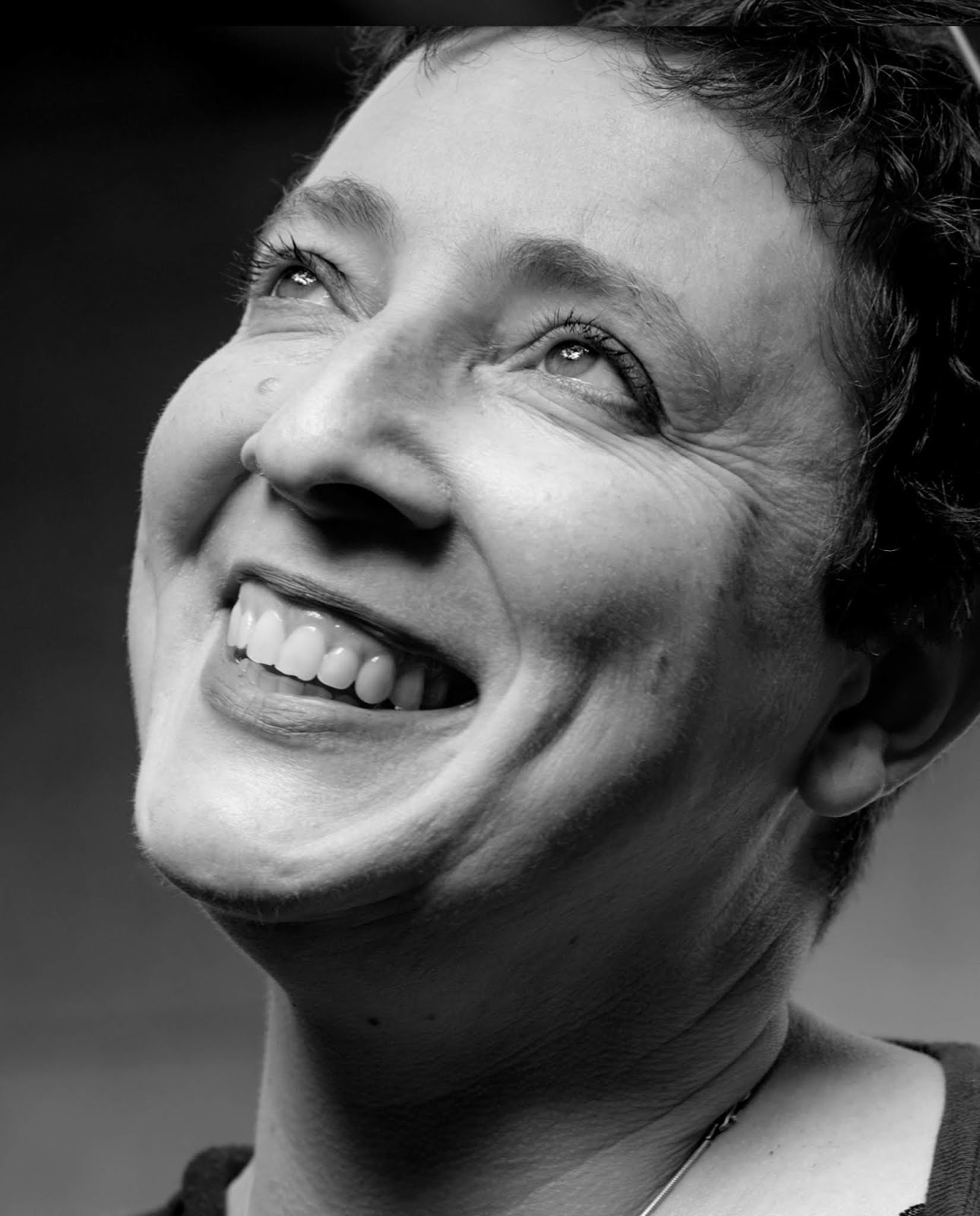
Robert Sheppard was born in Sussex, UK, in
1955, and lives in Liverpool, UK, with his wife, the poet and artist Patricia
Farrell. His poetry books include Complete
Twentieth Century Blues, Salt, 2008; Warrant
Error, Shearsman, 2009; History or
Sleep: Selected Poems, Shearsman, 2015; and Twitters for a Lark, Shearsman, 2017. Words Out of Time, Knives, Forks and Spoons, 2015, is his
‘autrebiography’, although his website (www.robertsheppard.weebly.com)
carries a standard biography. He has collaborated with artist Pete Clarke (see
photograph) and calligrapher Thomas Ingmire, amongst others. Also a critic, he
has published The Poetry of Saying:
British Poetry and its Discontents 1950-2000, Liverpool University Press,
2005; and The Meaning of Form in
Contemporary Innovative Poetry, Palgrave, 2016; as well as a collection of
essays on Lee Harwood and a monograph on Iain Sinclair. He co-edited Atlantic Drift, a trans-Atlantic
anthology of poetry and poetics with James Byrne (Arc/EHUP, 2017). His 1980s
magazine Pages (which is continued as
his blog (www.robertsheppard.blogspot.com)
is archived on Jacket 2. The Robert
Sheppard Companion, edited by James Byrne and Christopher Madden, featuring
articles on his work, interviews, a full bibliography, and poems, is
forthcoming from Shearsman. Retired from teaching, Sheppard is Emeritus
Professor of Poetry and Poetics at Edge Hill University, UK.
1 - How did your first book change your
life? How does your most recent work compare to your previous? How does it feel
different?
I
had to check what my first ‘book’ was (I assume pamphlets don’t count). It was:
Daylight Robbery, Stride, 1990. I’m
always grateful to Rupert Loydell for publishing this. I felt at that point (I
was 34 by then) that I’d laid down a marker. My most recent book Twitters for a Lark: Poetry of the European
Union of Imaginary Authors, is so different, in that a single-minded
‘linguistically innovative’ poetics has been exchanged for the ‘multiform’ discourses
that I think emerge. It’s a book co-created with many peers (including Rupert,
incidentally). We produced fictional poets and their verse for each of the 27
(other) European Union countries. It feels more of a crowd, to be amongst
friends, actually, collegiate in a good sense: there’s quite a range of poetics
and visibility between my collaborators Steve McCaffery and Joanne Ashcroft, for
instance. Or between Anamaría Crowe Serrano, the one collaborator I’ve never
met, and Patricia Farrell, to whom I am married (and with whom I’ve collaborated for
decades).
2 - How did you come to poetry first, as
opposed to, say, fiction or non-fiction?
I think
I started by writing songs, words for pre-existing melodies – and later writing
lineated words that seemed to be ‘poems’. Later still, at school I was reading
TS Eliot (and through him Pound, but not Williams at this stage). And outside
of school finding the ‘underground’ poets anthologised in Michael Horovitz’ Children of Albion. It must have had an
effect because two of the contributors, Roy Fisher and Lee Harwood, became
friends later, and subjects for my PhD. Sorry, I’ve jumped decades now. But I
do remember reading, courtesy of Southwick Library in Sussex (which I eulogise
in my Words Out of Time), the Penguin
Poetry from Africa. And I seem to
recall there was a poetry book by Marc Bolan there. This is before he went
electric, when he was simply eclectic!
3 - How long does it take to start any
particular writing project? Does your writing initially come quickly, or is it
a slow process? Do first drafts appear looking close to their final shape, or
does your work come out of copious notes?
At
the moment I have two modes of creation. Typically, over the years, I have
tended to amass writings (notes, drafts) and then collage them, sometimes in a
sweeping, all-enveloping action, perhaps working all day (and occasionally with
a system or process). The 40 page set of poems writing-through my friend Trev
Eales’ photographs taken from the press pit at rock festivals, ‘Charms and
Glitter’, was slowly accumulated as notes and then processed (cutting, lineating,
re-writing, re-forming) in one action. However, I am also writing non-traditional
versions of traditional English sonnets. There’s one book-length manuscript of
these, called The English Strain. At
the moment, I’m working through Michael Drayton’s sonnet sequence Idea. Mine is called Bad Idea and it’s about Brexit. I write
one each week: I psych myself up and, starting first thing in the morning, they
are usually finished by 11.00. In draft.
In
draft! Whichever method is used, there still is much revision to be undertaken.
Sometimes they are close to the final shape, but I’m never sure. The sonnets
(because based on existent poems, like translations) seem to be coming out
neatly formed, usually written linearly, which is novel for me. I’m suspicious
of that. They all need putting away in envelopes for days, weeks, sometimes
months. And then re-formed, and de-formed: forming.
4 - Where does a poem usually begin for
you? Are you an author of short pieces that end up combining into a larger
project, or are you working on a "book" from the very beginning?
I
have a lot of short pieces and they stay short pieces. Assembling them into a
book is a problem, though sometimes I am thinking of serial poems. Other times
(both the examples above, for example) I am writing a ‘project’: I never assume
anything will be necessarily published. In the case of my largest ‘work’, the
network of Twentieth Century Blues,
which I wrote between 1989 and 2000, I knew I wanted to write a sizeable work
but to avoid the magisterial gestures of the twentieth century long poem.
Creating multiple strands, I wanted to be able to structure a time-based work
(to end in 2000) that could be assembled by a reader in many ways. I thought
the small press publication network in the UK necessitated this mode of
presentation too, as discrete but linked pamphlets. Book publication was rare during
the 1980s and 1990s for ‘innovative’ writers outside of the mainstream. That’s
why Daylight Robbery was so
important. It’s ironical that the whole project is now published as one linear doorstop tome, Complete Twentieth Century Blues.
5 - Are public readings part of or
counter to your creative process? Are you the sort of writer who enjoys doing
readings?
When
I’m revising a text (reading it out loud) I sometimes imagine that I am reading
to an audience, that there is an immediate (though mute) response. Reading is
important to me (and to the British poetry I belong to) and I like to think I’m
good at it. It’s another mode of publication, isn’t it? (I’ve run reading
series of one kind and another for years, too, though not at the moment).
6 - Do you have any theoretical concerns
behind your writing? What kinds of questions are you trying to answer with your
work? What do you even think the current questions are?
In
my poetics piece Pulse I wrote:
‘Throughout this process, contingency is its rhythm, a pulse that matches the
varieties of montage, de-montage, that I attempt in my own practice, with
interruption as structure, with transformation and transposition, formal
resistance, creative linkage, “imperfect fit”, near-perfect fit, all kinds of
multi-form unfinish.’ I think that about sums up my current poetics. I am also
a critic; my most recent book, The Meaning of Form, opens with the statement: ‘Poetry is the investigation of
complex contemporary realities through the means (meanings) of form.’ I could
say more about these poetics (and about poetics in general, which I have also
written on, as a speculative writerly discourse) but I think I’ll stand by
these two statements and muse over them.
7 – What do you see the current role of
the writer being in larger culture? Does s/he even have one? What do you think
the role of the writer should be?
I’m
reading the proofs of a book on my work, generously edited by James Byrne and
Christopher Madden, The Robert Sheppard
Companion, and both Charles Bernstein in the preface and James in the introduction make much of the ‘social’
in my work, both my attempt to bring ‘aesthetic justice’ to the social poetry
scene, and in my matching of the ‘matter of history’ and the ‘manner of poetry’
in the work itself. I would hope for this to be true, but it still begs your
larger question about the function of the writer. What, for example, do I think
that my sonnets about Brexit will achieve? They are satires of our ridiculous
national circumstance, very funny I hope! I certainly don’t think my poems will
affect the social situation directly (although I temporarily post them on my
blog so that there will be some, limited, local, temporal, response) but I know
you can’t influence events much (or, rather, there are only limited occasions
when that occurs, with some writers, in particular contexts). It could be
argued that to turn the ‘matter of history’ into the ‘manner of poetry’ is to
reduce the efficacy, to turn the political aesthetic, but that could be
positive, if you conceive of the aesthetic dimension, as Marcuse, and even
Adorno, did, as a vehicle of critique and a positing of the possibility of an
alternative, or – to use different philosophical language – as a means of
deterritorialising social redundancies, sweeping out cliché. This seems to me
true, as long as one is modest enough to realise that one can only affect the
readers of the work, and then only potentially educate their desires. You can’t
change the world but you can contribute to the changing of the people who could
change the world. It’s indirect, but vital. Forms forming in the act-event that
is our encounter with the art-work, as Derek Attridge puts it. Language as a
bridge thrown between two people, as Vološinov has it (I write of his social
poetics in The Poetry of Saying).
Which
doesn’t answer your first question. The larger culture (I speak of Great
Britain) increasingly sees writing as part of the cultural industries (a term
used without irony, and one which Creative Writing as a subject has
assimilated, unexamined, and passed on, normatively, to the next generation).
We’re all poets laureate of the dung-heap, as I’ve recently put it. We’re
inexpensive parts of the entertainment industry, but this is not reflected in
more money for professional writers, whose income has decreased over the last
few years. But then, perhaps, part of the function of the contemporary poet,
un-employed by the society, a peripheral figure, like a shaman perhaps, is to
refuse such professionalisation in favour of ‘useless beauty’ (to quote Elvis
Costello) – which brings us back to the aesthetic dimension. Its resistance is
there, for those who recognise it, for those who want it.
8 - Do you find the process of working
with an outside editor difficult or essential (or both)?
Small
press poetry editors are generally non-interventionist in the UK. One of the
impressive things about working with James Byrne on our anthology Atlantic Drift: Poetry and Poetics (and
to see him at work on the Companion)
is to watch an astute editorial mind at work. I wish there were more such minds
at work on my poetry – but you’ve got to know when to not take advice.
9 - What is the best piece of advice
you've heard (not necessarily given to you directly)?
It’s
very tempting to say: to know when not to take advice, given my last answer!
But I’m teasing.
This
one’s specifically about research for writing, how not to get lost in it.
Playwright Louise Page told my MA students that one should research just enough
to write the first draft, write the first draft, and then only return to the
research to fill in gaps that need filling.
Then to proceed, without returning to what you think is research, but which is
actually a waste of time (from the point of view of the writing).
Whether
that’s of any use to me is another question! Marjorie Perloff, after my reading
of The Lores, told me, ‘Cut that reference
to Arafat! It’s too obvious!’ I did as I was told.
10 - How easy has it been for you to
move between genres (poetry to critical prose)? What do you see as the appeal?
Very
easy. More troubling is what the relation between the two is. Some of that
critical work translates into poetics of the creative work (I’ve been showing
that in my answers here), but some of it doesn’t. How it affects the work directly is a question I don’t
think I can answer, poetics being the speculative discourse that allows for the
development of poetic thought, and poetry itself, but not in any programmatic
way, and not in ways that are always entirely explicable by the author (or to
the author).
11 - What kind of writing routine do you
tend to keep, or do you even have one? How does a typical day (for you) begin?
A
morning person. Up and at my work, often the ‘Ark and Archive’ of nearly-daily
writing that I have been undertaking for some while, and from which I mine
works and parts of works, or use as ‘interfering material’ in collagic writings,
or simply undertake as a means of staying ‘writing fit’. Or I’m straight onto a
work in progress, whether that’s a longer piece, or (my newest routine, as
described above) of writing a complete version of the latest Drayton sonnet. By
lunchtime, whatever I’m doing then (re-drafting something, or engaging in the
endless reading-through of work as revision, or doing what I call – a joke! – ‘oeuvre
management’, re-ordering poems, preparing manuscripts, etc.,), I’ve finished.
Actually, I’m beginning to notice I’m wasting the latter parts of the morning.
Lunch at 1.00 on the dot, radio news on: got to keep up with the Brexit circus.
Afternoons and evenings: less or no writing. Reading. Ordinary life…
12 - When your writing gets stalled,
where do you turn or return for (for lack of a better word) inspiration?
Creeley
said to me in an interview: ‘The only way to write is to write.’ (He was
talking about his ‘block’.) Hang on, that
might be the best piece of advice I’ve heard!
What
I’d do? I’d get a photograph and write about it, from it, out of it. (I’m still
working though Hans-Peter Feldman’s book of images Voyeur, which I bought in Berlin in 2004! It’s the fall-back
material for the ‘Ark and Archive’. I added to page 477 this morning, 14th
January 2019.)
13 - What fragrance reminds you of home?
‘Home’
as in my parents’ house: The slowly-melting plastic of a bedside valve radio
listened to long into the night.
14 - David W. McFadden once said that
books come from books, but are there any other forms that influence your work,
whether nature, music, science or visual art?
This
is so huge a question as to be virtually unanswerable. Of course, much of it
comes from books, from the traditions and contemporary practices of writing.
But those books don’t just come from
books, do they? The socius, the psyche and the environment with their three
ecologies provide everything we need (and everything we need to protect!). Of
course, reading this interview, you can tell that photographs have been
important material for me, but that’s
not influence. I’m slightly suspicious of that word, the fluvial metaphor that
suggests the influenced person or artefact is a passive vessel for whatever has
flown into it. No choice. It’s more active, even given accidentals. We find
things: art, music, or even that stinking radio that’s about to burst into
flames that your last question evoked (‘out of nowhere’, as we, inaccurately,
say).
15 - What other writers or writings are
important for your work, or simply your life outside of your work?
There
are hundreds, I think, and they are not necessarily influences (in the sense
that you can detect stylistic traces borrowed from them in the work). There
some obvious senior poets who have been important to me: Bob Cobbing, Roy Fisher, Lee Harwood, Tom Raworth, Christopher Middleton, Bill Griffiths, and
Allen Fisher, to stick to the very-male British Poetry Revival (which is why
the list is male). There are peers like Maggie O’Sullivan, Adrian Clarke,
Robert Hampson, Alan Halsey and Geraldine Monk, though they are all a bit older
than me: let’s add Kelvin Corcoran, then. Then there are younger writers, Scott Thurston, Zoë Skoulding, Amy McCauley, Tom Jenks, Simon Perril, Jèssica Pujol i Duran, Sandeep Parmar, Jeff Hilson – just to stick to British-based poets. Erín Moure means more the more I read her. Let’s not even think about Oppen or
Creeley or Rosmarie Waldrop or Amiri Baraka or … Or about the multitude of
great writers from the past. My excursion through the sonnets of Petrarch,
Wyatt, Surrey, Charlotte Smith, and Elizabeth Barrett Browning was based on
respect (less so for Surrey, who was, let’s face it, a bit of a tit). Now
grumpy resentful Drayton. I’ve left so many names out. And I’m going to leave
it that way.
16 - What would you like to do that you
haven't yet done?
I
would like to extend the performance side of my work. I’ve worked with dancers
and musicians, but not for a while now, or consistently. And perhaps return to
writing prose, perhaps less narrative than the stories of The Only Life, Knives Forks and Spoons, 2011, and less ‘experimental’
than Unfinish, Veer, 2016.
17 - If you could pick any other
occupation to attempt, what would it be? Or, alternately, what do you think you
would have ended up doing had you not been a writer?
If
I’d not been a writer, I probably would have studied history (with perhaps
literature as a minor), perhaps become active in politics. But I possibly would
have still ended up teaching, which I have done for the last thirty odd years.
If I could pick something, I would have gone into blues or rock music as a
singer, which is a thing I’ve done now and then. I’m
hoping to participate in the Ern Malley Orchestra soon. In the words of Alejandra Pizarnik, which I used as an epigraph to ‘Freeze It’: ‘I would have preferred to sing the blues in any
small bar full of smoke than to spend the nights of my life scratching into
language …’
18 - What made you write, as opposed to
doing something else?
It’s
the compulsion to make, in the only way that is congenial (I don’t mean easy).
I fell into it and, despite writing a little fiction, it’s now – after so many
years, and after many years of teaching writing (and reading) – simply what I
do (one of the things I do).
19 - What was the last great book you
read? What was the last great film?
I’m
not a film buff, so I’ll allow myself more than one book choice! I have re-read
the poems of John Donne, both the startlingly brilliant lyric ones and the
odder, more conventional funerary odes. John Carey’s book John Donne is one of the best critical volumes I’ve read; published
at the height of structuralism, it speaks directly to the reader’s encounter
with the otherness of the work, as Derek Attridge would say, freighted with Carey’s
tremendous learning. OK then: Derek Attridge’s brilliant, compressed volume The Singularity of Literature, which
assimilates ‘theory’ but speaks directly, with subtlety, about reading. A
novel: Conrad’s masterpiece, Nostromo,
not having to read it now as part of my Iain Sinclair researches. Currently
finishing the short stories of Maupassant. Just beginning reading Great Expectations in the instalments,
and with the periodicity, of Dickens’ first publication. Having released myself
from full time employment, and having no fresh ideas for straight literary
criticism, I’ve released myself from directed reading.
20 - What are you currently working on?
Revising
the ‘Charms and Glitter’ poems. They were written quickly and I’m going back
through them, slowly, individually.
Bad Idea, which I have described above. I’ve
written 26 of the 63 so far, as I trace the Brexit disaster (it’s the
‘meaningful vote’ in Parliament on it tomorrow). That process has its own
graceful pace, even if the poems themselves are far from graceful, figuring
Britain as a free market Dogging Site run by a bunch of recognisable clowns!
I
have just finished one of my long poems, very compressed, of the ‘collagic’
kind, described in my answer to question 3, entitled ‘Flight Risk’ (at the
moment), the last part of an untitled collection of quatrain poems, which begins
with ‘The Accordion Book’ (which may be read in Adjacent Pineapple web journal).
Some
of my ‘English Strain’ sonnets and the first part of ‘The Accordion Book’ are
to appear in The Robert Sheppard
Companion. I’m looking forward to the launch of that. I’ve yet to work out
what I’m going to read. Perhaps I haven’t written it yet.
14th
January 2019