Showing posts with label Jack Davis. Show all posts

Tuesday, September 16, 2025

Guy Birchard, Most By Books


Preface

Though he daily invocate, though he sacrifice Hecatombs, the Muses and the Graces still upon the Dunce look asquint. John Donne profanely paraphrased.

Why on earth in a guy’s eighth decade would he contemplate issuing yet another unwanted masculinist stream of invitations and affection? or affectation and invective.

Why?

Jack B. Yeats answered Thomas MacGreevy: “I get headaches from reasons… I think Reasons are very little use down here. But up aloft, just after St Peter shuts the gate gently on us, with us within, we will be as happy as lambs throwing little round reasons from hand to hand until they roll over the side and flop down into Hell…”

The Ideal Reader would be she who takes as much time to read a page as the author took to write it. 

It is too much to ask.

I was recently intrigued to catch a copy of Victoria, British Columbia poet Guy Birchard’s Most By Books (Victoria BC/Parry Sound ON: Symple Persone Press, 2023), a chapbook designed and produced by poet Jack Davis [see my review of his own full-length debut here] “in a private edition of forty copies.” I was fortunate enough to discover Birchard’s work through a title produced by Beth Follett, Only Seemly (St. John’s NL: Pedlar Press, 2018) [see my review of such here], a title I picked up a small number of extra copies of when the press folded, the book is just that good. I give them away, here and there, to those that I think should be reading it, as well as to counter the fact that there is something about Birchard’s approach to almost going out of his way to sit just under the radar, releasing new work with small or even smaller, ephemeral presses. Over the past forty-plus years, Birchard’s list of published books and chapbooks includes Baby Grand (Ilderton ON: Brick Books / Nairn, 1979), Neckeverse (Newcastle upon Tyne: Galloping Dog Press,1989), Birchard’s Garage (Durham UK: Pig Press, 1991), Twenty Grand (Boston MA: Pressed Wafer, 2003), Further than the Blood (Pressed Wafer, 2010), Hecatomb (Brooklyn NY: Pressed Wafer, 2017), Aggregate: retrospective (Bristol UK: Shearsman Books, 2018), VALEDICTIONS (Ottawa ON: above/ground press, 2019) and Montcorbier (above/ground press, 2020), with a further title through above/ground press to appear later this fall. Might a selected poems at some point be worth doing? I would certainly think so.

The title of Birchard’s latest collection, Most By Books, is excised from a longer quote, set on the title page to include the full—“They do MOST BY BOOKS who could do much without them.”—lifted from the prose work Christian Morals (1716) by the English writer Sir Thomas Browne (1605-1682), a posthumously-published work originally composed as advice for his eldest children. Through nearly forty pages of lyric heft, Birchard reshapes Browne’s advice, leading by example through a selection of poems rife with reading. “From my fingers,” begins the poem “Mustapha Reached His Koran Back,” “off the shelf from which I had casually picked / up The Book in barely enough time to open it, Mustapha, with / dignified tutting, his father projecting approval, retrieved the / Koran from my hands, from before my eyes.” These are poems built from books, from not only reading but years of intense, dedicated and ongoing study; the kind of attentions that lesser poets proclaim loudly across author biographies, entirely the opposite of what Birchard writes for his: “Scholar of nothing. No degrees. No prizes. Neither profession, trade nor career. A lay poet. Anglo-Canadian.”

There is such an interesting way that Birchard uses writing, uses what we might think of as poems, as a way of thinking through writing and big ideas. “Augustine, rhetorician / that millennium and a half ago,” opens the piece “Homage to Sarah Ruden for Her Confessions,” “yet crazy as Beckett or Roberto Benigni / by virtue of the sedulousness and circularity // of his case, for want of confidence enough to match her / predecessors, drives our current lady translator to her cups.” This is Birchard, the well-read thinking reader, the intellectual crafting poems out of reading notes, allowing the lyric to explore and examine. He writes of St. Augustine and The Troubadour Club in West Hollywood, Jack Kerouac and Saint Pancras, moving across incredible distances through a short cluster of lines, stepping one foot ahead of another, keeping such detailed notes as he journeys. His poems blend study with journey, a wandering through language that explores alternate corners and catalogues of language. Dedicated to the late writer and critic Stan Dragland (1942-2022), Birchard’s bricolage, his own ‘journeying through bookland,’ one might say, is certainly comparable to Dragland’s work, but holds a different tenor, whether to Dragland’s work or the work of that other poet of bricolage (as Dragland wrote), Perth, Ontario poet Phil Hall. “Exiting the cinder block shower next morning,” writes the poem “Butterflies & Turtle,” “not a / soul around, sunlit, stepping into his gotch, his shoulders / and damp, bare back were suddenly a drift of Painted Ladies / alighting. // Guy fetches the camera a look of small-c concern.” There’s a density to Birchard’s lines that hold a different kind of weight, perhaps, well beyond the myriad of alternate reference, offering not just connecting reading and ideas from across an alternate spectrum, but, veering occasionally into Old English, one that holds a depth of language, and language meaning. As the poem “Company” writes, to close:

Smoked a rollie, using the tinplate ashtray. Sat, gazing round. Inside unaccustomed hush—out of the wind. Lit no woodstove. Book of Common Prayer in syllabics. Lit no kerosene lamp. Despite no roof overhead for weeks, we would not crash there. Nah.

Understood. At dusk, canoed back to make that heathen camp of ours in sandy, hallowed precincts between Native graves and water.

Slept.


Wednesday, December 13, 2023

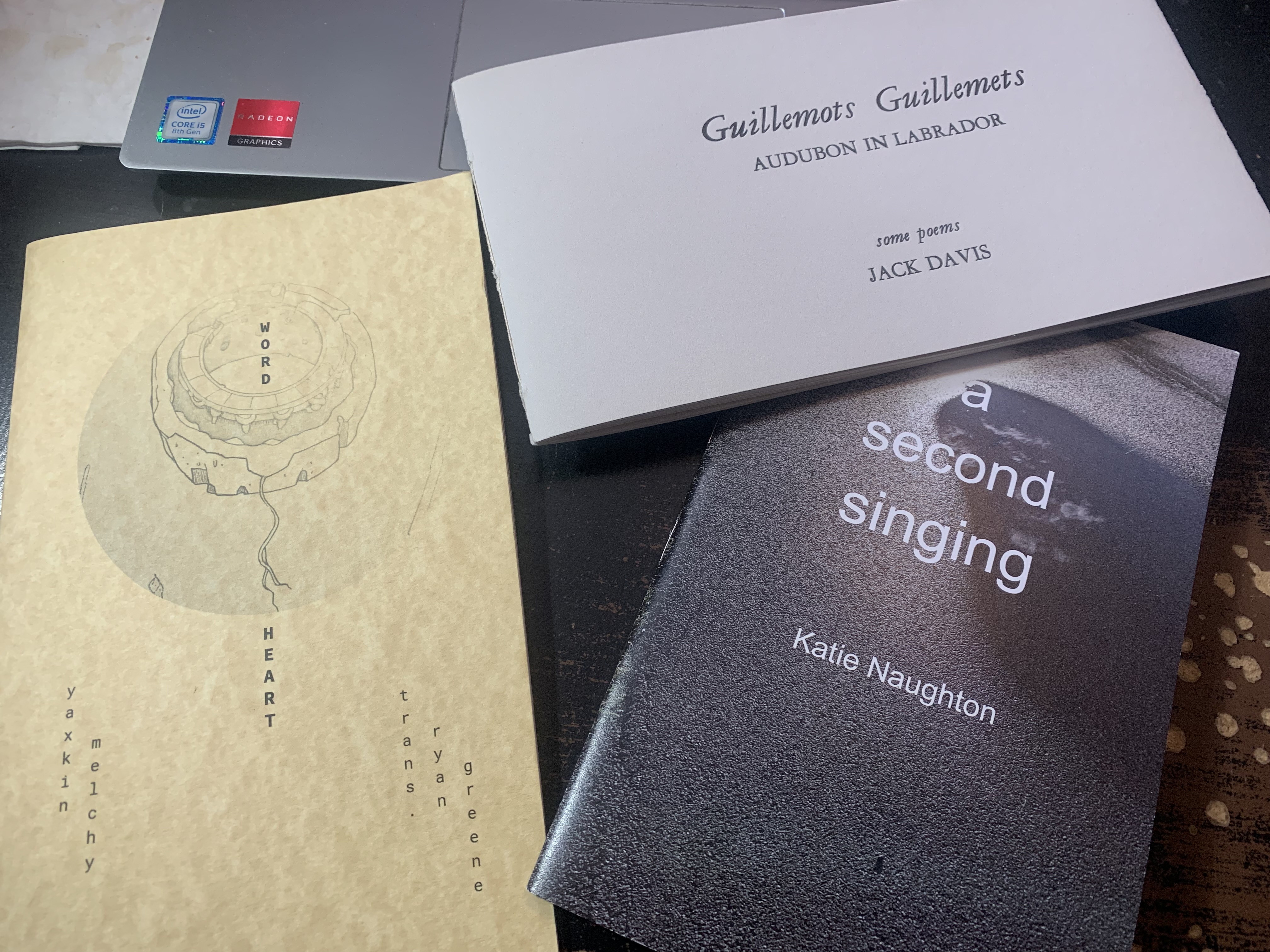
Ongoing notes: mid-December 2023: Jack Davis, Katie Naughton + Yaxkin Melchy Ramos (trans. Ryan Greene,

I sure have been picking up a bunch of chapbooks lately (but I would welcome further, as you probably know).

Calgary AB: Parry Sound ON: The debut publication by Monica Kidd’s Whiskey Jack Letterpress is the gracefully-produced Guillemots Gillemets: AUDUBON IN LABRADOR: some poems (2023), by Parry Sound, Ontario poet Jack Davis. There’s much to celebrate in this lovely and sleek publication, including the fact that Davis’ work is not only searing in its attention to detail, and the fact that he doesn’t publish that often [see my review of his full-length debut, Faunics, published in 2017 by Pedlar Press, here]. A note at the end of the chapbook offers that “This piece is composed solely of words contained in select entries from John James Audubon’s journal of his travels along the coast of Labrador in the summer of 1833, making illustrations to complete his BIRDS OF AMERICA.” What is it about Audubon that always gets the poets worked up? Not long ago there was Béatrice Szymkowiak’s full-length debut, B/RDS (Salt Lake City UT: The University of Utah Press, 2023) [see my review of such here] set as an erasure project of Birds of America (1827-1838), and even Andrew Steeves mentioned an Audubon project he was working on as part of his own ’12 or 20 questions’ interview (whatever became of that project, Andrew?). There is something intriguing about how Davis moves from the short, sharp lyric moment to a continued moment in this particular seven page, seven poem piece, offering a detail of small somehow stretched or continued. The small moment, touching and touching down once more, again, and continued. As well, there is something reminiscent of Robert Kroestch’s own The New World and Finding It (1999) in terms of letterpress, book structure and poem structure, each page and poem of Davis’ work three couplets long, set on the right page:

Inside this linen enclosing a skin of tolerable French
braided with a grouse for its maker

I am of a peaty nature fed by the drainage of
decomposed truths and opinions I would call a song

What I know full well is renewed every few minutes
like the shy accuracy of drawing ‘somewhere’ on a map.

Vancouver BC/Chicago IL: I’m always pleased to see new work by Vancouver-based American poet Katie Naughton [see also her above/ground press title], and her latest is a second singing (dancing girl press, 2023), a chapbook-length extended suite of lyric fragments, stanzas and moments extended across an ongoing stretch and thread and thought. “this is the moment / of crisis / this is / the crisis” she writes, mid-point in the collection, offering grey spools of lyric across climate, capitalism and the “formal histories” of personal space, geography, being and loss. As she speaks as part of a recent interview for the Colorado Review blog, referencing her pre-Vancouver time in Buffalo: “At Buffalo especially I’ve been exposed to very socially conscious poetry, or work that is very interested in thinking about positionality and forces beyond the individual that shape the conditions of individual life. I started thinking about how to contain those in poetry, and how to write from a place of relative privilege or being somewhere in the middle in a way that doesn’t just reinforce the oppressive system that you are both negatively affected by and also, at least relatively, rewarded by.”

look at the trees their August shade
from the window of your life your one window
from the bedroom from the stairs
you went up and won’t come down again
the heat, the house, the laundry and breath
done there
your minutes transit the house from the bed
of all Augusts
same silent heat wind sun shade still
of time gathered there, that room
I lay on the floor
your child and not
the blonde wood and white linen
soap and ceiling
you had a room once
a bicycle a dusty road
the oak shade the sun
in another state
as children
as I did
do

Houston TX: I’m intrigued by the chapbook WORD HEART (2023) by Mexican and Peruvian-Quechua poet (currently studying in Japan) Yaxkin Melchy Ramos, translated from Spanish by Arizona poet and translator Ryan Greene. According to Greene’s author biography, this chapbook was produced as part of a project to translate (and presumably publish) the first three books of Ramos’ five-part “constellation-book,” THE NEW WORLD. I’m intrigued by the lyric Ramos (via Greene) offers, one filled with beautiful optimism; open-hearted, writing light, especially across the dark. Ramos’ narrative “I” is one filled with resolve and optimism, even when wading waist-deep in grief.

BLANKETS

I’m out of my mind when I sleep
because poetry is a song
where your axles sing over the asphalt

I travel toward the thought of your mouth
when I see how the hills run and
                                                        I leave them in my dust
I travel by night
while your stomach is your heavy heart
and it rolls down the highway like a ship across the Moon

and you hear an identical word
and tomorrow will be the day the beds
in the houses
in the hospitals
in the bedrooms
in the childhood kneeling on the blankets
will end up in our heart’s folds
piling up day after day unwashed.


Sunday, February 11, 2018

12 or 20 (second series) questions with Jack Davis


For the past ten summers Jack Davis has worked as a Lookout Observer at a remote fire tower in the woods of northernmost northern Alberta. He also works with the street animal charity, Animal Aid Unlimited, in Udaipur, India. He lives in Parry Sound, Ontario.

His first book is the poetry title Faunics (Pedlar Press, 2017).

1 - How did your first book change your life? How does your most recent work compare to your previous? How does it feel different?

Faunics is my first book and, as I write this, is yet to be released yet, so any changes remain contained in my head and nervous system at this point. We’ll give it some time.

I’ve been writing steadily for over 20 years but without having published, and therefore “finished” one thing and moved on to the next, it’s difficult for me to judge or compare one period to the another. It certainly has changed and moved and continues to move away from the I of the lyric poem toward what is outside me.

2 - How did you come to poetry first, as opposed to, say, fiction or non-fiction?

A short attention span and no feel for narrative, maybe? Poetry has always stayed close in feeling and potential to painting and music for me, offering the uncanny possibility to try and use language to access what comes before language, before speaking. This is what keeps me writing and reading poetry.

3 - How long does it take to start any particular writing project? Does your writing initially come quickly, or is it a slow process? Do first drafts appear looking close to their final shape, or does your work come out of copious notes?

I take a geological approach to writing: everything takes a long time. Individual poems will start out of a small fragment of sound or image, or a single word, but it’s not unusual for that seed to stay in a notebook for years before the next or the preceding line or the context fall into place. My process is fragmentary and operates through patience, accretion and long fallow periods of thinking and listening interleaved with reconsiderations and rewritings. Nothing’s ever really finished. Even the poems in this new book are still moving. I like that.

4 - Where does a poem usually begin for you? Are you an author of short pieces that end up combining into a larger project, or are you working on a "book" from the very beginning?

The sound or associations of a single word is often the germ around which a poem will begin to take shape and or at least attract other words, like notes in a melody. I definitely think and write with a larger project in mind. Things begin intentionally as parts of these larger compositions or eventually reveal themselves as belonging to another project, or the start of some new series, as they come together.

5 - Are public readings part of or counter to your creative process? Are you the sort of writer who enjoys doing readings?

I have yet to do a public reading, but I’ll admit the prospect of being the centre of attention in front of an audience strikes fear into my reclusive, introverted heart.

I’m somewhat reluctant to associate poems I’ve written with my own voice, let alone my face or biography. My voice has less to do with these poems than the voice of the private reader, reading to herself. That, I think, is the proper voice for any poem.

I am, however, looking forward to the opportunity these readings provide to meet and talk with other writers and readers who share a love of language and books and perhaps I will be a convert to public readings yet.

6 - Do you have any theoretical concerns behind your writing? What kinds of questions are you trying to answer with your work? What do you even think the current questions are?

I ask questions more than I answer them in my work. Questions are always more vigorous and open to revelation, insight and wonder than the closed face of an answer. I want a poetry that catches thinking in the act—like coming upon a wild animal in the woods that you share eye-contact for a moment before it startles and scatters.

In this collection I’m concerned with, among other things, considering animals as they are—as subjects and ends in themselves. I attempt to do this by paying attention to them as an observer and cohabitant of their environment as well as considering their subjective conscious experience within this environment. I am fascinated by the near inconceivability, for humans, of thinking without or before language and the extraordinarily complex and abstract thought processes native to many animals. In less overt ways, I’m also interested in exploring the moral implications of seeing animals as the are and recognizing their agency and subjecthood in a life and environment we, at best, can share, but have no defensible claim of ownership over.

In my current work I’m interested extending this critique of anthropocentric ideas about nature and admitting the vital agency of the natural world as a collaborator rather than simply a subject in my attempts to conceive, read, divine, observe and attend to it.

7 – What do you see the current role of the writer being in larger culture? Does s/he even have one? What do you think the role of the writer should be?

I’m not much interested roles. The writer should be able to write for herself, to write whatever she wants to write, whatever moves her or inspires or compels her to want to make something out of words. That, I think, is how most of the writing that moves and attracts me gets made.

8 - Do you find the process of working with an outside editor difficult or essential (or both)?

In the case of editing Faunics, it was vital and illuminating. I was fortunate enough to be paired with my friend and preternaturally talented writer and editor, Stan Dragland. His questions and notes consistently challenged me to clarify and re-examine my choices from the smallest detail to the overarching arrangement of the manuscript. His contribution was indispensable to making this book.

9 - What is the best piece of advice you've heard (not necessarily given to you directly)?

I’ve always liked Robin Blaser’s admonition to “[d]econstruct meanings and compose a wildness of meaning in which the I of the poet in not the center but a returning and disappearing note,” but I’m starting to prefer the possibilities of a scale in which that note disappears all together.

10 - What kind of writing routine do you tend to keep, or do you even have one? How does a typical day (for you) begin?

No routine. If something comes I try to follow it and find out where it’s going, or take whatever spark that I stumble upon and see if I can make some heat out of it. I find that the longer I can go without speaking in any given day or week, the better chance I have of being able to hear or find that starting point for a poem and follow it through to a point in which I can set it aside and come back to it later with fresh eyes. These ideal conditions are difficult to achieve in normal life, but I’ve found working at night gives me some of what is conducive to my ability to write.

Within 10 minutes of reluctantly leaving my bed each morning I can be found walking the dogs in the wooded area next to our house. If all is right with the world, the mail will have been delivered by the time we get home, and I will have a new book to join me with my coffee.

11 - When your writing gets stalled, where do you turn or return for (for lack of a better word) inspiration?

I go for a walk. This is almost always effective for me in finding a solution to a piece that’s not working. In my new book, “Variations on the Decomposing Fox,” was almost entirely written over many walks on the trails at the Ontario Camp for the Deaf where I rented a cabin for a week last January to finish my manuscript.

12 - What fragrance reminds you of home?

Pine trees, red and white, in a wind.

13 - David W. McFadden once said that books come from books, but are there any other forms that influence your work, whether nature, music, science or visual art?

Faunics is definitely grounded in the braiding together of the two dominant conversations of my interior life: with nature and with other books. I find it difficult to separate these voices when I’m writing, but it often seems a sympathetic, or at least productive, hybrid to me.
                                                           
14 - What other writers or writings are important for your work, or simply your life outside of your work?

There are so many and they come in cycles or seasons or have been dominant at various points and fallen away. I speak of and to many of these writers in the poems of Faunics, but some poets that have been important include Paul Celan, Ernst Meister, Lorine Niedecker, Roy Fisher, Ronald Johnson, George Oppen, William Bronk, Pam Rehm, Harriet Tarlo, Karen Mac Cormack, Anja Utler, Maggie O’Sullivan, Tim Atkins, Karin Lessing, Jan Zwicky, Guy Birchard, Mark Truscott, Phil Hall, and Nelson Ball.

15 - What would you like to do that you haven't yet done?

Live in the Arctic and/or respond to my correspondence in a time frame of less than years.

16 - If you could pick any other occupation to attempt, what would it be? Or, alternately, what do you think you would have ended up doing had you not been a writer?

I would’ve liked to have been a composer or a painter, but I lacked the self-discipline or real talent to follow through on what where both passionate interests at one point or another.

My writing has, until this point, been such a private and personal pursuit that I’m not sure that it has bent the branch of my life to much of a degree. I suppose if I didn’t write that the time it occupies would be quickly and quietly filled with reading and unrecorded thoughts.

17 - What made you write, as opposed to doing something else?

I think it came more easily to me than drawing or music and so presented it self as the path of least resistance to a desire at articulate whatever was behind those early creative compulsions. I was also very fortunate to have teachers who took the time and interest to encouraged me in my writing, which makes a world of difference.      

18 - What was the last great book you read? What was the last great film?

In lieu of a film, I’ll offer three books I’m reading or have recently read. I just finished Martha Baillie’s wonderful novel If Clara. I’ll nearing the final pages of Barbara Caruso’s two volume “A Painter’s Journey,” which is full of insights not only into her own art and process but also into the art and poetry world of Toronto in the 1970s. And I’m currently enjoying Fenn Stewart’s smart and engaging poetry collection, Better Nature.

19 - What are you currently working on?

I’m looking very closely at a small section of Northern Ontario forest floor and wondering if I can translate it into a language that doesn’t include me.

Sunday, February 04, 2018

Jack Davis, Faunics


Listening

This animal
air

made to
make

some sense
from sound

the pre-linguistic
muscle

of words
held still

by this splint
of attention.

Occasionally a book of poetry appears, seemingly out of nowhere, that is openly discussed between poets as a ‘must read’ well before any reviews or notices have appeared, as is the case with poet Jack Davis’ remarkable debut, Faunics (St. John’s, NL: Pedlar Press, 2017). Faunics owes a debt to Nelson Ball and Mark Truscott, both of whom are acknowledged, both as notes at the end of the collection as well as individual dedications, for their influences upon his work. Because of this, Davis’ poems aren’t merely short or short-lined, but poems that fully comprehend the lessons of what Ball and Truscott (and others, including jwcurry, Cameron Anstee, Michael e. Casteels) and others have been working on for years (it might be worth pointing out that Anstee, also, has a debut collection set to appear very soon), writing an incredibly precise lyric of sustained attention.

Patterns

of replacement
a seed’s

genius passed
through birds

by pitch
filch & gut

assaying

their
selves.

Davis engages in what has been referred to as “quietude,” an incredibly detailed attention to smallness, silence and lines as short as a single word. Nearly one hundred and forty pages thick, Davis’ Faunics is smallness multiplied and magnified, composed of short, intricate and dense lyric poems that weave their ways through language, space and multiple species of birds, animals and fauna. He writes of listening, sparrows, asides, winter and counterweights, attending to his most immediate and intimate in ways both startlingly familiar and completely refreshing. As he writes to open the poem “Curtail”: “All beautiful / of pieces // every flesh / desired // found breath / our bodies // the broken-into warmth / of animals [.]” There is such a deep and abiding respect and attentiveness in these pages, in which he attends far more to his Northern Ontario surroundings than to the facts, or even the distractions of, his own presence. As he writes to open the poem “Edible Forests and Potable Waterways of Northern Ontario”: “Music / pushed through / flax & pigment / played into / other woods [.]”

Set in four sections – “Living Daylights,” “Animal Light,” “The Pre-Linguistic Heights” and “Voir Dire” – Faunics exists as a sketchbook of poems on nature, a distant cousin to the 19th century botanical book, as done by such as Virginia Woolf and Catherine Parr Trail, but one composed out of language, a fauna of sound and meaning in the sharpest detail, and the smallest possible space. This is easily one of the finest and most understated collections I’ve read in a long time.