Showing posts with label Sarah Burgoyne. Show all posts

Saturday, March 07, 2026

new from above/ground press: Wilkins, Maloukis, van Vliet, Cone/Lipschutz, Bach, Sparrow, Macdonald, Kennedy, Sparling, Burgoyne, Wells, Levy + Sharp, Touch the Donkey #48 + a bilingual anthol eds. O'Meara/Sylvain,

Towards A Poetry Of <something> Tentative / Notes from a stalled art project, Grant Wilkins $6 ; TWO, Rose Maloukis $6 ; inventions, Robert van Vliet $6 ; AN ACCELERATION & A CALM / A SHEAF BY THE LATE P. M. SAMSON / COMMENTARY BY BARNARD SWALLOW, A SHEAF BY THE LATE P. M. SAMSON, COMMENTARY BY BARNARD SWALLOW, devised by Jon Cone and K.Lipschutz $6 ; Touch the Donkey [a small poetry journal], forty-eighth issue $8 : Words and Image / Entre mots et images, eds./dir. David O’Meara and/et Véronique Sylvain, translations by/traductions de Myriam Legault-Beauregard $10 ; EVAD, Glenn Bach $6 ; SPECTACLE/SPECTATOR, Noah Sparrow $6 ; Weeds of Canada, Dawn Macdonald $6 ; LONG SPEECH FROM MY FATHER AS MY FATHER AS WU TAO TZU ET AL, Jake Kennedy $6 ; 310 Consecutive Life Sentences, Ken Sparling $6 ; AN ACCURATE CIGARETTE: Poetry & Prompts, Sarah Burgoyne $6 ; The Unknotter, Christina Wells $6 ; Vast Spaces, John Levy $6 ; Now When, A Poem, Travis Sharp $6 ;

published in Ottawa by above/ground press
January-March 2026
a/g subscribers receive a complimentary copy of each


To order, send cheques (add $2 for postage; in US, add $3; outside North America, add $7) to: rob mclennan, 2423 Alta Vista Drive, Ottawa ON K1H 7M9. E-transfer or PayPal at at rob_mclennan (at) hotmail.com or the PayPal button (above). See the prior list of recent titles here, scroll down here to see a further list of various backlist titles, or click on any of the extensive list of names on the sidebar (many, many things are still in print).

keep an eye on the above/ground press blog for author interviews, new writing, reviews, upcoming readings and tons of other material; and you know above/ground press has a substack now? sign up (for free!) for announcements, and even new features! catch recent/forthcoming interviews with ryan fitzpatrick, Travis Sharp, Shelly Harder, Sarah Burgoyne, John Levy, Misha Solomon, Guy Birchard, Rose Maloukis, Pearl Pirie, N.W. Lea, Guy Birchard, Jill Stengal, Lillian Nećakov, Cary Fagan, Renée Sarojini Saklikar, Ken Norris, Michael Sikkema, Ben Ladouceur, Nathanael O'Reilly, Micah Ballard, Lydia Unsworth, Amanda Earl, Buck Downs, russell carisse etc.

With forthcoming chapbooks by: Dag T. Straumsvåg, Sarah Burgoyne and Clara Yeager, ryan fitzpatrick, Stuart Ross and Jason Camlot, Misha Solomon, Stephanie Bolster, Susan Rudy, Shelly Harder, rob mclennan, David Phillips, Mrityunjay Mohan and probably others! (yes: others,

as well as a new issue of The Peter F. Yacht Club, just in time for this month's 16th annual VERSeFest: Ottawa's International Poetry Festival!

AND 2026 SUBSCRIPTIONS ARE NOW AVAILABLE (but you probably already know that,


Sunday, April 14, 2024

Sarah Burgoyne & Vi Khi Nao, Mechanophilia, Book 1


0          of two or three square miles
9          of tears striates across a river rewritten by a
7          city shape. A foolish pitch to cancel
4          my membership with loneliness.
9          Something hit our heads and tiptoed into cirrus
                              Clouds
4          while desolate rain memorized
4          imperfect geometries, letting fall
5          devastating isotopes of emotional indifference
9          in the same place. You, in pristine ditches, find
2          an absolute
3          tangle spreading apart
0          eyelids from dreams.

From Montreal-based experimental poet Sarah Burgoyne & Iowa City-based Vietnamese-born poet and multi-genre writer Vi Khi Nao comes the collaborative Mechanophilia, Book 1 (Vancouver BC: Anvil Press, 2023), produced through Stuart Ross’ imprint, A Feed Dog Book. I’ve been an admirer of Burgoyne’s work for some time [see my review of her latest solo collection here], but hadn’t previously been aware of the work of Vi Khi Nao (although I’ve caught more than a couple of interviews she’s conducted, including this one with Sarah Burgoyne), the author of not only six poetry collections, a short story collection and a novel, but a prior collaborative work, the novella Funeral, with Daisuke Shen (Kernpunkt Press, 2023). Mechanophilia, Book 1 is composed as the first of an ongoing, potentially open-ended collaboration between the two, comparable to the two volumes of the “Continuations” series [see my review of the second volume here], composed as well via email, by Douglas Barbour and Sheila Murphy. It is interesting to get a sense of the crossing of vast, geographic distances between these two writers, something articulated as well in a review of Nao’s prior collaboration, almost as though she is working to either chase or bridge a number of solitudes.

Mechanophilia, Book 1 is composed as a continuous, book-length piece across more than a hundred pages, following a numbering system of lines that accumulate, following the numerical structure of pi. A “collaborative epic,” as the press release offers, “by American poet Vi Khi Nao and Canadian poet Sarah Burgoyne (who have never met) that follows the omniscient conversations and complaints of ad hoc biblical characters as they attempt to make sense of themselves on an ordered, disordered planet.” The numerical system is reminiscent, slightly, of those grid-poems that Canadian Modernist poet Wilfred Watson (1911-1998), a poet better known for being married to legendary prose writer Sheila Watson (1909-1998) than for his own work, spent his career focused upon. Through Burgoyne and Nao, there is the suggestion of the call and response, threads that myriad and move beyond the two distinct voices that mingle, weave and interweave, blending into each other as a separate sequence of a combined single voice. Through these two, references weave into and around each other, changing shape and texture as the poem furthers. Part of what becomes interesting through such a project is not only how such a project might progress across the further three volumes, but how the individual works of these two might adapt as well. As their “EPILOGUE” writes:

Alas, we have lost heart. Or so it seems after three thousand and two lines of poetry (pi to 3,000 decimal places). But this is merely the first of many (infinite) volumes. To write this book, we foolishly cancelled our memberships with loneliness and wrote across countries, in virtual high seas, daily, for years, spooling out line after line of ancient questions, complaints, please, declarations, each taking a line, poets’ do-si-do. While we wrote, we got to know each other for the first time. We chatted about our lives, our loves, our families, our pain, our pasts, what we were eating, cooking, planting, not planting, buying, teaching, reading, painting, who was visiting, who was publishing, and whether the heart is really located under the floorboards, as Poe suggested. (It is.) This side chat, perhaps the most precious document of all, maps an epistolary acquaintance, charts a friendship in the making, and Mechanophilia is its shadow, its dream, its under-the-floorboards heart, friendship’s supraliminality. We think this is why it gets funnier as it moves along. Like books of the Bible, Mechanophilia at its current stage comprises four books, each corresponding to a few thousand digits of pi. This project will continue until we die. This is the first book. A genesis in more ways than one.


Sunday, February 12, 2023

Ongoing notes: mid-February, 2023: Sarah Burgoyne + ej kneifel

Good morning! Wait, where did January go?

And you’ve been catching the slew of above/ground press chapbooks out recently,yes? The press’ thirtieth year of operation!

Montreal QC: Sarah Burgoyne’s latest is the chapbook Air’s Error (Toronto ON: Anstruther Press, 2023), a title subtitled “A Dance in Fourteen Poems” that responds, as she writes in her notes at the end, as “a poem-to-dance translation of an improvised performance by Hilary Bergen on Montreal’s St-Hubert Plaza, March 3, 2021.” I’m curious about the occasional book or chapbook poem-offerings that respond to dance, a list I’m not even sure I can list beyond more than a title or two; Chicago poet Carrie Olivia Adams’ chapbook Grapple (above/ground press, 2016) comes to mind, certainly. As with much of her other work—chapbooks including A Precarious Life on the Sea (above/ground press, 2016), TENTACULUM SONNETS (above/ground press, 2020) and Double House (Turret House, 2022) [see my review of such here], as well as full-length collections Saint Twin (Mansfield Press, 2016) [see my review of such here] and Because the Sun (Coach House Books, 2021) [see my review of such here]—Burgoyne takes an idea or a subject and comes at it fully, working to explore, dismantle and dislodge across a wide canvas of sentences, composing a lyric to worm underneath her subject’s surface. And here, she utilizes the movement of a specific dance performance as both subject and prompt: “It takes a moment for the gaze / to settle,” she writes, in her opening poem “0:00 – 0:59,” “but when it does it / lands on you.” There is such a fine precision to Burgoyne’s lyric, a flow that contains and allows for a wide array of movement, even propulsion. Including a video link to the performance in her notes, Burgoyne’s thirteen improvisations, each less than a page long, take their titles as time-stamps, and it would be interesting to follow along to see how the text corresponds with the full performance. “Your hands are winged / as they sculpt space.” she writes, as part of “12:00 – 12:59,” “You / conjure now an animal who / once bowed her head to feed / here.” The chapbook closes with the six-page accumulation, “Epilogue: Instructions for Recognition,” that begins:

Your arm must follow the flight of balloons to a silver trumpet suspended in air.

You must pull it down and blow to awaken the danceless, shaped as mannequins.

The gesture upsets Time’s Capital’s dialectric.

Dance it.

There were entities that were powered through breath or wind, were mechanical and then appeared living to the people viewing them.

Film the dance in gown-surround.

Be ornate jellyfish in a glass pond.

Montreal QC: The latest from the delightful ej kneifel [see where we discussed the prose poem at periodicities: a journal of poetry and poetics] is the chapbook VIO-LETS (Anstruther Press, 2023). I’ve long enjoyed the quirky twists and sweeps of kneifel’s lyric prose that is somehow simultaneously neither a straightforward “lyric” nor “prose,” and yet, somehow both, mingling and mangling in a deceptively easygoing manner of steps and stops and starts. Across fourteen prose poems, kneifel composes a specifically and concretely abstract space around a shape of the prose poem, one held and halting, rushing like a mouthful of water or caught breath.

CATCH

little’s favourite time of day is when we agree that a saturday feels like a sunday. big won’t tell us his but we know he’s trying to keep mornings a secret. me, i like blue. i like when my shadows are tall as they want to be. or no, i like when water’s the air but i know they’re around cause they howl their whale songs. i’m not usually very good at just catching (i tip over light i trip over) but today i caught something so big even little had to go wow. we were under the oak when its shadow caved ours, when a new one ducked both and we swam in the shade. little said when i see something falling it’s always a bird, as, i can’t say what it was, but i caught it. i let it go too, and that taught them something. i know cause their bellies were wide.


Friday, June 03, 2022

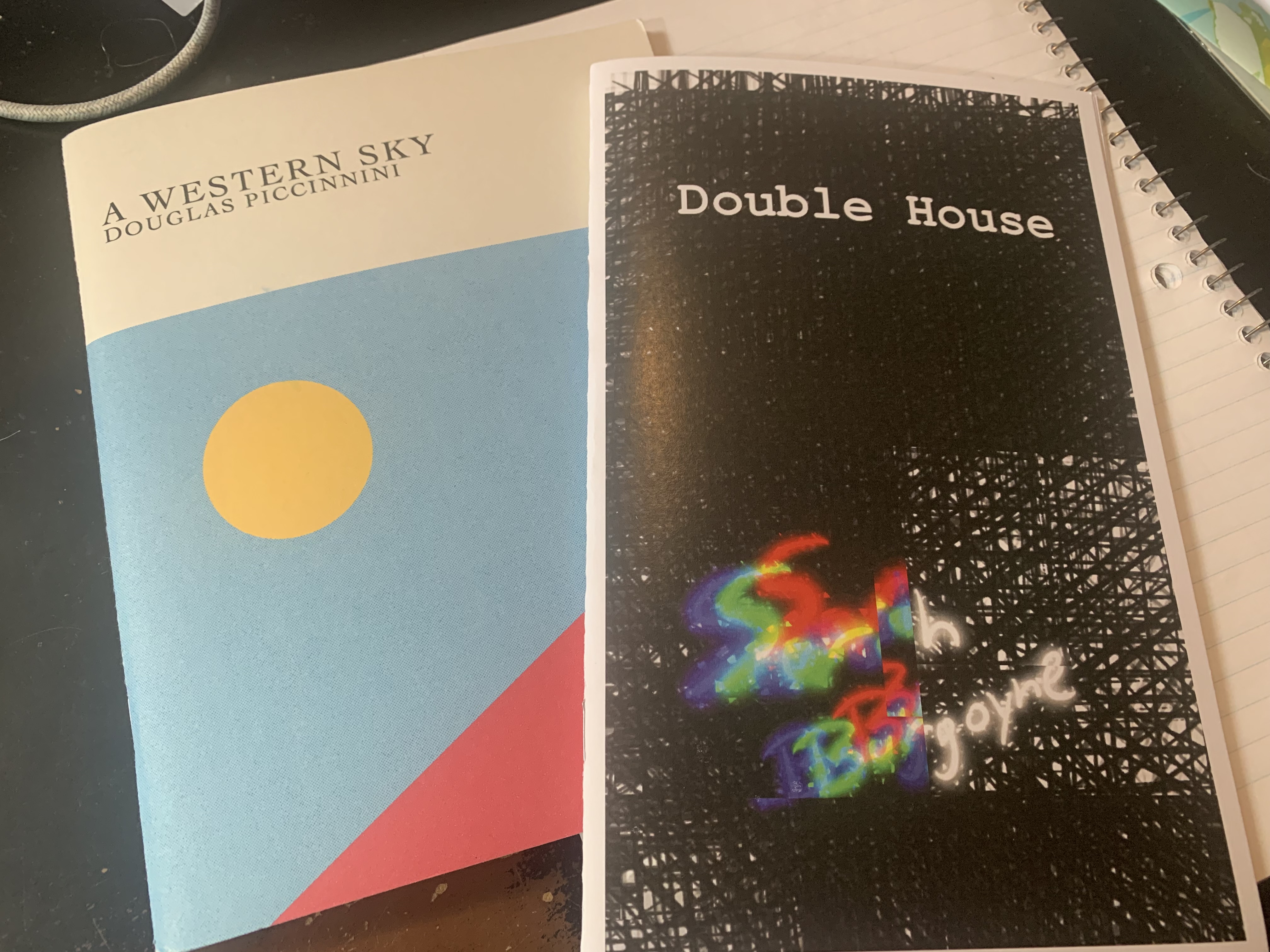
Ongoing notes: early June, 2022 : Douglas Piccinnini + Sarah Burgoyne,

Did you notice when we posted a new poem-a-day throughout April over at the Chaudiere Books blog, as part of our ninth annual acknowledgement of National Poetry Month (I mean, you did notice that, right?). And of course, the new issue of periodicities: a journal of poetry and poetics, where I’ve also been interviewing the shortlist for this year’s Griffin Poetry Prize?

New England: I’ve been going through American poet Douglas Piccinnini’s [see my 2016 “12 or 20 questions” interview here] latest title, the chapbook A WESTERN SKY (Greying Ghost, 2022), a lovely title produced in a numbered edition of seventy-five copies. Piccinnini’s A WESTERN SKY is a twenty-nine poem sequence of fragments composed as a lyric meditation on change and space. He writes an abstract sequence on breaks and blocks, attempting to reach beyond the boundaries of this sequence of sketch-out notes into something larger. “Money, no money – // say where to speak and break,” he writes, early on in the collection, “the clockhands as my own. // The hands of a prisoner speaking up. // Don’t let them hit you. / Don’t let them take you apart.”

The future approaches as if it were fixed—no
days but days multiply. Rooms of a house
you know and have entered—remember

change—this custom like a place you feel

studded in a sky, swept away, in a substance
like a signal departing as it arrives, to keep time

to see a tree top touched breeze
to say that, for example, you lose
the keys everywhere to find them.

Montreal QC: You’ve probably heard that Montreal poet James Hawes started a chapbook press, yes? Over at his Turret House, one of the most recent titles is Sarah Burgoyne’s Double House (2022) [see my review of her latest book here], a handful of poems composed during, as she writes in a brief note to introduce the poems, “domestic exile,” thanks in no small part to Covid-19 lockdowns. As she writes: “Something had begun to come up in the poems I was writing and the poems my friends were writing: domesticity (b)loomed. Our interior spaces puffed up their lungs and insisted on their presence in our work. I started to see my home more and more like a living body—with currents, with moods, with breath (sometimes poisonous), with infection, also. I came to know much more intimately the rhythms of my hitherto unknown housemates (a pigeon and a mouse) and they inevitably made their way into my poems. In a way, through domestic exile and through these poems, I discovered the porousness of my home’s conceptual borders (and its physical borders every time the mouse emerged).” I’m fascinated by the shifts in Burgoyne’s work through this small collection, an assemblage of experiments, one might say, as much as anything else, flexing her muscles and seeing what other possibilities the lyric might offer, or allow. Also, there’s something really interesting in the way she notes at the back of the collection, how the poem “Double House Poem” was composed “by adapting one of C.A. Conrad’s (Soma)tic exercises. I studied the light in every room of my house. I listened to my refrigerator. I made myself steamed broccoli with olive oil and salt. I lay on the floor listening to Philip Glass’s ‘Music in Contrary Motion’ and reflected on violence.’” Honestly, in many ways, the writing she offers to speak of her writing, and her process, is equally interesting to the writing itself, and this small collection offers tidbits of both. And the poem itself, “Double House Poem,” that includes:

The sink is my palm, upturned on the floor
for you. Think of your house. Descend.

The fig tree’s shadow is a ladder
for you to climb.

Press your ear to the fridge
inside is a cautious poet echoing your poem.


Saturday, May 01, 2021

Sarah Burgoyne, Because the Sun


Because the Sun takes inspiration from a decade-long fascination with a scene in Albert Camus’s L’étranger – the one in which his main character Meursault, ‘press[ed]’ by the blinding sun, shoots a man on the beach. I wanted to take up the relentless heat of the sun and its potential for transference – in this case, from atmosphere to human interaction, from Meursault’s murder of the unnamed ‘Arab’ to the example of gendered violence committed against the victim’s sister (also unnamed), and finally the micro-aggressions against Meursault’s girlfriend Marie. I saw a parallel here between atmosphere and violence in the 1991 film Thelma & Louise – what is it that moves Louise to pull the trigger on Thelma’s assailant after Thelma is safe? In both cases, the sun is a material symbol of pain, an affective backlog we’re slung under, pushing us through desert after desert, where we become deadly.

I gave voice to the speaker of Because the Sun, in part, by weaving excerpts from Camus’s extensive notebooks (scoured for every instance in which he refers to the sun), with the surreal lyric of automatic writing, scientific descriptions of heat and heat stroke, and film dictations. Because the Sun’s pastiche of personal and ‘objective’ (often scientific) voices strives to embody both stylistic and formal ‘relentlessness’ by teasing out discursive tonalities that blend and merge into each other, generating a blinding effect, like looking into the sun. (“NOTES”)

Montreal poet Sarah Burgoyne’s latest poetry title is Because the Sun (Toronto ON: Coach House Books, 2021), a book composed as a quartet of lyric and prose sections: “one, the sun,” “two, the sky,” “three, women” and “four, flowers.” The author of a handful of chapbooks both solo and collaborative, this is Burgoyne’s second trade poetry title, after the award-winning Saint Twin (Toronto ON: Mansfield Press, 2016). As she describes through the notes at the end of Because the Sun, Burgoyne writes the facets of the sun from Camus, and the point at which Camus’ novel and the film Thelma and Louise (1991) meet. “here is the closed room,” she writes, as part of the poem “WHAT WAS / ENFANCE,” in the first section, a poem that cities itself as “after Rimbaud,” “behind the chrysanthemums, the / dead little room and its mat of astroturf, the whole sky is / luminous (in the room), and the great obstacle is what has / already taken place.” An earlier version of that section, also, was first revealed as her “statement” to introduce her work as part of her participation in the “Spotlight series,” posted March 21, 2017. As part of a richly fascinating interview, “Sarah Burgoyne In Conversation With Vi Khi Nao,” posted April 13, 2021 at luna luna, the two discuss the implications of the sun, and Camus, as Vi Khi Nao asks:

The content of this book’s unraveling is structured/outlined by a quote you pulled from Camus: ‘I count. I say: one, the sea; two, the sky (ah, how beautiful it is); three women; four, flowers (ah, how happy I am).’ Can you share with us the intentions behind the omission of the content in parentheses?  Are beauty and happiness not a part of Camus’ sun? Did you want them implied?

SB: These are great questions, first of all. And I want to say that “solarly-accusatory” is an excellent description of the title. It’s actually the reason Meursault gives in l’Etranger during his trial for having shot the man on the beach: “c’était à cause du soleil.” Not the most convincing excuse… but every time the sun is at that low angle and burning right into my eyes I think of that scene. As for the beauty and happiness—yes—I believe they are very much part of Camus’ sun. The reason I scoured his notebooks was because I knew he must be obsessed with the sun, and even though it isn’t always written about in conjunction with beauty and happiness, (at one point he talks about ‘the real climate of tragedy’ being not the night but ‘the heat on the quays’), one doesn’t usually obsess over something unless one is somewhat in love with it…

The third section is a length of extended prose on the right side with an equally-placed hole excised on every face page, setting that text outside the boundaries of an exploration of Thelma and Louise, reminiscent of George Bowering working a similar excision of text in one of the stories in his short story collection, The Rain Barrel (Vancouver BC: Talonbooks, 1994). In Burgoyne’s text, it is as though there is a hole shot through it, whether sun or bullet-hole, that same hole running through and left behind at the end of the section. Burgoyne has previously done some stunning work with the prose poem form, especially the extended or serial prose poem, so it is fascinating to see her explore more conceptual frameworks through this latest collection. “a work of art is / a confession,” she writes, as part of the final section. The conceptual framework of Because the Sun works from Camus and Thelma and Louise, examining an array of sentences on and around the sun, but also explores the very nature of art-making, and the relationships language and art have with each other, artwork has with other artworks, and relationships those works might have with the audience/reader, including the narrator/creator of this particular work. One can create and even hide behind artwork, but it does not erase the creator; it does not provide a place from which to be completely invisible. “the tops / of buildings get a / little colder with all / the damning / evidence in our / hands we’re afraid / of punishment / we’re glad this / went nowhere” (“JACKPOT,” “four, flowers”).

correction: i am my own convection     overwrought
in yellow     i dress in the light
at the bottom of the pool i

ferry light along
here

i am in it (“THE SUN’S CITIZENS ARE SOLAR NOTES”)