
Showing posts with label Greying Ghost. Show all posts
Showing posts with label Greying Ghost. Show all posts
Saturday, July 08, 2023
Jon Cone, LIMINAL: SHADOW AGENT PT 1 and LIMINAL: SHADOW AGENT PT 2
Friday, June 03, 2022
Ongoing notes: early June, 2022 : Douglas Piccinnini + Sarah Burgoyne,
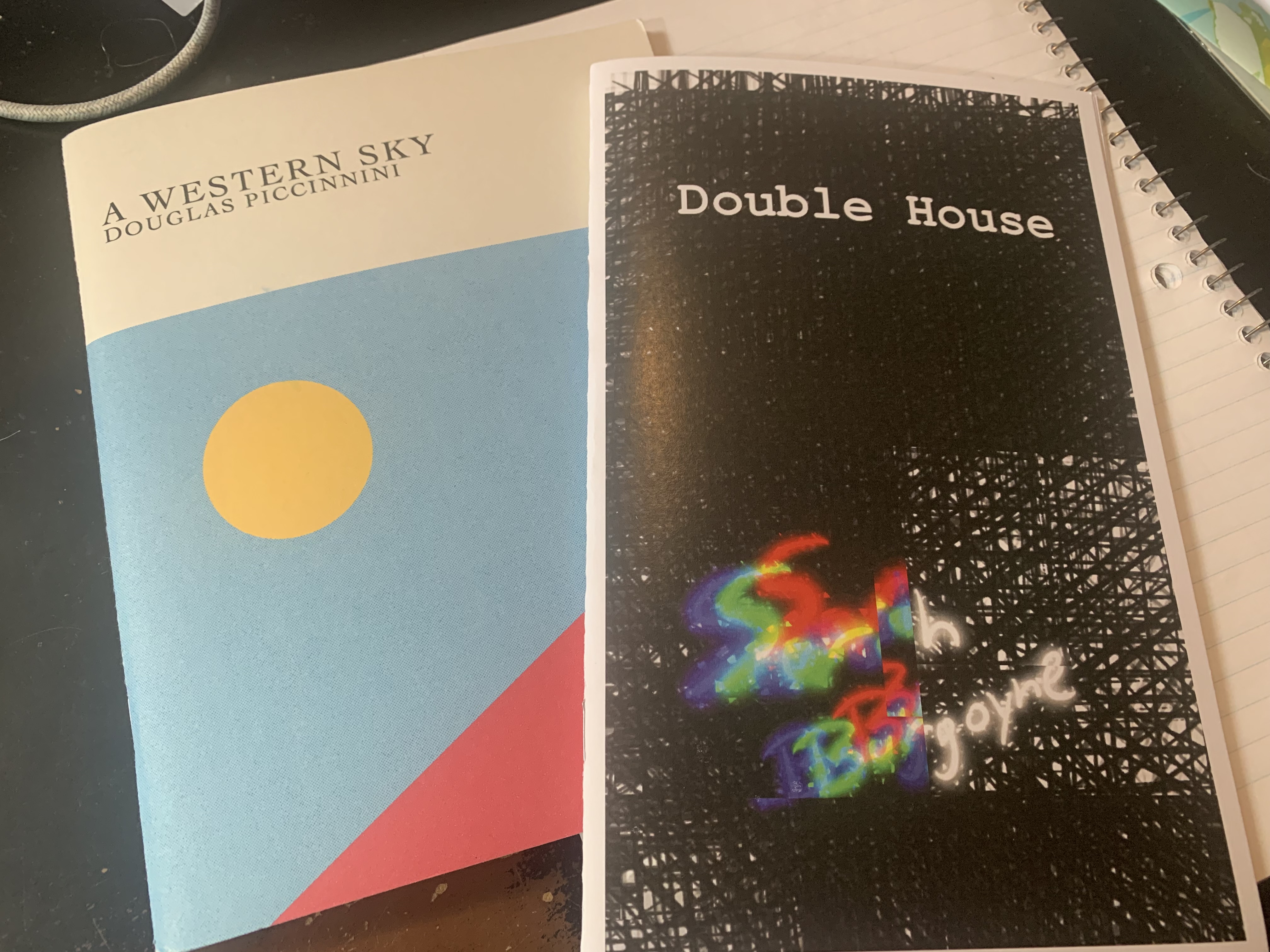
New England: I’ve been going through American poet Douglas Piccinnini’s [see my 2016 “12 or 20 questions” interview here] latest title, the chapbook A WESTERN SKY (Greying Ghost, 2022), a lovely title produced in a numbered edition of seventy-five copies. Piccinnini’s A WESTERN SKY is a twenty-nine poem sequence of fragments composed as a lyric meditation on change and space. He writes an abstract sequence on breaks and blocks, attempting to reach beyond the boundaries of this sequence of sketch-out notes into something larger. “Money, no money – // say where to speak and break,” he writes, early on in the collection, “the clockhands as my own. // The hands of a prisoner speaking up. // Don’t let them hit you. / Don’t let them take you apart.”
The future approaches as
if it were fixed—no
days but days multiply. Rooms
of a house
you know and have entered—remember
change—this custom like a
place you feel
studded in a sky, swept
away, in a substance
like a signal departing
as it arrives, to keep time
to see a tree top touched
breeze
to say that, for example,
you lose
the keys everywhere to
find them.
Montreal QC: You’ve probably heard that Montreal poet James Hawes started a chapbook press, yes? Over at his Turret House, one of the most recent titles is Sarah Burgoyne’s Double House (2022) [see my review of her latest book here], a handful of poems composed during, as she writes in a brief note to introduce the poems, “domestic exile,” thanks in no small part to Covid-19 lockdowns. As she writes: “Something had begun to come up in the poems I was writing and the poems my friends were writing: domesticity (b)loomed. Our interior spaces puffed up their lungs and insisted on their presence in our work. I started to see my home more and more like a living body—with currents, with moods, with breath (sometimes poisonous), with infection, also. I came to know much more intimately the rhythms of my hitherto unknown housemates (a pigeon and a mouse) and they inevitably made their way into my poems. In a way, through domestic exile and through these poems, I discovered the porousness of my home’s conceptual borders (and its physical borders every time the mouse emerged).” I’m fascinated by the shifts in Burgoyne’s work through this small collection, an assemblage of experiments, one might say, as much as anything else, flexing her muscles and seeing what other possibilities the lyric might offer, or allow. Also, there’s something really interesting in the way she notes at the back of the collection, how the poem “Double House Poem” was composed “by adapting one of C.A. Conrad’s (Soma)tic exercises. I studied the light in every room of my house. I listened to my refrigerator. I made myself steamed broccoli with olive oil and salt. I lay on the floor listening to Philip Glass’s ‘Music in Contrary Motion’ and reflected on violence.’” Honestly, in many ways, the writing she offers to speak of her writing, and her process, is equally interesting to the writing itself, and this small collection offers tidbits of both. And the poem itself, “Double House Poem,” that includes:
The sink is my palm, upturned
on the floor
for you. Think of your
house. Descend.
The fig tree’s shadow is
a ladder
for you to climb.
Press your ear to the fridge
inside is a cautious poet
echoing your poem.
Tuesday, June 13, 2017
12 or 20 questions with Judson Hamilton

Judson Hamilton lives in Wrocław,
Poland. He’s published a couple of chapbooks with Greying Ghost Press, a
novella with Black Scat Books and most recently a short story collection called
Gross in Feather, Loud in Voice. He’s
a contributor at Queen Mob’s Teahouse.
Twitter: @judson_hamilton
1 - How did your first
book change your life? How does your most recent work compare to your previous?
How does it feel different?
The
first book I published was a chapbook called Celebrity Slumbers it didn’t change my day to day life but it
showed me that publication was possible. My most recent work is a book of short
stories and my first was a book of prose poems so in that respect that aren’t
much alike but I like to think I’m a better writer now.
2 - How did you come to
poetry first, as opposed to, say, fiction or non-fiction?
I
kind of came to both at the same time actually. I’ve no idea how though.
3 - How long does it
take to start any particular writing project? Does your writing initially come
quickly, or is it a slow process? Do first drafts appear looking close to their
final shape, or does your work come out of copious notes?
There
is a lengthy amount of time where I’m just living with it and then it all
starts to come together pretty quickly from there.
4 - Where does a poem
or work of fiction usually begin for you? Are you an author of short pieces
that end up combining into a larger project, or are you working on a
"book" from the very beginning?
Everything
starts with a tone or an image, a voice or a line and expands from there. I’ll
just start writing things down, collecting fragments or scenes and see where it
goes making notes along the way until something coalesces.
5 - Are public readings
part of or counter to your creative process? Are you the sort of writer who
enjoys doing readings?
I
have only done one reading in my life and that was not long ago in Berlin. It
was fun but it isn’t a big part of my process.
6 - Do you have any
theoretical concerns behind your writing? What kinds of questions are you
trying to answer with your work? What do you even think the current questions
are?
If
I have theoretical concerns I’m unaware of them.
7 – What do you see the
current role of the writer being in larger culture? Does s/he even have one?
What do you think the role of the writer should be?
I’ve
seen this question a lot and frankly it has always puzzled me. It seems to me
that the writer has no role in society per se. A writer should write and that’s
all. Some write to entertain, some to tackle the big questions, and some for
political reasons but it all boils down to the same thing in the end and I’m
loath to reduce it to one role.
8 - Do you find the
process of working with an outside editor difficult or essential (or both)?
I’ve
only worked with an outside editor a few times and it has always gone pretty
smoothly (thankfully).
9 - What is the best
piece of advice you've heard (not necessarily given to you directly)?
“Onward
through the fog!”, which was the slogan for a headshop in Austin, Texas called Oat Willie’s (not sure if it is around anymore). It has always seemed to me to
be applicable to just about any situation. Good solid life advice.
10 - How easy has it
been for you to move between genres (poetry to prose)? What do you see as the
appeal?
I
have a tendency to meander between them whenever I get bored.
11 - What kind of
writing routine do you tend to keep, or do you even have one? How does a
typical day (for you) begin?
I
have always written on the go so I make a lot of notes on my phone and then
dump them into a notebook that I work in whenever my schedule permits. Later
that gets dumped onto the computer and the editing phase begins. Texts get
combed over until they are done.
12 - When your writing
gets stalled, where do you turn or return for (for lack of a better word)
inspiration?
I
don’t need much inspiration these days – just time. But I suppose if I needed
some I’d go for a long walk or to an art museum.
13 - What fragrance
reminds you of home?
Sawdust
and Azaleas in heat.
14 - David W. McFadden
once said that books come from books, but are there any other forms that
influence your work, whether nature, music, science or visual art?
I
don’t know what is directly influential these days but I’ve been listening to a
lot of beat tapes recently and classical music. I’ve got a large park near my
house and that must exert some influence on me as I’ve spent a lot of time
there. I love installation art and contemporary abstract art, graffiti etc. Perhaps
not science directly but I find robotics and outer space, life in the Anthropocene,
and synthetic biology pretty exciting.
15 - What other writers
or writings are important for your work, or simply your life outside of your
work?
I
really like the work of Will Self, Claire Donato, Jenny Boully, Nicola Barker, and
Tove Jansson. I could go on and on.
16 - What would you
like to do that you haven't yet done?
Write
some longer texts. Travel more.
17 - If you could pick
any other occupation to attempt, what would it be? Or, alternately, what do you
think you would have ended up doing had you not been a writer?
I
don’t work professionally as a writer but what would I do instead? I have no
idea.
18 - What made you
write, as opposed to doing something else?
It
started off as something I enjoyed doing and has become an inseparable part of
my life.
19 - What was the last
great book you read? What was the last great film?
20 - What are you
currently working on?
I
just finished a poetry manuscript called The
New Make Believe and have just started tinkering with some longer prose
ideas.
Sunday, February 14, 2016
Lisa Ciccarello, At Night
The favorite wife
dreams: all my body is a stone.
Here is how I control
my heart: I string each thought one behind the next, like beads.
I wear the answers I am
waiting to give. The jewelry becomes heavy as soil.
My long blink is a
scream & a yes. There are things I have to say, but they do not yet know
the questions they must ask. & a blink is no word; if they misunderstand—
A heart is just soil. Ask
anyone. A heartbeat is a blink. A long blink is a scream. A longer blink is
sleep. All night I am screaming.
The
author of eight poetry chapbooks—“I only
thought of the farm” (DoubleCross Press, 2015), “Chief!” (Ink Press, 2014), Worth is the Wrong Word (Black Cake Records, 2014), & if I die, make me how you are (The New Megaphone, 2014), (the shore in parts) (Greying Ghost Press, 2013), Sometimes there are travails (Hyacinth Girl Press, 2013), At night (Scantily Clad Press, 2009) and At
night, the dead (Blood Pudding Press, 2009)—Portland, Oregon poet Lisa Ciccarello’s first full-length poetry collection is At Night (Lancaster PA: Black Ocean, 2015). Composed as a
collection of untitled fragments collaged into a single, extended, accumulated
sequence, what connects these pieces are less a matter of shape, structure or
content, but a shared tone, one that evokes a mindful series of gestures,
mantras, recriminations and self-examinations. As she writes: “I is the smallest word she can say.” The
poems in At Night were originally
composed as individual pieces that connect under their shared title, as she discussed in a recent interview posted at litseen:
EVAN KARP: How long
have you been working on this book?
LISA CICCARELLO: I
started writing the poems that ended up being
the project that became this book right after I finished my MFA in 2007. I had
written the majority of the poems that went into this by 2009, with a tiny
addition to the project in 2011. For some reason I didn’t want to admit that I
had finished a book, perhaps because I didn’t want to be barred from ever
writing another “At night” poem, but by 2012 it was clear I’d moved on to
another large project & it was time to let go of this one.
EK: Did it change
incarnations/structure/come out as a chapbook?
LC: In my mind it was
always a series of connected poems that I was free to grow as I saw fit. The
poems were all titled “At night,” but as I wrote more of them I started to see
other categories they were fitting into (such as, dealing with marriage), so if
the poems had any of these additional markers, they would be titled “At night,
by marriage” or “At night, the perfect inside is outside” or, if they dealt
with more than one recurring theme “At night, inside the house, the dark has a
sound.” Two chapbooks were culled from it; “At night, the dead” (Blood Pudding
Press, 2009) & “At night” (Scantily Clad Press, 2009)

The
poems are incredibly visceral and tactile (“The way you drown a man—here, in
your mouth.” or, later on: “I got an eye that speaks its mind but a body that
does what it’s told.”), and present a variety of scenes, stories and shifts,
from more realistic stories to internal monologues to dreamscapes and folk
tales, all presented as part of an examination of an all-encompassing dark. As
she writes: “The dark has a sound like someone has fooled you. Someone has
fooled you.”
& in the night the
moon like a pond & in the day the pond like a mirror & in the night the
smoke of the house & in the day the curtain & in the night the moon
like an axe & in the day the length of the woods & in the night the
length of the night.
& in the night the
lantern & in the day the silver & in the night the candle & in the
day the ash & in the day the gathering of wood & in the night the
stacking of wood & in the day the virtuous kindling how cleanly stripped
& in the night the moon like a splinter.
& in the night the
moon & in the day the moon & in the night the stars & in the day
the sun & in the night the sun how they burned you when they thought you
were wrong & in the day the ash & in the night the ash & the moon
like a shovel & the moon like a tooth.
Monday, January 23, 2012
12 or 20 questions (second series) with Sommer Browning

Sommer Browning is the author of EitherWay I’m Celebrating (Birds, LLC; 2011), a collection of poetry and comics, and three chapbooks, most recently THE BOWLING (Greying Ghost, 2010) with Brandon Shimoda. Her work will soon appear in EOAGH, The Denver Quarterly, and EVENT. In 2008, she founded the hand-bound chapbook publisher, Flying Guillotine Press, with Tony Mancus. She lives in Denver where she and Julia Cohen curate The BadShadow Affair, a reading series.
1 - How did your first book change your life? How does your most recent work compare to your previous? How does it feel different?
The old three questions in one trick! My first book has afforded me a lot of opportunities I wouldn’t have been offered otherwise. I was asked to read and be on a panel at the Juniper Festival, I’ve skyped in with classes that are reading my book, I can answer the question, “How did your first book change your life?” without lying. Having a book has made me more confident in my work, but I’ve allowed it to place a different sort of pressure on me. I want the first book to propel me into something new, something better. That’s the pressure. I’ve always wanted the next poem to be better, but now I take that notion into my new work with a seriousness it didn’t have before. There’s something about codifying your work into a book that creates some very physical, real, monumental baseline. Now I have a place and with that a direction from or toward, before I was everywhere. The array versus the trajectory.
2 - How did you come to poetry first, as opposed to, say, fiction or non-fiction?
I came to poetry somewhere in the middle. Fiction first, plays, then maybe poetry. It was a series of quotidian life changing events. A fellow I admired gave me some Rilke, I took a workshop with Jean Valentine and she told me I should keep writing poems, these little details that I could have easily ignored, shaped me profoundly.
3 - How long does it take to start any particular writing project? Does your writing initially come quickly, or is it a slow process? Do first drafts appear looking close to their final shape, or does your work come out of copious notes?
For the most part first drafts appear looking close to their final shape. I tend to think about projects for some time before embarking on them. Single poems, though, come out of nowhere, and quickly. But my writing schedule is erratic. I work on routine constantly, and am never successful.
4 - Where does a poem usually begin for you? Are you an author of short pieces that end up combining into a larger project, or are you working on a "book" from the very beginning?
I suppose my goal is to have a book, eventually, but in the short term, I just try to write what is on my mind, what is interesting me, without thinking of length or cohesion or presentation. But that’s not true, too. Because sometimes I just sit down and write a book of president jokes.
5 - Are public readings part of or counter to your creative process? Are you the sort of writer who enjoys doing readings?
I get worked up at every public performance I’ve ever given and I will continue to do so. I have a performing phobia. Most of it occurs internally, rapid heartbeat, brain sweats, spontaneous astral projection; many people don’t believe I’m actually in complete agony up there. But somehow I like it. I even write pieces in order to perform them. Humans are weird.
6 - Do you have any theoretical concerns behind your writing? What kinds of questions are you trying to answer with your work? What do you even think the current questions are?
I like this question. I can’t say what the current questions are, I can barely say what mine are. But one of my concerns centers around truthfulness, or maybe earnestness is a better word. I hope my poems align themselves with the way I want to live in the world. I want to maintain an irreverent reverence at all times, whether that is toward love, beauty, sex or Being. For me, this is the most honest way I can live, with an askance look toward everything, but with arms ready to embrace it all; so one of my theoretical concerns about all art is that of authenticity, expressive rather than nominal. I’m borrowing Sartre’s term to talk about a literary genre he didn’t like—irreverent reverence! Now, I’m suddenly thinking of the Church of Jesus Christ without Jesus Christ from Wiseblood. And now I want donuts.
7 – What do you see the current role of the writer being in larger culture? Does s/he even have one? What do you think the role of the writer should be?
There are a couple of roles all writers share that are important to me. 1. For me, writers keep the boundaries of possible experience as wide as they can be. I think about empathy a lot, and how if the human race loses it, the loss compounds, becomes an avalanche of loss: friendship succumbs, then love, then beauty. Other than real life experience, I feel that writing is one of the few places in which we can experience empathy. I am talking of writing in the largest sense, from poetry to screenplays to jokes. 2. I think it is important also, to play with, engage, stretch & destroy language. It is an intellectual endeavor that challenges the heart and mind, and so inspires growth and growth inspires creativity and creativity inspires peace.
8 - Do you find the process of working with an outside editor difficult or essential (or both)?
I worked very closely with the editors at Birds, LLC, but most especially with the poet Chris Tonelli on my first (only!) book. It was essential. It was difficult only until my ego was tamed, which luckily didn’t take too long.
9 - What is the best piece of advice you've heard (not necessarily given to you directly)?
I hate advice.
10 - How easy has it been for you to move between genres (poetry to comics)? What do you see as the appeal?
The appeal of moving between genres? I don’t know that I do see an appeal. I just like poems and I like drawing weird things. Each occupies a slightly different portion of my brain. The comics seem more personal in a way; if I had a soul it would be one of my comics, maybe Li’l Dil, the smallest dildo inthe world.
11 - What kind of writing routine do you tend to keep, or do you even have one? How does a typical day (for you) begin?
After wiping the tears from my eyes, I put on a pot of tea, talk myself out of a shower, check my email, Twitter, Facebook, secret email, then Facebook again and rush out of the house late for work. By the time I get home, the tea kettle is burned to a crisp. Somehow there are poems on my computer.
12 - When your writing gets stalled, where do you turn or return for (for lack of a better word) inspiration?
I read. Even reading for ten minutes out of a random book generates ideas and motivation. Ideas are infinite, luckily.
13 - What fragrance reminds you of home?
Cat.
14 - David W. McFadden once said that books come from books, but are there any other forms that influence your work, whether nature, music, science or visual art?
Honestly, I would say all of those things because my biggest influence is just living. So stand-up comedy, watching a squirrel squirrel around, listening to Fela Kuti, joking with my husband, deciphering my mother’s text messages, flipping through my Caspar David Friedrich book, everything has the potential to influence me, and so also my work. Saying all that, music is crucial to my life/work. And so is film. And so is YouTube.
15 - What other writers or writings are important for your work, or simply your life outside of your work?
Again, not sure I can make the distinction between good for me and good for my work. A lot of fiction is important to me. Flannery O’Connor, Faulkner’s short story “Spotted Horses,” Beckett’s novels. Intellectually, countless poems; I feel like a traitor saying that fiction has always been more important to me emotionally.
16 - What would you like to do that you haven't yet done?
Go everywhere. Eat brains. Have a baby. Live in a motel. Save someone’s life.
17 - If you could pick any other occupation to attempt, what would it be? Or, alternately, what do you think you would have ended up doing had you not been a writer?
I would love to be a doctor. If I didn’t write poems, I would play more guitar.
18 - What made you write, as opposed to doing something else?
I think I would answer this the same way as I did question 2.
19 - What was the last great book you read? What was the last great film?
I can’t answer that, but over the past year, I really loved Shesshu Foster’s World Ball Notebook, Maggie Nelson’s Bluets, Patti Smith’s Just Kids & Robert Fernandez’s We Are Pharoah. And films? So many. This year I rewatched Haneke’s The White Ribbon and was again astounded, I saw and loved Refn’s Valhalla Rising, and I attended an evening of Dani Leventhal’s films and they were great great great great great.
20 - What are you currently working on?
I’m writing a collection of poems about my friendship with my best friend Sam, editing Serena Chopra’s chapbook Penumbra that’s coming out on the press I run with Tony Mancus called Flying Guillotine, and illustrating Noah Eli Gordon’s upcoming book, 62 Problems (or whatever it ends up being called!) And a dozen other things. Thanks for asking!
Subscribe to:
Posts (Atom)

