Showing posts with label Douglas Piccinnini. Show all posts

Friday, June 16, 2023

Douglas Piccinnini, Beautiful, Safe & Free


There, in my mistake. I am present. The present
lifted over itself. A day like grout
in the tiles suddenly brittle suddenly breaking
down this pattern. A date you remember
smeared in the pages of a calendar.

That was pleasure once. Sure-fit, needled
existence and as the nerve brough forward
a yellow seam in the silence. Silence thrust
its burning face to the glass—
that kind of domain. (“A WESTERN SKY”)

New Jersey poet Douglas Piccinnini’s [see his '12 or 20 questions' interview here] third published book and second full-length poetry title, after Blood Oboe (Richmond CA: Omnidawn, 2015), is Beautiful, Safe & Free (Palm Desert CA: New Books, 2023). The poems that make up Beautiful, Safe & Free, including the sequence previously published as the chapbook A WESTERN SKY (Greying Ghost, 2022) [see my review of such here], are constructed through notational accumulation: short lines, phrases and sentences are clustered together to form shapes of meaning and purpose, composed along the frayed and dusty edges of American civilization. “day after day mine silage / stuffs the animal vassal,” he writes, as part of the poem “CASH FOR GOLD.” Piccinnini composes his poem-clusters out of scraps and fragments around placement and uncertainty, declaring where he, the narrator, is situated in this montage of contemporary America, through all its devastation, contradiction and absolute beauty. “one is a mind in refrain shelving the days,” he writes, to open the poem “FLOWER SHIELD,” “as the throat of where you’ve been speaks // as the once between of boundaries / becomes particular to retain an abandon [.]” Piccinnini’s poems appear to skim across an endless surface but instead reveal such depths as can’t be fathomed, offering echoes of Canadian poet Hugh Thomas through how the accumulation of ellipses can provide a perfect outline of an articulated absence.

INTERROBANG

as if—stuttering
a percentage of glyphs
inflates you like a flower

in a loveable number
zeroed—whole—round

fit into you in what
like a splinter

milked from division

like an anthem jerks up—
to follow you everywhere

in every mask you slip on
to make meaning

Friday, June 03, 2022

Ongoing notes: early June, 2022 : Douglas Piccinnini + Sarah Burgoyne,

Did you notice when we posted a new poem-a-day throughout April over at the Chaudiere Books blog, as part of our ninth annual acknowledgement of National Poetry Month (I mean, you did notice that, right?). And of course, the new issue of periodicities: a journal of poetry and poetics, where I’ve also been interviewing the shortlist for this year’s Griffin Poetry Prize?

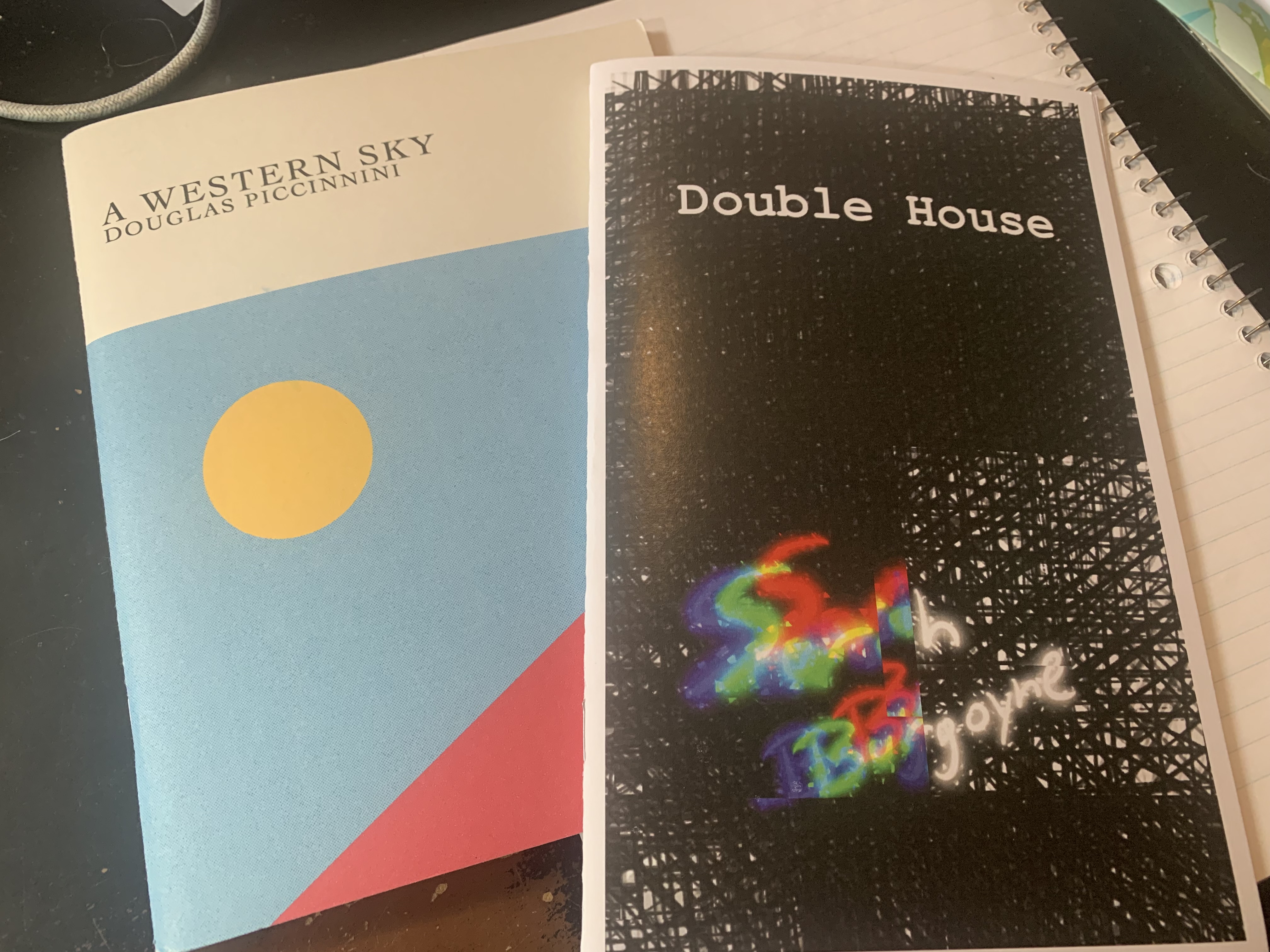
New England: I’ve been going through American poet Douglas Piccinnini’s [see my 2016 “12 or 20 questions” interview here] latest title, the chapbook A WESTERN SKY (Greying Ghost, 2022), a lovely title produced in a numbered edition of seventy-five copies. Piccinnini’s A WESTERN SKY is a twenty-nine poem sequence of fragments composed as a lyric meditation on change and space. He writes an abstract sequence on breaks and blocks, attempting to reach beyond the boundaries of this sequence of sketch-out notes into something larger. “Money, no money – // say where to speak and break,” he writes, early on in the collection, “the clockhands as my own. // The hands of a prisoner speaking up. // Don’t let them hit you. / Don’t let them take you apart.”

The future approaches as if it were fixed—no
days but days multiply. Rooms of a house
you know and have entered—remember

change—this custom like a place you feel

studded in a sky, swept away, in a substance
like a signal departing as it arrives, to keep time

to see a tree top touched breeze
to say that, for example, you lose
the keys everywhere to find them.

Montreal QC: You’ve probably heard that Montreal poet James Hawes started a chapbook press, yes? Over at his Turret House, one of the most recent titles is Sarah Burgoyne’s Double House (2022) [see my review of her latest book here], a handful of poems composed during, as she writes in a brief note to introduce the poems, “domestic exile,” thanks in no small part to Covid-19 lockdowns. As she writes: “Something had begun to come up in the poems I was writing and the poems my friends were writing: domesticity (b)loomed. Our interior spaces puffed up their lungs and insisted on their presence in our work. I started to see my home more and more like a living body—with currents, with moods, with breath (sometimes poisonous), with infection, also. I came to know much more intimately the rhythms of my hitherto unknown housemates (a pigeon and a mouse) and they inevitably made their way into my poems. In a way, through domestic exile and through these poems, I discovered the porousness of my home’s conceptual borders (and its physical borders every time the mouse emerged).” I’m fascinated by the shifts in Burgoyne’s work through this small collection, an assemblage of experiments, one might say, as much as anything else, flexing her muscles and seeing what other possibilities the lyric might offer, or allow. Also, there’s something really interesting in the way she notes at the back of the collection, how the poem “Double House Poem” was composed “by adapting one of C.A. Conrad’s (Soma)tic exercises. I studied the light in every room of my house. I listened to my refrigerator. I made myself steamed broccoli with olive oil and salt. I lay on the floor listening to Philip Glass’s ‘Music in Contrary Motion’ and reflected on violence.’” Honestly, in many ways, the writing she offers to speak of her writing, and her process, is equally interesting to the writing itself, and this small collection offers tidbits of both. And the poem itself, “Double House Poem,” that includes:

The sink is my palm, upturned on the floor
for you. Think of your house. Descend.

The fig tree’s shadow is a ladder
for you to climb.

Press your ear to the fridge
inside is a cautious poet echoing your poem.


Thursday, June 02, 2016

12 or 20 (second series) questions with Douglas Piccinnini


Douglas Piccinnini’s debut collection of poems, Blood Oboe, was published by Omnidawn in 2015 and earlier that year, Story Book: a novella appeared with The Cultural Society. His writing has been featured by The Academy of American Poets’ Poem-A-Day, Antioch Review, Lana Turner, The Poetry Project Newsletter, The Seattle Review, Verse, and The Volta—among other journals. He lives in Lambertville, NJ.

1 - How did your first book or chapbook change your life? How does your most recent work compare to your previous? How does it feel different?
My first book(s) Blood Oboe (Omnidawn) and Story Book (The Cultural Society) appeared within months of one another. They have been an extension of my life in a very practical way: the poems in Blood Oboe are, in some sense, the document of my life for the past decade: moving to New York, living in New York, leaving New York and all the parentheticals in between. As a novella, Story Book is in many ways a companion text to the poems in Blood Oboe.

At its best, I hope that this work has the potential to change the thinking lives of people around me (and distant to me) more than my own life.

It might be foolish to think that my own book would change my life, though the making of these books was a way of getting to know the world.

2 - How did you come to poetry first, as opposed to, say, fiction or non-fiction?
Poetry first came to me in the form of Religion. I was raised Roman Catholic. When I was young I prayed. A prayer is a kind of poem. I prayed in poems. And, I often thought in terms of a spiritual language, a language that reached for insight.

That part of my life is in the past now, but I think I approach poetry with a spirituality that tries to set the days in their place—:  A poetry concerned with the passing time and the coming time. To remember is to travel back in time and to dream is to travel forward in time. But time is a warped thing and each minute asks new questions and confronts what you thought you thought you knew in different ways.

At present, I am interested in a poetics that confronts the idea of linear time.

3 - How long does it take to start any particular writing project? Does your writing initially come quickly, or is it a slow process? Do first drafts appear looking close to their final shape, or does your work come out of copious notes?
I like to work on writing in multiples. I mean: to approach a subject or subjects from a number of different angles, like a painter might make a series of studies that hang together.

A feeling arrives in a pattern or, a pattern arrives like a feeling and I begin writing.

The poems are the notes: they communicate with other poems and other writing.  Instead of attempting to break down my impulses and make the poem confess something it didn’t do or doesn’t know, I’ll move on to another poem and retain some of the energy involved in the making of the previous poem.  

4 - Where does a poem or work of fiction usually begin for you? Are you an author of short pieces that end up combining into a larger project, or are you working on a "book" from the very beginning?
A poem begins with the compulsion to begin and ends with compulsion to begin something else. 

I don’t know yet. I’d like to be able to slip either way in terms of process.  A book is the fetish of the poem and the fetish of a life in poems. 

5 - Are public readings part of or counter to your creative process? Are you the sort of writer who enjoys doing readings?
Public readings are fun but feed into the cult of the author. I’d like to hire people to read my poems—people that don’t think of themselves as poets and people who do—to put the words in their mouths, to have them live the words a little.

6 - Do you have any theoretical concerns behind your writing? What kinds of questions are you trying to answer with your work? What do you even think the current questions are?
The only question is the question of time. From there: the horrors and joys of life are revealed. The question of time lived in resistance—in a reality of conflict and contradiction.

7 – What do you see the current role of the writer being in larger culture? Does s/he even have one? What do you think the role of the writer should be?
The current role of the writer in public and in private is to think globally and act locally. To be an action of peace and engaged in an active inquiry toward justice and peace.

8 - Do you find the process of working with an outside editor difficult or essential (or both)?
The physical act of writing is mostly a solitary effort but its intended effect suggestions a broader physical and intellectual connection in and of the world. To make writing is to admit to yourself the possibility that what you do or what you mean may become part of someone else’s life—a good editor understands this.

9 - What is the best piece of advice you've heard (not necessarily given to you directly)?
It’s important to have a good pair of shoes and, something to wear to a funeral.

10 - How easy has it been for you to move between genres (poetry to fiction)? What do you see as the appeal?
It’s more difficult for other people to understand when the work changes direction. It feels OK for me to follow an impulse.

11 - What kind of writing routine do you tend to keep, or do you even have one? How does a typical day (for you) begin?
I like to drink coffee and work in a café.  I like to read over what I’ve made. After, I like to have a drink and read what I’ve made and feel the floor building under my feet. Though this doesn’t always happen.

I’d prefer not to write where I live but I do. I like to travel. Being in other spaces, places that aren’t clear to me.

12 - When your writing gets stalled, where do you turn or return for (for lack of a better word) inspiration?
I’m a very private person that likes to live in public. I’ll go for a walk in the town I live in. I’ll sit in a bar or a café beyond a comfortable amount of time—waiting for something to happen. I’ll wait past when it’s OK. And then, when nothing happens I’ll wait longer.

When I lived in Brooklyn, I would walk for miles over bridges and back home. A couple of months ago I was in New York for a reading. The night before, I stayed at my friend Aaron Hodges’s place in Greenpoint. We used to play music together. He plays in a band called “Longshoreman.” On a bright fall morning, we walked from his apartment over the Pulaski Bridge into Queens and then, over the Queensboro Bridge and into Manhattan—went to Central Park, etc. He had an appointment and had split off around lunchtime. I walked around the park for a while then walked to Chelsea. It’s not that far of a walk but you can go through a lot of different parts of the city just by walking a few miles. A subway ride can hide the neighborhoods.

13 - What fragrance reminds you of home? Which home?
My home has been and will always be wherever my body is while I am alive. I like the smell of my body. I don’t like cologne or perfume because it conceals this.

14 - David W. McFadden once said that books come from books, but are there any other forms that influence your work, whether nature, music, science or visual art?
The culture of books begets books. Wouldn’t it be nice if a strong oral tradition existed, returned? Music is very important to me, probably more important than books. Often when I am working on something at home, I’ll stop and sit down at the piano for a while and play something. I’ll play something I don’t know or something I do and that is refreshing. Then I can usually go back to writing again. When I write poems, I often listen to very repetitive music; music that is like a landscape of rocks on a desert. I am listening to “A Brown Lung Hollering” by Vincent Gallo right now.

15 - What other writers or writings are important for your work, or simply your life outside of your work?
This list is incomplete: John Ashbery, Cassandra Wilson, Bob Dylan, Virginia Woolf, David Bowie, Lightnin’ Hopkins, John Cage, Terry Gilliam, Tim & Eric, Eric Satie, Jean Luc Godard, Brian Eno, Rae Armantrout, L. Frank Baum, Emily Dickinson, Martin Scorsese, Lead Belly, Frank O’Hara, John Lennon, Andy Kaufmann, Charlie Kaufman, Chuck Berry, Paul Éluard, Nina Simone, Spike Jones (director), Little Walter, Groucho Marx.

16 - What would you like to do that you haven't yet done? 
I’d like to go to Antarctica; there’s lots of poetry there but not a lot of people get there.

17 - If you could pick any other occupation to attempt, what would it be? Or, alternately, what do you think you would have ended up doing had you not been a writer?
I think deeply about cinema and about putting people and objects into a space: in a scene and in an image; trapped in time, in a timing.

For me, film is the most powerful, complete medium of all art.

18 - What made you write, as opposed to doing something else?
It’s an easy medium to travel with. It’s a lonely medium too. You can write in transit but you can’t always play guitar or piano—writing is an accessory for me and, it is accessible in that sense. I can finish a poem with only a few inexpensive tools.

19 - What was the last great book you read? What was the last great film?

A few recent films that have been on my mind: Tangerine (dir.) Sean S. Baker and written by Baker and Chris Bergoch; Beasts of No Nation (dir.) Cary Fukunaga.

I find myself returning and turning to (in no specific order) Rae Armantrout, Paul Celan, Emily Dickinson and Paul Éluard. I keep a copy of Leaves of Grass in the bathroom. What’s not to like about Walt Whitman except that so much of contemporary American poetry is full of poets doing impressions of Walt Whitman taking chances.

20 - What are you currently working on?
I am finishing a manuscript of poems called Grave Year Soul and working into a novel called The End Of My Life So Far.

Monday, January 18, 2010

Lana Turner: A Journal of Poetry & Opinion Nos. 1 + 2

A REGRET


The apprentices paint themselves how odd

The first line of a poem about painting

Or putting the finishing touches on

Waiting would also be about a rope

Designed to fray just where it stops

Falling outside the sorting field

Odd a line would write itself out

In apprenticeship to others, agree

To uncoil as the poem frayed

Strange also to have learned the manner

In which the rope becomes a brush

I experience as waiting as apprenticeship

To a painting dying in the sight of it

Predictable the rope frays here and here

Odd it stops like anything painted (Geoffrey O’Brien, No. 1)


I recently discovered the American annual Lana Turner: A Journal of Poetry & Opinion, edited by Calvin Bedient and David Lau out of Santa Monica, California. Lana Turner, where are you, we love you, wrote Frank O’Hara, but this isn’t exactly the form we expected her to take when she picked herself up again. A magnificent journal, each issue features essays on poetry, new visual art, fiction, politics, translations and poetry, and even some writing on music and movies in the second issue. What makes this journal is the rich volume and quality of work, as well as the range, packaging each of the first two as magnificent units. Hopefully this is a journal that will not only continue, but thrive. As the editor writes (extremely briefly) at the beginning of the first issue:

Wyndham Lewis’s BLAST and Robert Bly’s The Sixties are respected but distant models (very distant in the case of BLAST) for this new annual magazine, Lana Turner (whose subtitle in fact echoes that of The Sixties). The editors don’t aspire to the powerful salience in the magazine that the aggressive and brilliant Bly and Lewis enjoyed in theirs; but neither will we always remain behind the curtains, affecting to be nowhere in the vicinity. Now and again, we’ll step out. […] In dispensing with a further preamble, we anticipate that the journal itself will disclose its purpose. We hope that here and there it has an alerting value and that everywhere it gives you pleasure.

Some highlights of the first issue include a feature on/by Barbara Guest, including an essay and early poems, Marjorie Perloff’s essay “Rereading Frank O’Hara” (there he is again…), photographs by Judith Taylor and John Lucas, and poetry by Brenda Hillman, Juliana Spahr, Srikanth Reddy, Geoffrey O’Brien and plenty of others. Some highlights of the second issue include essays by C.D. Wright, Catherine Wagner and Calvin Bedient, visual art by Peter Sacks and Alan Halsey, and poetry by Rae Armantrout, Cole Swensen, Ben Lerner, John Ashbery and plenty more.


CRYSTAL HARD-ON


mineral edges in a possessed squad car.”


Olympic heat. Dramatic sludge in the dendrite hammer.


If it twists into crumpled shiny things, this rag of light works.


I’ll mop heavenward over the spasmodic drifts. Adjacent


To the wound: the glove: the shrunken brown hand.


Orchestral juice wins ninth place in metallic bands.


I’ll blast you. You blast you.


I feel like a cheap hungry siren. (Douglas Piccinnini, No. 2)


I can easily say this is one of the finest and most comprehensive new journals I’ve seen in some time. But do we really have to wait a year between issues? They are currently taking submissions for their next issue, but only until the end of March. I am already anticipating their third. Here’s the beginning of an essay by poet C.D. Wright, “Concerning Why Poetry Offers A Better Deal Than The World’s Biggest Retailer,” worth the price of the issue alone.

Today.


The poem stands alone.


But it is not made of itself alone. It is not brought into being by parthenogenesis. Not endowed with that level of self-sufficiency or self-concern. It gets it on with all the other arts. It communes with the non-arts. It strives for discipline. It never surrenders its wild streak. For some of the makers it is virtually on tap; for others it is wrenchingly wrought. Whatever it takes, it takes. Whatever it gives, is also taken. Once made it has a degree of autonomy and with that comes the terrible face of isolation from having been made and having no sphere. From having only its own space to occupy.


Is this it then? The consumption of all by one? Does Wal-Mart win?