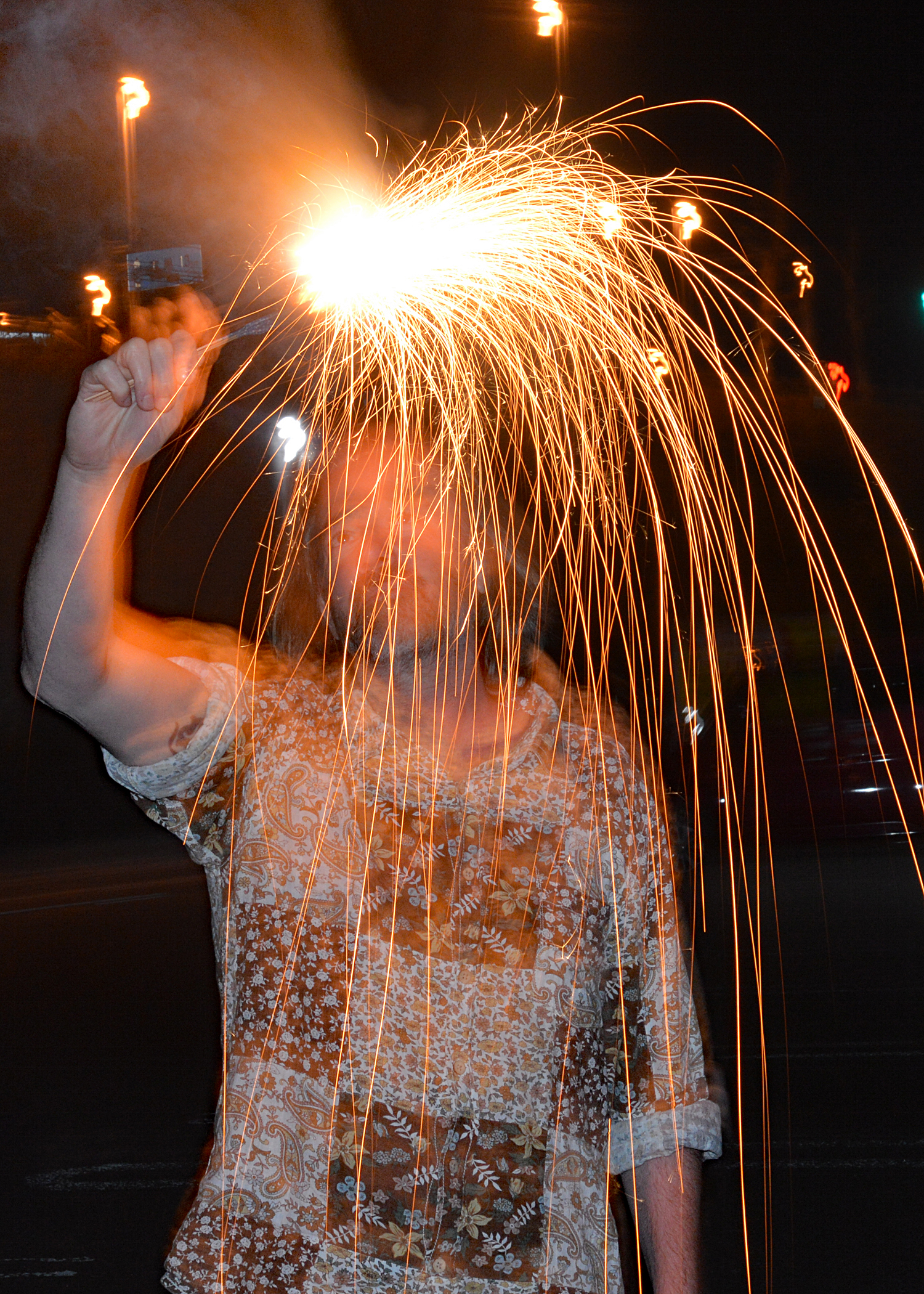
Jason Emde is a teacher, writer, undefeated amateur boxer, Prince enthusiast, and podcaster with an MFA in Creative Writing from the University of British Columbia. A finalist for the CBC Creative Nonfiction literary award, Jason is also the author of My Hand’s Tired & My Heart Aches (Kalamalka Press, 2005) and little bit die (Bolero Bird, 2023). Focused on roving, expatriation, pilgrimage, loss, and systematic derangement of the senses, his work has appeared in Ariel, The Malahat Review, Prometheus Dreaming, OxMag, Soliloquies Anthology, Ulalume Lighthouse, PopMatters, The Watershed Review, Brush Talks, The Closed Eye Open, Short Writings from Bulawayo III, and Who Lies Beautifully: The Kalamalka Anthology, as well as featuring in Orange Lamphouse’s Post-a-Poem project. Emde lives in Japan with his wife, Maho, and their typhoon sons, Joe and Sasha.
How did your first book or chapbook change your life? How does your most recent work compare to your previous? How does it feel different?
My first book changed my life by changing nothing at all. I fully expected it to vault me to the toppermost of the poppermost in no time flat and after it sold about twenty-seven copies I realized the world, literary and otherwise, wasn’t lining up to pat me on the back and reward me or even notice me at all. Which was a very useful lesson. As for my most recent work, I like to think it’s less indecently solipsistic than my previous stuff. It’s still often about me, but it’s also about where I am, about landscape and place. I’ve learned to notice not just the thing—me—but the things around the thing, too. At least a little bit, anyway.
How did you come to poetry first, as opposed to, say, fiction or non-fiction?
I came to plagiarism first. My first “book”—created in elementary school, grade three or thereabouts—was a truncated rewrite of The Tower Treasure by Franklin W. Dixon, the first Hardy Boys adventure. I stole the characters, the plot, some dialogue, copied a couple of the illustrations, and added a few little mysterious touches of my own. I got to poetry a little later, around 15 or so, scribbling graceless, awkward lines in little notebooks, and probably still plagiarizing—if slightly less obviously—the poets and lyricists I was into at the time. I read a lot of fiction when I was a kid—almost only fiction, actually—but I think I was drawn to poetry because it seemed both easier and sexier. I was wrong about that, of course. Or half-wrong, maybe.
How long does it take to start any particular writing project? Does your writing initially come quickly, or is it a slow process? Do first drafts appear looking close to their final shape, or does your work come out of copious notes?
It depends. If I’ve got a non-fiction piece in mind, I tend to let it brew and transude and filtrate for a while, and take it for walks, and make little notes, so that when I sit down to actually write it I’ve done a lot of work already and the basic structure tends to be more or less intact. After that it’s minor fixes and incremental improvements and linking up the connections. When I’m writing poetry I tend to be a little more spontaneous, or in any case try to be. That means a lot of my notebook scribbling turns out to be unusable crap, but occasionally I dash off something workable and there it is, almost ready to go. Susan Musgrave said, “Mystery, unknowing, is energy.” For me the quickest way to access that energy is to go in not really knowing what’s going to happen or where I’m going or anything. Being comfortable with unknowing and then not being afraid to tread all over the place.
Where does a poem or work of fiction usually begin for you? Are you an author of short pieces that end up combining into a larger project, or are you working on a "book" from the very beginning?
Robert Frost once wrote, “A poem begins with a lump in the throat; a homesickness or a lovesickness. It is a reaching out toward expression; an effort to find fulfillment.” That’s more or less how things begin with me. A throb, a wisp, a hint, a clue. And I’ve worked on projects in both directions: assembling little pieces that start, somehow, to click together until a bigger possibility, a bigger idea, begins to show itself, and also sitting down and writing the first sentence of what I know is a book. Depends on the project. Depends on the particular homesickness and lovesickness, too.
Are public readings part of or counter to your creative process? Are you the sort of writer who enjoys doing readings?
I used to do readings quite a bit in college, and always dug them in an egomaniacal way. I’ve always wanted to be a rock star, to be Prince or Michael Stipe or Ace Frehley or Lucinda Williams, or rather Prince and Michael Stipe and Ace Frehley and Lucinda Williams, and wear cool clothes and crazy make-up on stage in front of tons of rapturous fans and lots of women with exotic tastes. Doing readings was the closest I ever got. And the best compliment I ever got after a reading was overheard by a friend of mine: “You know that guy who looks like Michael Stipe? He read a poem about his penis!” Don’t think I’ve done a reading in Japan, or at least nothing public. The foreign community where I live is very small, and the slice of that community that’s interested in poetry or even reading at all is even smaller. Everything is Twinkle Panda video games you play on your phone. Nobody cares about my dopey little poems except for a few tender and very intelligent friends.
Do you have any theoretical concerns behind your writing? What kinds of questions are you trying to answer with your work? What do you even think the current questions are?
I think the current question is the same it’s always been: how to get through the day without doing too much damage to your dignity or damaging anybody else’s. That’s about it.
What do you see the current role of the writer being in larger culture? Do they even have one? What do you think the role of the writer should be?
It’s very weird to care deeply about scribbling in notebooks and blackening pages and reading all the time and buying too many books and hosting a podcast about writing and being interested in what your friends are reading and writing and sending actual letters and postcards to people and agreeing with Morrissey when he sings “There’s more to life than books, you know, but not much more” and then finding yourself talking to some guy in an airport bar and the guy says, “Why read books? I haven’t read a book since high school” and he’s proud of it. I’m all for whatever gets you through the night—and for me it’s books, it’s always been books—but for most people, and more and more, it seems to be other stuff. If people want to spend their time playing Shiny Bubblegum Princess games on their phone that’s up to them, but it doesn’t give me any pleasure. The writer’s role is clearly much diminished. But all that really means is that if you still feel compelled to write, knowing nobody gives a shit, it means you’re really a writer. It also means you’re free to write whatever the hell you want. Not having a role, or having a role so small it amounts to the same thing, means spirit is free to play where it will. And maybe that then becomes the role. The more people who are free, on whatever level, to do what they love, creatively, the more energy must be injected into the larger culture. In any case it’s very pretty to think so.
Do you find the process of working with an outside editor difficult or essential (or both)?
Essential. There’ll always be stuff I miss, either mistakes or connections. I’m always all parts grateful when somebody points them out to me. I’ll take all the help I can get my hands on.
What is the best piece of advice you've heard (not necessarily given to you directly)?
The best advice I ever heard is in Gary Snyder’s poem “Stories in the Night”:
I try to remember machinery can
always be fixed - but be ready to
give up the plans that were made
for the day - go back to the
manual - call up friends who know
more - make some tea - relax with
your tools and your problems, start
enjoying the day.
I don’t think of poems as machinery, but this is beautiful advice for life and writing.
How easy has it been for you to move between genres (poetry to fiction)? What do you see as the appeal?
Because I lack imagination, I’ve always mined my own life for material, which means I’ve written very little fiction. I took exactly one fiction class when I was doing my Master’s and got my lowest grade. It was a bit of a struggle, frankly. Recently I’ve started reading more and more fiction—Paul Lynch’s Grace got me started again, because it’s brilliant and beautiful—but I’m still not particularly interested in writing any. I lack the strength and skills for such adventures. As for moving between non-fiction and poetry, it’s never been difficult, which probably means I’m more interested in journalism than beauty. But we all have our crosses to bear.
What kind of writing routine do you tend to keep, or do you even have one? How does a typical day (for you) begin?
Apart from trying to write something—anything—every day, I don’t really have a routine. I keep trying to implement one but I never manage to stick to anything.
When your writing gets stalled, where do you turn or return for (for lack of a better word) inspiration?
Long walks. Nothing else works half as well.
What fragrance reminds you of home?
Somebody smoking outside when it’s really cold out always reminds me of Canada, because my best pal Stan and I started smoking in a serious way in the fall and winter of 1988, on long walks around town. As for my home now, there’s a certain type of incense that I burn a lot. I burn so much of it that when I took some paperbacks to the foreign book exchange corner in the Bier Hall here in Gifu and my pal Tom picked one of them up sometime later, he immediately knew it had been mine because of the smell. The whole book smelled like home. My home.
David W. McFadden once said that books come from books, but are there any other forms that influence your work, whether nature, music, science or visual art?
Definitely music. I’ve probably been more influenced by my favourite singer-songwriters than everything else combined. Bob Dylan, Leonard Cohen, Tom Waits, Michael Stipe, Joni Mitchell, and Morrissey all had, and have, a tremendous impact on my work.
I met David McFadden once, and asked him what question he always hoped somebody would ask him but no one ever did. He said, “Can I buy you a drink?”
What other writers or writings are important for your work, or simply your life outside of your work?
There are some writers who just make me feel better, who help me get through the night, who make me love being alive, who make me excited to go outside and look around and talk to people. Jack Kerouac, Don DeLillo, Joan Didion, David Foster Wallace, William Faulkner, Susan Musgrave, Paul Lynch, Gary Snyder, Sharon Olds, Lucia Berlin, John McPhee, Ottessa Moshfegh, Louis-Ferdinand Celine, Dazai Osamu, Allen Ginsberg, Martin Amis, Walt Whitman, Janet Malcolm. Loveliness.
What would you like to do that you haven't yet done?
Get rich from writing. Like, megastrophically rich.
If you could pick any other occupation to attempt, what would it be? Or, alternately, what do you think you would have ended up doing had you not been a writer?
I think I’d like to be a criminal mastermind with a sinister master plan.
What made you write, as opposed to doing something else?
I don’t really know; maybe it’s like what Adam Gopnick writes in The Real Work: “There was no primitive trauma in history that made mankind as it is any more than there is a primal trauma in childhood that made us as we are. We are this way because it’s the way it happened.” In other words it came to pass as most like it was. But I’d imagine that growing up in a house full of books, with two parents who were great readers, and having had one or two very encouraging teachers early on had something important to do with it. And it’s a great privilege to have a part, now, no matter how small, in the world of books. A very great privilege indeed.
What was the last great book you read? What was the last great film?
Last great novel: Ian McEwan’s Lessons. Last great book of poetry: Susan Musgrave’s Exculpatory Lilies. Last great piece of non-fiction: Gary Snyder’s The Practice of the Wild. Last great film: Barton Fink. I watched Barton Fink with my dad only yesterday, actually. It was great. He’d never seen it.
What are you currently working on?
It’s only in the percolating phase right now, but I want to write something—I don’t even know what, yet—about my neighbourhood here in Japan. The few blocks around my house, the little postage stamp of land where I live. Deep focus on a small area. Intense focus on where I am. Robert Frost again: “Locality gives art.” I’m only now learning what John Lent tried to teach me a long time ago: where you are is interesting. You don’t have to go to New York or Paris to find a place to write about, there are enough interesting blunders and fiascos and little bits of beauty and all kinds of fascinations all over the place and the trick is to believe in the dignity and worth of your own experience and be right in your body right in the middle of it all, noticing. It’s like I’m constantly telling my son, when his mind wanders to what might happen in thirty minutes or what the next thing is going to be, in the future where it’s bound to be better and more interesting than it is here, at this moment: be where you are. Be here now. It took me a long time to even begin to understand that that’s the real work, and I want to see what I can do with it in my notebook. One of my notebooks. I’ve got quite a few.


