Showing posts with label Lea Graham. Show all posts

Wednesday, August 14, 2019

Lea Graham, From the Hotel Vernon


Sentences for the Baker

In jail, they say, he learned tactics of a tiny man, slept in his own shit, foiled the sodomizers & years before demoted from baker to mopper among rumors of incest, illiteracy—the twelve-year old chicken-plucker of Water Street known to feed the Vernon mice, those tiny sailors, saltines & nips at noon. Once, on a Friday night, two spangled Holy Cross girls plunged their hands into that bearded nest, danced him beneath Joe Miron’s muraled sailors & seas, the Mariner’s albatross still in flight, circa 1940.

He said: some thing was sprouting in his neck.
He said: I don’t come down here for the beer, you know.
He said: It’s lonely all day alone up there.

American poet Lea Graham, originally from Arkansas but now living, teaching and writing in New York State, finally follows her debut collection Hough & Helix & Where & Here & You, You, You (No Tell Books, 2011) [see my review of such here] with From the Hotel Vernon (Co. Clare, Ireland: Salmon Poetry, 2019). As the back cover offers: “The poems in this book grow out and around the Hotel Vernon, built at the turn of the 20th century in Worcester, Massachusetts. Once an elegant place for local politicians to make their backdoor deals at the edge of the city, it slowly fell into decline each decade following Prohibition.” From the Hotel Vernon focuses on the central point of the real hotel and echoes of history, composing a collection of poems that gives a sense of being a series of sketches or small studies populated by tourists, poets, ghosts, an array of local characters, Keno and historical figures (for the sake of full disclosure, there is even a poem included here dedicated to me, and on/around her reading of my poetry collection paper hotel).

Graham the poet has approached the real Hotel Vernon as pilgrimage and personal study, occupying both real and imaginary spaces, somewhere between the articulation of voice of some of Ottawa poet Stephen Brockwell’s poems (in which he records the storytelling and speech of specific people to shape into poems) to the mythologies wrapped around Michael Redhill’s Lake Nora Arms (Toronto ON: Coach House Books, 1993) [see my note on such here]. Graham’s poems don’t miss much, and her studies invoke both mythology and study, whether writing out or invoking cab drivers, Roy Orbison, drunks at the bar, Bakery Joe, Frank O’Hara, Al Capp and multiple others, as she writes:

I’m writing this from the Hotel Vernon where Louis just slid me a note on a Keno card—Fats is Saved! reads the scribbled news flash across ovals & numbers. The boys sit out back between dumpster & 290, grilling dogs, singing “The Night the Lights Went Out in Georgia” & “Gentle on My Mind.” They call Roy Orbison, “that kid,” as in that kid can sure sing or that kid really had something. If the bedbugs weren’t so frequent & the hound-eyed man down the hall didn’t shit in the shower every Thursday, this could be home. Some nights, Al & I sit on the roof, watch the square blink on & off, memories in motion.

Once in Paris near the St. Michel station, I was homeless after missing the last train to Saint-Cloud & losing my shoes. The French the hotelier spoke—even poorer than mind—still managed to send me through the accordion gates & up a hall which couldn’t avoid The Shining in my mind: isolate parallelograms beckoning red with no red in sight. I was sleepless to a dubbed Law & Order SVU, three showers. Compelled to rise each hour on the hour, detecting a figure across the courtyard at a window. How did she know to push the curtain back a bit, to shift in that way? Why was she searching this Parisian dark? How did I wake precisely to see her each time? Six a.m. appeared. I saw myself, a mirrored window. Like Arbus twins, one-armed & lazy-eyed. That ambiguity of lips. Wherever you go, there you are. (“Notes from the Hotel Vernon”)

In an undated interview conducted by Caroline Bernier and posted at Poor Yorick when the collection was still in manuscript form, she spoke of her connection to Worcester, Massachusetts, and specifically to the Hotel Vernon:

PY: What is your connection to the city of Worcester, Massachusetts?

I moved to Worcester from Chicago in 2000, following a former spouse who had just gotten a job there. I lived there for seven years, teaching in various colleges and universities, most notably Clark University.

I didn’t really like Worcester for most of the time I lived there. I found it gritty and hard to break into socially. It wasn’t until the very end when I worked at the Hotel Vernon that I began to have a greater understanding of the city. This was largely due to a sense of community that existed there and also my learning its history through long-time residents. People would come in and tell me all kinds of stories about the city and its neighborhoods. Its name actually means “city of work”—and it is a place that so many people came to work and still do. From my own work experience bartending at the Hotel Vernon, I began to really see the city for the first time through the prism of pride that people who really knew it had.

I think that having such a changed perspective about Worcester because of the personal-historical connection taught me a lot about place and how any place can be a good place to be—depending on what and who you know and your openness to it and them. I stopped being snobby about places and was able to move beyond the cliché of “here is hip/sophisticated/interesting versus there is only poor/dirty/dull.”


Friday, July 20, 2018

new from above/ground press: Jarvis, Downe, Cardon + Graham, (as the 25th anniversary summer sale continues!

year of pulses
Jenna Jarvis
$4

See link here for more information

PROPOSITIONS
Lise Downe
$5

See link here for more information


What was the sign you gave (a selection)
by Allison Cardon
$5

See link here for more information

Spell to Spell
by Lea Graham
$5

See link here for more information


keep an eye on the above/ground press blog for author interviews, new writing, reviews, upcoming readings and tons of other material;

published in Ottawa by above/ground press
July 2018
a/g subscribers receive a complimentary copy of each


To order, send cheques (add $1 for postage; outside Canada, add $2) to: rob mclennan, 2423 Alta Vista Drive, Ottawa ON K1H 7M9 or paypal (above). Scroll down here to see various backlist titles (many, many things are still in print).

Review copies of any title (while supplies last) also available, upon request.

Forthcoming chapbooks by Beth Ayer, Lisa Rawn, Ian Dreiblatt, Jamie Townsend, Cole Swensen, Jason Christie, Melissa Eleftherion, Uxío Novoneyra (trans. Erín Moure), Travis Sharp, Stuart Kinmond / Phil Hall, Natalee Caple, Jon Boisvert, Stuart Ross, Dennis Cooley, Michael Martin Shea, Jennifer Stella, Miguel E. Ortiz Rodríguez + Julia Polyck-O'Neill.

And there’s totally still time to subscribe for 2018, by the way (backdating to January 1st, obviously).

AND THE ABOVE/GROUND PRESS 25TH ANNIVERSARY SUMMER SALE CONTINUES! (until August 15th,

AND DON'T FORGET THE ABOVE/GROUND PRESS 25TH ANNIVERSARY EVENT IN OTTAWA ON AUGUST 25TH AT VIMY BREWING COMPANY! READINGS AND LAUNCHES BY JASON CHRISTIE, JULIA POLYCK-O'NEILL, STUART ROSS, AARON TUCKER, NATALEE CAPLE + OTHERS!

Sunday, April 09, 2017

our american adventure; or: what we did on our (winter/spring) vacation

I think it's safe to say we've done a ridiculous amount of travel over the past couple of years, especially with one or two small children. Do you remember when we were in Washington DC? Boca Raton? Berlin? The Netherlands? Toronto? Glengarry? Sainte-Adele? And so on, and so on. Rose has even (also) been to Calgary and Winnipeg, if you can imagine. It's hard not to feel completely spoiled. Or quite mad, really.

Recently, we spent nearly a week driving around with the girls for the sake of a final bit of adventure prior to the end of Christine's maternity leave (which isn't even the final, given we're soon off to Toronto for the sake of Christine's April 13th BookThug launch). We did the same mad trip with baby on the East Coast near the end of her prior maternity leave, as well; a trip twice as long as this one, but a bit easier to manage, given we'd only one child's schedule to consider. Really, this trip was prompted by a New Year's Eve sale at the hotel in Burlington, Vermont we'd stayed in at the end of our prior maternity leave trip, when we told ourselves: "End of March. We'll have money by then, right?" Everything else was planned around a date we'd scheduled some three months prior.

This was a purely social trip, attempting to see a couple of friends on the American side: Lea Graham, Geoffrey Young and Marthe Reed (I'll get to them in a bit). There were thoughts about working some of Christine's genealogical on this trip, but we'd neither the time for her to properly research prior to leaving, nor the opportunity to get to where we really would have had to get to (further east/south: coastal, etcetera). We shall have to figure that out for another trip, later.

We were admittedly nervous about crossing the border, with incredibly mixed feelings about even wishing to be allowed through. Is theirs a country we currently wish to support? And yet, we can't abandon those people we know and like down there. We crossed, but the uncertainties continue, to be sure.

Tuesday, March 28, 2017: Given we were heading east, past Montreal, to cross for the sake of Burlington, Vermont, we thought it might be good to begin with a quick morning trip to see my father on the homestead, en route. We'd aimed to leave the house early enough, but, of course, managed to not even get to his house until nearly noon. Despite packing the day before, we still aren't functioning well enough to go from thought to function less than a few hours with the two girls, but we'll get there.

And why did I not take any pictures at the farm? God sakes. Well, my father seemed well enough. I think he appreciated our visit. We even saw the old hired man he had for years, when I was growing up (Jack McCourt, whose daughter went to school out there with Nicholas Lea).

From the farm, we headed back on the 417 and into, through and past Montreal without stopping. We hit the hotel at Burlington, Vermont by dusk, and unpacked ourselves into a sprawl into our room. For the sake of easing Rose into sleep-mode in our single room, I took wee Aoife out for a stroll near our hotel, and saw some rather lovely lights along the cobblestone street. We picked up postcards, saw plenty of bumper stickers for Bernie, and Aoife waved at all the passersby from her ring-sling.

Christine had borrowed a tent-like sleeping unit for the baby, which Rose quickly made her own. She was very happy there.

Wednesday, March 29, 2017: Ours was a hipster hotel, where the staff were all young, wore (local) flannel, and the men wore beards. Basically, every male working there looked like Ottawa poet Chris Johnson. Once breakfast in the restaurant, we walked the two blocks to the Echo Lake Aquarium and Science Center. Once my brilliantly clever wife noticed how much admission was, she clued in to the fact that Canadian family memberships can often be transferred, so she purchased a $90 Family Membership to various Ottawa museums and science centres, which allowed us to walk into Echo for free (we would have literally paid more than half to get in, as compared to a membership that now allows us into Ottawa's Museum of Nature, Science and Technology etc for free for a full damned year).

At the butterfly room, no one mentioned that they are HUGE and they will LAND ON YOU. I cared little for this. Once they came near, I was out of there. Rose and Christine were less wary.

The space was actually pretty cool. Rose was quite happy to stick close to the children's area for most of our visit, and ran around various corners alongside dozens of other parents (most of the women there were pregnant, I noticed) with boatloads of small children.

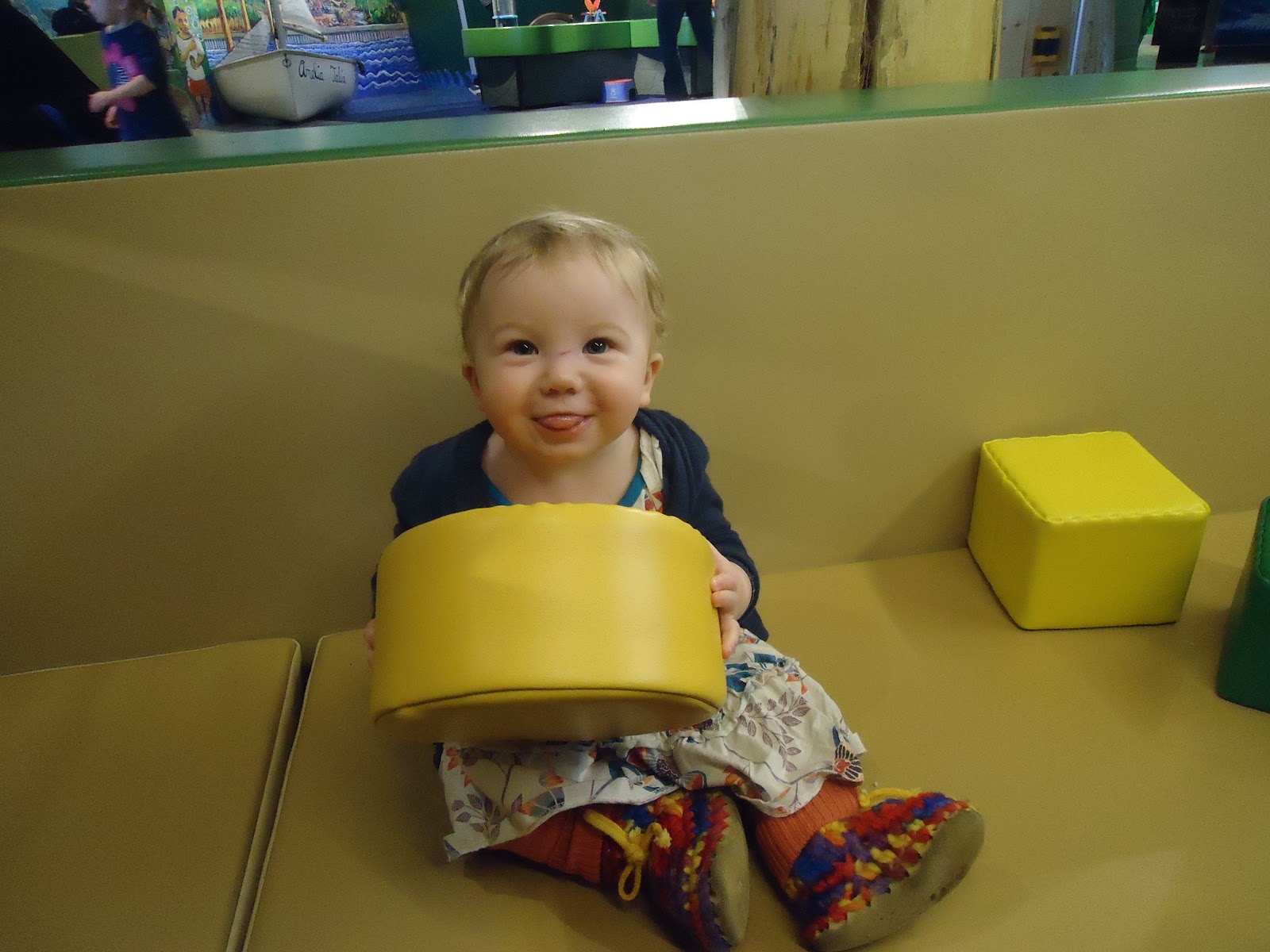
There was a weekly children's corner reading, which Rose listened to, but bailed before they could work on their craft. She went back to a pirate ship she designated a fairy ship. By that point, Aoife was awake, and she and I spent time in the small contained area for pre-walking children. Aoife absolutely loved it, and laughed and waved at everyone and pointed and played with soft toys for quite some time [she's inches close to walking fully on her own; note the small scratch on her nose from when she was scurrying along the bed in the hotel, and slipped by the nightstand, the night prior]. I was tempted to nap, but there were too many people around to really get away with such.

Post-museum, we made back up the hill for some lunch, and so Christine could visit that Vermont Flannel shop she loves. And then we returned to the hotel (Aoife and I made a wee side-trip for the sake of the Post Office), where we crashed. Hard. Or, at least, Christine and I did. The children were (still) a bit more energetic.

On the walk back from the post office, I saw a sign that made me realize that Ethan Allen's homestead was only a six-minute drive from our hotel, but closed for the season, which was a bit disappointing. I was curious, given the connection I'd recently discovered between him and my birth mother's family (our ancestor was defeated by Allen, which prompted the move north of the border during the American Revolution). I was curious: I'd read a bit on my ancestor, which suggested that Allen was a rather unpleasant individual, but I was amused to see that the website to his own homestead museum basically says the same thing. Geez, just how bad was this guy? Didn't help, I'm sure, that one of his main associates for a time was Benedict Arnold. Jerk.

After a wee rest (and cartoons), Christine had a far better suggestion: did you know that Ben & Jerry's original factory was nearby? AND DID YOU KNOW IT HAS TOURS?!?

We drove the twenty minutes, and I was enthralled. We took the tour! We took many photos! We had ice cream! We visited the gift shop!

I mailed at least three postcards from there, that said, only: "We are at Ben & Jerry's original factory in Vermont. Jealous?"

Thursday, March 30, 2017: After breakfast, we left the hotel and aimed ourselves the four-and-a-half hours straight south from there towards Kingston, New York, where our pal Lea Graham lives. I've known Lea for more than a decade now, having been introduced to her via Dennis Cooley, and I've been able to publish a number of her pieces, including a chapbook and even a collaborative chapbook we did some ten years or so ago, but I've barely seen her in years.

Heading south along the highway, the gps directed us straight west across Lake Champlain, where we ended up at a ferry terminal before landing, half an hour later, across the shimmering water. Given the gloomy grey of our first two days, it was nice that the sun was out for such a drive through unfamiliar territory, and the girls seemed amused at the sparkly lake water.

We drove and we drove and we drove, wandering numerous windy back-roads throughout New York State once we crossed, uncertain of where the hell the gps was taking us. We drove, with full awareness that we were dealing with two children with opposing schedules: one, for nursing, and the other, for occasional (and seemingly random) bathroom stops (usually without much notice).

At one of those stops, we discovered the highway pit stops that included areas to simply drive over and use one's cellphone ("text stops"), as well as small buildings with washrooms, dozens of tourist flyers, and a handful of coin machines for food and drink. While these were all well and good, it did make me wistful for the array of On Route stops along Highway 401 in Ontario. I mean, really.

I took photos of Rose at one, during one of those bathroom stops. It was nearly half a dozen photos before she wasn't fully sticking out her tongue (and then she would laugh). She's three, after all.


Once at Lea's (see my recent Touch the Donkey interview with her here), we were barely there five minutes before poet Claire Hero [below left, listening to Lea explain something or other] arrived for a pre-arranged "poet dinner" (poet and publisher Ryan Murphy, a poet I'd published and interviewed for Touch the Donkey, had also been invited, but his schedule wouldn't allow for such, unfortunately). It was grand! Conversation and babies and only a wee bit of chaos. Also, pre-arranged, I brought a box filled with chapbooks, books and other ephemera for Claire (and one for Ryan as well), and she was kind enough to trade for a copy of her first book.

The children were a bit wound up after the long drive, but slept better than I might have thought.

We stayed up late with drinks and conversation and drinks. And conversation. [And, once home, Lea announced that she's a poetry title forthcoming with Salmon Poetry, who is also releasing a second of mine come next spring; hooray!]

Friday, March 31, 2017: The following morning was a bit hazy, which included coffee, and the children playing quietly (or not quietly, depending). There was coffee. And Lea took Rose outside, briefly (in the rain pouring buckets) to assist with the refilling of the bird-feeder (which she enjoyed).

From there, we aimed for the ninety-minute drive east, to Great Barrington, MA, for the sake of visiting poet and former The Figures publisher Geoffrey Young (see my recent interview with him here; see the recent chapbook I produced of his here). I hadn't met Young yet, but we'd been in mail and email conversation (exchanging books/chapbooks, etc) for some fifteen years at least (thanks to Ken Norris, given our shared Artie Gold interest), so I'd been looking forward to that. Still, given the prior day's drive had been a bit hard on the young ladies, we thought we should only do Gt. Barrington as a day-trip, to help reduce the potential drive for the following morning to Syracuse, New York.

The gps took us up and around and everywhere. In the pouring rain, we passed the (closed for the season) boyhood home of W.E.B. du Bois. And, a sign that could drive fear into the heart of any wayward traveller: "pavement ends" (fortunately, this did not last long). Where the hell were we going?

We made it for lunch, and found Geoffrey to have a fantastic energy, especially for someone over seventy years old. We talked non-stop (including Rose) and went through his huge house absolutely filled with the most stellar array of artworks from dozens of visual artists. There was so much to take in! And, for the sake of our ongoing exchange of above/ground press titles for The Figures backlist, he filled a box of some FIFTY TITLES for me. Absolutely incredible. I now have more Clark Coolidge titles, for example, than I ever imagined possible.

After a couple of hours there, we were back in the car towards Kingston, and Lea's house, where the evening was far quieter than our night prior.

Saturday, April 1, 2017: We slowly figured ourselves out with coffee, breakfast-for-the-kids and more coffee, and the flurry of packing without leaving anything before heading west again for Syracuse, New York, and the poet/publisher Marthe Reed. More than a couple of times we had to stop again for the sake of the children, including one of those "text stops" so Rose could use up some energy, and Aoife could nurse.

I'd originally met Marthe through the reading Stephen Brockwell and I had attempted in Louisiana, when she was kind enough to host us in Lafayette at the University. Since then, they'd moved here, where she and her partner both teach, which has allowed them to even come to Ottawa twice for the sake of a visit (including the launch of her above/ground press chapbook, After Swann, and her appearance at the ottawa small press book fair).

After the flurry of travel and adventuring, we appreciated the quieter evening, although Rose was rather wound up, and took some time to calm down. Both girls appreciated very much that Marthe pulled out some bins of toys leftover from their two children (both grown), set for some time into dusty storage. Once opened, the toys were well-utilized.

And: Aoife even teased with some small stretches of solo-walking (only her second day of such, over the week prior).

Sunday, April 2, 2017: Before heading north towards the border, we took a stroll into the graveyard across the street from their house, in part for the sake of their two dogs, and for the sake of our Rose, who happily ran around through and into the puddles. We kept having to explain that she couldn't take any of the flowers, of course.

They were such kind hosts! Such kind hosts. But oh, how we longed to be in our wee house.

The girls and I hit a Barnes and Noble before leaving town, as Christine managed a store a few doors over for a couple of items she can't get on this side of the border. I was happy to collect a recent issue of Jubilat, and Fanny Howe's The Needle's Eye (Graywolf, 2016), Claudia Rankine's The End of the Alphabet (Grove Press, 1998) and Bernadette Mayer's Works & Days (New Directions, 2016). I've long been a fan of Howe and Rankine, but really haven't read nearly enough Mayer. I'm hoping to get into these books soon.

In the bookstore, I was amused that George Saunders has his own table under the "local authors" banner (I hadn't realized he lived nearby, but everyone has to live somewhere, right?). I wanted to say something smarmy about that, given he's been on multiple major media outlets for his new book, but everything I'm hearing speaks to the attention being well-deserved. And it is good for bookstores, especially big chain ones, to be acknowledging local. And I hear that he's, on top of everything else, super-nice.

Ah, well.

A couple of hours later, we made it across the border, and I had to keep reminding myself which set of numbers on the speedometer to pay attention to. In Kingston, Christine hit an outlet mall on their FINAL DAY, and the girls and I set down for lunch at some burger place. What was it called? Harper's Burger Bar. Right. Rose coloured, and Aoife made noises at people sitting nearby. Christine met us, and then she and Rose wandered back to the outlet mall. Aoife and I found a used bookstore, and a copy of Ken Belford's The Post Electric Cave Man (Talonbooks, 1970). Shouldn't that guy have a big selected poems at some point?

Of course, we thought we'd been a bit longer in Kingston than we'd intended. Turning the gps back on in the car, it couldn't see us in the parking lot, and wasn't able to understand where we were until I pulled the car onto the street, which, of course, was in the direction opposite than where we were heading. The gps found us, and turned us right onto The Tragically Hip Way, a block-long stretch named after the infamous band.

Ah, I said, that's okay, then.

What do you mean? asked Christine.

Well, it means we're ahead by a century.


Saturday, January 07, 2017

Touch the Donkey supplement: new interviews with Downs, Babineau, Murphy, Cole, Graham, eckhoff + Avasilichioaei

Anticipating the release next week of the twelfth issue of Touch the Donkey (a small poetry journal), why not check out the interviews that have appeared over the past few weeks with contributors to the eleventh issue: Buck Downs, Kemeny Babineau, Ryan Murphy, Norma Cole, Lea Graham, kevin mcpherson eckhoff and Oana Avasilichioaei.

Interviews with contributors to the first ten issues, as well, remain online, including: Meredith Quartermain, Amanda Earl, Luke Kennard, Shane Rhodes, Renée Sarojini Saklikar, Sarah Cook, François Turcot, Gregory Betts, Eric Schmaltz, Paul Zits, Laura Sims, Stephen Collis, Mary Kasimor, Billy Mavreas, damian lopes, Pete Smith, Sonnet L’Abbé, Katie L. Price, a rawlings, Suzanne Zelazo, Helen Hajnoczky, Kathryn MacLeod, Shannon Maguire, Sarah Mangold, Amish Trivedi, Lola Lemire Tostevin, Aaron Tucker, Kayla Czaga, Jason Christie, Jennifer Kronovet, Jordan Abel, Deborah Poe, Edward Smallfield, ryan fitzpatrick, Elizabeth Robinson, nathan dueck, Paige Taggart, Christine McNair, Stan Rogal, Jessica Smith, Nikki Sheppy, Kirsten Kaschock, Lise Downe, Lisa Jarnot, Chris Turnbull, Gary Barwin, Susan Briante, derek beaulieu, Megan Kaminski, Roland Prevost, Emily Ursuliak, j/j hastain, Catherine Wagner, Susanne Dyckman, Susan Holbrook, Julie Carr, David Peter Clark, Pearl Pirie, Eric Baus, Pattie McCarthy, Camille Martin and Gil McElroy.

The forthcoming twelfth issue features new writing by: Gil McElroy, Colin Smith, Nathaniel G. Moore, David Buuck, Kate Greenstreet, Kate Hargreaves, Shazia Hafiz Ramji, Erín Moure and Sarah Swan.

And of course, copies of the first eleven issues are still very much available. Why not subscribe?

We even have our own Facebook group. It’s remarkably easy.


Thursday, May 12, 2016

Lea Graham, This End of the World: Notes to Robert Kroetsch


On Crows

Last Thursday, the light at the ridge above that bend in the Hudson spread like Dreamsicles in July. Crows valentined dumpsters. Earth called cadence below. Lamps floated stem-less, sturgeon moons in a month of wolf whistles & Route 9’s chemical taste. Was it Williams who said “the hardest thing to do is see”? (Or was that just my gynecologist?) As a kid, my mother caged a crow believing one day it would sing “Hello, Dolly.” She faithfully fed it pork chops under a sycamore tree. Instead, it ate her spelling bee ring. She often said: Crows love the shiny things. Beware.

There aren’t that many poets from Arkansas composing poems influenced by Canadian prairie poet Robert Kroetsch, with the notable exception of Lea Graham (who, herself,was recently shortlisted for the 2016 Robert Kroetsch Award for Innovative Poetry), through her new chapbook This End of the World: Notes to Robert Kroetsch (Ottawa ON: Apt 9 Press, 2016). The author of the poetry collection Hough & Helix & Where & Here & You, You, You (No Tell Books, 2011) [see my review of such here] and the collaborative chapbook Metric (above/ground press, 2011) and Calendar Girls (above/ground press, 2006), Graham writes in her acknowledgements that “These poems were written in dialogue with many of Robert Kroetsch’s texts,” including Excerpts from the Real World (Oolichan Books, 1986), The Completed Field Notes (The University of Alberta Press, 2000), The Crow Journals (NeWest Press, 1980), The Hornbooks of Rita K (The University of Alberta Press, 2001), The Lovely Treachery of Words (Oxford University Press, 1989), The Sad Phoenician (Coach House Press, 1979), Too Bad (The University of Alberta Press, 2006) and What the Crow Said (General Publishing Company, 1978), as well as Andrew Suknaski’s The Ghosts Call You Poor (Macmillan of Canada, 1978) and Ken Jennings’ Maphead: The Wide, Weird World of Geography Wonks (Scribner Books, 2011). In an interview forthcoming at Touch the Donkey, she discusses some of her connections to prairie poetry (and poets) in Canada:

I think that being from Arkansas, I have both a good sense of humour about place, but also a sense of the underdog in me. I think that maybe that’s a sense of the west, what you are up against, a sense of the isolated or rural. I grew up partially on my grandparents working farm in Greenland, Arkansas where I had an acute feeling of how isolated I was from the rest of the world (meaning: the world of books). But also, I had these young uncles and an aunt who worked in my grandfather’s dairy barn and chicken houses—and who were always playing jokes on me and my brothers and on each other. They used to leave messages to each other written in soap on the bathroom mirrors. There was a toolbox of arrowheads, fish hooks, grinding stones and Civil War cannon balls under the sink in the bathroom. I have written of that image over and over again. The sense of the humorous and fleeting, but of the tactile and enduring, too. When I read cooley and Kroetsch, it felt like I was reading at least a part of my own family, but in the most intellectual and tricky ways. And to be geographically connective about it, my maternal grandmother was from the Dakotas and later Montana. Her mother was from Norway and had been a homesteader.  She—Dagmar Zacharias—is the only one of my great-grandparents who was from the old country—everyone else was “American.” In any case, my maternal grandmother met my grandfather when he was an itinerant worker from Northwest Arkansas during the Depression and had worked his way up to Billings, Montana where he worked part of the week in a bakery and another part in a dairy. The bakery was in a basement, but had a window onto the street where you could only see people’s legs. He picked out her legs of all the young nurses on their way to school. This family story (or maybe the way I tell it), doesn’t seem far from the Canadian narratives I’ve read.

Robert Kroetsch infamously called literature a conversation, and the epistolary poems in Graham’s This End of the World: Notes to Robert Kroetsch do read as missives directed to the late Alberta poet, composed directly from where she is to wherever it is that he is, or was, and her ten poem collection opens with a quote from Kroetsch’s Excerpts from the Real World: “Perhaps if I call you forever you’ll hear me toward the end.” Kroetsch famously wrote poems that spoke of repeatedly returning to the beginning; through composing “the end,” is Graham attempting to circumvent Kroetsch’s continuous delay, or is she simply responding in kind, composing the yang to his ying? Is she, through her title, admitting that she can actually hear him, and could the entire time? In the poem “After Irene,” written after a hurricane, she writes: “You’ve written that our job is to uninvent the world. To unconceal. To make visible again.” Later on in the same piece, ending:

You’ve said it yourself: we can never leave home, never escape the skiffle bands & buttermilk, the avocado seed suspended on windowsills. You with your buffalo wallow & tipi ring. So long Binghamtop dreams! Me with my Civil War cannonballs, knucklebones under the sink. Our storm’s core cages us like a story. Like a thousand sea birds, bewildered, becalmed, trapped in eye’s past.

Her poems are prose-thick with information and references, collaged narratives composed in furious, passionate bursts, each in their own way searching for ways in which to make sense of the chaos, all of which is directed beyond the immediate chaos and back into “Bob” (all of which makes me hope she comes to Ottawa next spring for the rumoured Robert Kroetsch conference, so she can speak to him further). “You sing on the other side of the Wailing Wall,” she writes, to end her poem “Excerpts from This End of the World”: “words I wish I could take back / from the Coro desert or the post-industrial town / I am doomed to & that promise / of milk, honey.” Her poems evoke much of Kroetsch’s work for their shared questioning, their passions, from friends, food, travel and lovers, and the occasional drunken revelry and crude passing remark. Throughout these poems there is a searching, a seeking, as she looks to the work of Robert Kroetsch for advice, and direction, almost as though the lyrics of Lea Graham are repeatedly asking Robert Kroetsch: Why does the heart want what it wants? As she opens the poem “On the Mystery of the Vanishing Phoenician from 110 Mill Street”: “Bob, / I am writing this from the old millstream where your Sad Phoenician vanishes. I bring it with me to sit on the ledge when I need the rush, an eyeful of swoosh. Just when I’m fixed on a bright flip-flop or stroller wheel, I realize it’s skedaddled.” Later on in the same piece, writing:

Last month it disappeared to a dance in Smuts. All the way to Wood Mountain, can you believe it? That bit from cooley, who said it had been seen with Suknaski’s ghosts. They snuck into an old Métis church with their beer breath & dialect, telling stories of Duck Lake, sex in mangers. It drug in a few days later, stone-roasted, announcing its retirement to Assiniboia. Boy oh boy, Bob, did you raise it to act like this? Even crazy mclennan swears it Skypes him late every fourth Tuesday, repeating pornographers & poets enjoy large views nine times before clicking end. He & his lady shake & drink & claim they’ll start banning its mention from the Mercury Lounge. It late-nights, inventing toponomies for Medicine Hat. Can’t shut up about the onomastics of ex-lovers (the woman from Nanaimo, et al). How do I exist with a book that goes on like this?