I think it's safe to say we've done a ridiculous amount of travel over the past couple of years, especially with one or two small children. Do you remember when we were in
Washington DC?
Boca Raton?
Berlin?
The Netherlands?
Toronto?
Glengarry?
Sainte-Adele? And so on, and so on. Rose has even (also) been to Calgary and Winnipeg, if you can imagine. It's hard not to feel completely spoiled. Or quite mad, really.
Recently, we spent nearly a week driving around with the girls for the sake of a final bit of adventure prior to the end of Christine's maternity leave (which isn't even the final,
given we're soon off to Toronto for the sake of Christine's April 13th BookThug launch).
We did the same mad trip with baby on the East Coast near the end of her prior maternity leave, as well; a trip twice as long as this one, but a bit easier to manage, given we'd only one child's schedule to consider. Really, this trip was prompted by
a New Year's Eve sale at the hotel in Burlington, Vermont we'd stayed in at the end of our prior maternity leave trip, when we told ourselves: "End of March. We'll have money by then, right?" Everything else was planned around a date we'd scheduled some three months prior.
This was a purely social trip, attempting to see a couple of friends on the American side:
Lea Graham,
Geoffrey Young and
Marthe Reed (I'll get to them in a bit). There were thoughts about working some of Christine's genealogical on this trip, but we'd neither the time for her to properly research prior to leaving, nor the opportunity to get to where we really would have had to get to (further east/south: coastal, etcetera). We shall have to figure that out for another trip, later.
We were admittedly nervous about crossing the border, with incredibly mixed feelings about even wishing to be allowed through. Is theirs a country we currently wish to support? And yet, we can't abandon those people we know and like down there. We crossed, but the uncertainties continue, to be sure.
Tuesday, March 28, 2017: Given we were heading east, past Montreal, to cross for the sake of Burlington, Vermont, we thought it might be good to begin with a quick morning trip to see my father on the homestead, en route. We'd aimed to leave the house early enough, but, of course, managed to not even get to his house until nearly noon. Despite packing the day before, we still aren't functioning well enough to go from thought to function less than a few hours with the two girls, but we'll get there.
And why did I not take any pictures at the farm? God sakes. Well, my father seemed well enough. I think he appreciated our visit. We even saw the old hired man he had for years, when I was growing up (Jack McCourt, whose daughter went to school out there with
Nicholas Lea).
From the farm, we headed back on the 417 and into, through and past Montreal without stopping. We hit the hotel at Burlington, Vermont by dusk, and unpacked ourselves into a sprawl into our room. For the sake of easing Rose into sleep-mode in our single room, I took wee Aoife out for a stroll near our hotel, and saw some rather lovely lights along the cobblestone street. We picked up postcards, saw plenty of bumper stickers for Bernie, and Aoife waved at all the passersby from her ring-sling.
Christine had borrowed a tent-like sleeping unit for the baby, which Rose quickly made her own. She was very happy there.
Wednesday, March 29, 2017: Ours was a hipster hotel, where the staff were all young, wore (local) flannel, and the men wore beards. Basically, every male working there looked like
Ottawa poet Chris Johnson. Once breakfast in the restaurant, we walked the two blocks to the
Echo Lake Aquarium and Science Center. Once my brilliantly clever wife noticed how much admission was, she clued in to the fact that Canadian family memberships can often be transferred, so she purchased a $90 Family Membership to various Ottawa museums and science centres, which allowed us to walk into Echo for free (we would have literally paid more than half to get in, as compared to a membership that now allows us into Ottawa's Museum of Nature, Science and Technology etc for free for a full damned year).
At the butterfly room, no one mentioned that they are HUGE and they will LAND ON YOU. I cared little for this. Once they came near, I was out of there. Rose and Christine were less wary.
The space was actually pretty cool. Rose was quite happy to stick close to the children's area for most of our visit, and ran around various corners alongside dozens of other parents (most of the women there were pregnant, I noticed) with boatloads of small children.
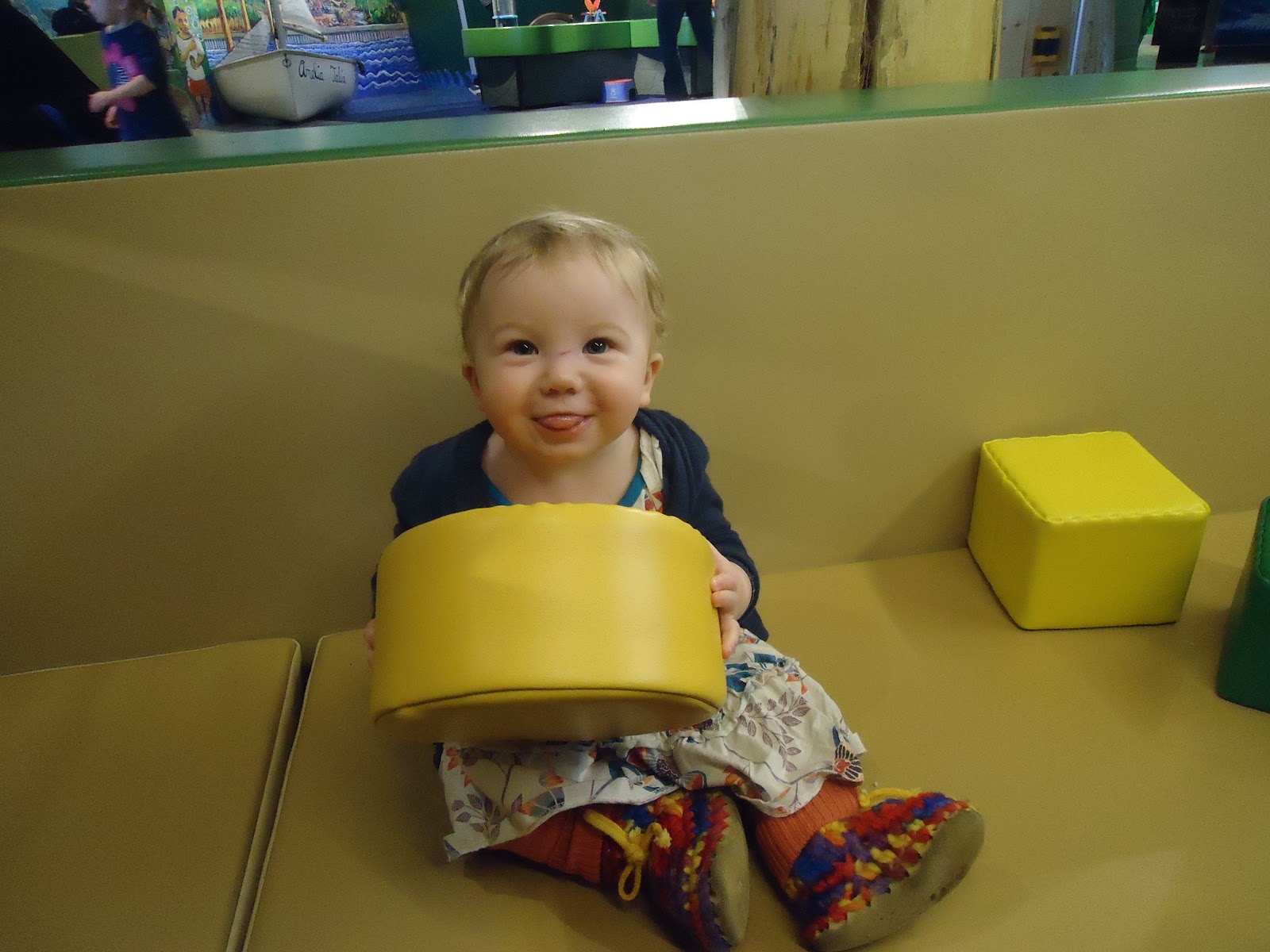
There was a weekly children's corner reading, which Rose listened to, but bailed before they could work on their craft. She went back to a pirate ship she designated a fairy ship. By that point, Aoife was awake, and she and I spent time in the small contained area for pre-walking children. Aoife absolutely loved it, and laughed and waved at everyone and pointed and played with soft toys for quite some time [she's inches close to walking fully on her own; note the small scratch on her nose from when she was scurrying along the bed in the hotel, and slipped by the nightstand, the night prior]. I was tempted to nap, but there were too many people around to really get away with such.
Post-museum, we made back up the hill for some lunch, and so Christine could visit
that Vermont Flannel shop she loves. And then we returned to the hotel (Aoife and I made a wee side-trip for the sake of the Post Office), where we crashed. Hard. Or, at least, Christine and I did. The children were (still) a bit more energetic.
On the walk back from the post office, I saw a sign that made me realize that Ethan Allen's homestead was only a six-minute drive from our hotel, but closed for the season, which was a bit disappointing. I was curious, given the connection I'd recently discovered between him and my birth mother's family (our ancestor was defeated by Allen, which prompted the move north of the border during the American Revolution). I was curious: I'd read a bit on my ancestor, which suggested that Allen was a rather unpleasant individual, but I was amused to see that
the website to his own homestead museum basically says the same thing. Geez, just how bad was this guy? Didn't help, I'm sure, that one of his main associates for a time was Benedict Arnold. Jerk.
After a wee rest (and cartoons), Christine had a far better suggestion:
did you know that Ben & Jerry's original factory was nearby? AND DID YOU KNOW IT HAS TOURS?!?
We drove the twenty minutes, and I was enthralled. We took the tour! We took many photos! We had ice cream! We visited the gift shop!
I mailed at least three postcards from there, that said, only: "We are at Ben & Jerry's original factory in Vermont. Jealous?"
Thursday, March 30, 2017: After breakfast, we left the hotel and aimed ourselves the four-and-a-half hours straight south from there towards Kingston, New York, where our pal Lea Graham lives. I've known Lea for more than a decade now, having been introduced to her via Dennis Cooley, and I've been able to publish a number of her pieces,
including a chapbook and even a collaborative chapbook we did some ten years or so ago, but I've barely seen her in years.
Heading south along the highway, the gps directed us straight west across Lake Champlain, where we ended up at a ferry terminal before landing, half an hour later, across the shimmering water. Given the gloomy grey of our first two days, it was nice that the sun was out for such a drive through unfamiliar territory, and the girls seemed amused at the sparkly lake water.
We drove and we drove and we drove, wandering numerous windy back-roads throughout New York State once we crossed, uncertain of where the hell the gps was taking us. We drove, with full awareness that we were dealing with two children with opposing schedules: one, for nursing, and the other, for occasional (and seemingly random) bathroom stops (usually without much notice).
At one of those stops, we discovered the highway pit stops that included areas to simply drive over and use one's cellphone ("text stops"), as well as small buildings with washrooms, dozens of tourist flyers, and a handful of coin machines for food and drink. While these were all well and good, it did make me wistful for the array of On Route stops along Highway 401 in Ontario. I mean, really.
I took photos of Rose at one, during one of those bathroom stops. It was nearly half a dozen photos before she wasn't fully sticking out her tongue (and then she would laugh). She's three, after all.

Once at Lea's (
see my recent Touch the Donkey interview with her here), we were barely there five minutes before poet
Claire Hero [below left, listening to Lea explain something or other] arrived for a pre-arranged "poet dinner" (poet and publisher
Ryan Murphy,
a poet I'd published and interviewed for Touch the Donkey, had also been invited, but his schedule wouldn't allow for such, unfortunately). It was grand! Conversation and babies and only a wee bit of chaos. Also, pre-arranged, I brought a box filled with chapbooks, books and other ephemera for Claire (and one for Ryan as well), and she was kind enough to trade for a copy of her first book.
The children were a bit wound up after the long drive, but slept better than I might have thought.
We stayed up late with drinks and conversation and drinks. And conversation. [And, once home, Lea announced that she's a poetry title forthcoming with
Salmon Poetry, who is also releasing a second of mine come next spring; hooray!]
Friday, March 31, 2017: The following morning was a bit hazy, which included coffee, and the children playing quietly (or not quietly, depending). There was coffee. And Lea took Rose outside, briefly (in the rain pouring buckets) to assist with the refilling of the bird-feeder (which she enjoyed).
From there, we aimed for the ninety-minute drive east, to Great Barrington, MA, for the sake of visiting poet and former The Figures publisher Geoffrey Young (
see my recent interview with him here;
see the recent chapbook I produced of his here). I hadn't met Young yet, but we'd been in mail and email conversation (exchanging books/chapbooks, etc) for some fifteen years at least (thanks to Ken Norris, given our shared Artie Gold interest), so I'd been looking forward to that. Still, given the prior day's drive had been a bit hard on the young ladies, we thought we should only do Gt. Barrington as a day-trip, to help reduce the potential drive for the following morning to Syracuse, New York.
The gps took us up and around and everywhere. In the pouring rain, we passed the (closed for the season)
boyhood home of W.E.B. du Bois. And, a sign that could drive fear into the heart of any wayward traveller: "pavement ends" (fortunately, this did not last long). Where the hell were we going?
We made it for lunch, and found Geoffrey to have a fantastic energy, especially for someone over seventy years old. We talked non-stop (including Rose) and went through his huge house absolutely filled with the most stellar array of artworks from dozens of visual artists. There was so much to take in! And, for the sake of our ongoing exchange of above/ground press titles for The Figures backlist, he filled a box of some FIFTY TITLES for me. Absolutely incredible. I now have more
Clark Coolidge titles, for example, than I ever imagined possible.
After a couple of hours there, we were back in the car towards Kingston, and Lea's house, where the evening was far quieter than our night prior.
Saturday, April 1, 2017: We slowly figured ourselves out with coffee, breakfast-for-the-kids and more coffee, and the flurry of packing without leaving anything before heading west again for Syracuse, New York, and the poet/publisher
Marthe Reed. More than a couple of times we had to stop again for the sake of the children, including one of those "text stops" so Rose could use up some energy, and Aoife could nurse.
I'd originally met Marthe through the reading Stephen Brockwell and I had attempted in Louisiana, when she was kind enough to host us in Lafayette at the University. Since then, they'd moved here, where she and her partner both teach, which has allowed them to even come to Ottawa twice for the sake of a visit (including the launch of her above/ground press chapbook,
After Swann, and her
appearance at the ottawa small press book fair).
After the flurry of travel and adventuring, we appreciated the quieter evening, although Rose was rather wound up, and took some time to calm down. Both girls appreciated very much that Marthe pulled out some bins of toys leftover from their two children (both grown), set for some time into dusty storage. Once opened, the toys were well-utilized.
And: Aoife even teased with some small stretches of solo-walking (only her second day of such, over the week prior).
Sunday, April 2, 2017: Before heading north towards the border, we took a stroll into the graveyard across the street from their house, in part for the sake of their two dogs, and for the sake of our Rose, who happily ran around through and into the puddles. We kept having to explain that she couldn't take any of the flowers, of course.
They were such kind hosts! Such kind hosts. But oh, how we longed to be in our wee house.
The girls and I hit a Barnes and Noble before leaving town, as Christine managed a store a few doors over for a couple of items she can't get on this side of the border. I was happy to collect a recent issue of
Jubilat, and
Fanny Howe's The Needle's Eye (Graywolf, 2016),
Claudia Rankine's The End of the Alphabet (Grove Press, 1998) and
Bernadette Mayer's Works & Days (New Directions, 2016). I've long been a fan of Howe and Rankine, but really haven't read nearly enough Mayer. I'm hoping to get into these books soon.
In the bookstore, I was amused that
George Saunders has his own table under the "local authors" banner (I hadn't realized he lived nearby, but everyone has to live somewhere, right?). I wanted to say something smarmy about that, given he's been on multiple major media outlets for his new book, but everything I'm hearing speaks to the attention being well-deserved. And it is good for bookstores, especially big chain ones, to be acknowledging local. And I hear that he's, on top of everything else, super-nice.
Ah, well.
A couple of hours later, we made it across the border, and I had to keep reminding myself which set of numbers on the speedometer to pay attention to. In Kingston, Christine hit an outlet mall on their FINAL DAY, and the girls and I set down for lunch at some burger place. What was it called?
Harper's Burger Bar. Right. Rose coloured, and Aoife made noises at people sitting nearby. Christine met us, and then she and Rose wandered back to the outlet mall. Aoife and I found a used bookstore, and a copy of
Ken Belford's The Post Electric Cave Man (Talonbooks, 1970). Shouldn't that guy have a big selected poems at some point?
Of course, we thought we'd been a bit longer in Kingston than we'd intended. Turning the gps back on in the car, it couldn't see us in the parking lot, and wasn't able to understand where we were until I pulled the car onto the street, which, of course, was in the direction opposite than where we were heading. The gps found us, and turned us right onto
The Tragically Hip Way, a block-long stretch named after the infamous band.
Ah, I said, that's okay, then.
What do you mean? asked Christine.
Well, it means we're
ahead by a century.