Showing posts with label Invisible Publishing. Show all posts

Monday, December 29, 2025

12 or 20 (second series) questions with Nadia Ragbar

Nadia Ragbar lives in Toronto with her partner and son. Her short fiction has appeared in Broken Pencil and This Magazine, among other outlets. Her flash fiction appeared in The Unpublished City, an anthology curated by Dionne Brand, which was shortlisted for the 2018 Toronto Book Award. The Pugilist and the Sailor is her first novel.

1 - How did your first book change your life? How does your most recent work compare to your previous? How does it feel different?

I think a lot of writers would agree that having a debut book out lends more legitimacy to your small talk. I can answer the question, “So, what do you do?” with a little less sheepish hemming-and-hawing now!

Before writing The Pugilist and the Sailor, I wrote flash fiction and short stories. The through line, thematically, is that my characters all tend to be in limbo and are daydreaming their way to some concrete action or decision. The novel feels different because it’s told across different time periods and through an ensemble cast, so I was able to expand the breadth and depth of many characters, which I have learned is my favourite approach at the moment.

2 - How did you come to fiction first, as opposed to, say, poetry or non-fiction?

I started out by writing poetry as a teenager but let it go in favour of fiction as a young adult. Fiction gave me that room for character development, which is what drives my writing. Flash fiction became a natural place to move to after poetry, but having written a novel now I definitely want to write another.

3 - How long does it take to start any particular writing project? Does your writing initially come quickly, or is it a slow process? Do first drafts appear looking close to their final shape, or does your work come out of copious notes?

I am a slow writer. The first thing I do is buy a spiral bound notebook from the dollar store. It is very important that this is not a beautiful, hardcover journal. I spend a lot of time before writing letting a vibe percolate in my mind, and there are a lot of notes at this point. Characters come to me quickly, along with the emotional frequency I’m trying to capture, but plot (and what’s at stake) takes me much longer to figure out. Once I build up enough of the world, the writing does start to come faster. I edit a lot as I go; I do so much fiddling at the line level every time I open my Word doc as a way to figure out the world, which is, actually, why I’m so slow to make progress. I continuously rake over passages, but then many draft scenes will appear in tact by the final version. In my novel, what changed most drastically in the final version was its structure.

4 - Where does a work of prose usually begin for you? Are you an author of short pieces that end up combining into a larger project, or are you working on a "book" from the very beginning?

This novel was my thesis project, so I knew from the outset I was writing a “book” but coming from flash fiction I approached writing it as though I was writing a series of flash, and the early structure felt like I had a bunch of building blocks to move around. Later I had to work on building in the connective tissue and re-organizing all of my blocks to make the telling of the story more coherent and less disjointed.

5 - Are public readings part of or counter to your creative process? Are you the sort of writer who enjoys doing readings?

I enjoy doing readings because I like preparing for them. Something about having to present my work forces to me to get my thoughts together about that particular passage as it relates to the whole project.

When I’m editing I do a pass where I read the whole thing out loud (well, generally, loud whispering to myself if everyone else is home). That is very helpful because I have a tendency to write long, meandering sentences, with endless qualifiers, so my ears and breath help where using just my eyes can’t.

6 - Do you have any theoretical concerns behind your writing? What kinds of questions are you trying to answer with your work? What do you even think the current questions are?

I think my writing is emotional, and what drives a piece is usually trying to get at the core of why some elusive feeling feels the way it does. Currently, I’m starting a new project that is examining unconscious patterns of behaviours and experiences that repeat unconsciously down a family line, and so I’m interested in a kind of emotional-psychological-psychic genetic inheritance. 

7 – What do you see the current role of the writer being in larger culture? Do they even have one? What do you think the role of the writer should be?

I think what writers do is offer a place to access and exercise empathy and introspection. I think that writers offer complexity and diversity to our thinking and understanding. And that writing offers a way to stretch our attention spans again. I think the writer can access authenticity in a way that is passed on to readers, so the truth of a feeling, experience, expression or intellectual curiosity is up for consideration and analysis. Whether writing is a mirror or a window, the writer can be one (of many) saying ‘look here,’  ‘and here,’ and ‘over here.’

8 - Do you find the process of working with an outside editor difficult or essential (or both)?

I really love working with an editor. Writing is a necessarily collaborative pursuit, regardless of all the time you spend alone doing it. It’s so essential for a piece to have those second, third, forth pair of careful eyes on it. An editor asks important questions about the work and your intentions, which is the only way a story can become the best version of itself.

9 - What is the best piece of advice you've heard (not necessarily given to you directly)?

One of the best pieces of advice I’ve used (directly) is to ground writing through the body by using sensory descriptions. Slowing a scene down to some of the granular details of what the character is feeling in their body at that moment becomes the point of entry for your reader to step into the character’s shoes and relate to the character, and your story, more fully.

10 - How easy has it been for you to move between genres (flash fiction to the novel)? What do you see as the appeal?

Moving between flash and the novel feels relatively easy—it’s a matter of scale. The appeal for me in writing longer work is in taking a fragment and then figuring out how to widen the view to take into account the context that fragment got broken away from. I like the digging around, but, at the same time, that is the challenge for me; I’m slow to write so I like the brevity of flash, whereas a novel is a different kind of commitment.

11 - What kind of writing routine do you tend to keep, or do you even have one? How does a typical day (for you) begin?

I don’t have a set writing routine at the moment but steal twenty minutes here-and-there to write. I have a son in grade three so mornings are spent getting ready for school. On the most ideal day I wake up at 5:00 am and meditate and then write a bit before anyone else is up. I can do this consistently when I have a deadline, but more often than not, I barely register that I’ve turned off that 5:00 am alarm and rolled over. It is with a great deal of optimism that I still set that alarm every day though!

12 - When your writing gets stalled, where do you turn or return for (for lack of a better word) inspiration?

There was one specific moment when I stalled out while writing The Pugilist and the Sailor, after having been on a roll. It was super frustrating and I was starting to think that maybe I didn’t really have the chops to write this thing. After about two weeks of not being able to get anything down, it occurred to me that all of my main characters were stalled in the novel—two were laid up in a hospital bed, and one was in bed torn up with grief. When I realized that we all just had to get out of bed, I was inspired again. I jumped ahead to a point when the characters were more active and kept going.

More generally, other books and shows help me get out of a rut. I’m inspired seeing how other people create something and I get really excited to read or see something executed masterfully. Creativity is contagious, I think.

13 - What fragrance reminds you of home?

I have a really weak sense of smell. And also a pretty bad memory. I am certain the two are related. Recently I made a pact with another nose-blind writer friend that we were going to make an effort to pay more attention to fragrances through the day, in order to use more scent descriptions in our writing, and essentially take that advice from above.

But I will say that the smell of fresh cut grass takes me back to being a kid, and specifically to the feeling of having a whole day ahead of me without any obligations.

14 - David W. McFadden once said that books come from books, but are there any other forms that influence your work, whether nature, music, science or visual art?

I definitely agree with that sentiment but in The Pugilist and the Sailor, there is a lot of time given to characters who are knitting and sewing. I love to do both and love the connections between text and textiles: strands that are woven, or unraveling, a gesture toward something tender and tactile.

15 - What other writers or writings are important for your work, or simply your life outside of your work?

The work of my friends and peers is important to me—Jess Taylor, Sofia Mostaghimi, Andrew Battershill, Menaka Raman-Wilms, Daniel Perry—I’m really proud and inspired by the talented people I know and have met. I’m also trying to read more and more poetry because it’s a vital and essential form.

16 - What would you like to do that you haven't yet done?

I’m thinking of trying my hand at poetry again! I do feel intimidated by it though. Also I’d like to write a play.

17 - If you could pick any other occupation to attempt, what would it be? Or, alternately, what do you think you would have ended up doing had you not been a writer?

After high school I wanted to be a Literature professor. At this point, however, another occupation I’d like to attempt is making greeting cards. If I’m no longer a writer, then I’ll gladly  leave the insides of the cards blank.

18 - What made you write, as opposed to doing something else?

I was in grad school studying Comparative Literature and I remember sitting in windowless seminar room realizing that I wanted to try to write a novel and not only analyze them. I loved to read as a kid, and it wasn’t until I was a teen that I realized I loved to write as well. I feel really energized after I write; if I get one of those twenty-minute stolen sessions in, I feel buoyant through the rest of the day.

19 - What was the last great book you read? What was the last great film?

I was really moved by Denison Avenue, by Christina Wong and Daniel Innes. I love the visual component of that book. The last movie that I was wholly absorbed by was Anatomy of a Fall.

20 - What are you currently working on?

I’m in the very early—dollar store notebook phase—of a story about a Guyanese family in suburbia during the 80s where ancestral behaviours and events are unconsciously being repeated. I’m at the stage where I’m getting to know a rowdy cast of characters!

12 or 20 (second series) questions;

Friday, July 11, 2025

12 or 20 (second series) questions with Bindu Suresh

Bindu Suresh [photo credit: Eva Maude] is the author of the novella 26 Knots (2019) and the novel The Road Between Us (2025). A former journalist, she has written hundreds of articles for various newspapers, including the Montreal Gazette and the Buenos Aires Herald. She has a degree in literature from Columbia University and a medical degree from McGill University, and currently works full-time as a pediatrician. She currently lives in Montreal with her husband, her seven-year-old daughter, and her five-year-old son.

1 - How did your first book change your life? How does your most recent work compare to your previous? How does it feel different?
My first book legitimized me as a writer in my own eyes. Prior to that I’d published poetry and short stories in literary journals, and written newspaper articles in my time as a print journalist, but it was with my first book that I began to see myself as a writer.

I think my most recent work is similar to my previous work in style, tone, and form, but it’s also more lighthearted, less Romantic, less tragic.

2 - How did you come to fiction first, as opposed to, say, poetry or non-fiction?
I actually started, as a teenager, with poetry, but had moved on pretty definitively to fiction by the time I turned 18. I discovered an interest in character, and then (though less so) in plot. My beginnings are still evidenced in my poetic style of prose; this is actually the sine qua non of my writing, for me.

3 - How long does it take to start any particular writing project? Does your writing initially come quickly, or is it a slow process? Do first drafts appear looking close to their final shape, or does your work come out of copious notes?
I find the ideas and words come pretty quickly once I start, and that first drafts appear looking close to their final shape. I don’t have any notes; I have a timeline, which I use to track what my characters are doing when (very necessary in a book like my latest, in which eight characters traverse twenty years and three continents), a rough document that I use in the moment (to compare two versions of a sentence to decide which I prefer), the main document with the novel itself, and that’s it.

4 - Where does a work of prose usually begin for you? Are you an author of short pieces that end up combining into a larger project, or are you working on a "book" from the very beginning?
I often (well, for the two novels I’ve written!) start at the beginning: that is, on Page 1. After that it can be a bit all over the place, with me writing Page 2, then 3, then what ends up being 15, and 16, then what in the end will become 143 and 144. And then the ending, then maybe back to the beginning. For me it is certainly short pieces that end up combining into a larger project, though I am aware the whole way through that I am working on a ‘book’. So it’s a bit of both, I suppose!

5 - Are public readings part of or counter to your creative process? Are you the sort of writer who enjoys doing readings?
I do enjoy them; I enjoy feedback of any kind, to be honest, and readings—particularly the questions and discussion that follow—are a kind of feedback. I write for my own brain’s satisfaction and pleasure in getting a story down on the page, but I also write as a grateful reader; that is, as someone who feels she was helped and guided to live a happier life through the fiction she read. My fondest wish as a writer is to get to do the same for someone else.

6 - Do you have any theoretical concerns behind your writing? What kinds of questions are you trying to answer with your work? What do you even think the current questions are?
I don’t, really. The questions I’m trying to answer are on the level of our human experience: what makes us act the way we do? What are the consequences of our decisions? I usually use relationships (parental, platonic, and most often, romantic) as the means through which I explore those questions.

7 – What do you see the current role of the writer being in larger culture? Do they even have one? What do you think the role of the writer should be?

I think I alluded to this a bit in a previous question, but for me the role of the writer is to augment our understanding of the world, and to help us live better, happier lives as a result.  

8 - Do you find the process of working with an outside editor difficult or essential (or both)?

Ha, both! I hate fighting over commas, over whether-or-not-I-need-two-metaphors-here, and the like. But I would also hate to go without it, because the only editor I have ever worked with—Leigh Nash, now at Assembly Press, who edited both 26 Knots and The Road Between Us—deeply parsed every line and made the book better for it. Even if I disagreed with her and the line in question stayed as it was, my understanding of my own line had deepened in having to defend it.

9 - What is the best piece of advice you've heard (not necessarily given to you directly)?
Can the best piece of advice come from me, having discovered it through trial and error? If yes, then I’d say it’s to end each writing day knowing where you’re going next. That way, when you sit down the next day to write, you start on a roll instead of in front of a glaring blank page.

10 - How easy has it been for you to move between genres (journalism to non-fiction to fiction)? What do you see as the appeal?
It’s been fairly easy to move between genres. Each kind of writing brings its own satisfaction: journalism (efficiency, clarity, the odd interjection of humour if you can get away with it/the piece calls for it), and fiction (world- and character-building, the use of more poetic language, the construction of a story arc). I certainly wouldn’t be good at all forms of writing, but I would love to try them all—I’ve always been tempted to write a play, for example, given how important I think dialogue is to a story.

11 - What kind of writing routine do you tend to keep, or do you even have one? How does a typical day (for you) begin?
My writing routine is very much grab-the-time-when-you-can. I’m a shift worker (I work in a pediatric emergency setting) so sometimes I work in the mornings and sometimes in the evenings, sometimes on weekdays and sometimes on weekends. If I have a number of day shifts in a row I’ll try to take advantage and write in the early morning, say at 5am, before my kids are awake. If I work an evening shift, I can write in the morning when they’re at school. I’ve learned to start with writing as my first work of the day and leave less intellect-requiring tasks (identifying, testing and then throwing out all my kids’ cap-less, dead markers, folding laundry, answering emails…) for the evening. That way my most energetic self is put towards the work that is most important to me.

12 - When your writing gets stalled, where do you turn or return for (for lack of a better word) inspiration?
To be perfectly honest, what happens now is that I doggedly and ineffectually continue on, imagining that if I just ‘think harder’ for a while longer I’ll solve whatever problem has presented itself and come up with the finally-right sentence. At the end of sometimes hours of frustration I’ll then remember all the actions I could have taken to get myself unstuck: reading a book, going for a run, organizing a closet. I’m still learning to notice when I’m stuck and to realize I need to take a break. Thankfully, I don’t get stuck often!

13 - What fragrance reminds you of home?
Lilacs. They were ever-present for me growing up, first as a child in Saskatchewan, then as a teenager in Calgary. And now, at my home in Montreal, I’m lucky enough to have a lilac bush in my backyard.

14 - David W. McFadden once said that books come from books, but are there any other forms that influence your work, whether nature, music, science or visual art?
I’d agree with that statement, in that my biggest influences have been other books. I do also love visual art, and dance, and frequent exhibitions and performances often, so I am sure those are influences, too. Films and plays have also been hugely influential.

15 - What other writers or writings are important for your work, or simply your life outside of your work?
There are writers who have influenced my development as a writer, like Alice Munro (who does so much with so little), William Faulkner (who leaves much unsaid and leaves the reader to fill in the gaps), or Jorge Luís Borges (with his commanding narrative voice that impels the reader to suspend all disbelief). There are contemporary writers I’ve discovered more recently that have propulsive plots with literary execution in a balance that I admire (Damon Galgut, Claire Keegan). There are writers I read simply because they’re enjoyable to read (though they are gifted writers, also, certainly), like Sally Rooney and Elizabeth Strout.

16 - What would you like to do that you haven't yet done?
I don’t think there is anything! Can I cheat and list things I love to do that I don’t do any longer? If so, I’d say dancing—salsa, merengue, and tango—which I did a lot pre-kids and haven’t had time to go back to post-kids. I’d also like to travel anywhere I haven’t been and learn as many languages as I can; I think the next one I’d learn would be German (though, in a practical sense, before embarking on a new language I would try to improve my French and Spanish, which seem to undergo a steep attrition the minute they’re not used).

17 - If you could pick any other occupation to attempt, what would it be? Or, alternately, what do you think you would have ended up doing had you not been a writer?
I already have another career (as I know many other writers do): I’m a pediatrician. To answer in the spirit of the question, however, I’d probably say I would have become a literature professor. That way I could continue to keep books close, but also teach, which I love doing. (As a doctor I get to teach residents and medical students, as well as my patients’ parents, all the time.)

18 - What made you write, as opposed to doing something else?
For me, the drive to write comes both from a sense of joy and a sense of duty. It is my favourite thing to turn my mind to. It is also—by my personal sense of ethics—what, if I happen to have any skill at doing, I should turn my mind to. I mentioned before how grateful I am to the novels and stories that have shown me how to live a happier, more considered life, and if I can do even in small part the same, I feel that I should.

19 - What was the last great book you read? What was the last great film?
When I’m writing I tend to read contemporary novels in English, so when I’m between projects I take advantage to branch out to other languages and periods. I just finished Rebecca, by Daphne du Maurier, which was great. In terms of the last great film, I’d say Anatomy of a Fall, by Justine Triet.

20 - What are you currently working on?

Nothing currently! I’m taking a little six-month break between the end of editing The Road Between Us and writing something new. I always say I have three jobs: being a writer, a doctor, and a mom (though, of course, being a mom is a full-time job!). The pause will allow me to more fully throw myself into the other two; in the fall I’m sure I’ll be delighted and ready to start a new project.

12 or 20 (second series) questions;


Sunday, June 22, 2025

12 or 20 (second series) questions with Cara-Lyn Morgan

Cara-Lyn Morgan is a citizen of the Metis Nation and the descendant of enslaved people in North America.  She was born in Oskana, the area commonly known as Regina, Saskatchewan, and her work explores cultural duality, decolonization, motherhood, and the historical and present-day impacts of colonization.  She currently lives and works in the Greater Toronto Area.  She is a wife, mom, gardener, and neighbour.  Her first collection, What Became My Grieving Ceremony was awarded the Fred Cogswell Award for Poetic Excellence and was followed closely by her second collection, Cartograph.  Her third book, Building A Nest from the Bones of My People, has been warmly received since its release.

1 - How did your first book change your life? How does your most recent work compare to your previous? How does it feel different?

When I made my decision to go to art school and to study writing and visual arts, I had a foreboding sense that I had disappointed everyone.  As the child of an immigrant, it can often feel like you are on a set path of success and there’s a great deal of anxiety that surrounds a life choice that threatens “security.” I had a feeling that my parents felt I was indulgent and somewhat petulant in my choice, believing that writing was essentially a “hobby” and that I should explore options that were much more stable, writing in my spare time.  But I believed that I had a story to tell and that I was worthy of the investment to tell it, so when Thistledown accepted my first manuscript and my book was eventually published, I felt very vindicated and validated in my choices to that point.  The physical book felt like proof that I was not just writing as a way to entertain myself.  

My most recent work is a complete departure in style and in content from the previous two works.  This is because I am a completely different person than I was when I started telling stories, specifically ones about my family.  Since I first published, I have become a wife, a mother, someone who understands the mechanics of editing, someone who understands colonization and intergenerational trauma differently—I simply navigate the world from very different eyes.  I’m a matriarch, and I feel a greater responsibility to this current book because it is a new legacy for me.  These family stories are uncomfortable and sad, so I have shifted from writing “love letters to the family” as my previous books have been described.  But no, maybe that’s unfair.  This collection is a love letter to the family as well, because it was written out of a deep love and loyalty.  I wrote this collection because I love my children and I want them to know where they come from.  

2 - How did you come to poetry first, as opposed to, say, fiction or non-fiction?
I began my studies at UVic thinking I was a fiction writer—I fully expected to write novels.  But part of the curriculum was to do introductory courses in a variety of media and I was blessed to study in one of Tim Lilburn’s poetry classes.  He told me early on that my work was important and no one had ever said this to me.  I had always felt like writing was a luxury that I indulged in and was kind of good at, but no one had ever read my work and said “this work is important and people should read it.” I found that poetry was the medium that worked for the stories I wished to tell.  It was the medium that connected with how I walked in the world—paired down, hyper focussed.  It was the closest thing to painting and visual arts (which I was also studying) in a writing style, and so it felt very organic and familiar to me.  There’s a purity in poetry, it is the embodiment of art for art’s sake—we spend a great deal of time and energy creating it and are rarely compensated financially for the work we do.  It’s a shame but it’s beautiful as well.  

3 - How long does it take to start any particular writing project? Does your writing initially come quickly, or is it a slow process? Do first drafts appear looking close to their final shape, or does your work come out of copious notes?
My first two books were written rather quickly and came out relatively close to each other, within a few years I believe.  This current one took a great deal longer, for a variety of reasons.  First, it deals with very fresh trauma which I experienced in real time, recorded as journal entries as a mechanism to process the trauma, and then wrote into poems.  Simultaneously, I met my future husband, got married, and was quickly pregnant, all while navigating a totally alien reality without my family (as I knew it) and dealing with post-partum anxiety, post-trauma stress, and a gamut of other things all culminating at once.  So, the book took much longer to conceptualize and to flesh out.  I remember editing and revising while my newborn slept on my shoulder, being interrupted mid-thought by her as she stirred.  I no longer had endless time to work, my time was no longer my own.  

In terms of my process, I normally begin writing long-hand through a process Tim Lilburn taught me called “emptying the hands” where I basically write subconsciously, just a stream of thought for a set amount of time without editing or even reading it back.  From there, I return to the writing a few months later and comb through the rambles to find a good line or thought, phrase or feeling, and that is usually where the poem comes from.  They are born there, and I build from that.  I’m also a note writer—I find scraps of paper with short lines of poetry or phrases which I compile over time and sometimes those become the poems.  

Definitely my writing at the beginning of my career looked very different in draft than it did as a finished collection, but I feel like this current work had a much more cohesive flow and content—I knew what I was writing and why, so it came together for me.  The order of poems, for instance, stayed relatively consistent from draft to draft.  

I would also say that one of my main editorial tricks is that I have no problem sacrificing my lines—some writers get very attached to a certain line, or image, or phrase, but I am not this way.  I am happily ruthless in the culling of words if it makes for tighter writing.  

4 - Where does a poem usually begin for you? Are you an author of short pieces that end up combining into a larger project, or are you working on a "book" from the very beginning?
I think currently I do write with a collection in mind—I have become a much more conscientious writer as I have matured.  This is, I think, motherhood, and the necessity to use my time as efficiently as possible, as so little of it now belongs to me.  I used to have a lot of space in my life to writing about just everything and anytime in an attempt to find beauty.  I have experienced a lot of changes in my life over the past decade and those changes have altered my perspective and my approach to writing.  These days, I eek out a bit of space for my work and have to get written what I need to write with the awareness that at any moment some aspect of my life will emerge, and that if I have not writing my thoughts down I may not get an opportunity to do so again.  So I write very feverishly these days, my poetic lines are shorter and my images are more plain.  This is because likely a small child has popped into my poetic space to ask a question or be comforted, or whatever it is they require at that moment.  I lose lines and thoughts and phrases just as my children lose their cleats, this piano music, their matching socks.  

5 - Are public readings part of or counter to your creative process? Are you the sort of writer who enjoys doing readings?
I love reading my work in public, even though I am an introvert by nature and relatively shy person (though I am often accused of saying this falsely because I am able to mask my shyness after four decades), I have always enjoyed readings.  I think this is because I write poetry to be read aloud, it is an aural art form and part of a storytelling tradition that feels good to me—this is the good medicine of our Elders.  Storytelling is healing, and so reading feels like that to me.  
 
6 - Do you have any theoretical concerns behind your writing? What kinds of questions are you trying to answer with your work? What do you even think the current questions are?
Definitely I have many concerns with my work as it is rooted in family, history, and is extremely intimate.  In my current collection, I had to be extremely aware that the story I was telling was about my own perspective and my own experiences of trauma, despite the collection being centred on the family, their experiences, admissions, stories, memories, etc.  I wanted to ensure I was telling the stories without adopting any one else’s trauma, and that I was fair to my own perception and my own navigation of a very difficult circumstance.  I actually had to rewrite the collection in the editing phase when I became aware that a family member who had read one of the drafts was feeling extremely stressed and vulnerable due to some of the stories I had decided to tell—there are no words that I could ever write that would be worth putting that kind of pain in to the world, so I made a choice to rewrite.  My publisher was generous in allowing this, and I think the work was far more successful as a result of this.   In terms of questions—I am always trying to answer the questions about who I am, and where I come from.  I have always been interested in family stories and the ways in which they influence how we walk in the world. Now that I am a mother, I also seek to write in a way that will help my children to understand our history-whatever that may be.  I think as a Metis person and as someone descended from enslaved peoples, there will always be mystery.  There will always be questions about who we were, and what our people endured to get us here.  I want to write down everything I know, as I understand it, so that they will have access to their own stories.  

7 – What do you see the current role of the writer being in larger culture? Do they even have one? What do you think the role of the writer should be?  
I can’t speak to all writers but I can speak to poets, who I believe have an essential role in society.  Poetry, with its curated lines, holds up a mirror to society in a way that perhaps other genres do not. It is hyper-focussed—we are the recorders of the precise way that dust flutters in a ray of sun, of how the swirled bark of a tree feels when we place our finger tips on it.  We consider the daffodil, the pucker of sumac in the hinge of the jaw.  Poets remind us that we are interconnected, that we are all relations.  And poetry is a genre that is the embodiment of art for arts’ sake.  We write because we are drawn to create work, not because of the promise of financial compensation or even because of the desire to be read.  Poets quietly record the world almost in opposition of attention, and I think that in a world that is constantly demanding attention and is constantly seeking a wider audience, we need that.  

8 - Do you find the process of working with an outside editor difficult or essential (or both)?
Absolutely essential.  I think that outside editors remind us that not everyone navigates the world as we do.  They are so important to helping us see beyond our own writing—I often hyper-focus on whether I should be using a semi-colon or if I broke my line before or after a specific word, and miss that something I have written can be interpreted in a completely different way or that from a cultural perspective may mean something other than what I had intended.  When we are creating work that we intend to send out in to the world we have to do so with the understanding that no everyone will understand what we are saying and not everyone will be engaged, and having an outside set of eyes grounds the work by letting us block interpretations.  Often editors will say to me “you said this, but did you mean to say this other this?” and if I don’t want a line or a stanza or image to be read in a certain way, I can use language an other poetic tools to block that reading.  

9 - What is the best piece of advice you've heard (not necessarily given to you directly)?
Rest is resistance.  This is something I take extremely seriously as a woman who is both Indigenous and the descendant of the trans-Atlantic slave trade. Generations of trauma and oppression have disregarded the need for women (especially women of colour) to engage in rest and self-care, and self-reflection, and quiet contemplation.   But someone once gave me the permission to rest, and they explained that it is the greatest form of protest.  I try to live by this.

10 - How easy has it been for you to move between genres (poetry to visual art)? What do you see as the appeal? 
I think these two genres serve very specific purposes in my life—I have always loved colour and texture and visual art (both creating and observing it), and so here’s a tactile connection for me between the creation of visual art.  It feels like physical story telling, but is also extremely humbling because it is 100% open to the interpretation of the viewer.  Painting, for me, leaves no room for me to say “No, I meant to say this” when someone looks at my work and tells me “I see this.”  I just have to accept that interpretation and remind myself that we all see the world only through the eyes that we have, not through what people tell us we must see.  Poetry is more about expressing my thoughts.  I have always written to save myself from carrying the heavy stuff.  Writing poetry releases these stories from my brain, and perhaps, from my responsibility.  So that I can continue to grow and evolve and look for new ways to record the world as I see it.  

11 - What kind of writing routine do you tend to keep, or do you even have one? How does a typical day (for you) begin?  
Nowadays, my routine is dictated 100% by my family and children specifically.  I no longer have a regular writing practice, and instead seek to find time where I am able.  I supposed I have become a very undisciplined writer but a relatively disciplined mother.

12 - When your writing gets stalled, where do you turn or return for (for lack of a better word) inspiration?
I never worry when the work slows down.  Sometimes I think this happens to give me space to process information so that I can write it better, sometimes it is because I have new stories and experiences unfolding that will eventually become work.  I am proud of the work I have created, and I have always had the feeling that if that is all I was ever meant to write, it would be ok.  That said, usually the “stall” is just a regeneration period, and the work reveals itself either by way of experience or inspiration.  

13 - What fragrance reminds you of home?

Grass.  I have prairie bones, so wet crops. Alfalfa.  The moments before rain falls.  These are prairie smells, that is my home.  

14 - David W. McFadden once said that books come from books, but are there any other forms that influence your work, whether nature, music, science or visual art?
Family stories are my biggest influence.  I have always been interested in memory and how our memories change from person to person, and how all families seem to have that collective desire to speak of the past.  Even if the past they recall is sterilized or even fabricated, there’s a human-ness to sitting at a table late at night and falling in to recall.  I have always loved to hear these stories, and as I have grown to better understand the world, I even appreciate the difficult stories.  I feel deeply that our ancestors, those who know the story’s ending, want us to tell stories because stories are how we heal and grow.  

15 - What other writers or writings are important for your work, or simply your life outside of your work?
I am very interested in non-fiction work currently—I love Helen Knott’s memoirs.  Becoming a Matriarch speaks to me so much, that book came in to my life exactly when I needed to face my own evolution.  The Hon Murray Sinclair’s memoir Who We Are is also close to my heart right now.  I feel like everyone needs to read that book to better understand this country and how to further reconciliation within it.  Bad Cree by Jessica Johns is another recent read that I really enjoyed.   It seems I’ve taken a break from reading poetry.  

16 - What would you like to do that you haven't yet done?

I’d like to go to culinary arts school and open up a bakery that caters to people with food allergies.  I have a child with multiple life threatening allergies and have spent a great deal of time and energy learning how to give her food experiences that are relevant culturally and also safe, and I feel like in a perfect world I would have a beautiful little bake shop where people can come in and feel safe and have an experience that makes them happy about the food they are experiencing.  I’d sell dairy-free ice cream and nut free pastries, sesame-free bread and beautiful chocolates.  

I used to make allergy safe candies to sell at local markets, and I can’t even count the times that someone would try them and start to cry.  A mom once said she had never shared a chocolate bar with her son before.  I’d love to keep giving people those kinds of moments.

17 - If you could pick any other occupation to attempt, what would it be? Or, alternately, what do you think you would have ended up doing had you not been a writer?
Well, I spent 20 years as a uniformed officer with Canada Border Services Agency, and in fact, I wrote most of my first draft of my first book sitting in one of those booths where you show your passport.  For some reason that is very funny to most people who know me only as a writer.  And the fact that I write poetry is always so mystifying to anyone who knows me only as a law enforcement officer.  These days, I teach police officers Indigenous culture and history and reconciliation.  But I would have liked to have been a baker or a pastry chef.  How different a person I would have been though.

18 - What made you write, as opposed to doing something else?
I was taught to use writing as an emotional tool early on, to help process the trauma of my parents’ divorce and other adverse events.   I journaled and wrote so that I wouldn’t be overwhelmed by things I was experiencing as I grew up, and now I use writing to process intergenerational trauma, and to send stories in to the world so that I do not carry them alone.  I have always written, so I it doesn’t feel like it was ever a choice.  I just did it.  

19 - What was the last great book you read? What was the last great film?

As mentioned above, Helen Knott’s Become a Matriarch is top of mind.  I also loved Sinead O’Connor’s memoir Rememberings.  It takes a certain bravery to write a memoir and though I write a lot about my life through poetry, it feels some how easier because poetry comes in breaths and snippets.  I have always love reading the memoirs of interesting women though, and these two are extremely interesting.  In terms of films, I feel like I have been watching Disney cartoons exclusively for the past seven years but recently I took a flight and re-watched the 1986 version of Little Shop of Horrors with Rick Moranis and Steven Martin among others.  That is a great film, I have always loved it but realized that I didn’t understand what I was watching when I had seen it as a child.  I loved the music and the singing and thought it was funny at times, but sometimes you have to revisit these types of stories once you’ve lived long enough to have been through some things.  They hit differently now—but man, the music in that movie is still so good.

20 - What are you currently working on?
I’m working on a collection of stories about homecoming—I recently travelled to my dad’s birthplace in Trinidad and Tobago and my mother’s/my birthplace in Saskatchewan and have been looking at ways in which returning home after learning painful truths about your family feels different.  I travelled to many of the sites of my own childhood traumas, spoke to myself as a child in those places.  I think there are some interesting poems coming out of those recent travels.

12 or 20 (second series) questions;

Sunday, April 13, 2025

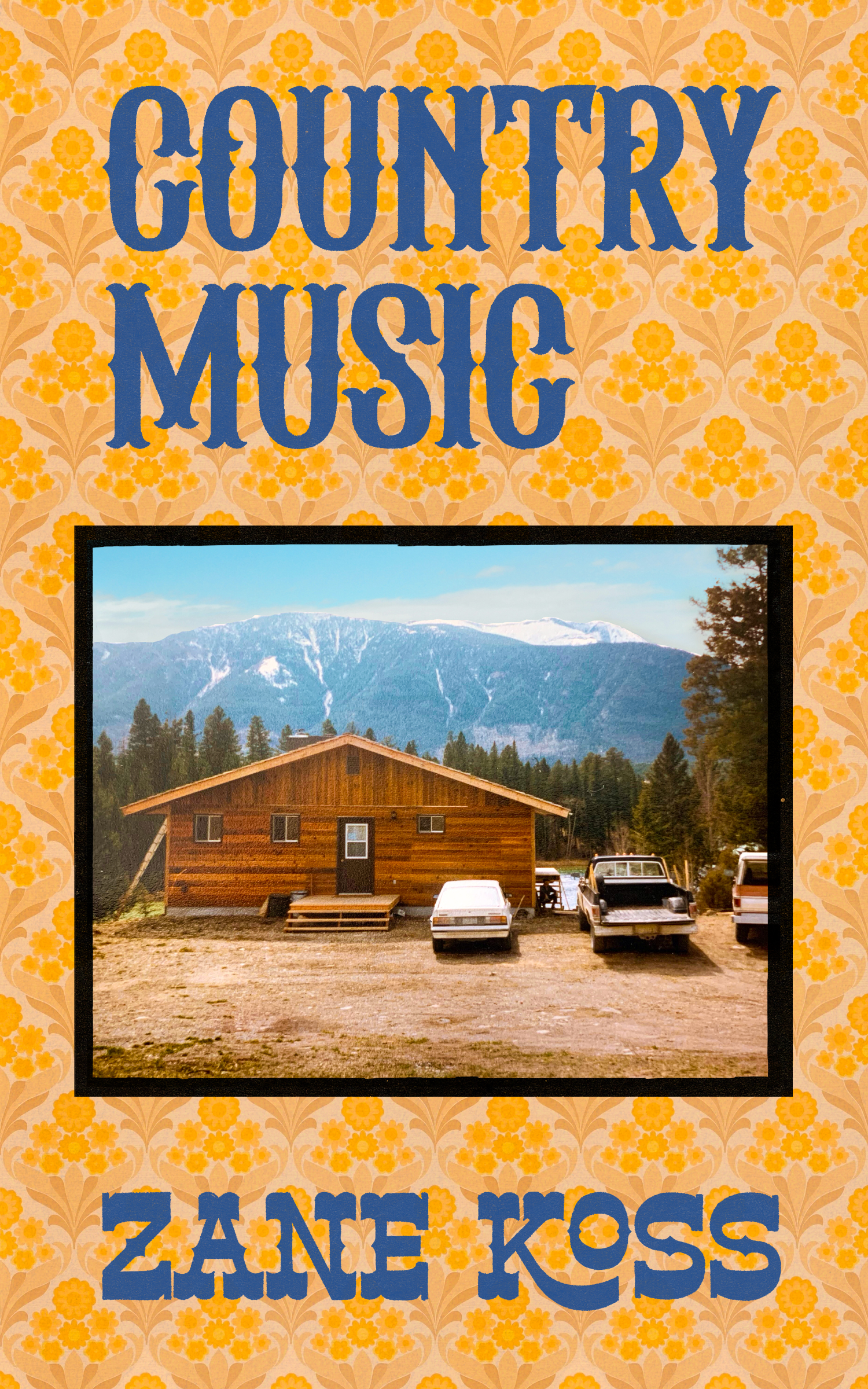
Zane Koss, Country Music


tell the cougar story

                                    so jerry and tom go out

this one time to check jerry’s traps he’s got a line out

for lynx and you have to check these quite regularly

so the poor thing isn’t stuck there so long that it starves

to death or chews its leg off to get out it’s just

a regular foot trap staked to the ground

and they get there to where it’s supposed to be

and it’s gone but there’s some tracks heading out

over the snow, big tracks, not a lynx and they follow the tracks

and there it’s this huge cougar the trap stuck on its paw

dragging the chair and stake and jerry’s only got his 22

because he’d thought it would just be the lynx

Guelph, Ontario-based poet and translator Zane Koss’ second full-length collection, following Harbour Grids (Picton ON: Invisible Publishing, 2022) [see my review of such here] is Country Music (Invisible Publishing, 2025), a book-length poem of stories, ghosts and the country music of rural British Columbia upbringing. It is a very different tone and approach from, say, the music of Dennis Cooley’s Country Music: New Poems (Kalamalka Press, 2004) or Robert Kroetsch’s “Country and Western” section of his Completed Field Notes (University of Alberta Press, 2002). As the back cover offers, Koss’ music emerges from stories told around campfires or the kitchen table, held “against the backdrop of rural British Columbia,” offering working-class tales of “humour and violence of life in the mountains.” Koss weaves these stories through and around the shape of an understanding of his own origins, and how he got to where he is now. As he writes, early in the collection: “where have our fathers / gone i have still lived more years / of my life // on a dirt road than a / paved one, / i tell people that, and // though      true, it doesn’t / feel that way; mike, / where have we gone [.]” He opens the book, the poem, with a sequence of storytelling narratives to establish his foundation of a good story, plainly told; conversational, sections of which feel comparable to The Canterbury Tales, but all told by the same unnamed narrator. The poems, the extended long poem, of Country Music, is structured in accumulating sections, offering short narrative bursts of storytelling lyric, notational across the pause and parry across each storyteller’s particular diction.

seen that picture of you
with the gun

    with the twelve-gauge pump-action
    shotgun
and the dead birds, pixelated

while you mourn your grand
father; i bet you        are wondering;

                but me,
i never shot anything except
popcans and paper targets,
but i know it,                  clubbed
fish to eat; gutted
             them,        myself

    one time my dad brought
home a tiny rabbit
    in a cardboard box        that
his skidder had disturbed

There is a way that Koss writes these stories as part of his own DNA, but as much deliberately left behind, distancing himself from the roughness, the low-level violence; of knowing one is from a particular space but no longer of that space, no matter how foundational some of those experiences, that thinking. “when they tell these stories now // i fill in the lost details // as they try to tell them // wanting it exactly // as i remember it // every rhythm // every detail [.]” Or, this particular moment, as one’s own learned impulses make unexpected appearances:

    these days hand-fees the cat scraps from the table;
but sometimes, the urge overcomes me, to lay my hot
coffee spoon against the thinnest skin on the back of
kate’s hand; it comes up deep from below, faster than i
know how to fight it; when i tell her you used to do that
to me at the breakfast table, every morning, she can’t imagine
you thus.

The next page, the next line, writing: “truthfully, i can no longer either [.]” This is a thoughtful and powerful collection, as Koss articulates a roughness, and a particular kind of low-level toxic masculinity taught that he still works to remove from himself. Through such, Koss’ Country Music is comparable to Dale Martin Smith’s Flying Red Horse (Vancouver BC: Talonbooks, 2021) [see my review of such here], in which Smith speaks of fathers and sons, and what passes through and what he works to prevent passing along. Koss, in his own way, works to think across similar spaces and distances, attempting to articulate even how to utilize the page as that best thinking space, to find both comprehension and comfort. “how to make the page the space,” he writes, “where that happens /// alone,” he writes. “the page the context in which improvisation                  could // driven by the difference only // only possible in otherness // to make the page a space of // confronting my own otherness to myself // as a means of improvisation // cannot quite [.]”

As well, there’s a particular kind of pacing and visual rhythm displayed in Koss’ long poem that is reminiscent of the late Prince George poet Barry McKinnon’s classic I wanted to say something (Caledonia Writing Series, 1976; Red Deer College Press, 1990); whereas McKinnon’s wrote the stories of prairie immigration across his family history, focusing on parents and grandparents, Koss writes a more immediate setting of attempting to articulate and understand himself through family stories, including the telling and retelling of many tales he was directly around for, leading up to the present moment. “the beer bottles / mark time,” he writes, “gathered around, telling new / ones [.]” Koss writes not purely through the lens of what these stories tell but in the telling, of the attempting to clarify what it is that helped make him, and those elements he chooses to hold, and others he attempts to leave behind, all while wishing to remember the whole of it, as best as he can. And, as Barry McKinnon opened sections of his prairie long poem with “I wanted to say something,” so too, Koss, composing his structural echo across the interior of his own particular British Columbia upbringing:

I wanted to write a poem

                        that would somehow
place me
                        late night

kitchen table

            stories


                                    a campfire


All my sense

                                                depends upon
that