Showing posts with label Brian Fawcett. Show all posts

Friday, March 04, 2022

Brian Fawcett (May 13, 1944-February 27, 2022)

Sad news out of Toronto, hearing that Brian Fawcett died this past Sunday night after an extended illness. Strange to think I’ve known him some twenty years, as one of our early in-person encounters came through Prince George, British Columbia poet and publisher Barry McKinnon, prompted by a Toronto reading we were doing together to launch our 2004 Talonbooks. There’s a photo I can’t find of our post-reading assemblage, as both Stephen Brockwell and the since-late Priscila Uppal were simultaneously amused and confounded by Fawcett’s smartass remarks, including his numerous comments upon the length of my hair (he heckled similar, during the event). Fawcett spent years taking swipes at my hair, at more than a few readings. Once, at a festival. I suspect he was jealous.

I’d long been aware of Fawcett as a writer, having latched, somewhere in my twenties, to the “Sex at 31” poems that he and McKinnon had originated in Prince George back in the late 1970s, when the two of them decided on an open-ended sequence of self-contained poems to be completed every seven years from their age at the time, thirty-one [see my longer note on such here]. At that point, Fawcett was right in the mix of it all, and published an array of poetry titles throughout the 1970s and into the 80s, before he seemingly abandoned poetry for prose, leaning hard into a career as a journalist and public intellectual. He authored numerous books of non-fiction, writing fearlessly on subjects that others might have hesitated to touch, including Cambodia: A Book for People Who Find Television Too Slow (1986), Gender Wars: A Novel and Some Conversation About Sex and Gender (1993) and Virtual Clearcut, or The Way Things Are In My Hometown (2003). Later on, he co-write a book on one of his mentors, Robin Blaser (with Stan Persky; 2010) [see my review of such here], and a really touching and self-aware memoir on his late parents, Human happiness (2011) [see my review on such here]. He approached the lives of his parents, and elements of his own, as well, with the same rigor he approached anything else he had worked on. He was an intellectual who wore his working-class roots on his sleeve, and wrote prose that was unsentimental, with no patience for nonsense, but approached with his full, open heart. He wrote straight to the point, whether you liked it or not (and you were welcome to disagree). I’d be curious to go back into some of these works, to see how certain may have aged, although I suspect not as much as one might think; each one highly readable, entertaining and moving at a speed of thought that might otherwise seem impossible.

For a period, he seemed very much an outlier, approaching the work of the public intellectual out of a literary upbringing and roughneck northern British Columbia, deeply attentive to community engagement, and the importance of how a story gets told. Having spent years engaging with literary journals and figures including The Capilano Review, Barry McKinnon, George Bowering, Sharon Thesen, George Stanley and Robin Blaser, he expanded his writing through a variety of subject matter that converged where politics, policy and social justice were forced to contend with his skepticism. As part of the same, he co-founded the online Dooney’s Café with Stan Persky in 2001, where he regularly engaged with politics and literature.

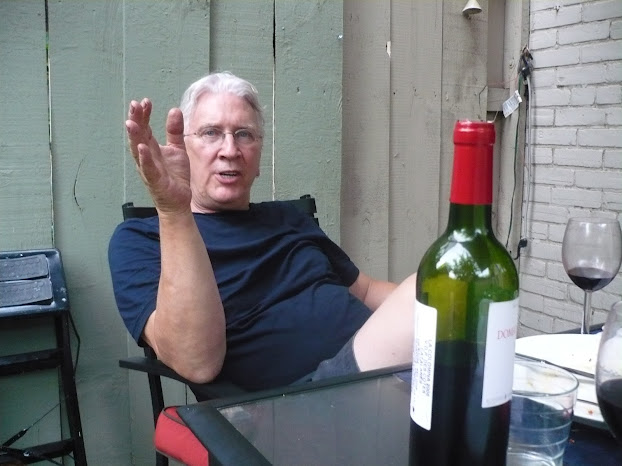
There was a period of time, circa 2009-10, that I was spending more time in Toronto, crashing in either Fawcett’s spare room, or out in the coach house behind their house, which allowed for us to get to know each other a bit better. He was amused by my enthusiasms, and proudly showed me their coach house, converted by him into a small office/studio, surrounded by tomato plants. In August 2010, I arrived to housesit for a week or so, with only Brian on-hand to hand over keys. Before he left, we had dinner (from whence my photo of Brian emerges), and I was provided lengthy instructions on how to daily water the dozens of varieties of tomato plants that surrounded their yard, up the fire escape and across the rooftop deck of the coach house: a barrel of yesterday’s water to feed the tomatoes, and another barrel to fill (because the temperature out of the hose would have damaged the plants). It took more than an hour, each time. He’d managed to secure seeds from numerous places, including some he said near impossible to find. He was working, he said, on a book. At one point, he made me a toasted tomato sandwich, slathered with mayonnaise and sprinkled with sea-salt, something I never would have considered (disliking tomatoes and mayonnaise, for example). It was perhaps the finest sandwich I have ever had, and I say with no exaggeration that it was a sandwich I still think of.

I was also told if I touched the good wine while he was gone, he would murder me. Don’t drink good wine, he warned me, because its expensive, and you’ll be ruined for the cheap stuff. He still blamed a particular friend for getting him into good wine.

Brian Fawcett had a sharp mind, and a devastating wit. He didn’t miss much, it would seem. Most of the times I’d hear from him at all (but for some emails from last year, tantalizing me with photos of a poetry manuscript he was supposedly working on that he then refused to discuss) were in response to some bulk email I’d sent out, lambasting whatever author it was, wondering how I could publish such drivel. Don’t they know how to use sentences? After a while, I wondered if that’s why I kept him on those lists, to be able to hear him respond in some offhand, gruff manner. Knowing full well he enjoyed the conflict. The more time we spent together, the more confused he seemed by me, until realizing, he claimed, that I was “ambitious, but not competitive,” which he considered entirely his opposite. He also suggested I should write a “straight” novel, just to show that I could. And, once it was published, announce loudly how easy it was to write, all of which would make it easier to get my more lyric works of fiction published. During the same 2010 visit, he answered a call from a phone scammer, and delighted in putting them in their place. Two years ago, he offered me this piece of advice as well, out of the blue:

Some literary advice: find a writer/poet whose work you dislike intensely, and beat the living crap out of him/her for a specific book/text.

It’ll make people listen more carefully to you.  You have a reputation of being too nice, too unwilling to give offense.

(Plus It would entertaining as hell to watch all those tools you’re carrying do something bad…)

Perhaps he’s right? Perhaps I have been doing this wrong all along. He was always one for a good brawl, it would seem. He posted a bit more than a week ago on Facebook that he was on the way out. He was dying anyway, and had better things to do. We knew it was coming, and had been for some time. I shall miss his humour, his engagement and his fierce intelligence. I shall miss the ways in which he challenged my thinking. I shall miss his endless array of literary gossips and tall tales. I shall miss his kindness.

Saturday, March 01, 2014

Snowbirding in South Florida: Boca Raton (and Key West), part two:


We recently spent ten days is South Florida, spending time at Christine’s father’s condo [see my report on the first part of our trip, here], now back in Canada since Wednesday, late late late; back to the snow and the rain and god knows what else was waiting for us (along with ten days of exciting mail).

We spent days floating around doing lots of little things, lots of little nothings. I managed to get some tricklings of work done, but mostly attempting not to do much of anything. Once Christine’s father returned to Toronto, we managed quiet days with a single daily outing that usually wore us completely out.

We made for the Barnes and Noble for magazines, hit a used bookstore for a couple of finds, went to lunch a few times. The Cheesecake Factory, for example (the restaurant I really thought The Big Bang Theory had invented, until we were here last year), or that place on the beach with the yummy drinks.

We made for the pool, so Christine could swim. We attempted and re-attempted the beach.

Baby Rose with her feet in the ocean.

Baby means having few outings, and outings predominantly outside of the 10am-2pm range of mid-day massive heat (we didn’t want her to have heatstroke, obviously). And she usually begins settling in for the evening around 5pm. The windows of opportunity for outings are small, and we must aim ourselves very precisely.

We managed to watch the entire first season of Arrow on Netflix. Not nearly as bad as I had suspected (and better, in many ways, than the entire second half of Smallville).

On Sunday, we drove down to the Keys, for the sake of (among other things) Ernest Hemingway’s house, and the great-great-great (etcetera) grandchildren of his infamous polydactyl cats. But be aware: when MapQuest tells you that it’s roughly a four-and-a-half hour drive from Boca Raton to Key West, Florida along Highway I-95, know that it lies terribly (add about two hours to their math), which made for a tremendously long day.


We were too late into the Keys to make for the Hemingway House, but wandered downtown through our hotel shuttle to see what we could see, including the sun sinking slowly into the ocean. We also made it to Sloppy Joe’s (on the recommendation of James Missen), where we took baby for loud drinks and a deeply inappropriate musical duo. The food was pretty good, and the baby didn’t even complain that much (we didn’t stay long).

And of course, Key Lime Pie. And a tourist t-shirt for the baby as well.

After such a long day, the three of us in bed and out well before 9:30pm (which never, ever happens).

First thing the next morning, we made for the beach outside our hotel, so we could stare south towards Cuba. The sand looked unnaturally clean, and we suspected a constructed beach, the ocean water slowly eroding away until trucks might arrive to replenish.

The cormorants, and the pelicans. Not a human in sight.


At the Hemingway House, we learned he lived there only during the 1930s, until the marriage with his second wife broke (she lived there for the rest of her life), and his years in Cuba meant that he lost his home, property and manuscripts once Castro came through (manuscripts that are said to remain in Cuba). I wonder, just what have we missed?

At his Key West home, Hemingway’s enviable and uncomplicated writing studio (which reminded me of the one Brian Fawcett had in his previous home on Palmerston, writing out in the coach house), where he wrote all but the first and last of his novels, which is quite astounding to think about. A room of his own, above where the bookstore now stands. When Papa lived here, the railing he rigged out on the roof so he could commute every morning from the master bedroom straight over to his writing studio, without having to once touch the ground.

Until noon or so, when one of his fishing buddies might arrive.

Imagine: winning the Nobel Prize, most of which was composed in that house, over the space of a single decade.

So now I've been to The Margaret Laurence House in Neepawa, and Hemingway's house in the Keys (I've not yet been to the Burton House). Might they ever open one for Alice Munro?

We saw the polydactyl cats, the great-great-great-great (etc) grandchildren of Hemingway’s originals, all distant cousins of our Lemonade. We saw how the cats Clark Gable and Cary Grant didn’t care for each other, and needed to remain separated. We saw the feline Liz Taylor [pictured], who apparently was allowed to have two litters as opposed to the single litter all the other female cats there were allowed (even her namesake in cat form required more than everyone else).


We saw the first swimming pool in the Key, built for Hemingway’s wife, which apparently Ottawa writer Richard Taylor jumped in when he came to visit, years ago (according to Lise Rochefort).

Navigating the toll road (which, again, MapQuest claimed would be four hours) back north, we did make the trip in about five hours, just in time to freshen up and get over to Mark Scroggins’ house to have dinner with he and his wife Jennifer, and their two lovely daughters [as we did last year].

Another six or seven hour drive in two days might have killed us.

Both ways, into and out of the Keys, the local radio station plays songs by The Tragically Hip. Huh.

While there, we had a lovely dinner with the family, as his wife Jen played with Rose for a while (until Rose started to notice she couldn't see us), and their two daughter took turns entertaining her (the younger one played with puppets, which Rose loved, and the elder sang her songs to quiet her town near the end of the evening). I also discovered that Scroggins has a collection of essays and longer reviews appearing later this year, which I’m very looking forward to.

The following day and a half, in comparison, were quite tame: we were all exhausted, and Rose, especially so. We rested, and rested, until we made for the plane.

Sunday, April 29, 2012

Brian Fawcett, Human happiness


This woman is Rita Joan Fawcett, then Rita Surry. She worked as a cashier in the meat department of the Hudson’s Bay store in downtown Edmonton. She was a dance club queen, and girl-about-town. It is 1933, and she is 23 years old, about to meet Duncan Hartley Fawcett, the man she will marry in 1936.

She’s a big-boned girl, buxom, pretty without quite being beautiful, but healthy and very well-groomed, always. Those are silk stockings on her legs, the watch on her left wrist will last 40 years, her manicure is impeccable but not ostentatious, and the necklace—are they real pearls?—is tasteful.

Her best asset is her smile, which could still light up rooms when she was 90, and made her friends all her life without making her seem goofy or an easy mark. Behind it was a quick and an encompassing sense of humour that didn’t require malice or schadenfreude to fire it up, and which masked her native shrewdness. There are no photographs of her in which she looks like a deer in the headlights, and I never saw her in real life that way. Her weakness was that she couldn’t see things coming. She only saw people coming, about whom she often made snap judgments that were rarely off the mark—and nearly always final. She kept her feet on the ground her entire life, and taught the skill to her children. This was no small accomplishment, given their very different characters.
Nearly a decade in the making is award-winning Toronto writer Brian Fawcett’s courageous memoir of his late parents, Human happiness (Toronto ON: Thomas Allen Publishers, 2011). For years a journalist and public intellectual,Fawcett has been taking on big subjects through non-fiction, from his Cambodia:A Book for People Who Find Television Too Slow (1986), Gender Wars: A Noveland Some Conversation About Sex and Gender (1993) and Virtual Clearcut, or The Way Things Are In My Hometown (2003), to Robin Blaser (with Stan Persky; 2010) [see my review of such here]. His subjects have been large and small, and in this new book, the subject is his own parents, their marriage and the family they created. This is perhaps the largest and most difficult of subject matters, and Fawcett manages it with stark honesty, attention and humour, without a speck of sentimentality.

It is a difficult thing to turn one’s gaze upon the speculations of one’s own house, one’s own life, and Fawcett does it with alarming and straightforward skill. Human happiness is a warm, direct, honest exploration and heartfelt portrait of a couple existing of their own place, their own time. Over the years, his non-fiction works have concerned themselves with political and social histories, with calling out those who required it (otherwise known as a low tolerance for bullshit), and he approaches his parents’ history in much the same way. How does one comprehend their own parents honestly, and the contexts through which they became who they were?

As the title attests, this is a book about happiness, after all; about how it is sought after, discovered, and even about how it is perceived, amid the arguments, the long stubborn stretches and the misunderstandings (Fawcett’s scene of he and his brother in their father’s office as their father entirely misreads his two sons is astounding).

If attention might be called the highest form of respect, and even the highest complement, in Human happiness, Brian Fawcett has given his all. 
There’s something else that makes all this worth the telling: the two central figures in this story literally couldn’t have imagined that a story could be written about their lives. They both had the sort of modesty of expectation that prevented them from seeing themselves as central to anything, even, at times, their own lives. They didn’t see their marriage as drama, or their lives as a narrative that had a fireworks-and-orchestra beginning followed by plot-point catastrophes and epiphanies, and they didn’t see its ending coming until it was on them even thought they both prepared for death in exquisite detail. They saw their individual lives and their marriage through the lens of a plan, one that they pursued relentlessly without talking about it very much, and except in moments they thought of as weakness, without looking back to see what had worked and what hadn’t.

This is also about the desire to find a human and humane happiness, about the goodness of the human spirit, about the unappreciated comedy of our expectations and it is about the will we don’t hear very much about these days. Not the will to dominate others, or make life about ourselves, but the often-interrupted will to love and be loved, and the contagious decency that arises from it.

My private moments? Like most people born in North America during and just after the Second World War, I grew up without the faintest curiosity about the people who’d brought me into the world, and even less about the ancestors who had gotten them to our staging grounds. Toward the end of my parents’ lives I began to understand that this lack of curiosity was a serious mistake, and in part, this book is my attempt at restitution: this is about them, but it is also for them.

Wednesday, August 11, 2010

Al Rempel, understories


Next Year

this year you say: I’m eating cranberries
as if you’ve found a new miracle cure
but really, you might as well have said
I’m sucking on rose-hip skins and spitting
out the seeds—both did well this year
last year you gorged on saskatoons
wiped the juice in slow circles around
your lips like it was the forbidden fruit
the year before that I can’t remember—
you know how some people forget
the glasses perched on their forehead
but know the difference in rainfall
between the summers of ’78 and ’79? or
how much snow fell not ten years later?
old people mostly—who knows what
you’ll be sucking on next year, your sticky
fingers wagging about the bushes, maybe
staining my lips with a gentle shove

On the surface, Northern British Columbia poet Al Rempel’s first trade collection, understories (Halfmoon Bay BC: Caitlin Press, 2010), is a seemingly-straightforward collection of lyric narratives, but scratch at the surface, and there are a number of pieces here with intriguing rhythms, sentences rolling through that geography of north. This is an area increasingly explored for the sake of writing, from the days of Sharon Thesen, Brian Fawcett and even Artie Gold to current Rob Budde, Ken Belford and Gillian Wigmore, with Barry McKinnon the thread that seemingly holds four decades of Prince George poetry together. There are so many parts of the collection where the poems seem to skim, and remain somehow ordinary, instead of heading deeper, beyond expected territory; we know about the snow and the trees and the mountains. Why not tell us something that we don’t? Still, it’s interesting to see the echoes of influence, from the compact single stanzas of Ken Belford in poems such as “Next Year,” and there is something absolutely exquisite about the breath-couplets, the lines of the poem “A Few Lines for Prince George,” that begins:

thirteen years old and I’m exhuming the contents of the World Book Encyclopedia
right down to the transparencies in Volume 9, the Human Body vascular and muscular—

imagine a great lake overhead, dammed up by volcanic rock and the remains
of the last ice-age, maybe 10,000 years ago, until one day the whole thing busted loose—

stripping off skin, tendons, veins until I reached the female reproductive system
a big letdown, only the barest suggestion of breast, no more revealing than bulges—

Tuesday, July 06, 2010

Robin Blaser, by Stan Persky and Brian Fawcett


My first encounter with Robin Blaser’s poetry was in 1960. I was a nineteen-year-old sailor stationed at the American naval air base at Capodichino, Italy, just outside Naples. Harold and Dora Dull, a couple from the San Francisco poetry scene, whom I’d met the year before at Sunday afternoon poets’ meetings there, had arrived for a sojourn in Europe and were staying in a small fishing village, Amalfitano, along the Amalfi coast just south of the bay of Naples. On Friday afternoons, I left the military base and took the bus from Naples to spend the weekend with them. […] The first weekend I arrived at the eyrie they’d rented above the sea, Harold handed me a copy of a recently written poem that he’d brought from San Francisco. It was by Robin Blaser, a San Francisco poet who had been living in Boston and working as a librarian at Harvard, and whom I knew of only from talk in San Francisco that placed him as one of a literary threesome that included Jack Spicer and Robert Duncan. They had all been classmates at the University of California in Berkeley at the end of World War II. The poem Harold handed me was called Cups and was Blaser’s first “serial” poem, the form Jack Spicer had invented a couple of years earlier in his book After Lorca. (Stan Persky)


In the new book, Robin Blaser (Vancouver BC: New Star Books, 2010), Vancouver writer Stan Persky and Toronto writer Brian Fawcett each write lengthy essays on Blaser [see my obit for him here] the writer, the mentor and influence, from their own perspectives, going back well into the 1960s. Written in homage to the late Vancouver poet, mentor, teacher, composer, intellectual and friend Robin Blaser, who was the last surviving member of the trio of poets that made up the San Francisco Renaissance of Blaser, Robert Duncanand Jack Spicer. It’s interesting that both came to Blaser first through the poetry to become poets themselves, turning finally to non-fiction as their eventual and individual forms, and the two pieces, Persky’s “Reading Robin Blaser,” a more personal piece that delves specifically into Blaser’s own poetry, and Fawcett’s “Robin And Me: The New American Poetry and Us,” writing Blaser in the context of “the New American Poetry” and the failures of such, provide unique counterpoints to Blaser’s place in the world, and the two authors as well. What comes across best (the two essays sandwiching a series of black and white photos of Blaser over the years, which are quite lovely) is the level at which Blaser demanded, by example, that those who paid any attention to him become thoroughly engaged with multiple facets of the world, questioning whatever came across their path, and Persky and Fawcett, in different ways through their works, have certainly done that. With the Jack Spicer biography already in print, and the perpetually-forthcoming Robert Duncan biography by Lisa Jarnot, Robin Blaser reads as an intriguing opening into, perhaps, the most modest yet most accomplished of the three, and one can only hope that Blaser’s own work can achieve further consideration. Will there be a biography, eventually, here as well?

Unfortunately, this lovely little folio, for reasons that haven’t been explained to me, is something that the Chapters chain of bookstores is refusing to carry, despite the range of awards and accolades between the authors and subject (Blaser won a special Griffin Poetry Prize not long before he won for his reissued The Holy Forest, and Persky won a Lietenant-Governor’s Medal from British Columbia and the Governor-Generals’ Award, for example). If this can’t get through the membrane of books that those-that-hold-power tell us we should read, what chance have the rest of us?

But still, how interesting is it that these two, who learned how to question the world, be interested in everything and explore critically through Blaser’s influence, both started with writing and publishing poetry but neither publish such anymore (Fawcett claims to still compose, but not send out unless asked, and even then)? Brian Fawcett starts his piece with talking about walking into his first class during the first year of Simon Fraser University in 1966, which also happened to be Blaser’s first class as well:

The Writer was Robin Blaser, and there was something about him that convinced me, even though the very idea was preposterous, that he really had met Jack Kerouac. He was also, it turned out, on a first-name basis with nearly all the contemporary poets I’d been reading since I was sixteen or seventeen, the most important of these being Allen Ginsberg, John Wieners, and Gary Snyder. All were part of a movement called the New American Poetry, a group of poets assembled and categorized by Donald Allen’s 1960 Grove Press anthology of the same name. I was carrying a much-pored-over copy of that anthology when I arrived at Simon Fraser, and it is hard to describe the intensity of my excitement when I found Blaser’s name in its table of contents along with those of my heroes.

Saturday, July 03, 2010

Ongoing notes: the Toronto Small Press Fair, spring 2010;

[Nathaniel G. Moore at the TSPF; and then he went to the movies.] I don’t understand why the literary community in Toronto still keeps such a wide berth from the semi-annual Toronto Small Press Fair; I mean, I understand why, but the current organizers didn’t even know about the “troubles” the fair had a few years back (one wasn’t even on the continent at the time, and the other wasn’t much closer to the fair). Those involved on both sides don’t even come near, so what I don’t understand, why does everyone else also stay away? The new Meet the Presses fair is a positive thing, but why this insistence on factions? Why can’t we all just get along? I am not interested in factions; here are a couple of the items I picked up at or around the fair this time around. 

Toronto ON: Since discovering Sarah Pinder’s work at the previous Toronto fair, I’ve been quite taken with these small, graceful poetry and fiction chapbooks produced by her Bits of String, including Garden, Gardener: poems by Sarah Pinder (2008). Her poems are odd, quirky things, and her chapbooks are only two or three dollars; how can one not be charmed?
Half-Price Bed and Breakfast

On pilgrimage, I post,
aim and erect.
Missing cotton, velveteen,
a purple bite, a powder-puff,
I make a mini regatta in
crisp paper and set them a-sail
in the trout stream.

There’s something charming, naïve and then not-so in her pieces (I like this one, shades of Richard Brautigan’s surrealism), and even the back page, writing “I made this in Hamilton, ON, listening to my neighbours set off Victoria Day fireworks.” Check out her website for more information.

Toronto ON: Another little chapbook I picked up was Catherine Paquette’s A Theory of Darkness (the unkindness of ravens press, 2010), what appears to be a little sampler from a “larger cross-genre mystery novel” work-in-progress. Why do you, Pacquette, require an introduction at the beginning instead of little essay at the end? As a reader, I’m less interested in the explanation than the work itself, and wish she would have let her readers experience such without preconception. There are some good lines here, in a series of small straight-prose sections, albeit in need of editing: “Time is a formula to hate. Clocks are laughable containers. Like hearts.”
The Funeral Home of Time

A mug shatters. It is like that – the fragmenting. Something breaks into something else. The sun is rising. Breaking out from the darkness and the moon is fading out with the stars. Her breath regains and loses itself unevenly as she steps over the shards. Yes, she has lost. There are deaths all around her. she is grasping for something, but the temporal grope leaves her empty handed. She sits and watches the dark becoming light. The ruins of the night. Invisibly present and invisibly past, weaving in and out of the shifting moment. Now, she is hungry and takes in, chewing. Changes matter into mush and uses it to fuel her now. An empty plate; a broken cup. No, we do not have time to attend all the little funerals.

Ottawa ON: Produced by Ottawa writer Matthew Firth’s Black Bile Press is Toronto writer Nathaniel G. Moore’s “Sensational” Sherri (2009). Just what is it about professional wrestling, between this and his first novel, Bowlbrawl (Montreal QC: Conundrum Press, 2005) that keeps Moore (who once appeared on City TV’s Ed the Sock in a Mexican wrestling mask and subsequent match), and even Michael Holmes, going? “Never mind Mickey Rourke in The Wrestler…” the back cover tells us.
Ricky’s face filling red, voice evaporating. “Hey,” he said. Not sure if his words could be heard, not that if they mattered, just if he was actually speaking or lying down somewhere thinking this was going on and, “So, hey,” shifting the stool closer to the strangers, “But have you, or Carla, do you know?” He was slipping on and off the stool. “Hi … there.” He was using a bad Elvis voice. “Do you, hold on,” [wobbling his ass on the stool]. “So have you, you …” [focusing on one of them, one girl’s bony bare wrist. “S-s-s-sorry; I’m Rick by the way, must be wondering,” [slurrrr slurrrrr]. “Can you sit sit sit, okay, can you sit on on … a white frost cake. I mean, doesn’t goddabe white frost per say, can you sit on a cake for my birthday; it’s in July?”

Heels don’t turn but stay the same way. Heels are bad guys who work with heroes or baby-faces. When a heel becomes good, it’s called a face turn, or turning face.

Toronto ON: I didn’t get this at the fair, but Brian Fawcett handed me a small stack of his THE NORTHERN B.C. RULES with The Regulations for Snipe Hunting (David Mason Books, 2010), a small booklet of lists including “The General Rules,” “Survival in the Bush,” “Surviving in Town” and “The Snipe Hunting Regulations.” You can take the boy out of Prince George… What I enjoy best of all in this unassuming chap is the space at the end, the “several blank pages for additions to these rules. If you would like them to be considered for subsequent editions, please forward them to the publisher or author,” the inside says. Do you think they really would? As the colophon claims:
These rules are designed for physical survival in the Canadian north, which is an area that starts anywhere 100 kilometers north of a major Canadian city and extends to the geographical point at which all-terrain vehicles and skidoos outnumber normal transport, and government officials outnumber human beings (at which point “north” becomes “North” and only idiots are willing to put up with the cold and bugs).”

Fawcett, currently in Toronto but originally from Prince George, British Columbia, has a long history with the north, and about writing creative non-fiction works that could best be described, I suppose, as suggestions on negotiating various aspects of the world, including his work through the ongoing Dooney’s Café. From the first page, here are the first four, for example, general rules:
1.) In the north, rules only work in optimum conditions. Most of the time the rules are frozen solid or fouled with mud like everything else.

2.) Only things designed in the north work in the north. Everything is now designed south of the north.

3.) The most common natural hazard in the north is other people with beer or hard liquor on their breath. Unless you’re actively looking for trouble, bears are down around 17th in the list of things likely to harm you.

4.) All government and corporate megaprojects not only fail to produce promised benefits, they also produce unexpected side effects that eventually make life worse while exponentially increasing the volume of broken down or abandoned vehicles and other non-rustproofed machinery littering the landscape.

Who can argue with the logic of that?

Monday, February 08, 2010

Barry McKinnon, In the Millennium

the world

a contradiction of attempts at connection to it /


I crave loneliness as its opposite (“In the Millennium”)

Prince George poet Barry McKinnon has always been a poet working through and around the essences of what is essential, and essentially human, while somehow managing to still evade, and pretend he isn’t at the same time. If his previous books wrote “the centre,” writing (with gentle irony) his geography of Prince George, British Columbia, his in the millennium (Vancouver BC: New Star, 2009), his first trade poetry collection of the new decade/century (his The Centre: selected poems 1970-2000 that appeared in 2000 belongs in the previous, don’t kid yourself), McKinnon manages a series of concentric rings moving from that same central point, and back again. Originally composed as a ten-part manuscript of “in the millennium,” McKinnon has produced a collection of some thirteen sequences—including “Bastard File,” a section of shorter, wayward, even, pieces—with titles such as “Sex at 52,” “It Can’t Be Said,” “Bolivia/Peru,” “In the Millennium” and “Prince George (Part One).” McKinnon has always been one of those poets writing a continuous piece his entire career, with each new long poem/sequence fitting in with all that has come before, much like the American poets Kate Greenstreet and Fanny Howe, and Canadian poets bpNichol, Fred Wah and Robert Kroetsch.

desperate predation & no sense of what

they could ever care


: the city as body – began, arked, disintegrated, garbage strewn,

lumps of clothes / single shoes / bags of needles / thrift store

moved or bankrupt though the goods they sold were free


to my right, natives clumped, stoned and grinning, once

dispossessed, to be dispossessed again / not mingling, but

clumped by the abandoned Food Teller doorway / wait for crack,

booze and heroin


what it is, is. cruel that body and mind sense their own demise.

the city is organ. it sees itself. disintegrated. its body and mind

its own demise


turning left, sense nothings left. “closed / staff shortage”


give shake of head,


fucked / without a voice. (“Prince George Core”)

McKinnon, over the years, has worked his core, his poetic exploration of the north, his north, the centre, moving slowly out; writing an exploration of his immediate, including Prince George, his wife, rare travel, ageing, friends, loss and conversation, as well as the ongoing “sex at” series started with Brian Fawcett in the late 1970s as “Sex at Thirty-One,” continuing here with its usual regularly of ever seven years. Just what has McKinnon learned throughout those intervening years?

this embrace gives the momentary world the edge you think

is paradise, and our ruin becomes its meaning


and welds us silver in a ring of virtue and trust

unerring faith, given at last our sense of a last

divinational pause


at 52 it was a multiple – might as well say an angel’s voice


to pull my winged heart to the wells of thought: disappear to

come alive. to be nothing

reveals

everything you forgot. & thus at 52, a kind of recognition

immediate trust leading to kindness through

noise – (“Sex at 52”)

Just what is it McKinnon accomplishes in this new collection? A book that exists as a unified whole (as, arguably, all his collections do), in a poetry that can dipped into anywhere, any page, and continued from that point. Call it extension, furthering, a broadening of the aesthetic he’s been building for decades. Not remaining still through continuing previous concerns, and turning them inside out, making this collection, in part, the answer to where his ongoing poetic research (for those who know enough to follow) is, exactly, now, in this new century, this new millennium. As McKinnon writes in the endnote of his “Head Out (A Letter, Essay, Poem – to Cecil Giscombe)”:

The title poses a great millennial question: if we know, with varying degrees of intensity the arbitrariness of what being into dislocation is, (aren’t we all in it, or about to be?) – then what is it to be out of dislocation? The place this question imagines is open to what human values we would presently wish to define it as (a real place without compromise or illusion?). What presence & location do humans anywhere have in the current psycho / sociology of what has happened / happening here / anywhere you care to look? The world’s largest clearcut in the Bowron valley is 40 minutes from Prince George – large, invisible; it’s “nothing”, they say. The unrecorded world, this close, (20 minutes from Giscome) – yet, minimal fact given the human dislocations & disturbance of the larger daily world eco / human diaspora. A question:

the task of poetry?

poetry /

What I’ve wanted. The poem itself (an artifact / real place) – & I’ve also wanted the very moments of its act & its energy (integration / location) – to include, as well, a necessary, disintegration of its conscious and unconscious premises? By this I mean the practice I think I see in George Stanley’s new work: he writes / builds a line that seems dismantled at the same time – to reveal accurate processes of mind and life moving to these jagged truths. This want of a new world? This want of the new poem! Get a life! I hear them say while “real life goes on” into and out of the language and world at hand – into & out of