Friday, January 11, 2008

12 or 20 questions: with Rosmarie Waldrop
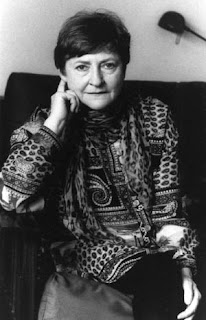
Rosmarie Waldrop was born in Kitzingen am Main, Germany, in 1935. At age 10 she spent half a year acting with a traveling theater, but was happy when schools reopened and she could settle for the quieter pleasures of reading and writing which she has since pursued in and out of universities (Würzburg, Freiburg, Aix-Marseille and Michigan, Ph.D., 1966), in several countries, but mostly in Providence, RI where she lives with Keith Waldrop (with whom she also co-edits Burning Deck Press).

She taught at Wesleyan University and, as occasional visitor, at Tufts and Brown.

The linguistic displacement from German to English has not only made her into a translator, but gave her a sense of writing as exploration of what happens between. Between words, sentences, people, cultures.

Books of poetry include the trilogy Curves to the Apple (The Reproduction of Profiles, Lawn of Excluded Middle and Reluctant Gravities), Blindsight, and A Key Into the Language of America (all from New Directions), Love, Like Pronouns (Omnidawn), Another Language: Selected Poems (Talisman House), Split Infinites (Singing Horse Press). Her collected essays, Dissonance (if you are interested), was published by University of Alabama Press in Fall 2005.

Her two novels, The Hanky of Pippin’s Daughter and A Form/of Taking/It All (originally published by Station Hill) are available in one paperback (Northwestern UP).

She has translated 14 volumes of Edmond Jabès's work (The Book of Questions, The Book of Resemblances, etc.). Her memoir/study, Lavish Absence: Recalling and Rereading Edmond Jabès, was published by Wesleyan University Press. She has also translated, from the French, Jacques Roubaud (most recently, with Keith Waldrop, The Form of a City Changes Faster, Alas, Than the Human Heart (Dalkey Archive) and Emmanuel Hocquard; from the German, Friederike Mayröcker, Elke Erb, Oskar Pastior, Gerhard Rühm, Ulf Stolterfoht, and others.

[Photo by Renate von Mangoldt]

1 - How did your first book change your life?

The fact that THE AGGRESSIVE WAYS OF THE CASUAL STRANGER was published alleviated my insecurity, at least socially. It made it easier to say, I'm a poet.

2 - How long have you lived in Providence, and how does geography, if at all, impact on your writing? Does race or gender make any impact on your work?

that's a lot of questions masquerading as one.
I've lived in Providence for 40 years, but I still feel BETWEEN as the poem with that title in my first book stated:

I'm not quite at home
on either side of the Atlantic.

Since then I've translated much Edmond Jabès and have come to agree with him that a writer's only real place is in her books. Of course we're both expatriates! I know many writers are strongly rooted in a landscape.

Gender is something we don't get away from, because we write from our body. If I may quote another poem:

A poem
like trying
to remember, is a movement
of the whole body. ("The Ambition of Ghosts" in STREETS ENOUGH TO WELCOME SNOW)

The fact that I am a woman clearly shapes my writing: thematically, in attitude, in awareness of social conditioning, marginality—but does not determine it exclusively. The writer, male or female, is only one partner in the process of writing. Language, in its full range, is the other, and is beyond gender. In spite of Lacan's attempt at appropriation and in spite of our language declaring that "man" means human being. The language a poet enters into belongs as much to the mothers as to the fathers.

3 - Where does a poem or piece of fiction usually begin for you? Are you an author of short pieces that end up combining into a larger project, or are you working on a "book" from the very beginning?

Usually a phrase. I write few single poems any more. Sometimes sequences start with a single poem and grow, other times I begin with a matrix for a whole book (like the time I used Anne-Marie Albiach's book ETAT, or rather its grammatical structure.)

4 - Are public readings part of or counter to your creative process?

They are a sounding board that can make me hear problems I hadn't noticed while working by myself.

5 - Do you have any theoretical concerns behind your writing? What kinds of questions are you trying to answer with your work? What do you even think the current questions are?

I don't think poems are there to answer questions. I've worked much from Wittgenstein and, more recently, Agamben, but always using them for the purposes of the poem. As Whitehead says, "the primary function of a proposition is to be relevant as a lure for feeling.”
More precisely, I'm mostly exploring syntax rather than vocabulary or images.

6 - Do you find the process of working with an outside editor difficult or essential (or both)?

Depends. I usually appreciate the new perspective and what I can learn from it.

7 - After having published more than a couple of titles over the years, do you find the process of book-making harder or easier?

All writing is hard. If anything it has been getting harder.

8 - When was the last time you ate a pear?

Do I dare to eat a pear? I mostly opt for cheese instead.

9 - What is the best piece of advice you've heard (not necessarily given to you directly)?

Can't think of anything--I suppose that means I don't listen to advice!

10 - How easy has it been for you to move between genres (poetry to fiction to non-fiction)? What do you see as the appeal?

I write mostly prose poems now. I suppose that means settling in the between-genres. The prose paragraph has a spaciousness where form can prove “a center around which, not a box within which” (Ezra Pound). Or as Emily Dickinson wrote in a letter: "Moving on in the Dark like Loaded Boats at Night, though there is no Course, there is Boundlessness." I love this "though!"

11 - What kind of writing routine do you tend to keep, or do you even have one? How does a typical day (for you) begin?

I always WANT to have a writing routine, but I never manage to.

12 - When your writing gets stalled, where do you turn or return for (for lack of a better word) inspiration?

Translating.

13 - How does your most recent book compare to your previous work? How does it feel different?

Every book feels completely different to me. When I put a Selected Poems together I was surprised (and rather relieved) to see how much continuity there actually is in my work.

14 - David W. McFadden once said that books come from books, but are there any other forms that influence your work, whether nature, music, science or visual art?

McFadden is right. Music used to be a big factor for me. Poems used to start with a rhythm, but much less so now. What science I've used of course came from books too.

15 - What other writers or writings are important for your work, or simply your life outside of your work?

This should be a HUGE list. But let's say, some writers I keep going back to: Kafka, Musil, Dickinson, Pound, Rilke, Oppen, Wittgenstein, Merleau-Ponty, Queneau, W.G.Sebald, Yoel Hoffmann, Lyn Hejinian, Mei-mei Berssenbrugge, Marjorie Welish, Guy Davenport, and of course Keith Waldrop.

16 - What would you like to do that you haven't yet done?


17 - If you could pick any other occupation to attempt, what would it be? Or, alternately, what do you think you would have ended up doing had you not been a writer?

A musician.

18 - What made you write, as opposed to doing something else?

Books were always my world.

19 - What was the last great book you read? What was the last great film?


20 - What are you currently working on?

Poems that work with a vocabulary derived from the definitions of certain key words. Reading books about the brain with the hope that this will lead to poems. Translating younger German poets for a magazine issue of Burning Deck's "Dichten=" series. Typesetting the next Burning Deck book: DWELLING by Heather C. Akerberg.

Thursday, January 10, 2008

why is it, every five years some publisher decides to be the next hot thing in canadian literary fiction (while getting plenty of attention for saying/doing it), & then, slowly & eventually, they fall to the wayside (when they realize there's no money in it), when the rest of publishing is still here, continuing to make books...?

Raincoast Books to ditch publishing arm (from cbc.ca)

At least one Canadian author says she feels "cut adrift" after Raincoast Books, the West Coast company that brought the blockbuster Harry Potter series to Canadian readers, announced Monday its imminent departure from the publishing business.

The Vancouver-based company is halting its publishing program and announced other cost-cutting measures, putting the blame on the strong Canadian dollar and the resulting detrimental effect on the book retail industry.

The 15 books set for release this spring will be the final slate from Raincoast, which largely counted West Coast and children's book authors in its publishing stable.

"It basically means that I've been cut adrift," children's book author and illustrator Cynthia Nugent told CBC News.

Nugent, whose credits include illustrating the popular book Mister Got to Go and penning the pre-teen novel Francesca and the Magic Bike, said she has published the majority of her oeuvre with Raincoast.

"Everything I have will cease to be in print, once the ones they have are sold out and the current project has been cancelled," she said.

Co-founded by Allan MacDougall and Mark Stanton in 1979, and currently headed by MacDougall, Raincoast gained fame both for the Harry Potter series and its use of post-consumer recycled paper in its printing.

Raincoast officials said the company plans to refocus on its core business of distribution and wholesaling, but the streamlining measures will mean the closing of its warehouse in Mississauga, Ont., axing about 20 jobs in Vancouver and Toronto and reducing the number of its distribution clients.

Nevertheless, the company will continue to offer the Harry Potter books — part of its ultra-successful venture with U.K. publisher Bloomsbury — to Canadians, they added.

Amid the rapid rise of the Canadian dollar last fall, anger grew among the book-buying public over the fact that prices in Canada remained significantly higher than those of U.S. retailers.

In interviews on Monday, Raincoast marketing vice-president Jamie Broadhurst said that, in response, the company dramatically dropped its suggested retail prices by 20 per cent. He described the shuttering of the publishing program as a tough but necessary measure.

"It's, of course, really sad news for the staff and for publishing in general," said Margaret Reynolds, executive director of the Association of Book Publishers of British Columbia.
However, she added that other B.C. publishers could be able to pick up the slack left by Raincoast.

Wednesday, January 09, 2008

12 or 20 questions: with Sharon Thesen

Sharon Thesen spent her childhood in small towns all over western Canada. She was born in Tisdale, Saskatchewan, in 1946. By the time she was six years old, her family had migrated via Edmonton and Fairview, Alberta, to Prince George, B.C. From age seven to nine, she lived in a kind foster home in Vernon, B.C. while her mother recovered from tuberculosis at Tranquille Sanitorium in Kamloops. She attended several schools in and around Kamloops until the family moved to Prince George, in 1960. She graduated from Prince George Senior Secondary School and moved to Vancouver in 1964. In 1966 she enrolled at Simon Fraser University, where she did a Master’s degree in English. In the mid-seventies, she worked at a Vancouver community planning agency and then at Capilano College, where she taught English until 2005 and was involved with, and editor of, The Capilano Review. She is now living near Kelowna, BC, and is an Associate Professor of Creative Writing at UBC Okanagan, where she co-edits Lake: A Journal of Arts and Environment. Since 1980, she has published eight books of poetry. She has been shortlisted three times for the Governor-General’s Award, has won the Pat Lowther Award for her book A Pair of Scissors, and has served on the Griffin Poetry Prize jury. She has edited two editions of The Long Poem Anthology and is currently considering a third edition, as well as a new poetry collection and other writing projects.

1 - How did your first book change your life?

Terrified! Now I had to be a poet.

2 - How long have you lived in Lake Country, and how does geography, if at all, impact on your writing? Does race or gender make any impact on your work?

I’ve lived in Lake Country for two and half years. Geography—i.e. topography, the landscape, the weather, what’s outside, hugely affects my writing. The light, the clouds, the time of the day, the cars going by—they are all poetic signals. Race and gender are two words that I find dispiriting, although I understand that they most likely inflect everything.

3 - Where does a poem usually begin for you? Are you an author of short pieces that end up combining into a larger project, or are you working on a "book" from the very beginning?

A poem usually begins for me with a feeling of hunger. And then sometimes a first line. But sometimes I have a “topic”, too—for example, my goldfish waking up in the spring, or the way things are in February. I write short pieces that eventually accumulate into a book length manuscript, but I’ve also written long poems and short books on certain subjects (e.g. the Kelowna wildfire, Malcolm Lowry, the death of a friend).

4 - Are public readings part of or counter to your creative process?

Public readings help sometimes to edit a particular poem. Readings help me to deeply hear my own work. Readings can also be humiliating events. I remember one reading where I became more and more mortified that the poem was so full of similes. In that reading venue, similes were a big no-no. I felt like killing myself afterwards.

5 - Do you have any theoretical concerns behind your writing? What kinds of questions are you trying to answer with your work? What do you even think the current questions are?

No, not really. If anything, my poems fight against “theoretical concerns.” I suppose I try to answer whatever question comes up. The current questions, or question, seems to me to be about sanity.

6 - Do you find the process of working with an outside editor difficult or essential (or both)?

Unfortunately, I’ve not much worked with heavy-duty outside editors, or even medium or light-weight editors. As I said, unfortunately. I could use a stronger editor.

7 - After having published more than a couple of titles over the years, do you find the process of book-making harder or easier?

Harder, because you expect more of yourself just as you’re beginning to thin out, get tired.

8 - When was the last time you ate a pear?

Pears I am not crazy about. Pears so often disappoint.

9 - What is the best piece of advice you've heard (not necessarily given to you directly)?

“The only way out of this mess is to become enlightened and then enjoy it!”

10 - - What kind of writing routine do you tend to keep, or do you even have one? How does a typical day (for you) begin?

A typical day for me: Wake up, get out of bed, drag a comb across my head. Drink coffee, read the paper, leave for work. Writing is ALWAYS on my mind but I find it hard to find enough time to spend on it. When I write, it’s usually because I have a deadline, or I need to. I’m not a morning writer, nor do I have a schedule.

11 - Where is your favourite place to write?

My favourite place to write is at my desk at home.

12 - When your writing gets stalled, where do you turn or return for (for lack of a better word) inspiration?

For inspiration, I read something, sometimes poetry (I have a shelf of poetry books that can sometimes get me going), sometimes something random from the shelf; or I go for a walk; or listen to some music, or I make a cup of coffee. Writing used to be much easier when I was still smoking.

13 - How does your most recent book compare to your previous work? How does it feel different?

The Good Bacteria is all over the map. It’s the weirdest book I’ve ever written. Robert Bringhust imitation Haida cadences using Okanagan imagery, 9/11 fantasies about cropduster airplanes in innocent barns, wildfire meditations, eulogies, lyrics, you name it. I was completely amazed (and grateful) that Anansi published it! (It received a GG nomination, a Dorothy Livesay nomination, and a ReLit nomination—you could have knocked me over with a feather!)

14 - David W. McFadden once said that books come from books, but are there any other forms that influence your work, whether nature, music, science or visual art?

I’m a soaker-up of anything beautiful, anything alive—whether person, place, or thing. Certainly nature plays a huge role in that, but I’m not really a “nature poet.” For some time I studied Matisse and tried to write poems out of that, but it didn’t work. My own living in the world in whatever ways I do seems to furnish me with enough “material.”

15 - What other writers or writings are important for your work, or simply your life outside of your work?

All writings, all language use. I read all the time. I read a lot of student writing, I read the local rag, I read Chatelaine at the hairdresser’s. I listen to the way people speak.

16 - What would you like to do that you haven't yet done?

An exquisitely beautiful and brilliant play!

17 - If you could pick any other occupation to attempt, what would it be? Or, alternately, what do you think you would have ended up doing had you not been a writer?

I’m still trying to be a writer! Otherwise, maybe a dancer, or a cartoonist.

18 - What made you write, as opposed to doing something else?

Poetry seemed to me to be the vitality of truth. Before that, I was misled by a search for truth alone.

19 - What was the last great book you read? What was the last great film?

The last great book I read was The Inheritance of Loss, by Karin Desai. Last great film? Anything with Philip Seymour Hoffman in it.

20 - What are you currently working on?

I’m currently at work on three projects: a poetry manuscript; a prose work entitled “My Education as a Poet”, and a long piece about the Queen Charlotte Islands/Haida G’Waii in the 1920’s and 30’s.

12 or 20 questions archive

Tuesday, January 08, 2008

Chus Pato's Charenton, trans. Erin Moure

the body starts to generate heat. felt, i’m wrapped in it, in the
snow,
As a translator, Montreal poet Erin Moure [see her 12 or 20 questions here; see my review of her most recent poetry collection here] seems very attracted to writing that mixes poetry and language theory, as well as philosophy; a poetry that engages language and thinking. With her earlier work translating some of the work of Quebecoise writer Nicole Brossard from French into English, and her own transelations of Pessoa (resulting in her book Sheep’s Vigil by a Fervent Person, published in 2001 by House of Anansi), Moure’s interest in working more than one language and more recent forays into learning the Galician language (the Moures are originally from the same Spanish region) make her work as a translator from the Galician a natural progression of her own life’s work. With her earlier translation of Chus Pato’s m-Talá (published as a chapbook by Vancouver’s Nomados in 2003), her work on the Canadian/British co-publication Charenton (Ottawa ON: Buschek Books / Exeter UK: Shearsman Books, 2007) becomes the second of Pato’s work she has translated into English. Called “one of the most singular and acclaimed writers in contemporary Spanish poetry,” Chus Pato writes in Galician, but has been translated into a number of other languages including Spanish, Polish, Serbian and Portuguese, and now English, with Moure serving as her official English translator.
for such beauty to exist you have to imagine a wall [(– this wall, is it high?)(– vast)] of brick with buttresses shoring up its rhythm; in front of it, a green border masks a doorway lost in time. An older poet walks past here each morning, her emotions more or less / like the building, boarded up, abandoned to disintegrate. To her, doubts have the texture of gorges and the pent gasp of mouth-to-mouth, and as for her more or less – poetic? – efforts, she’s not sure if she should keep dragging this code through narrow and twisting alpine passes, or if she should persevere or not with the taxing exercises of rescue and shipwreck, if she should just give up all that has been obsession and justification for life.

now she sets soft greenery in front of you (moss) that grows at the rim of sewer covers or in the geometrical quadrangles of flagstones (in fact, there’s a sidewalk here). In the middle, the poet, devastated as an architecture (without acanthus, capital, fust, doric) – possibly even the building at 15, B Street in the strangest of towns, in a remote country – was stopped short by a disappearance, by lack of energy, of projects… by the corrosion of years. Later a first field of frost.
There is much in this work reminiscent of the work of Canadian ex-pat poet (now in Chicago) nathalie stephens [see her 12 or 20 here], as both work to create a poetic that moves slyly as a single unit of composition from one step to the next through not only matters of identity and identity politics, but in using the combined fragments of poetry/prose to further the poetic to the next level, refusing to remain static in a single form.
like flowers, blooming from inside your eyes, the letters. You get up to see if you can shake them off: they stick. Cradle-transparency words. They suck you through tunnels of Green vegetation, flatlands that are not The Limia, patches of greenery you can’t get through, ships. You treat them as if they were foreign vocables and spend hours peering into the Latin dictionary, into the anthology of French literature, the sole ones you love. You decide on their meaning because to your mind such words are always interchangeable. You loathe these terms because you want to endure, because clover dodder doesn’t exist, nor BRIARS, nor oaks. Thus you spin round, or it’s the lay on the ground that changes direction. From this point on, words mark risks, of identity-character
There was even conversation a few years ago put forth to the Canada Council, spearheaded by Moure and Robert Majzels [see his 12 or 20 questions here], petitioning them to consider allowing money to be used to “translate and promote foreign works in Canada” [I even posted their letter here], but I don’t know if anything ever became of it.
thinking of that word “zebra”

is like believing the earth is still a flat disk

**

there are various trees, fallen, and the mountain stays up,
unstuck, because it leans on the wall of the room in which i
write
the forest takes up one of the four corners of my table, the
corner of where the sun rises

on the summit a bear ambles in the snow (a bear mannequin)

between me and the forest, diagonally: framed photographs
a gasoline heart, a purple plume, a stork, Snow White’s slipper
and then the forest

i know it’ll hurt to clean out the forest
Pato’s poems write through performance and the body, taking apart literature, history and various personal/public myths into her own house of endless rooms, and an endless desire to work beyond whatever constraints a personal/public politic can have over us.
notwithstanding, it’s useful, the “I” is, for example, for knowing
what floor you’re on without having to ask, for orienting
yourself with a map (“I”-decipher of codes)
Her poems work through myth even as her biography at the back of the book writes:
In her words: “writing metabolizes the world, even that world that cannot be absorbed into writing.” And: “I have a predilection for those constructions which investigate the possibility of a language-thinking that refuses to repeat the already-written and lives in contact-lamination with the seams of the unsayable, of what hasn’t yet been written into the corporeality of the poem.” “To me, the poem is a freedom-machine.” “My autobiography? It does not always seem to be mine; sometimes I would rather have other lives. Insofar as all autobiography participates in fiction, I prefer not to be forced to choose, so I opt not to have one.”

Monday, January 07, 2008

ongoing notes: some recent American poetry collections by Zawacki, Padgett, Young & Byrne

A whole bunch of things since getting back to my western desk; I’ve started posting more interviews for that 12 or 20 questions series (Peter Darbyshire even noticed); Amanda Earl, but today, posted a list of what some Ottawa writers are up to on their various poetry projects, and wrote a "best of" for 2007 (that was nice enough to include me). Pearl chimed in on Phil Jenkins' original article on potentially bringing back Ottawa laureates (with a follow-up letter or two in the Ottawa Citizen); here are some photos I recently posted from two Alberta adventures (Calgary extravaganza and the Olive Reading Series), and the Ottawa launch of the Peter F. Yacht Club #8. And did you see this strange little mention of a few Canadian poets, including John Newlove, Max Middle and Sharon Harris?

Athens GA: On the recommendation of expat nathalie stephens (currently in Chicago) [see her 12 or 20 questions here], I got in touch with American poet Andrew Zawacki (co-editor of Verse), who sent me a copy of his third poetry collection Anabranch (Middletown CT: Wesleyan University Press, 2004), a follow-up to his previous By Reason of Breakings (2002) and Masquerade (2001).
2

snow today and through tomorrow
and through tomorrow night, in a stutter

the logic of dominos, music the method
of dice: northsouth and isterdriven

do not tarry, do not turn, because
the impartial, because because:

gigolo heat and the haze it chafes against
encrypted blue, a prayer for their sickness

that went, that went: the salt of x
is the psalm of x, encoded in apricot,

gunpowder tea, and given
to being given again and against:

I owe myself, I owe myself,
dancing in front of the doorway my debt,

dancing in front of it, open or shut (from “Viatica”)
There is something vaguely ghazal-like to Zawacki’s lines, pushing further his lines of thought through a series of accumulations. I like the slowness of his poems, in the four long poems that make up this collection; these four poems that stretch out as far as he can take them. Still, this book is (now) four years old; how long do we have to wait before we see another?
alone and in advance
over an unknown grave (from “Viatica”)
New York NY: It’s interesting the difference between confidence in Canadians and Americans, with the title of American poet Ron Padgett’s new poetry collection, How to Be Perfect (Minneapolis MN: Coffee House Press, 2007); the first thing it reminds me of is Charles Gordon’s non-fiction title How To Be Not Too Bad: A Canadian Guide to Superior Behaviour (Toronto ON: McClelland & Stewart, 1994) (not that one has anything to do with the other). The author of roughly twenty books of poetry and prose over the years, the second generation New York School poet Padgett (check out this recent interview with Padgett) is capable of some fantastic and subtle wisdom in his poems, one that makes it more and more obvious how he could be a favourite of Toronto poet and fiction writer Stuart Ross (and also reminiscent of some recent George Bowering pieces) [see my recent review of Padgett’s book of collaborations, published by Stuart Ross’ Proper Tales Press].
History Lesson

I think that Geoffrey Chaucer did not move
the way a modern person moves.
He moved only an inch at a time, in what
we call stop action. Everyone in his day moved
like that, so they could be shot into a tapestry,
but also because time moved in short lurches
and was slightly jagged and had fewer colors
for them to be in. But that was good. Humanity
has to take it one step at a time.
Great Barrington MA: Despite ending his infamous press The Figures a few years ago (1975-2005), American poet and curator Geoffrey Young continues to produce collections of poetry through other publishers, most recently The Riot Act (Lowell, MA: Bootstrap Press, 2008).

THE 97TH KENTUCKY DERBY

She yelled
the horses are prancing through introductions
& I dropped the book of Job
hustled in
& heard we had six minutes til post-time.
She’d just put on short pants and a shirt
after taking a bath & was trying
to get a comb through her long tangled hair.

I said wait a minute
unsnapped her pants
pulled them down around her thighs
slid down her standing body
& buried my tongue in her moist bush.
I perfumed it, she said.
I can taste it, I said.

Pretty soon I was sitting on the floor
& she was sitting on me
riding me back and forth
yelling giddiup giddiup
way out ahead of those other horses
who hadn’t even arrived at the starting gate yet.
I heard a trumpet announce something & the crowd got excited.

& carefully I manoeuvered her until she was flat
on her back, head below the TV
and now I was riding her, rocking gently
not even racing now
as the announcer spoke of the Derby’s glorious history.

Arching her back, she looked upside down
at the horses on the screen
some in the starting gate
others glistening and edgy and powerful
about to enter
but we couldn’t wait for them
& in a beautiful homestretch
at least a minute before Cañonero II

won the 97th Kentucky Derby by three lengths
we kicked it all the way home.

I find it interesting just how far some of Young’s poems move through narrative (much like Canadians David W. McFadden and Stuart Ross, and American Padgett), yet he titles, perhaps ironically, perhaps not, a poem and the first section of the collection, “Why I Don’t Write Novels” (particularly reminiscent of the work of both Ross and Padgett).
WHY I DON’T WRITE NOVELS

A man approaches a closet,
opens the door, reaches in,
selects a shirt, slips it off
the hanger, replaces hanger

on rod, turns from closet
with shirt in hand,
and without shutting closet
door, walks into bathroom,

stands in front of mirror,
puts shirt on, watches
his hands buttoning it, loosens
his belt, tucks shirt into pants,

tightens belt, smiles at
the glass, leaves the room.
The first section, as well, starts with three quotes by other writers:
“To me all sonnets say the same thing of no importance.” William Carlos Williams

“And could one make a sonnet of nothing but trees.” Clark Coolidge

“I am not a sonnet, you are not a sea urchin, and this is not a poetry contest, comrade.” Stephen Rodefer
That first quote is quite a challenge; where did Williams say this? I would be interested in finding out. I wonder what a poet such as Stephen Brockwell would make of such quotes?

Young also runs a summer art gallery down there in Great Barrington (the same town, incidentally, where Canadian ex-pat poet Jan Conn lives).

Providence RI: The author of a number of other poetry collections [see her 12 or 20 questions here], Irish ex-pat Mairéad Byrne’s most recent collection is Talk Poetry (Oxford OH: Miami University Press, 2007). Made out of a series of prose fragments [see also the short review by Rachel Loden on her own blog], almost as short essays/stories, they remind me a bit of George Bowering’s recent chapbook published through Edmonton’s Olive Reading Series [see my note on such here], except not as fiercely tight. Byrne’s pieces move through “life itself,” as referenced by the opening quote by Claes Oldenburg that reads “I am for an art…that is heavy and coarse and / blunt and sweet and stupid as life itself.”
Global Hastening

I don’t know what happened to May. It disappeared in a blur of rain & grading. One minute it was May 1st. Now it’s May 19th. Everything’s whizzing by. When I was young summer lasted all year. It was like the ocean. Amber waves of grain rolling way off to the horizon. Now it’s like zzzpptt! As soon as it’s Monday it’s Friday. Months are like weekends. You make a note to do something & 3 years later it’s done. There’s no point in looking forward to anything. I understand that as you get older time speeds up. But this is surreal. Everyone’s hit. And it’s not just a horizontal thing. It’s vertical too. My daughter says I can’t BELIEVE freshman year is almost over. My 9-year old confides to her friends Time flies. Babies go bye bye bye bye. And they can’t even talk. What’s happening? The temporal caps are melting. This
one’s for Mr. President.
There are a number of these pieces working through temporal concerns, whether ageing or simpley the passage of time, almost the theme that runs its way through this collection. Byrne’s prose-poems read almost like floating entries, and drift and flow like water, like clouds along meandering lines that sometimes close, and other times, allow the reader to continue once the piece is done; a good poem stays with you, long after you’ve finished reading, and there were a number of pieces here that strayed, and even stayed.
Figures

I used to be 4 years younger than my husband then he left me with 2 children & I got 7 years older very quick. Two years went by. I was 11 years older by then. He stayed the same age, always 30, possibly even younger. In no time, I was 20 years older than him & hurtling towards old age. Even the children began to age. They were small & wrinkled, older than their own father. His skin was baby-smooth, his brown hair rising like a stack above their wilting heads—or like a vividly brushed dun & purple mountain ringing the horizon in the pan of which, somewhere, they tottered

Sunday, January 06, 2008

12 or 20 questions: with Rachel Zucker
Rachel Zucker is the author of three books of poetry, most recently, The Bad Wife Handbook. In May, Women Poets on Mentorship: Efforts and Affections, the anthology she co-edited with poet Arielle Greenberg, will be published by University of Iowa Press. She lives in New York City with her husband and their three sons. She is a certified labor doula and a homebirth activist. For more information please visit her website: http://www.rachelzucker.net/

1 - How did your first book change your life?

My first book was accepted for publication right around the time that my second child was born. I had an eighteen month old, a newborn, and was enrolled in a graduate program in Clinical Psychology at Rutgers. It was more than I could manage. It took more than two years from the time that Wesleyan was interested in my book until it finally came out, but knowing the book would be published was extremely helpful when I decided to drop out of Rutgers. It made the decision (which wasn’t really a decision) to write “full-time” (which of course I wasn’t really doing) feel more legitimate.

2 - How long have you lived in New York, and how does geography, if at all, impact on your writing? Does race or gender make any impact on your work?

I was born and raised in Manhattan. I lived in New Haven as an undergraduate at Yale, but I wasn’t very rooted at Yale and treated New Haven a bit like a suburb of New York. I lived in Iowa City for two years when I got my MFA at the University of Iowa’s Writer’s Workshop. Then I returned to New York because my husband began a PhD in English at Columbia. Other than the two years in Iowa it feels like I’ve always lived in New York. My husband and I think about leaving all the time but by now we have a strong community here. Also, where would we go? We’ve been spoiled by the politics of New York City and can’t imagine living in a red state. Canada?

Every summer Josh (my husband) and I try to leave the city for an extended period of time—we’ve been to Nova Scotia twice, Prince Edward Island, Maine, Denver—and the change of geography and experience of being away from home have been very important to my family and my writing.

The process of trying to see and make sense of new surroundings (or make sense of New York from a distance) often results in a tumult of writing; I think poems are one way I make sense of my world.

Meanwhile, New York is so often the background or rhythm or subject matter of my poems that I often fail to even notice. Then I go to a reading and someone reads a poem with all these deer and birds and it has a different tempo, and I realize how much my poems are from New York. But of course there are so many New Yorks! As the mother of young children I stay in my neighborhood most of the time. I look out the window at the city during someone’s nap. I walk to the park. I go and say hello to Jay who owns the health food store nearby. I take the children to school and pick them up. This is a very, very different experience from, for example, my father, who works in a large building in Midtown and wears a suit every day and often takes the subway during rush hour.

Race, gender and religion do play a part in my poetry. I just read Major Jackson’s essay in APR about how white poets fail to write about race. I’m still digesting the essay but certainly my whiteness and my presence in a mostly nonwhite city is largely invisible in my poems. I need to think about that. Gender and religion, on the other hand, are visible in my poems both in terms of process and subject matter.

3 - Where does a poem or piece of fiction usually begin for you? Are you an author of short pieces that end up combining into a larger project, or are you working on a "book" from the very beginning?

There is no one way or set pattern to my poem-making. I have a notebook and sometimes there is a poem I make from bits and pieces. Right now I am at work on a longer piece in installments. Sometimes shorter poems appear as I procrastinate on the longer one.

4 - Are public readings part of or counter to your creative process?

Public readings are very important to my process. I love to read new work and a reading will often push me to write or at least finish something. Also, in preparing for a reading I often do my best editing. I practice reading poems out loud so that I know how long a piece takes and so that I am comfortable reading it. As I practice I notice which lines are hard to say or which parts of the poem I consistently skip or forget. Often these are places I will cut. Sometimes they are the most important part of the poem.

I think it is important, from time to time, to be responsible to your audience in a face-to-face way. Of course the reception one gets from a particular audience is not a foolproof indication of anything, but it’s really necessary to have to stand up in front of people who have devoted time and energy and maybe money to come and see you. It’s important to feel the pressure not to let these people down and to remember that poems have readers (and listeners) and are always, on some level, about human communication.

5 - Do you have any theoretical concerns behind your writing? What kinds of questions are you trying to answer with your work? What do you even think the current questions are?

Yes.

Hard questions?

Can human beings get close enough to one another to experience and express real empathy?

6 - Do you find the process of working with an outside editor difficult or essential (or both)?

I’m deeply grateful to my friends (and teachers) who have, over the years, read my poems and helped me make them better. I can’t imagine sending a book manuscript out into the world without at least a few of my most trusted readers (Catherine Barnett, Arielle Greenberg, D.A. Powell, Wayne Koestenbaum, David Trinidad) see it first.

7 - After having published more than a couple of titles over the years, do you find the process of book-making harder or easier?

I find the process of book making quite difficult. My most recent collection was just as hard if not harder than the first two.

8 - When was the last time you ate a pear?

Pears are my favorite fruit. I am very picky about pears. Eating a bad or even mediocre pear is a profoundly disheartening experience; one I try hard to avoid. Every Friday morning I go to the farmer’s market on 97th Street between Amsterdam and Columbus and see if the pears are ready. This morning the nectarines were all gone and the apples and pears had taken over. I bought a beautiful clap pear that looks like it’s blushing pink through its yellow skin and still has a small part of the branch and two perfect leaves attached. I think it will be ready tomorrow.

9 - What is the best piece of advice you've heard (not necessarily given to you directly)?

“Don’t be afraid of your suffering. Only be afraid that you will not learn from your suffering.”

10 - How easy has it been for you to move between genres (poetry to fiction to non-fiction)? What do you see as the appeal?

It isn’t the moving between genres that’s difficult for me but the other genres themselves. Fiction involves a lot of terror for me. Both fiction and non-fiction require a tremendous amount of time. I am a very slow writer (I can’t believe how long its taking me just to answer these questions!).

The appeal of fiction and non-fiction? Ummm, readers?!

11 - What kind of writing routine do you tend to keep, or do you even have one? How does a typical day (for you) begin?

Here’s my day so far: Woke up at 6:30 am. Changed baby, pumped 4 ounces of breast milk while holding the baby and reading the paper and shouting commands at my older sons. Got their backpacks ready and finished breakfast for boys. Changed baby and read him two books. Put baby down for nap. Cleaned up kitchen, worked on interview, returned emails, ordered groceries on-line, worked on my long poem in-progress. When baby woke up: nursed him, took him to the health food store for ginger and skullcap tincture (trouble sleeping), ate lunch, nursed/ changed baby. Husband on childcare duty for 2 1/2 hours: worked on interview, returned email, spoke on phone, marinated meat, did the laundry, worked on long poem-in-progress, asked friend to throw me a book party. Baby up: nurse, change, wait for husband to come home with older sons. Baby down for 3rd nap (cranky today). Should be cleaning the kitchen or writing but am working on interview. It is 4:08pm. Boys will be home soon and I’ll make dinner, supervise homework, 3 baths (its 87° today), good night books, baby to bed, big boys to bed, husband out tutoring high school students.

12 - When your writing gets stalled, where do you turn or return for (for lack of a better word) inspiration?

I go to a reading (which almost always inspires me). I just saw Matthew Zapruder and Deborah Landeau read. They were wonderful! I read a book – particularly something dense and complicated. Lyn Hejinian or Leslie Scalapino almost always get me writing.

13 - How does your most recent book compare to your previous work? How does it feel different?

I have no idea.

14 - David W. McFadden once said that books come from books, but are there any other forms that influence your work, whether nature, music, science or visual art?

I love visual art. I love the language of science (there’s a lot of science in my new book). As I said, I think I often write poems as an attempt to connect to my landscape, so place is important (not as a subject matter but more as a strong tide I’m swimming against).

15 - What other writers or writings are important for your work, or simply your life outside of your work?

Are you kidding? Do you want a list of 50 poets?

And fiction writers? Wow. I couldn’t possibly name them all. I’ll say only that I am trying very hard right now to figure something out about writing – a puzzle of sorts – that has to do with Nathan Englander, Michael Chabon and Marilynne Robinson.

16 - What would you like to do that you haven't yet done?

Travel around the world for a year with my family.

17 - If you could pick any other occupation to attempt, what would it be? Or, alternately, what do you think you would have ended up doing had you not been a writer?

Midwife.

18 - What made you write, as opposed to doing something else?

No one/ nothing made me do anything. This is what I’m doing. Maybe some day I’ll do something else.

19 - What was the last great book you read? What was the last great film?

The Yiddish Policeman’s Union.

20 - What are you currently working on?


I’m collaborating on a book-length hybrid genre piece with Arielle Greenberg called Home/Birth. Arielle and I are also editing an anthology of essays by women poets about mentorship called Women Poets on Mentorship: Efforts and Affections that is due out this May from University of Iowa Press. I just finished my fourth collection of poems, which is tentatively titled. Museum of Accidents and will be published in 2008 by Wave Books. I just wrote an essay about nursing for an anthology and as soon as I’m done with these questions hope to get back to work on my novel.

Saturday, January 05, 2008

rereading paige ackerson-kiely
on the airplane back to edmonton

if this delay were darkness,
it would never dawn. a series of delays,

which in the end, make up
a single wait.

a star would not abandon.

air & dust combine into immediate creation:
a baby, a magazine, plastic tumbler of gin.

books become unreadable; small bricks.

my whole life on this solid earth
& four hours more, the ground

become unbearable.

I was not looking at her fingers,
but I know where they were.

all the beautiful things might move.

Friday, January 04, 2008

Today my lovely daughter turns seventeen years old; where does the time go?

She doesn't like me posting pictures of her, so nothing to post; picked up a copy of Nicole Brossard's Mauve Desert for her recently (and the new issue of Buffy Season Eight, things I have yet to drop into the mail), and hoping to get a copy of Thomas Wharton's Salamander [see my review of such here] for her as well.

Not sure when I'm home next; when will I see her again?

related notes: what I wrote last year; the year before;

Thursday, January 03, 2008

12 or 20 questions: with Greg Hollingshead

Bio: I was born in Toronto and grew up in Woodbridge when it was still a village on the north edge of the city. My father worked in the cotton mills across the street, my mother in an office. He had left school in Grade 8, she in Grade 10. For most of his life, my father served in local politics. Shortly before his death at 66, he ran for mayor of Vaughan. When I was thirteen, my brother Paul was born. That same year my mother’s desire to see her children well educated had me starting Grade 9 at a day school for boys in the city, the University of Toronto Schools, where I was miserable for five years but had good teachers. My primary school teachers had taught me grammar, at UTS I was introduced to modern literature by an Irishman named R.G. Harrison. I still remember the excerpt we read from Portrait of the Artist as a Young Man. In 1968 I completed a B.A. in Honours English at the University of Toronto. The same year, the poet and editor Dennis Lee included some poems of mine in a collection called T.O. Now: The Young Toronto Poets, one of the first books published by the House of Anansi. After a year in Europe (where, in a cave in Crete, at age 20, I began my first unpublishable novel, “Monster Weather,” about a climate change that turns Canada tropical), I returned to Toronto to complete an M.A. in English.

From 1970 to 1975, I lived in England, first in Ladbroke Grove, London, then Oxted, Surrey, while writing a PhD at the University of London on the philosopher George Berkeley and his influence on English poetry before the Romantics. In 1975 I accepted a job as Assistant Professor in eighteenth-century literature at the University of Alberta, in Edmonton, Alberta. Soon after arriving, I met the novelist and short story writer Matt Cohen, the university’s first writer in residence, and we became friends. In the British Library, I had read and liked his first story collection, Columbus and the Fat Lady. At the end of the school year, we drove back to Ontario in his truck. Matt Cohen was a mentor, model, and editor in my early days as a writer and a good friend until his early death in 1999. Before the five-day conversation we had on that drive back to Ontario, it had never occurred to me to write short stories. I began my first as soon as I got out of the truck. Matt Cohen edited my first book, Famous Players (1982), a collection of stories published in Toronto by Coach House Press. Over the next ten years I published about fifty stories while trying to write a publishable novel. During that time, I bought a cluster of isolated cabins on a lake in Algonquin Park in Ontario, where I still spend summers. In 1983, I married Rosa Spricer, a psychologist in private practice. Our son David was born in 1984.

In 1992 my second story collection, White Buick, and my first novel, Spin Dry, were published. When sorting through thirty or so stories written over eighteen years, in order to create White Buick for Ron Smith at Oolichan Books, I set aside the more comic for another book. This became The Roaring Girl (1995), edited by Patrick Crean at Somerville House. My other books had won various provincial awards, but The Roaring Girl took what was then the most visible Canadian fiction prize, the Governor General’s Award for Fiction. The Roaring Girl sold well and was published in the U.K., Germany, and China. In 1998, working with Phyllis Bruce at HarperCollins Canada, I published my second novel, The Healer, which was also published in the U.K. and U.S. The Healer was shortlisted for the Giller Prize and won another national award, the Rogers Writers’ Trust Fiction Prize. In 1999 I became Director of Writing Programs at the Banff Centre in Banff, Alberta. In 2004 I published my third novel, in which I was able to combine my fiction and eighteenth-century interests. Bedlam was longlisted for the IMPAC Dublin Literary Award and shortlisted for the Commonwealth Prize for Best Book in the Caribbean and Canada region as well as for various provincial awards, including the Grant MacEwan Award. It has also been published in the U.S., by St. Martin’s and Picador. In 2005 I became Professor Emeritus at the University of Alberta. In the spring of 2007 I received the Lieutenant Governor of Alberta’s Excellence in the Arts Award. In addition to my work at the Banff Centre, I now devote myself mainly to writing.

1 - How did your first book change your life?

It taught me that there would likely continue to be a distance between my estimation of my work and other people’s estimation of it but that the situation was not necessarily hopeless.

2 - How long have you lived in Edmonton, and how does geography, if at all, impact on your writing? Does race or gender make any impact on your work?

I have lived in Edmonton since August 1975. About a third of that time I have spent, in descending order of amount of time, in rural Ontario, Montreal, Paris, and London. The three sorts of geography that affect my work most are tract development and strip mall suburbia, the open prairies, and the Canadian Shield. Race and gender questions have been coming up in the novel I’m working on now. My interest has always been in marginalized people but usually for class or age or psychological reasons, not race or gender.

3 - Where does a piece of fiction usually begin for you? Are you an author of short pieces that end up combining into a larger project, or are you working on a "book" from the very beginning?

It can be anything: a mood, the rhythm of a phrase, an image, a scene, a story, a character. With a novel I spend from a couple of years to ten or more gathering pieces of everything—words, phrases, images, aphorism, titles, characters, story ideas, thematic ideas—until I’m ready to start, at the beginning. But with this latest novel, I’ve written most of it out of sequence.

4 - Are public readings part of or counter to your creative process?

Part of. Giving a voice to what you’ve written in a public space while watching the faces of your audience is a chance to hear very clearly what’s wrong with it—sentiment, rhythm, tone—in a way that isn’t available in private.

5 - Do you have any theoretical concerns behind your writing? What kindsof questions are you trying to answer with your work? What do you even think the current questions are?

Two mainly, with the novel. First, maintaining a complexity-in-simplicity of texture in the prose that pleases me aesthetically but doesn’t tire my reader. Two, finding non-banal ways to exert the pull of the narrative from start to finish. Morally, my central concern is the gulf between what our brains know and what the structure of our selves normally limits us to knowing.

The current public questions are mainly—as a reflection, I would say, of the atmosphere of helplessness and despair that has gripped the West—political, as if short-term, patchwork answers are the only ones possible, yet nobody really even believes this. I don’t know how long we can continue to pretend that knowing ourselves is not the first principle of everything. It’s the only way to begin to understand that human society needs to be built on obligations not rights.

6 - Do you find the process of working with an outside editor difficult or essential (or both)?

Essential, not difficult. By the time an editor sees my work I know what I’m trying to do well enough so that I know which suggestions to accept and which to reject. Having a good editor is a joyous experience, because it’s having a fresh mind as good as, or better than, your own, inside your work doing what it can to improve it. A writer suffers a disability who can’t hear what is true in what an editor is saying. A big part of learning how to write is learning how to distinguish good advice about it from bad.

7 - After having published more than a couple of titles over the years, do you find the process of book-making harder or easier?

Harder. With age and fatigue, inspiration can come and go. Also, you don’t want to be doing the same thing again, so you’re always starting from what feels like scratch, at the same time as you’re setting your aim higher. This is necessary, but it doesn’t get easier.

8 - When was the last time you ate a pear?

A couple of weeks ago. There are some in the bowl right now. A good pear is really something, but the skin bruises easily, they rot suddenly and fast, and they’re often grainy. I recommend slicing them at right angles to the core, lifting the slices free of it and of the fibres that connect the core to the stem. That way, working down the fruit from the stem, you lift off slices with a hole at the centre of each in the star shape of the core. Our back yard when I was growing up was filled with vines and fruit trees: apples, cherries, grapes, pears. I still associate pears with wasps. A friend says the forbidden fruit was really a pear: sexier and more dangerous.

9 - What is the best piece of advice you've heard (not necessarily givento you directly)?

Know yourself.

10 - How easy has it been for you to move between genres (fiction to non-fiction)? What do you see as the appeal?

As long as it’s narrative I find the move easy enough. Writing nonfiction narrative can teach, or remind, a writer a lot about what is needed to create realism in fiction. A true story will often be a wealth of strange detail that puts most fiction, with its conventional imaginings, to shame.

11 - What kind of writing routine do you tend to keep, or do you even have one? How does a typical day (for you) begin?

I get up at six. After breakfast and a look at the paper, I start writing shortly after seven. I write for four hours, longhand, starting with correcting the clean copy I made the day before. Later in the afternoon, about four or so, I make the clean copy for the next day. That takes an hour or more. I do this weekdays. On Saturday I finish the clean copy by noon. Sunday is my day off. Working on a novel, I’m usually working on 20 to 40 pages each day, adding new material at a page a day at best and retiring pages as finished “first draft” as I go. Taking Sunday off means I’m not fully back on track till Wednesday. By Friday I’m getting tired. I probably have about four terrific writing hours a month.

12 - When your writing gets stalled, where do you turn or return for (for lack of a better word) inspiration?

Reading (fiction, nonfiction, poetry). Music (pop). Nature.

13 - How does your most recent book compare to your previous work? Howdoes it feel different?

As I said above, the current one seems, so far, to be more about race and gender (as well as age) than the previous ones. Also, this time I’m working from autobiographical circumstances in a way that I have only in the short stories. And it’s coming together—if it is—in a very haphazard way. I’m trying to make a certain comic-realistic tone work in a novel and plot it in a way that particularly satisfies at the end.

14 - David W. McFadden once said that books come from books, but are there any other forms that influence your work, whether nature, music, scienceor visual art?

Yes, all of the above. I read a lot of popular science. And lately I’ve been collaborating with the visual and installation artist Blair Brennan. We’ve been working on an Enlightenment Machine based on the machine in Kafka’s “The Penal Colony.” Ours writes on the body what you as an individual need to know before you die.

15 - What other writers or writings are important for your work, or simply your life outside of your work?

At crucial stages of my life, certain writers have been very important: Laurence Sterne, Samuel Beckett, William Burroughs, Thomas Pynchon, Emily Bronte, Cormac McCarthy, Raymond Carver, W.G. Sebald. Some I come back to again and again: Alice Munro, Anton Chekhov, Mikhail Bulgakov.

16 - What would you like to do that you haven't yet done?

Spend time in India. Live in New York for a while.

17 - If you could pick any other occupation to attempt, what would it be? Or, alternately, what do you think you would have ended up doing had younot been a writer?

The only thing I wanted to be as a child, after fireman, was a stuntman. Now my alternative occupation would be stand-up comedy. It’s a writer’s profession.

18 - What made you write, as opposed to doing something else?

The greatest challenge I could think of—and the greatest fun—was communicating the “truth” of the contents of my imagination. And I liked the idea of working alone and the lack of complicated or expensive gear. When I started, there was no talk of readings or promotional tours. Also, I soon learned that I’m happiest when I have a mental project developing, preferably a big one. It helps me to organize the experiences that come in. Otherwise, as the song says, it all “blows right through me like a ball and chain.”

19 - What was the last great book you read? What was the last great film?

I don’t find many books “great.” The last for sure would be Middlemarch, which I finally got to only a couple of years ago. But from more recently, I thought Coetzee’s Disgrace could fit that description. I’ve read it a few times. I find it amazing how he can do something so powerful with such ordinary, even banal, language. I just didn’t think it was possible, making something like that work so well for a reader like me. As for a film, again, time will tell if it’s “great,” but it’s pretty damn good: the Coen brothers’ No Country For Old Men. They did full justice to Cormac McCarthy’s smarts.

20 - What are you currently working on?

I’ve talked about this a lot already. It’s set in contemporary suburban Toronto, contemporary Edmonton, and central France just after the Second War. It has no title yet and keeps threatening to collapse on me, so I won’t say any more.

Greg Hollingshead
31 December 2007


12 or 20 questions archive

Wednesday, January 02, 2008

ongoing notes: some (more) magazines;

After my initial report [see it here], a small smattering of other literary journals I've seen recently (don’t worry, I'll be back at my desk in Edmonton tomorrow…). Have you seen the recent updates to the Chaudiere Books blog, by the by? Buy our books so we can pay our printers and make more!

Vancouver BC: I'm very taken with these two new issues of West Coast Line, #49 (IntraNation) and #50 (Staging Vernaculars). Two very different theme issues dealing with the multi-disciplinary, each come out of conferences, with the first edited by Ashok Mathur and the second by Glen Lowry. The IntraNation symposium was held at Vancouver's Emily Carr in 2002, and began with something very simple, as Mathur writes in his introduction:

I thought back, then, to an earlier time at the Banff Centre when a friend, Ian Rashid, and i sat in the coffee shop of what was then "La Palette" and jotted down a similar but different list. That piece of paper or napkin or notebook fell away somehow, but remained in my consciousness such that i figured ian was in the studio with me as i scrawled notes and names on the wall. And then, circled in the middle, lines going everywhere, that one word, interfered with and disrupted by a mid-way uppercase letter: IntraNation. All these names, i reasoned, were attached to creative bodies who inhabited complex spaces, multiple nations, some of which existed wholly within another, others that contested the very being and logic of the attendant nation state. The notion of nation still loomed large in this consciousness, but what seemed to hold sway was what was simmering beneath the surface. How did racialized, indigenous, queer, classed subgroups of any particular "nation" work through and beyond those putative borders? And, more to the point, what process did our variegated art practices go through when we worked, lived, and played at that "intra" space?
With contributions of writing and visual art by various artists such as Roy Miki, Sylvia Hamilton, Hiromi Goto, Karin Lee, Shirley Bear, David Bateman, Michelle Forsyth and Nhan Duc Nguyen, he works not necessarily to answer the question but to further open it.

2
It began with a turn
of a cheek

the blend
of air and palm

fastened on the
stroll in a tunnel

graffiti free
tonic splurges

shrug off the
shore babble

The decibel range
spreads out

Letting out the seams
worked to an extent (Roy Miki, "Of Sentient Beings")

The subsequent issue, edited by Glen Lowry, has some magnificent moments in it, including in his own "OF—IF NOT IN—A VERNACULAR," writing a piece that writes through its own saying:

New geographies written. The kinesis of mass migrations, international urbanizations, diasporic exiles. Accent, expat or a poet's slant vernacular? One doesn’t always get to choose, is not necessarily chosen.
Contributors to this issue include Erin Moure, Denise Oleksijczuk, Steven Shearer, Erin Moure [see her 12 or 20 here], Bruce Baugh, Antonia Hirsch, Walter K. Lew and Michael Baers.

The vernacular is enacted in the tension between the everyday and the distinctive, the common and the particular, and this tension, possibly, in some senses, constitutes "staging," is the very stage on which a vernacular is enacted.

That this tension is productive. That the staging is temporary always. That "native" is "exposure" here too.

As in Giorgio Agamben's sense of singularity, the native is always that which is exposed to its own outside, which is ever "adjacent to." Otherwise, how would we identify it as native? How would native as singular be staged? (Erin Moure, "Staging Vernaculars")

Tokyo, Japan: Who doesn’t love NOON, the journal of the short poem? With the fifth annual recently in my mailbox (yes, some folk still mail me things), I've been able to read a whole slew of small pieces, including by John M. Bennett, Jesse Glass, Alistair Noon, Bill Freind, Joseph Massey, Kit Kennedy, William Cirocco and others.

Further Ascension (after Celan #2

as the outward life is laid off
send in login, for remaining logos
ringtone, nokia ringtones, one to
one, orange, mobile, phone, mobile
phones, tone, tune, music, free
entwcikeln logos entwickeln free
sms sending logos entwickeln free sms
sending insanities reveal themselves (David Baratier)

Contact Philip Rowland at noonpress@mac.com for information on subscriptions/submissions.

Calgary AB: At the recent Calgary Extravaganza [see my report on such here] I was able to get a copy of filling Station issue #thirty9; I've always had a soft spot for filling Station, now nearly a teenager, and including the work of familiars and unfamiliars such as kevin mcpherson eckhoff, Evan Broens, Donato Mancini [see his 12 or 20 here], Kim Goldberg [see her 12 or 20 here], Joel Katelnikoff, Adam Bateman, Hye-Seung Jung, Jaspreet Singh and Changming Yuan.

Human History

five eleven
one seventy
and six or seven
plus
thirty four
twenty nine
and thirty five
approximately equals
three and
indefinitely more

times
(point six one eight?)

eden as the function
for the whole world
uncertain (Changming Yuan)

filling Station has always maintained an interesting mix of new authors, both Calgary and otherwise, as well as interesting writing by more mature writers, including visual poems (one of the few Canadian journals that seems to take the form seriously), a real dialogue with visual arts (not just reproducing images) and author interviews.

A Natural History of Sailors

A mature sailor sustains a hard outer covering.
Head covered with small pits & elaborate side bristles

resembling feathers, ferns.
Eye piercing a single, reasonably clear image.

When not feeding, tongue is kept
curled up inside face.

In winter millions navigate vast distances
to hibernate in the highlands. At night they cluster.

In spring they mate.
In most cases this ritual is brief.

The sailor holds his partner tightly
drawing the tips of their abdomens together.

If threatened the pair can fly away, maintaining their embrace.
Afterwards he dies.

Driving at night you might collide with certain sailors
attracted to the headlights of your car.

To sail north they keep they rising moon over their right shoulders
and, spellbound by a proxy moon

such as a headlamp or porch light, draw closer.
On a moonless night your porch could well be crowded

with more bewildered sailors
than you have time or inclination to net. (John Wall Barger)

Ottawa ON: I'm very taken with the artwork on and inside the new issue of Arc Poetry Magazine (#59), by Gerald Vaandering. Is it only recently that literary journals (there are plenty of examples, including The New Quarterly) have just figured out the best of visual arts?

Poem for Holly

She pilots a cruiseliner down the canal,
banking it off the narrows' rocky walls.
She died in a car crash at age eighteen
near my home, only to reappear now
as the failure of this ship. She is alone
at the helm, above muffled piano song
and passengers' tinkling glasses, above
the scrape of concrete and steel. "It always
amazes me," she says, "what we can live
without knowing," jarring her vessel into
another perfect dusk. She loves the feel
of the vibrating hull in her hands. Below,
a passenger sloshes a neck of champagne
across her dress front, shrieks. (Michael DeBeyer)

One of the strengths of Arc over the years has been the annual reviews of poetry books by Ottawa residents, and one of the strengths that former editor John Barton (now in Victoria running The Malahat Review) brought to the table. It's been two issues since the last example of such [see my review of the issue they published in-between], and the only review by an Ottawa writer in this issue is Rob Winger (a very good book, but since he's an editor, it doesn’t really look good on them) [see my review of same here; see his 12 or 20 here]. Since they're pretty much the only trade journal that cares about poetry between Toronto and Montreal (with Queen's Quarterly as a notable exception), what happened with that?

I have to admit I find the longer critical piece that Carmine Starnino wrote on Margaret Atwood's new poetry collection, The Door (2006), somewhat interesting. Too often our mature writers get critically left out in the cold…