Showing posts with label The Blasted Tree. Show all posts

Friday, September 18, 2026

12 or 20 (second series) questions with Kyle Flemmer

Kyle Flemmer is a writer, publisher, and digital media artist from Calgary, Canada in Treaty 7 territory. In 2014, he founded The Blasted Tree Publishing Co., a small press focused on experimental poetics and visual art. His artworks and publications have been exhibited locally and abroad. Flemmer’s other books include Barcode Poetry, Supergiants and TzAR: Pixel Art Anthology.

1 - How did your first book or chapbook change your life? How does your most recent work compare to your previous? How does it feel different?

My first few chapbooks were released in 2014/2015 via my small press, The Blasted Tree. They changed my life in that they were part of the first wave of publications I worked on and helped establish me as not only a new writer, but a new editor and publisher as well. Over the last decade, I have worked for various presses and magazines and now have a career in academic publishing. By putting my own writing out there in this way, I joined a nation-wide community of small press publishers that has slowly but surely reorganized my life around it, and I am now one of the lucky few who makes a decent living in the Canadian book industry.

Recently, I have shifted focus to stand-alone book projects, both in my writing and in my publishing, rather than treating publishing as a form of ongoing creative practice. It used to feel like my whole career depended on a constant flow of poems, chapbooks, books, and other publications. Now that I am somewhat more established, I feel more able to give my attentions to individual projects, which, I hope, lets those projects roam more freely, becoming what they ultimately need to be rather than what I think they should be in order to serve the trajectory of my creative practice. The stakes at the ground floor felt a lot higher than they do where I’m at now. I’m having a lot more fun, feel a lot less pressure, and the work comes out better.

2 - How did you come to poetry first, as opposed to, say, fiction or non-fiction?

In truth, I did not come to poetry first. Growing up, I was big into prose of all types and read very little poetry. I was largely oblivious to the existence of a contemporary poetry scene, and it never crossed my mind that writing poetry was even an option until my early 20s. That changed when a friend showed me Allen Ginsberg’s “Howl.” It blew my mind and prompted me to start taking poetry more seriously, even penning a few lines of my own.

However, poetry still remained secondary to my interest in books more broadly. As an undergraduate, I enrolled in a “great books” Liberal Arts program and initially viewed poetry as “supplementary” to the giant tomes I had signed up to read. It was not until my final year, when I encountered Douglas Kearney’s “Quantum Spit” in a writing class, that poetry truly clicked for me. The poem rewired what I understood text and poetry to be capable of communicating, and from that moment my approach to both reading and writing became oriented toward poetry.

3 - How long does it take to start any particular writing project? Does your writing initially come quickly, or is it a slow process? Do first drafts appear looking close to their final shape, or does your work come out of copious notes?

My writing process is all over the map, so far as beginnings go. Sometimes I have an idea that arrives fully formed and I’m able to just dive right in. Other times, I have a murky inkling about a poem that takes ages to bring to the surface. Occasionally, the poem arises through the act of writing itself, and I find it by pushing words around on a page, but, more often than not, I find it through preparatory research. My poems are indeed built from copious notes, but the first draft usually looks more like the final shape than it does my notes. I credit this to identifying the spirit of the poem before I start committing words to paper. I argue that if you want to make a good lasagna, it’s helpful to know what dish you’re preparing beforehand, then fuss over the ingredients as you cook. Nobody makes a great lasagna by chucking ingredients into a pan willy-nilly. Better to have a target in mind. As for my cooking, same for my poems. Once I have a sense of what I want to make, then the practical decisions around form and content can begin.

4 - Where does a poem usually begin for you? Are you an author of short pieces that end up combining into a larger project, or are you working on a "book" from the very beginning?

I tend to think in series or, in practical publishing terms, in chapbooks. William Carlos Williams described a poem as a small machine made of words, and I feel similarly, though I cleave to the poetic impulse as a small engine that spits out poems. In general, I look for a concept that is capable of producing five or ten or more poems. Variations on a theme, if you will. I am looking for engines that can carry my some distance, and when that engine runs out of gas, I start looking for another. In this way, I will make a half dozen chapbook-length series that then become a book. At the book-length manuscript stage I try to revisit the logic of each series to make sure they all belong together, and sometimes the best changes are the last one that bring the these parts into alignment. In general, the book itself is a distant goal that rarely influences how I start a poem.

5 - Are public readings part of or counter to your creative process? Are you the sort of writer who enjoys doing readings?

Not be a diva, but I love participating in readings. I am very much an “on the page” kind of poet, so readings force me to embody my words in a real and public forum, which is hugely informative for my practice. There is a difference between putting some words on paper and putting those same words directly into people’s ears. I used to shake with fear reading my poems, and this fear was obvious to the audience. I was embarrassed and scared, so my poems came off as embarrassed and scared. Overcoming this fear, learning to steer my energy from anxiety to excitement, then from excitement to composure, has absolutely changed the way I write. I make a lot of visual poetry and a lot of poetry I tend to explain before reading (to better translate it from page to stage); learning how to bring my work before a live audience has become a central pillar in my self-confidence as a poet. Now I am usually thrumming with energy, ready to hit the stage and give people a show. That’s the job. I’m not so much performing the poem as a dramatist or spoken word artist (I envy the bravado of those folk), but I hope to perform the text as an extension of my own body, which feels really good most of the time.

6 - Do you have any theoretical concerns behind your writing? What kinds of questions are you trying to answer with your work? What do you even think the current questions are?

The overarching concerns behind my writing are the perennial questions at the heart of poetry itself: What is language capable of? How is meaning created and communicated, received and interpreted? What even is a poem? What isn’t? What is the relationship between form and content? I think, at best, a poem serves, not as an answer to a question, but as an expression of the desire to pose big, unanswerable questions. The point is not to solve the mystery of life, the universe, and everything, it is to celebrate that mystery. I want my poetry to be a point of departure for readers, an encouragement to think differently, to see the world anew, to go beyond what is on the page into an undiscovered territory of their own making. I guess I would say my agenda is not to provide answers or present arguments but to instigate curiosity and further exploration.

7 – What do you see the current role of the writer being in larger culture? Do they even have one? What do you think the role of the writer should be?

All writing, whether hard science or pure fantasy, is a form of documentation, though not so much of reality per se, but of conscious human thought. Writing is the deliberate ordering of thought into a form legible to others. A writer’s job, then, is to hone the craft of documenting their thoughts, feelings, impressions, imaginings, observations, and so on. Writing is a vital part of culture because we are social animals whose identities and beliefs are co-created through interaction with each other. Put simply, writing is a portal into the interiority of another person, and to enter another’s thoughts in this way, to allow their thoughts to enter you, is deeply humanizing and humbling. I have the impression our culture is plagued by an epidemic of individualism, which erodes community by diminishing our accountability to one another. The role of writers today is to foster community by documenting and articulating the full breadth and depth of the human experience.

8 - Do you find the process of working with an outside editor difficult or essential (or both)?

So far, my experiences with editors have been nothing but pleasant and productive, though I don’t involve an editor until late in the writing process. I like to make my own way to the destination before having someone check my work. The best editorial support, in my opinion, addresses big-picture stuff, like the arrangement of a manuscript, rather than ground-level stuff, like specific word choices or line breaks. I usually have a strong sense of what I’m up to in any particular poem—the maneuver I’m trying to land—but I appreciate help ensuring that my maneuvers are apparent to readers and fit within the larger trajectory of the book.

Moreover, I’m fortunate to have worked with editors who didn’t expect me to follow their suggestions to the letter because I tend to extrapolate whole new directions from specific feedback. For instance, while revising my most recent book, The Wiki of Babel, it was suggested that I move the process notes from the back of the book into an introduction to better prepare readers to enjoy the poems. I moved the notes up, but they came across a little desperate, like I was trying to sell readers on my work, so I rewrote the introduction in the neutral, matter-of-fact voice of Wikipedia, which was an improvement. Then I figured the introduction should not just sound like a Wikipedia article, it should actually be one, so I rewrote it again to match the form of an article. But if we’re going to open the book with what appears to be a Wikipedia article, shouldn’t the rest of the book look like Wikipedia also? So I revised the whole manuscript one last time to better mirror the structure and aesthetics of the online encyclopedia. The result is a book that makes its ethos evident so readers have no doubt about what they are getting into when they encounter the poems. This kind of extrapolation satisfies the editor’s specific concerns while making the manuscript more cohesive and stronger overall, and I view this as an essential part of the writing and publishing process.

9 - What is the best piece of advice you've heard (not necessarily given to you directly)?

Don’t wait for permission to express yourself creatively, and don’t wait until your art will meet with guaranteed approval before sharing it. The most valuable thing you have to give is an articulation of your authentic self. Nothing you are passionate about is too minor to celebrate, and nothing you fear is reason enough to stop that celebration. You are more like a squirrel than a machine; delight in your activities, take long naps when you feel like it, know that 75% of your efforts will be lost in the woods and the woods would not stand without your efforts. You are not here to work, you are here to live, to spread joy, and to leave things better, more fertile and fun, than you found them.

10 - What kind of writing routine do you tend to keep, or do you even have one? How does a typical day (for you) begin?

I have no writing routine to speak of, though I do have a fruitful writing practice, if that makes sense. To be honest, I only really write when I feel called to. I am a multidisciplinary artist, an editor, a publisher, and a writer, and all those roles intersect and fill my cup in different ways. Some days I can put thousands of words down. Some years I make no tangible strides toward publication. Most days I pursue some aspect of my personal creative practice, be it publishing or writing or digital art, and all is well. That said, creativity is almost never how my day begins and almost always how my day ends. It’s hard for me to get into the mental space to create until the hustle and bustle of the day has settled into the meditative slowness of night. I would rather stay up until 2am sustaining a spontaneous creative flow state than get up early and force myself to write within a predetermined schedule. Ideally, all my days begin slow and all my nights stretch out as long as they need to.

11 - When your writing gets stalled, where do you turn or return for (for lack of a better word) inspiration?

Usually other writing. I am a devotee of the Stebnerian way and do not believe in writer’s block. I can’t speak for anyone else, but my brain has no trouble producing ideas for creative projects, both good and bad, more than I could ever possibly pursue. Whenever I lack the inspiration to write, I turn to some other aspect of my creative practice that is not lacking in inspiration. I have many other creative avenues that I hope to explore. On the rare occasion when I have to write but don’t really feel like it, I turn to other writers I admire. Good poetry always makes me think, “Ah hell, I better get down to business.” Nothing stokes my fire like professional envy!

12 - What fragrance reminds you of home?

Oooo, tough question. I am a child of divorce and lots of moving around when I was young, so I don’t really have a single sense of home with a specific scent to refer to. That said, I think the thing that has kept me most grounded throughout life is my relationship with our many family dogs. I’ve lived with maybe a dozen different dogs, and there is something about their smell after basking in the yard on a hot summer day that feels deeply comforting and homey to me. There is no better feeling than when a dog comes inside to check on you on a beautiful day, and you hug it close, and you can feel the warm scent of clover and sun-bleached pet dander wash over whatever was preoccupying you before. For me, this is the mental health magic bullet. The love of a happy dog is the epitome of home.

13 - David W. McFadden once said that books come from books, but are there any other forms that influence your work, whether nature, music, science or visual art?

All the above and more: the internet, video games, live-streamed rocket launches, flowers, rays of light, art galleries, food, feats of athleticism, acts of kindness, clouds, grief, feminism, quantum physics, inebriants, showers, cartoons, mythology, the Dewey decimal system, gardening, satire, subtitles, jogging, cultural festivals, pulp sci-fi films, the prairies, glitch art, etc. But mostly it’s books. Other books provide the model, and while I try to allow all my experiences to feed into my creative practice, I write books largely because I have been shaped by books.

14 - What other writers or writings are important for your work, or simply your life outside of your work?

That would be a long list, so I’ll stick to a handful of writers that have had an outsized impact on my life and creative practice. Sina Queyras is an exceptional poet and teacher who dragged me into the light of contemporary poetry and experimental writing. Sina found me wandering clueless through literary and creative writing studies and plugged me directly into the community where I fit best. They put me on the path, literally “read these poets, then go talk to them.” Similarly, derek beaulieu switched me on to small press publishing as its own form of creative practice and connected me with publishers across Canada and beyond. I learned from him to create more space than I take up, to let my work circulate freely, and to cultivate the community as much as possible. Kevin Stebner helped me to overcome imposter syndrome and decision paralysis. His views on creativity unlocked my own unstoppable creative impulse, and I have grown into a full-blown artist as a result. Honestly, I could go on naming writing who’ve changed my life in some way. Surround yourself with good, talented people, and you’ll always have inspiration and support ready at hand.

15 - What would you like to do that you haven't yet done?

As a person in general or as a bookish person specifically? As a book person, I would like to explore new forms in my writing, publish in formats yet to be invented, make more collaborative work, organize a proper multi-stop book tour, maybe win an accolade of some type… nothing too far afield from the ambitions of a typical writer who’d like to make an impact with their work. As for things I’d like to do in general, there are many places I would like to travel and many things I’d like to learn. I want to take a knife skills course and get good at chopping food. I have never seriously attempted to learn a second language, but Spanish has long interested me and I should dive in. It would be cool to run a marathon; even a half marathon would be satisfying. I’ve got a fear of tarantulas I’d like to conquer, perhaps even hold one one day. Sky-diving seems like a rush, that’s a bucket list item, but going up in a hot air balloon would probably scratch that itch. I’m pretty lucky and have had the opportunity to try most of the things I’d really like to do in life, so I’m not carrying around a lot of urgent longing for things left undone.

16 - If you could pick any other occupation to attempt, what would it be? Or, alternately, what do you think you would have ended up doing had you not been a writer?

This is a tough question for me because my occupation isn’t really “writer” so much as it is “editor and/or publisher” with writing on the side. I didn’t realize what I wanted to do as a profession until my early twenties, and, even then, my trajectory was vaguely “something to do with books.” I just knew that I valued books all my life and I wanted to contribute to that field, broad as it is. My writing is a function of this overarching commitment to books because, as a rampant consumer, I thought I should somehow produce as well.

Before writing/editing/publishing took off for me, I was renovating houses with my dad. I come from a working class family, and without the privilege of a quality public education and the opportunity to share my work with likeminded people, I would probably still be doing some form of manual labor. I quite like painting and tiling in particular, demolition as well. Something about the need to proceed methodically paired with the immediate, tangible results of one’s efforts really scratches an itch for me. I can imagine doing this kind of work on the daily, but it is hard for me to imagine caring deeply about any kind of work other than book-related activities.

17 - What made you write, as opposed to doing something else?

My first book was written largely out of boredom. The second came from extensive research. My third book is an anthology and an expression of love for all the artists in it. My most recent book is mostly just goofing around on the internet. I’m not sure I have a cohesive reason for why I wrote those books as opposed to, say, play a video game instead, but I can say emphatically that I do not write in opposition to some other pursuit. In fact, I have many hobbies and interests that I pursue on the regular, sometimes divergent from my writing practice, other times overlapping with it. What I read influences my taste in films and video games. The games I play are often used as source material for my glitch art. Making digital art has pushed me to learn how to code, and computer programming has, in turn, changed the way I write. In short, I don’t avoid the “something else” when it calls to me. Instead, I try to fit it alongside my writing.

18 - What was the last great book you read? What was the last great film?

Over the last few months, I have been rereading the Dune books in anticipation of the third installment in Denis Villeneuve’s film trilogy. I think my favorite book in Frank Herbert’s original series is volume four, God Emperor of Dune, which tells the story of an immortal, superhuman tyrant who, after achieving godhood, methodically tortures all of humanity, and his inner circle of advisors and bodyguards in particular, for thousands of years until they finally work up the will to overthrow him. The crux of the story is that the tyrant is the architect of his own demise; by goading humanity into seizing its freedom in the long run, he saves our species from an even worse fate at the hands of other, more brutal and chaotic elements of human nature. It is bizarre and heady and oftentimes out of step with contemporary sensibilities about gender roles and good taste, but my feeling is that the book is meant to offend and repulse the reader, who must reject the methods and culture of the god emperor alongside his most devoted followers. Quite brilliant, if you can tolerate the absurd, unsavory bits.

As for films, Arrival, another Villeneuve project, is my all-time favorite, and I re-watch it regularly. I have a penchant for films that are artfully shot but overtly stress-inducing, like Uncut Gems, Civil War, Children of Men, Melancholia, The Substance, Nope, and so on, but Arrival has the opposite effect on my nervous system. It is beautiful and comforting and tragic in a way that feels supremely quotidian and human, despite its extraterrestrial and fantastical elements. Arrival affirms my belief in empathy, language, the scientific method, cultural exchange, de-escalation, feminism, love, and an acceptance of death as the true path to inner peace. It argues that life, with all its high highs and low lows, is always worth living. Brings bittersweet tears to my eyes every single viewing.

19 - What are you currently working on?

I have a couple different book projects in the works right now, but the one I am most excited about is a collaboratively-written graphic poem I am making with a Costa Rican artist known as cap’n. Using retro video game aesthetics and a choose-your-own-adventure-style narrative structure, we are creating a book about living within and responding to the natural world. We are taking inspiration from video games like Super Mario World and Pokémon which have several distinct regions that can be navigated in a non-linear fashion. We are also inspired by games like Super Metroid wherein the appearance and toolset of the playable character changes as they adapt to different regions. Each region will be based on an earthly environ—desert region, jungle region, polar region, and so on—with multiple locations to explore. Because the artwork will be simple pixel art, color will play a big role in expressing our story. We plan to add in some sort of invented symbol system to signpost the different regions and pathways through the book, but our intention is to keep the meaning of the character’s transformations ambiguous so they can stand for many things: evolutionary pressure and learned behavior, personal and physical growth, accumulated trauma and wisdom, souvenirs and contaminants, armor and adornments. There is much more to say about the philosophy of the graphic poem, but I believe we’re onto something beautiful.

12 or 20 (second series) questions;

Tuesday, May 20, 2025

12 or 20 (second series) questions with Kevin Stebner

Kevin Stebner is an artist, poet and musician. He produces visual art using old videogame gear, and produces music and soundtracking with his chiptune project GreyScreen, post-hardcore in his band Fulfilment, as well as alt-country in the band Cold Water. Stebner has published a number of typewriter visual poems and other concrete work in chapbooks, including Timglaset, The Blasted Tree, No Press, above/ground, among others. and has recently published two books, Game Genie Poems, a collection of lipogram poems written in a Nintendo Game Genie from The Blasted Tree, and Inherent, a collection of 100 letraset concrete poems from Assembly Press. He is also the proprietor of Calgary’s best bookstore that’s in a shed, Shed Books. Stebner lives in Calgary, Alberta. kevinstebner.com

1 - How did your first book or chapbook change your life? How does your most recent work compare to your previous? How does it feel different?
I'm trying to even think of what I would consider "the first" -  and I honestly can't even place it. I simply see what I do as a lineage of artistic output. In terms of the literary,  this was a big year for me, publishing two major works with two incredible presses: Game Genie Poems with The Blasted Tree and Inherent with Assembly Press. To be perfectly honest, the difference in feeling comes from the external, that these projects found such loving and caring homes, that there's been such an overwhelming response to them from their readership. For one so used to indifference (and that sentiment is a universal for the creative, I know, but, boy, it always feels like you're the only one) it's really gratifying to have these books doing what they're doing.

2 - How did you come to visual poetry first, as opposed to, say, more traditional narrative forms?
I came to visual/concrete after endeavours into more traditional, prose writing. But after a long hiatus of leaving that type of writing aside (my creative endeavours largely focused on bands and music, community projects, installation art) - but coming through the pandemic, it gave me the time to work on longer-form projects. So out of it came a novel, a music album of Kraut inspired work, and a swath of concrete poems (typewritten and letraset work). I've spoken of this at length, but I don't see myself as a writer per se, I am a multidisciplinary artist, and that artistic endeavour can move into any realm it so wishes, which can develop into novels, poetics, concrete poetics, art curation, wrestling trivia, various genres of music, and so on. It can manifest in any number of things, but this variance of interest forms the variance output.

3 - How long does it take to start any particular writing project? Does your writing initially come quickly, or is it a slow process? Do first drafts appear looking close to their final shape, or does your work come out of copious notes?
I'm a many projects, many bands, many books on the go at any time kind of person. In a way, I do my best to simply plug away at projects, not thinking about the end, until at some point, that end arises. Thinking about something taking too long, thinking about what it needs to look like, those factors are already a stress on what should ultimately be a joy: creation! The question seems to be dancing around the unspoken notion of "perfection" - and that word I find a debilitation.
 
In the case of the concrete work in INHERENT, the sheer nature of the process (letraset on paper) doesn't allow for "editing" in a major sense. The letters, once on the paper, are there and cannot be changed once down - or perhaps the editing occurs during the process of the writing itself, the slow and conscious choices that happen when composing. Especially for my concrete work, some come from notes, an inspirational mode where I need to get the idea down, but other times it flows out, letting the letters, or keystrokes, decide for themselves how they move.  Once done, the editorial process consists of what to include and what to leave out, which pieces are strong enough to want to show and include. I would not say I'm a strong editor.  I always attempt to present work as best as possible, but there comes a point where an edit washes away the interesting rough edges, the places where the life of a work lives. Vigour and excitement always trump professional slickness, for me. The goal is never perfection, the goal is documentation.

4 - Where does a poem usually begin for you? Are you an author of short pieces that end up combining into a larger project, or are you working on a "book" from the very beginning?

I tend to view things as "project" designations. So rarely would I think in larger "book" sized confines. Those might be too daunting, the scale of those might be too vast to see them doable. Within INHERENT, each "chapter title" was its own project in itself. And many of those were published on their own as their own chapbooks ("Agalma" from above/ground, "Peaceful" came out from The Blasted Tree, "Significant" from No Press). Each section was bourne for a single sheet of letraset, and so was only initially thinking about the confines as to how to use that sheet, that was the project. Only after completing a number of those was I even thinking of a "book" as a whole. Working in smaller project modes, and assembling into a larger later, was helpful. Even writing a novel, or working on an album, I would suggest mere looking at the one smaller piece as the project - let's complete this song, let's complete this story arc - and then do that a number of times, to eventually there's enough to assemble into a larger whole. I think that thinking of projects in "book" terms can be debilitating, whereas seeing it as a collection of individual pieces is a more helpful creative mode.

5 - Are public readings part of or counter to your creative process? Are you the sort of writer who enjoys doing readings?
In this case, releasing INHERENT, I was really confronted with how to "read" it publicly. A book of concrete poems, which purposefully eschew semantic meaning all together. This idea led to the chapbook "Extrins"which I released alongside INHERENT, in which I asked a number of poem friends (concrete and otherwise) the question as to how to read the book. Their responses were inspirational and lovely and curious (but ultimately didn't help me getting closer to "reading" them in public). For the release then, I did a sort of Q&A type events, intended more as a (not dissimilar to the Explication in the back of the book itself) invitational explanation of the work in INHERENT, offering some insights into where it came from, how to engage concrete poetics, and where it came from. In general, I wouldn't consider a reading at all when creating the work itself (so no, not part of the initial creative process at all - I would potentially go so far as to say that if you're thinking about an end audience in general, that would potentially stunt the artfulness of the work in a major way), but how to engage the work publicly becomes a NEW creative endeavor.  

6 - Do you have any theoretical concerns behind your writing? What kinds of questions are you trying to answer with your work? What do you even think the current questions are?
I'm still stewing on this one, frankly. In some ways, Inherent was attempting to be free from exerting my own control and ideas into it. Can these poems have their own voice, not an authorial one? But I wonder how possible that is. A good question that: what are the current questions? Maybe that's a theoretic concern in itself - we've said all humans can say, perhaps there's a message from the structure of typefaces and synergy that can give an insight? My newer series I'm working on I'm leaning more into titles, each being more of a piece of wishful thinking, a hope, for what these poems could embody.  Putting a little more of myself, giving a little less distance.  I wonder if that changes the nature of what these poems do? (I'll answer your questions with even more questions...)

7 – What do you see the current role of the writer being in larger culture? Do they even have one? What do you think the role of the writer should be?
I'll stretch this to an artistic thinker in general - writer, musician, visual artist, game designer, pro wrestler, etc... The role I see is that for the artist to fight the mundanity and ubiquity of our society as a whole. And this need not be an overt political, need not be a gigantic pipe bomb of an act - they can be tiny little pieces to chip at the darkness. The creative act is a defiant act in itself, an exertion of individual ebullition.  And there's a kinship in that. Even those making bad art, at the very least we have that, I'll be on board with anyone chipping away at that poison control of ubiquity.

8 - Do you find the process of working with an outside editor difficult or essential (or both)?
Difficult, certainly.  So much of the work I do, either being constraint based, or very process-based - essentially both being uneditable - the poems simply become what they are. There are no better synonyms, only one word can fit the confines, or once a typewriter keystroke is made, or letraset put to paper, there is no going back.  The only real edit sometimes is to cut the whole poem or not.  Through my process, though, I tend to self edit. Make more than you need and keep the cream. Make 10 , keep the best 7 or 8. That usually allows me to end up presenting the best of the bunch.

9 - What is the best piece of advice you've heard (not necessarily given to you directly)?
The best piece of advice comes from (one of) the best songs of all time, "Academy Fight Song" by Mission of Burma, the penultimate line of the song being "I'm not judging you, I'm judging me" - to me, this has meant to that the outside world is always going to have something to say, a culture of poison is going to constantly be in your ear, telling you you're not good enough, holding you to some unattainable benchmark, a comparison to another's success. Whereas, you just simply put it on yourself, the little bit you can control, holding yourself to your own standard, holding yourself accountable to your own fabric.  I may not always succeed, but that change of focus on my little corner, on me and what little artistic output I can accomplish, that focus is the best thing I've found to keep the bitterness at bay.

10 - What kind of writing routine do you tend to keep, or do you even have one? How does a typical day (for you) begin?

I try (and the advice I give to others, is) to do one creative thing every day. This can manifest as a written poem, and concrete poem or two, writing a song, writing a chapter in a book. Those are obvious examples. But it could also be something as small as writing down one good line in my notebook, finding a chord change to steal, making a mix tape, researching typefaces, sending mail to pals, stapling zines, reading something you'll use later... It's about never making your art a chore, or an obligation, but something that remains exciting, something that's responsive to inspiration and the muses, something that's still joyful when you sit down to do it. What you make doesn't have to be grandiose, it can be minorly incremental, and that's valid.

11 - When your writing gets stalled, where do you turn or return for (for lack of a better word) inspiration?
I've spoken on this before in "Make a Thing" - my zine of encouragement to friend who are making art in general. But for me, I've found is that getting stalled on projects and writer-block cannot be controlled.  The muse moves as she likes and she cannot be forced. The solution then is to have MANY projects on the go. When you're stuck on one, pick up another. I don't know where this novel is going, I can't find a chorus to this song, etc. Move on to something else and come back to it.  As long as you're exerting that creative muscle in some manner, it's staying active. This will inevitably leave room for the muse to return, giving you time to find that tidbit that reinspires the project from before.

12 - What fragrance reminds you of home?
n/a

13 - David W. McFadden once said that books come from books, but are there any other forms that influence your work, whether nature, music, science or visual art?

(Related aside: I discovered McFadden as a young teenager while I was working as a Page at the Red Deer Public Library. I had shelved a copy of (the brilliantly designed and ever charming) A Trip Around Lake Erie, was wildly taken with it, and I've been studying and collecting him ever since. I'm only missing a few titles. He remains my favourite Canadian "writer" writer). Though, I'll disagree with the man here, mostly in it's small limits - I'm very much a proponent of the "if you're an artist you make art" mind, and that to limit oneself to one mode of art is a stunt on oneself and one's artistic output.  Art comes from Art, gotta go much wider. Writing is one way it manifests, certainly. And all that to say I am collector scum, eater or media, student of culture, high and low alike, - Yo La Tengo's kraut-like chooglers, Lungfish and Daniel Higgs' poetic esotericism, Kenny Omega's pro-wrestling matches, cassette culture, circuit bending. Ultimately as a punk, someone involved in DIY and hardcore, and all that surrounds it, that mindset remains the biggest influence in my work, and especially in how I approach it, what's behind it, the ethics of it.  Art comes from art. The net is wide.

17 - What made you write, as opposed to doing something else?
Why are these exclusive? I write, and do something else!

12 or 20 (second series) questions;

Wednesday, March 26, 2025

Ongoing notes: late March, 2025 : Neil Surkan, Katherine Alexandra Harvey + Jamie Kitts,

You know that the fifteenth annual edition of VERSeFest: Ottawa’s International Poetry Festival began last night, yes? I know you’ve already purchased tickets for our remaining days. You wouldn’t believe the roster we have for this one. And the above/ground press Canada Post increase sale is still going on, don’t you forget. Did I mention forthcoming chapbooks by Meredith Quartermain and R. Kolewe, among others? That is pretty cool.

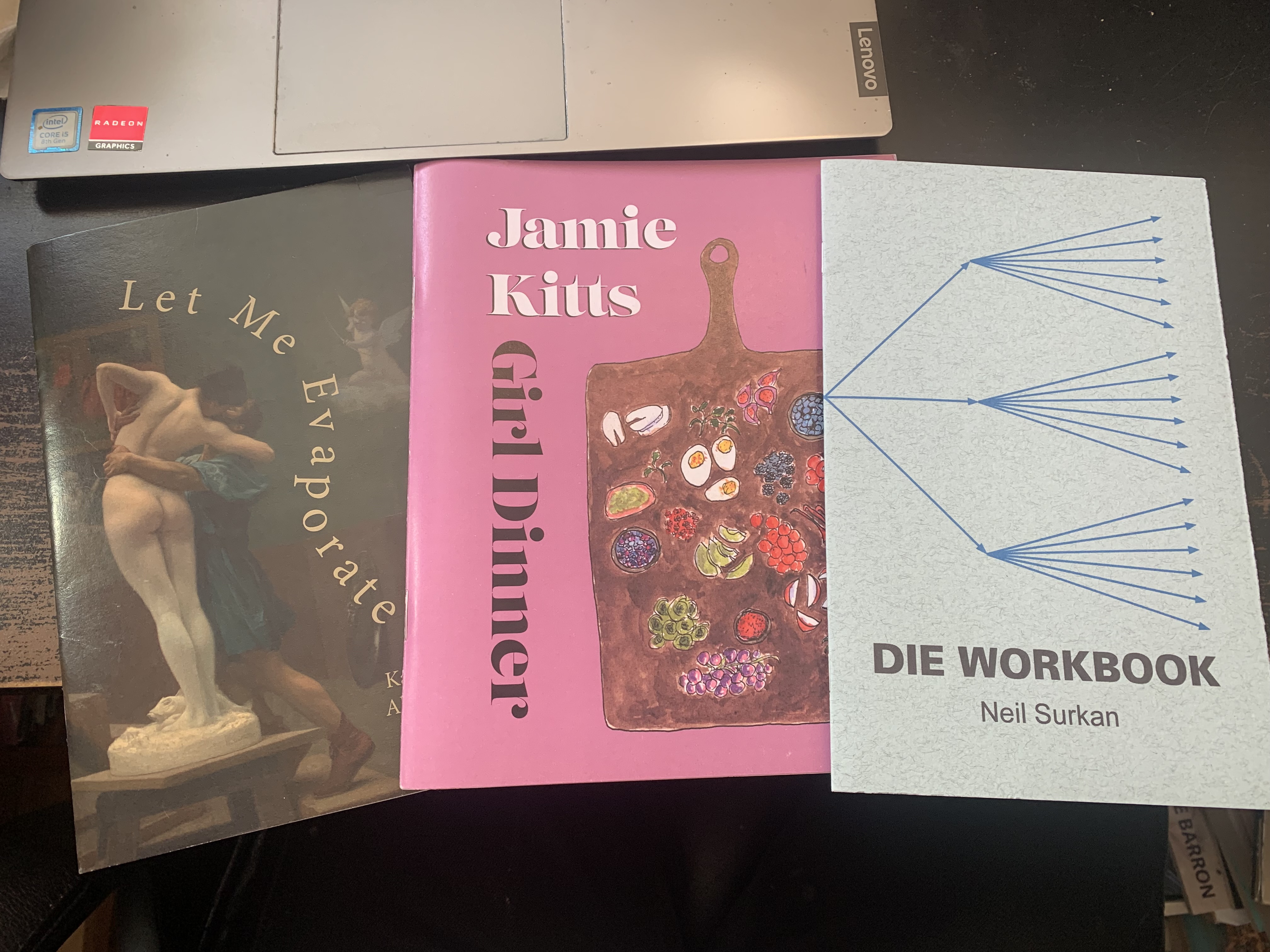
Calgary AB/Nanaimo BC: British Columbia poet Neil Surkan’s latest, following the full-length On High (2018) and Unbecoming (2021) [see my review of such here], both from McGill-Queen’s University Press, as well as three prior chapbooks [see my review of one of them here], is the chapbook Die Workbook (Calgary AB: The Blasted Tree, 2024), a short sequence assembled through self-contained and accumulated fragments. “Like a steaming cup in a shaking room,” the poem begins, “unmoored, your life belongs to chance. / Attend the damage. Our purpose is damage. / Once the earth reveals its restlessness, / the dead can’t protect you. / You mustn’t defend the dead.” The detailed sketch of his lyric is compelling, offering dense lines of lyric that extends into sentences, combining structures in a way I’d be interested to see him push further.

Drafting in my little shorts when I got home,” he writes, “my focus turned to a die: I began to experiment with corresponding each trapdoor with the die’s six sides, with precisely six options, so that a reader might roll a die and find one of six words filling in a given gap. In turn, they would come up with a particular poem in a particular moment (a riff, I suppose, on bibliomancy).” He writes of endings, of chance, writing a randomization process comparable to some of the sound work Ottawa poet Grant Wilkins has been doing lately, for example; he writes short bursts that assemble into something larger, more ongoing, one step after another.

The dead can’t protect you
once the earth reveals its relentlessness
like a brimming cup in a shaking room.
Sacred, your life belongs to chance –
you mustn’t defend the dead.
Accept the damage. Our lot is damage.

Toronto ON: Having heard her read a couple of years back through the Ottawa International Writers Festival, I was curious to see a copy of Let Me Evaporate (Toronto ON: Anstruther Press, 2024), the debut chapbook by novelist Katherine Alexandra Harvey, who, according to her bio, “splits her time between Newfoundland and Montreal,” working to complete a second novel and a full-length poetry debut. Harvey’s poems are first-person observational and gestural, comparable to monologues one might hear from a stage. “When you think of me in LA,” she writes, to begin the opening poem, “Hollywood Happened Differently For Me,” “think of Hollywood Hills // recovering from that death flu, my cough rattling across the wrap / around deck, how it was all painted white and I listened [.]” There is a clarity to these poems, these narratives, akin to lyric diary entries, working a narrator-character across a range of experiences. “All I really wanted,” she offers, as part of “Your Father’s Reputation Never Got You Anywhere,” “was for my father to know his lessons / resonated.” There are times I would like her lines to be a bit tighter, certainly, but I would be interested to see where she might land with a first full-length poetry collection; I suspect such an announcement isn’t that far off.

The Wake

I removed my belly button and paid attention to the healing process. No one believed I could feel the hole closing over, that it reminded me of being born. My mother was laid out on the kitchen table for a week. Formaldehyde high, you never noticed when my skin blackened. I felt undesirable. You called me a perpetual victim. I plucked out my eyelashes and pencil curled my hair so you wouldn’t see my edges. I watched them dig holes for all the women. Your only comment was that dress is too tight for a funeral put something else on for the love of God. My watery silhouette shadowed the tombstone. I swallowed dirt by the fistful. Found a worm and fed it crabapples for a calendar year. Get off on the cleanup. I pocketed ones all over town. I never bought the flowers after all this time.

Fredericton NB: From Ian LeTourneau’s Emergency Flash Mob Press [see their periodicities note on the press here] comes Fredericton poet and editor (qwerty magazine and Gridlock Lit) Jamie Kitts’ Girl Dinner (2024), an assemblage of poems composed as a curious mix of purpose, lyric styles and exploratory shapes. “I’m clay, sand, and limestone, / three parts,” Kitts writes, to close the poem “I’m at the Global Climate Crisis,” a piece subtitled “after a skeet by Juno Stump,” “three names / Bill and Blaine and Pierre / marked-up Sharpie my square body / the sudden nearest soonest violence / not the first, never / the last to serve cunt / at the global climate crisis.” There’s a swagger through Kitts’ explorations, politically and socially engaged and self-aware, composing poems attempting different elements around the first-person narrative lyric to see what works, what fits, what plays. There’s a confidence here, and an openness, seeking out what might be possible. “You over heaven, me in your eyes,” Kitts writes, as part of the playfully serious “This is not a poem, it’s a meme,” “Girl, I’m so fucking glad we’re not guys / Gender’s fake but we are not / IF SHE BREATHS, SHE’S A THOT [.]”

Thursday, December 08, 2022

ongoing notes: Jo Ianni, Leslie Joy Ahenda + Ryan Eckes,

[Cameron Anstee/Apt 9 Press]

We made it through another ottawa small press book fair! Can you believe it? The event was grand, by the way, and a packed house (with a few dearly missed friends/exhibitors, but we shall see them soon enough). And Pearl Pirie even posted a report on such, which was nice. Might the world be opening up again, slowly? Be aware as well that we’re returning to our holiday parties via The Peter F Yacht Club; mark your calendars for December 27th, everyone.

Toronto/Ottawa ON: From Cameron Anstee’s Apt. 9 Press comes inside inside inside (2022) by Jo Ianni, a Toronto-based performer, poet and organizer. Given Ianni’s work as a performer, I’m finding the visual elements of his poems absolutely fascinating, and would be interested to hear how a performer would perform such works that exude such visual properties, stack and staccatoed and staggered:

flick
absence
reappears in a
    
special
        
little
          
lick
    
cur from
 
all that noise
    
turned
       
round
           
click

There’s such a propulsion to these fragments, one that exists simultaneously with the fine precision of small, deliberate points, one word set carefully against another, a structure that sits closer to the aesthetic of the works of poets such as Nelson Ball, Michael e. Casteels and Anstee himself.

The sun welds me to
this here place
A shattered pair of glasses
in the gutter
Walking into sunrise ( everywhere )
big cabbage leafs
grow  make their shapes making
their shapes touch
and a bird shits good luck on my shoulder
Tries to

Toronto ON/Calgary AB: I’m intrigued by the twists and turns of Toronto/Tkaronto poet Leslie Joy Ahenda’s chapbook-length sequence The Republic of Home (2022), as published by Kyle Flemmer’s The Blasted Tree. Self-described on the title page as a poem “after / Inventory by Dionne Brand,” Ahenda’s meditative sequence, composed across November 2021, provides an increasing tally of dead across a temporal expanse. “twenty-four thousand two hundred and sixty-one,” she writes, to open the fifth section, “the children, the children, / two hundred and fifteen children, / then more, and more, and more // what else could possibly matter?” There’s a mutability to this poem, a shifting, almost a shimmering, to her structure that is intriguing, one that moves in and out of focus, allowing for a shift in states that is just enough to keep a reader slightly off-balance, including the shifts between numbering, moving from standard numbering to Roman numerals and back again. “then men here declare themselves / innocent of all events,” the fifth poem continues, “those that have happened / and those to come /// twenty-five thousand five hundred and forty-seven [.]” Ahenda incorporates Brand’s lines into her poem, weaving them into a lyric of mourning, of loss, one that can’t be fathomed but needs to be accounted, documented. “the dead, at least,” she writes, as part of “VII,” insist / on remaining countable / at least this [.]” Composed during the Covid era, she speaks of numbers but only hints at specifics, offering “when a woman mustn’t have that child,” as she writes in part eleven, “when, again, the men here say / she will and she’ll enjoy it? // when, again, a young man injures one, / murders two—let’s call it by its name, / no sense beating around these men— / without consequence?” One can only hope she is working on a full-length manuscript; I am very interested in seeing more work from her.

II

twenty thousand one hundred and thirty-two


let’s forget all this then

we instead pass our time
decanting each other’s bodies
as if aged, precisely, in oak, as
if precious, as if necessary

we forget every corpse along
the wind-stormed commute
to our bed where the sun casts,
for a moment, a paisley glow

on the wood-panelled floor,
the honeyed walls, the creeping ivy,
until, oh, those corpses spill in
through the window, so quiet

we didn’t, at first, take note—
at last, briefly, occupied


twenty-two thousand and one

Philadelphia PA: I’ve been taken with Philadelphia poet Ryan Eckes’ work for some time [see my review of a prior chapbook here], continuing his anti-capitalist lyric in the chapbook Old Light (Radiator Press, 2022). The poems assembled in this chapbook are each constructed through a kind of collage of direct statements that offer shapes not shown on the page, writing lines around a silence, an unspoken something, enough to provide it not only shape but voice. “most people have a name an address,” he writes, as part of the opening poem, “under the table,” “it’s true // you can buy lottery tickets for everyone in your family // you can read the sunday paper to your dog [.]” He writes of labour, economy and capitalism, articulating a working class lyric set in the shadow of language poetry and the prose poem. Isn’t Eckes due for another trade collection soon? I would certainly hope so.

HOV

i keep getting ads to be an uber driver, which reminds me of a term i learned in chile for adjunct professors—los profesores taxis—and a poem by russell edson in which a taxi driver turns into canaries as his car flies thru a wall and back out again. that’s where i’m at, jobwise. a cluster of canaries flying toward you. in chile, students started evading subway fares and it turned into a rebellion. now their government has to re-write the constitution. in the u.s., fascists are wearing t-shirts that way “pinochet did nothing wrong.” republicans and democrats have long agreed, so has the ny times: capitalism is the only way, they say, and some apples are bad. so the government keeps killing black people and jailing those who fight back. every employer encourages you to vote. your employer is running against your employer. they’ll never pay enough. how are you getting home tonight?

Tuesday, October 11, 2022

the book of smaller : some reviews, some interviews/podcasts, (oh, and ive some new chapbooks out,

I should have been mentioning, I suppose, some of the reviews coming in for the book of smaller (University of Calgary Press, 2022) (I still have copies for sale, don'chaknow). Kim Fahner, Margo LaPierre, and Jérôme Melançon collaboratively did a really stunning one, over at periodicities: a journal of poetry and poetics. Jami Macarty did a really neat one over at Miramichi Review (although I should point out that my references to Sainte-Adèle were to the village in Quebec, and completely unrelated to Vancouver poet Adèle Barclay). Benjamin Niespodziany provided a short review via Neon Pajamas, which was pretty cool. And there are even some wee reviews over at the book's Goodreads page! What! I mean, even the CBC recommends you read this book, so what are you gonna do?

Susan Johnson interviewed me on the collection on her Friday Special Blend recently, so be sure to listen to the podcast of that. Andrew French also interviewed me for the same via his podcast, Page Fright: A Literary Podcast.

Amanda Earl also interviewed me recently for her podcast, The Small Machine Talks, on the recent 29th anniversary of above/ground press. Pearl Pirie conducted a brief interview with me around the new book, and I answered Colin Dardis' questions via his Fill Your Books! Oh, and I answered Michael Murray's questionnaire recently via his Galaxy Brain (I should probably point out that I post links to all of my interviews here as they appear, in case you ever wonder about those).

Also, did you see that Greg Bem provided a wee review via Goodreads of my chapbook, Autobiography (above/ground press, 2022)? Oh, and I've a new chapbook out now with paper view books, 4 poems on receiving the phizer covid-19 vaccine (second shot, (2022) (my first chapbook published in Portugal!), and another small item out with Kyle Flemmer's The Blasted Tree, Canadian Poem (2022). And I've a chapbook forthcoming with Rose Garden Press as well, sometime next month. There's probably other stuff I'm forgetting about right now, but these are some highlights. I mean, there is just so much going on! What!

Monday, September 19, 2022

Ongoing notes: mid-September 2022: Andy Martrich/Nicole Raziya Fong + Dakotah Jennifer,

Can you believe there’s another small press fair in Toronto this weekend? On Saturday, come by Toronto’s Harbourfront for the Small Press Market curated by Kate Siklosi and hosted by the Toronto International Festival of Authors! I’ll be there with above/ground press, naturally, alongside InPrint Collective, Anstruther Press, Dumagrad Books, Knife Fork Book, Guernica Editions, Simulacrum Press, Proper Tales Press, Gordon Hill Press, Invisible Publishing, Baseline Press, Book*hug Press, Gap Riot Press, Teama Publishing, Puddles of Sky Press, nOIR:Z and Serif of Nottingham. And did you see the report I posted recently from the Fisher Small and Fine Press Fair?

Calgary AB: I’m just now going through Leguminosae Delusion Athletics (Calgary AB: The Blasted Tree, 2021) by Andy Martrich and Nicole Raziya Fong, a lovely hand-sewn chapbook produced in an edition of sixty copies. Leguminosae Delusion Athletics exists as a collaboration between Martrich, an American writer living in France, and Fong, a poet based in Montreal. Moving through the assemblage of text and image, the long poem is set as a sequence of untitled and seemingly self-contained bursts of text, one per page, writing a thread referencing a particular family of plants (beans, legumes). There is a curious way both the text and the artwork curl in and around, wrapping meaning and image around and across a sequence of accumulating threads. “Ready to create a family and shelter to cache,” one section begins, “preservation and canned goods // Constructing a snow fort / nodding and grinning with nonverbal / understanding of the day // Attempting to wake the kids with a bullhorn / while bright and coiled in packed ice / Spy vs. Spy where one begins the end of the other / bordering spoiled iconography [.]”

According to a note on the chapbook included on Fong’s website: “Leguminosae Delusion Athletics is a collaborative poetry and art project about representative absence. Dynamism is treated as a form of ritual delusion throughout the long poem, composed by Andy Martrich, lingering on the cusp of afflictions that can’t be undone. The accompanying art, by Nicole Raziya Fong, draws from cues in the text, corresponding to different sections of the poem and mirroring the disassemblage of apparent forms and figures.” As the opening piece reads:

From the point of view of the safety
the physical safety of our leguminosae
better to fan than to compress
 

From the view of accessibility
cutting-edge methods make division practicable
gratuitous molting glimpses imago
 

Catalogs preceding recognition foster evil wished
upon the egg
shedding omniscient bloodsucker
 

Poised toothless
photomapping by robotic helicopter
spreading wings as a material ear through

suspended weather

To know when to drop into the unincorporated
area where you were born
accentuate a very high temperature without the

relief of melting

A ring-around-the-erotica public seafront where
the docks come alive with electric pulse

New Jersey: Behind on everything, but just now getting to Dakotah Jennifer’s chapbook debut, FOG (Bloof Books, 2019). According to the author biography at the back of the collection (information three years out of date now, obviously), “Dakotah Jennifer is an eighteen-year-old black writer currently attending Washington University in St. Louis.” There is an impressive clarity and liveliness to the work here, no matter how old the author might be. This is a lyric that strikes, in part, for its directness. “How do you travel from south carolina to New York in bare feet.” she writes, as part of “The American Protection Against Black Violence Act,” the poem that opens the small collection. “Who was the president in 1863. / Why did he free the slaves. / What is the definition of an ally. / Do you know what the paper bag test is. Do you approve.” She writes how history impacts the present, writing on race, politics and social issues. As her author biography continues: “Jennifer writes about race, class, and gender, stretching her emotions into tangible things. She strives to write things that grow.” Given the strength of the poems assembled here, I am expecting great things from Dakotah Jennifer, and not simply just the possibility of a full-length debut; there is a powerful, passionate and patient resolve to these poems, one that works to document and articulate, in not just an abstract hope but a pointed demand for something better.

Proof

You want to know why they ask you for proof,
For evidence in the case,
You know they’ll never indict a man they see themselves in

But you try anyway.
You want to know why you don’t cry when they boys are dead

   
but when they are alive.
Why you mourn the country and not the fallen.

You count stars as if they are not already dead.
You tell oblivious boys you love them and then run away with it.

You know only what you have been told about the struggle,
But also what you trek through every day.

You don’t believe the reports until you see the footage.
You cringe at the gunshot before you realize they did too.

You write poems about boys that aren’t dead or dying,
You make them immortal when they already are.

You write down black and it turns to dust.
You hope to exist but disappear in the mirror.

You research hate crimes to give them the numbers.

They don’t believe you.