Showing posts with label Amanda Earl. Show all posts

Saturday, October 31, 2026

Ongoing notes: The Fisher Small + Fine Press Fair (part three, : Amanda Earl/Matthew Walsh + Ambrose Albert,

See part one here, of course. And part two. And my report on the event. And we will see you at the ottawa small press book fair on November 14, yes? And the reading the night prior? And, I suppose you might wonder, why am I only covering two publishers across this range of notes? There weren’t any other chapbooks I managed to pick up! I mean, I can’t review what I don’t see.

Ottawa/Toronto ON: I’m always intrigued to see collaborations, especially from poets of whose work I am already fond, so was pleased to see Amanda Earl [see my review of Earl’s latest here] and Matthew Walsh’s [see my 2025 interview with Walsh here] call-and-response collaboration Slutflowers (Toronto ON: knife fork book, 2026). “I have this concern with my own death / that I feel in my bones,” begins the poem “Scythe and Fate,” “especially it has / taken up a spot in my ilium bone, placed / above my acetabulum. I feel that it’s / a poet’s job to think of the existential, mark / down that what confuses me into a notebook which / I can burn before my death or not.” Slutflowers is an assemblage of short poems composed via a technique borrowed from American poet Terrence Hayes, “a technique of using words from an existing work for end words of a poem.” Gestural, performative and sly, these are poems riddled with self-conscious desire composed via constraint and resistance, even as they allow themselves to not follow their own rules. “I am missing some of the lines on my hands / for palmistry. I drink out of them,” begins “Palmars,” “cupped / below the faucet, from the heart and life over / and over ad nauseum.” As Earl offers in the acknowledgments, writing: “Matthew approached me with this method as a way of writing our collaborative chapbook. I suggested we use as our source, Jean Genet’s Our Lady of the Flowers (1963), one of my favourite deviant resources. We assigned each other ten random pages. If we felt like it, we responded, in some way, to each other’s poems.” And while one might speculate on which poet composed which piece or pieces, as a straight back-and-forth between the two, I think there is something to be said for refusing to place any poem with one over the other.

Scattered

Tonight dear reader, I am tired of being wooden.
A man I met writes to me of dude books which are effigies
I’d like to burn because how often I feel other
by my lack of inclusion and am just one of the masses
of women disappeared by the canon as if we are the same
nothings not as sweet as these dudebros want us to be but
fundamental
to their nonsense is all of this resentment.
We don’t have the luxury of being contemplative.
They relegate us to quietism.
I wish them the same.

Toronto ON/Fredericton NB: The latest from poet Ambrose Albert is the chapbook cross/faded (Toronto ON: Anstruther Press, 2026), a collection of twelve sharp-edged first person lyrics. “they call the phenomenon ‘the brain zaps.’” begins the short poem-burst, “coup de foudre,” “I call it the air before a thunderstorm. / metal on your tongue. scent more / ozone than petrichor. harsher. / you’re all sweat and dizzy / from the buzz. the crackle of it.” Albert’s lyrics hold the tone and tenor of monologues, quietly performed, but performed nonetheless, holding gesture and truth across carved lines of syntax and angles, including the poem “top surgery and it’s completely different but also still / top surgery,” that includes:

it’s theorized the missing appendages from Greco-Roman statues
were a result of censorship. everyday wear and tear. trans ancestors
entrust me a chisel, there’s an angel in the marble to be freed.


Tuesday, September 01, 2026

rob mclennan on Kyeren Regehr's The Poet Laureate Podcast,

I was interviewed on-stage by Kyeren Regehr (Victoria, British Columbia's seventh poet laureate, by the way, who I interviewed as part of the episode, also) as part of The Poet Laureate Podcast back in the spring [see my report on such here], which is now available to listen to! As part of the promotion for such, Kyeren writes:

"In this special double-interview episode, rob and Kyeren sit down to trade roles: interviewer/interviewee. Their conversation moves between the public weight of municipal laureateships and the quiet discipline of the page, digging into city politics, writer's retreats, and the art of the occasional poem  and more. It’s an unscripted, wide-ranging conversation about creative momentum, memory, missed contest deadlines, and the sheer joy of making stuff without asking for permission. (Plus: cake.)

With gratitude to Arc Poetry Magazine for their generous sponsorship, and to The City of Victoria"

Also, be aware I'm reading on Saturday, September 12 as part of Amanda Earl's ottawa the real surreal, alongside Amanda, Ellen Chang-Richardson and Manahil Bandukwala. We're reading poems on and in front of four different Ottawa Centretown locations! See information on such here.


Tuesday, December 02, 2025

new from above/ground press: Cahill, Earl, Cavaleri, Niespodziany, Comay/Fagan, Birchard, Chernoff, la Rocque, carisse, Hill, Nećakov, Siklosi + Bjerg/Jung,

BAD TEMPOR, Jimmy T Cahill $6 ; SOCIALLY AWKWARD GHOST, Amanda Earl $6 ; Studies, Micah Anthony Cavaleri $6 ; The Man, a sequence of foolish men, Benjamin Niespodziany $6 ; The Sun Will Bleach It Away, Rebecca Comay / Cary Fagan $6 ; DIDIKUY, Guy Birchard $6 ; SLOPTIMISM of the WILL, MLA Chernoff $6 ; Circling the Black Sun, Lance La Rocque $6 ; That H uman E ffluence A nd P lastic, russell carisse $6 ; a nest, a burrow, a lea stone, Jeremy Luke Hill $6 ; The World is Beautiful, Lillian Nećakov $6 ; household: meadow, Kate Siklosi $6 ; eyesore, Johannes S.H. Bjerg and Charlotte Jung $6

published in Ottawa by above/ground press

October-November 2025
a/g subscribers receive a complimentary copy of each


And did you see my report on this past summer's above/ground press 32nd anniversary event?


To order, send cheques (add $2 for postage; in US, add $3; outside North America, add $7) to: rob mclennan, 2423 Alta Vista Drive, Ottawa ON K1H 7M9. E-transfer or PayPal at at rob_mclennan (at) hotmail.com or the PayPal button (above). See the prior list of recent titles here, scroll down here to see a further list of various backlist titles, or click on any of the extensive list of names on the sidebar (many, many things are still in print).

keep an eye on the above/ground press blog for author interviews, new writing, reviews, upcoming readings and tons of other material
; and you know above/ground press has a substack now? sign up (for free!) for announcements, and even new features! catch recent/forthcoming interviews with Guy Birchard, Jill Stengal, Lillian Nećakov, Cary Fagan, Renée Sarojini Saklikar, Ken Norris, Michael Sikkema, Ben Ladouceur, Nathanael O'Reilly, Micah Ballard, Lydia Unsworth, Amanda Earl, Buck Downs, russell carisse etc.

With forthcoming chapbooks by: Glenn Bach, Travis Sharp, Sonja Greckol, Frances Cannon, Stuart Ross and Jason Camlot, David Gaffney, Kevin Spenst, Jill Stengel, Mrityunjay Mohan, Buck Downs, Salem Paige, Robert van Vliet, David Phillips and probably others! (yes: others,

AND 2026 SUBSCRIPTIONS ARE NOW AVAILABLE (but you probably already know that,

Friday, November 21, 2025

The Factory Reading Series pre-small press book fair reading, November 21: Stuart Ross, Liam Burke + Amanda Earl,

span-o (the small press action network - ottawa) presents

The Factory Reading Series
the pre-small press book fair reading

featuring readings by:
Stuart Ross (Cobourg ON)
Liam Burke (Ottawa)
+ 
Amanda Earl (Ottawa)
lovingly hosted by rob mclennan
Friday, November 21, 2025
doors 7pm; reading 7:30pm
Anina’s Café, 280 Joffre-Bélanger Way

[And don’t forget the ottawa small press book fair, held the following day at the Tom Brown Arena]


Stuart Ross [pictured] has worked in the small press trenches of Canadian writing for 50 years. His new chapbook, The Thing About the Thing in Exile reprints a dozen poems that appeared in his first publication at age 16, plus a new essay. He has published over 20 books, most recently the poetry collection The Sky Is a Sky in the Sky, the Trillium Book Award–winning memoir The Book of Grief and Hamburgers, and the short story collection I Am Claude François and You Are a Bathtub. He has received the Canadian Jewish Literary Award for Poetry and the ReLit Award for Short Fiction, as well as the Harbourfront Festival Prize for his contributions to Canadian literature. Stuart runs the Feed Dog Book imprint for surrealist poetry at Anvil Press and the 1366 Books imprint for experimental fiction at Guernica Editions, and has been running his own Proper Tales Press since 1979. He lives in Cobourg, Ontario.

Liam Burke (he/him/himbo) lives in Ottawa, Canada, on unceded Algonquin Anishinaabe land. He is the winner of the 2023 Diana Brebner Prize, and is most recently the author of status ailment (Anstruther, 2025) and the co-author of Orbital Cultivation with Manahil Bandukwala (Collusion, 2021) and machine dreams with natalie hanna (Collusion, 2021) which was shortlisted for the 2022 bpNichol Chapbook Award. He was shortlisted for the 2022 Austin Clarke Award for a collaborative poem with Manahil Bandukwala.

Amanda Earl  (she/her) writes, edits, reviews, publishes and makes mischief on the unceded territories of the Algonquin Anishinaabeg Peoples. Earl is the managing editor of Bywords.ca and the editor of Judith: Women Making Visual Poetry. Subscribe to her Substack, Amanda Thru the Looking Glass and buy limited edition gorgeousness from Creatively Yours, her forthcoming year-long whimsical collaborative creation with her husband, Charles Earl. Her latest chapbook, her eleventh with above/ground press, is SOCIALLY AWKWARD GHOST (2025). More info: AmandaEarl.com. Instagram: earlamanda.

Saturday, May 24, 2025

Sunday, October 29, 2023

Amanda Earl, Beast Body Epic


Feathermarked along or frost-etched
deep into and below. Stalactites
suspended into the dark and my body.
Am I destroyed or am I armoured?
Was I tough? Did I hang on against
all pronouncements?

One of the frustrations of no longer running a trade literary press is that we would have easily produced one or two further titles by Ottawa poet Amanda Earl beyond her full-length debut, Kiki (Ottawa ON: Chaudiere Books, 2014), so it was a delight to see her self-produce her latest, the book-length Beast Body Epic (Ottawa ON: AngelHousePress, 2023) [launching online on November 12]. Beast Body Epic directly responds to the author’s health crisis from a few years back, and the ongoingness of Earl’s expansive lyric and visual structure echoes, slightly, of how Dennis Cooley responded to a burst appendix, through his departures (Winnipeg MB: Turnstone Press, 2016) [see my review of such here]. As Vancouver poet and editor Elee Kraljii Gardiner writes as part of her introduction to Beast Body Epic: “She leans into visual poetry, the epic, allusion, disassociation, memoir, verse, prose, fable, allegory, and other modes in order to tell a complex story in a surprisingly succinct work. The variation is not only necessary, it’s seamless, and Amanda’s text flows with the protagonist through crisis into stasis and onward.” Gardiner is an interesting choice to write an introduction, as she knows full well about experiencing a medical crisis and exploring the same through lyric: her collection Trauma Head (Vancouver BC: Anvil Press, 2018) [see my review of such here] is “a book of poetry about [her experience with and after] an arterial dissection and stroke [.]”

Throughout her book-length epic, Earl offers a dense language of sound and play, traversing visual, prose, lyric experimentation and flourish, occasionally sketching a kind of narrative point-form. “Death spent years as the taker.” she writes, early on in the collection, “Loaded art into their conversation. / The Rot was too drunk and needy, couldn’t breathe. / She nightmare herself to sleep. / The sun ceased. // The fluttering started and didn’t stop. / First the pigeons, then the crows. / Black wing over black wing. / There’s a wolf in the labyrinth, / the Rot’s husband told her.” Earl’s lyrics and visuals are wildly performative, capable of incredible grace, flourish, anguish and precision, as required. “A nurse gives me Tylenol 3,” she writes, mid-way through the collection, “a gown / and long white compression socks. / I feel like Anne of Green Gables or / maybe Raggedy Anne, my body / stuffed full of rags, my clothes too / big for me, a little orphan girl without / parents or anyone to save her.” This is a collection that somehow manages to fly in multiple, even contradictory structural directions simultaneously, while holding together as a clear book-length work with a narrative through-line. If you haven’t been paying attention to the ongoing work of Amanda Earl [see my review of her stunning Judith: Women Making Visual Poetry anthology here], you clearly need to begin.


Thursday, March 23, 2023

Ongoing notes: late March, 2023: Amanda Earl + Nada Gordon,

I can’t believe you’ve been missing out on our thirteenth annual VERSeFest: you know you can stream each of our events for free, yes? Whether live or archived? There’s so much going on!

Ottawa ON/Montreal QC: From James Hawes’ Turret House Press comes Ottawa poet Amanda Earl’s latest chapbook, Fear of Elevators (2023). Given how much of her past few years have featured heavily on producing visual works, most of which is part of her work-in-progress “The Vispo Bible,” it is good to see Earl still exploring ideas through text as well. Working through her anxieties around elevators, living on the nineteenth floor of a downtown Ottawa apartment building, her introduction to the collection begins: “Fear of Elevators began when the elevators in my building were being repaired and replaced.” Constructed as a collage of prose—essay, fiction, fairy tale, archive, memoir—and poetry, from the narrative lyric to the visual. Earl playfully moves back and forth with ease across fragments and directions, and even offers her own reworking of Robert Frost’s infamous poem “The Road Not Taken” (first published, as I’m sure you know full well, in the August 1915 issue of The Atlantic) through her poem, “The Elevator Not Taken.” She manages to echo the cadence and rhythms of Frost’s piece quite well, and the playfulness of this particular poem is rather delightful, as the first half reads: “Two elevators fell and rose in a highrise. / And glad I could not travel both. / And be one traveler, long I stood. / And looked up at once as high as I could. / To where it lurked on the top floor. / Then took the other, as just as dangerous. / But having perhaps the more expedient claim, / because it had arrived and I had to pee. / Though as for that elevator passing / there was a worn down as the other, / really about the same.”

There is something curious about the way Earl utilizes collage for this particular item, furthering a structure she’s been employing for a while now, simultaneously pencilling a through-line across what might be seen as a scattershot of layered sections, one on top of each other. The effect is interesting, and one she’s explored for some time, with varying degrees of success. It is interesting to see her expand the possibilities of chapbook-length structure; might this be something eventually book-length as well?

In the Roppongi Hills complex in Tokyo, Japan there have been 32 accidents involving the revolving door since the building’s opening in April. A six year old boy was killed. Seven people became stuck in the revolving doors & three had to be taken to the hospital by ambulance for treatment after suffering serious injuries. The company also said 20 accidents have occurred involving smaller, hand-pushed revolving doors. The sensor doesn’t activate at first & the door continues to revolve for at least 25 centimetres. Mori Building is Japan’s biggest private developer. Sanwa shutter fell 14 yen, or 2.2 percent to 619, on Friday.

Evil revolving door tries to kill clueless innocent people! Looks like someone tries to enter the wrong way from the left? Is this a hit and run? Or is the wind blowing too fast? The glass shattered perfectly fine, like safety glass is supposed to: Instead of large dangerous pieces of glass which could kill, safety glass breaks into tiny pieces which won’t do as much damage.

Brooklyn NY: For a while now, Brooklyn poet Jordan Davis has been producing chapbook-length volumes of selected poems, one of the latest is by Brooklyn-based American poet Nada Gordon, her The Swing of Things (Subpress, 2022). This is the first of Gordon’s works I’ve encountered, so I’m unaware of the larger scope or scale of her work, so this “remix” is a curious introduction, and one reminiscent of how Phil Hall reworked selected scraps to assemble his own critical “selected poem,” Guthrie Clothing: The Poetry of Phil Hall, a Selected Collage (Wilfrid Laurier University Press, 2015) [see my write-up on such here]. The chapbook-length poem “The Swing of Things” is structured through untitled sections (as well as an array of photographs, some of which suggest their own collage-works), short bursts that exist across each page; some of which group, or even cluster, allowing for its own kind of collage-work possibility. Her visuals and text both suggest the familiar but one that is twisted, turned and shaped into what is unerringly new, and some of which is just enough to unsettle, question or even simply wonder. Gordon’s poems hold a delightful heft, subtle in its play and dark corners, writing from both the shadow and the sudden light.

I believe in meerkats –
Where’re you from, you long skinny
curious dark-eyed thing?


If I fall into the hole of this poem
will you pull me out?
It’s a hairy catastrophe,


like putting HOT PINK PAINT
on an apocalyptic feeling, stinking a little
of the would-be sublime

Tuesday, October 11, 2022

the book of smaller : some reviews, some interviews/podcasts, (oh, and ive some new chapbooks out,

I should have been mentioning, I suppose, some of the reviews coming in for the book of smaller (University of Calgary Press, 2022) (I still have copies for sale, don'chaknow). Kim Fahner, Margo LaPierre, and Jérôme Melançon collaboratively did a really stunning one, over at periodicities: a journal of poetry and poetics. Jami Macarty did a really neat one over at Miramichi Review (although I should point out that my references to Sainte-Adèle were to the village in Quebec, and completely unrelated to Vancouver poet Adèle Barclay). Benjamin Niespodziany provided a short review via Neon Pajamas, which was pretty cool. And there are even some wee reviews over at the book's Goodreads page! What! I mean, even the CBC recommends you read this book, so what are you gonna do?

Susan Johnson interviewed me on the collection on her Friday Special Blend recently, so be sure to listen to the podcast of that. Andrew French also interviewed me for the same via his podcast, Page Fright: A Literary Podcast.

Amanda Earl also interviewed me recently for her podcast, The Small Machine Talks, on the recent 29th anniversary of above/ground press. Pearl Pirie conducted a brief interview with me around the new book, and I answered Colin Dardis' questions via his Fill Your Books! Oh, and I answered Michael Murray's questionnaire recently via his Galaxy Brain (I should probably point out that I post links to all of my interviews here as they appear, in case you ever wonder about those).

Also, did you see that Greg Bem provided a wee review via Goodreads of my chapbook, Autobiography (above/ground press, 2022)? Oh, and I've a new chapbook out now with paper view books, 4 poems on receiving the phizer covid-19 vaccine (second shot, (2022) (my first chapbook published in Portugal!), and another small item out with Kyle Flemmer's The Blasted Tree, Canadian Poem (2022). And I've a chapbook forthcoming with Rose Garden Press as well, sometime next month. There's probably other stuff I'm forgetting about right now, but these are some highlights. I mean, there is just so much going on! What!

Thursday, July 01, 2021

Judith: Women Making Visual Poetry, ed. Amanda Earl


The challenge of reception remains. How to make such work – by women in particular – visible within the general clutter of literary publishing and the larger field of cultural noise. But as gender politics in publishing meets the fertile graphical-poetic imagination of so many talented and engaging writers, these issues will resolve themselves. The terms ‘visual’ or ‘concrete’ seem less and less necessary as identifiers that separate one category of works from the larger field. All works of written poetry are graphical, but only some take advantage of that in interesting ways. The wonder is that such a varied and prolific outpouring is taking place – and being given the kind of notice signalled by this anthology. For someone of my generation, whose work was systematically denigrated, or, alternately, merely ignored, this is an excellent development to witness. Perhaps it will also serve to remind women of what is at stake in being in control of our own language – since that is where the political efficacy of our subjectivity resides. The politics of gender are not diminished in these days, only transformed, and the polymorphous approach to authority is intimately bound to questions of self-determination. If I cannot speak myself in terms appropriate to the symbolic presentation of my being, then how am I to act with the full warrant of citizenship in the linguistic world? The question can only be answered across the broad spectrum of gendered positions, beyond binarisms and oppositions, but also, cannot ignore the legacies structured into our language and the visual presentation of our selves. (Johanna Drucker, “(In)Visible Women or Gender in Concrete”)

It would be hard not to be amazed by Ottawa poet, editor, critic and publisher Amanda Earl’s incredibly expansive, inclusive and long-awaited anthology Judith:Women Making Visual Poetry (Malmö, Sweden: Timglaset Editions, 2021), a book funded, in part, through an impressive crowdfunding campaign earlier this spring. Subtitled “A 21st century anthology,” Judith is named for Vancouver poet Judith Copithorne, who is known as the first woman in Canada to engage (in a sustained, ongoing way) with visual and concrete poetry, appearing in such important early Canadian concrete/visual poetry anthologies as the four author Four Parts Sand (Ottawa ON: Oberon Press, 1972), John Robert Colombo’s New Directions in Canadian Poetry (Toronto ON: Holt, Rinehart and Winston, 1971), bpNichol’s The Cosmic Chef (Ottawa ON: Oberon Press, 1970) and bill bissett’s THE LAST BLEWOINTMENT ANTHOLOGY VOLUME 1 (Toronto ON: Nightwood Editions, 1985), as well as in more recent volumes such as The Last Vispo Anthology: Visual Poetry 1998-2008 (Fantagraphics, 2012) and The New Concrete, Visual Poetry in the 21st Century (Hayward Gallery Publishing, 2015). For years now, Ottawa writer/publisher/bookseller jwcurry has been referring to Copithorne as “our first lady of concrete,” and Copithorne has actively been producing and publishing since the late 1950s. Earl’s acknowledgment of Copithorne is wonderfully appropriate, although it is curious to note that the first volume of concrete and visual works produced in Canada was actually (as jwcurry once offered) Lozenges: Poems in the Shapes of Things (London ON: Alphabet Press, 1965) by poet Colleen Thibaudeau (1925-2012), a title that appeared mere months prior to the first publications by bpNichol himself, who spent an entire career working, among other forms, concrete and visual poetry. In the context of Thibaudeau’s own work, her experimentation with visual forms through Lozenges, published by her husband, the poet James Reaney, appears to have been an outlier; a line of experimentation set aside for her eventual and lengthy career focusing on more narrative forms of poetry.

Judith includes a foreword by Johanna Drucker, “(In)Visible Women or Gender in Concrete,” and introduction by Earl, “This Book Is an Action,” and the two trace the reasonings and arguments for examining these kinds of works, and theories for why so much of this has been historically overlooked. As Earl writes: “Over the years, I have been told numerous times by male publishers, editors, and visual poets that few women make visual poetry. And judging from visual poetry anthologies published in the twenty-first century, this appears to be true, with representation of women between 12-21% except for Women in Concrete Poetry and Poesia Visiva both of which publish works from the twentieth century.” As a response to that repeated assertion, Earl offers a comprehensive list of “1181 Women Making Visual Poetry” (a list that has grown since to more than 1200 names in her ongoing Google doc). The list of so many historical and practicing artists simply add to the heft and very essence of this collection: how could so many artists be overlooked, and for so long? As Earl introduces the list of names:

Beginning in April, 2019, Joakim Norling and I began to record the names of women making visual poetry in a shared spreadsheet in order to select potential contributors for the anthology. We easily reached 100 names and began inviting contributors to the book by the summer. The list kept growing. I asked for more names from our contributors and through social media. This list is the work of a community, many communities, with a shared goal to increase the visibility of women making visual poetry. we received names from editors, publishers and visual poets. Our list expanded to include Arabic calligraphers, Native American Ledger artists, quilters, word painters, photographers, sculptors and more. I found even more women sharing their visual poetry in the form of embroidered texts, collages, wearable art. We have included only the names here, but many of the women listed are easy to find on Google.
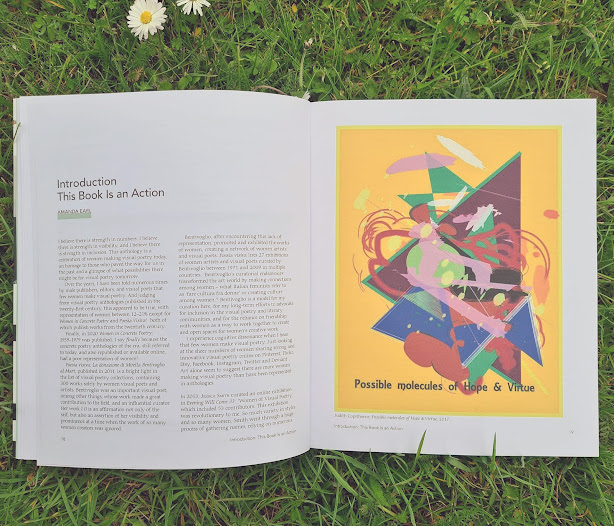
At the core of the collection sits works by a selection of artists from around the world working in visual and concrete forms: Rosaire Appel (USA), Viviane Rombaldi Seppey (Switzerland/USA), Kimberly Campanello (USA/Ireland/UK), Iris Colomb (London, UK), Amanda Earl (Canada), Judith Copithorne (Canada), Cinzia Farina (Enna, Italy), Ankie van Dijk (Netherlands), Satu Kaikkonen (Finland), Mara Patricia Hernandez (Mexico/USA), Dona Mayoora (aka Don May and Donmay Donamayoora, USA), Terri Witek (USA), Astra Papachristodoulou (UK), Karenjit Sandhu (UK), Mado Reznik (Argentina), Lenora de Barros (São Paulo, Brazil), Petra Schulze-Wollgast (pws) (Rostock, Germany), Ruth Wolf-Rehfeldt (Germany), Kate Siklosi (Tkaronto/Dish with One Spoon Territory/Toronto, Canada), Ines Seidel (Munich, Germany), Hiromi Suzuki (Japan), Erica Baum (USA) and Audra Wolowiec (New York, USA). The large format, as well as so many stunning, full-colour images give the collection the physical sense of a coffee table book, and each author’s section includes artist’s statements, a note on another artist that influenced their work, and a recent discovery, all of which provide context and further information on these artists and their works. As part of such, it is interesting to see the cross-influence between contributors: Kate Siklosi offers Ines Seidel’s work, for example, as her influence, and Astra Papachristodoulou as her discovery. As Siklosi writes on Seidel:

Ines Seidel’s work further instills in me a poethics of care, and of finding strength in fragility, that carries me through my poetic practice and beyond. In her work, she painstakingly sews paper and other materials together into wonderfully intricate sculptures – and in this delicate practice, she has taught me the creative value of patience and of ‘staying with the trouble’ while creating work that commands such acute attentiveness and care. This care-ful mindset toward the work has also been an incredibly sustaining ethos for me personally – and throughout 2020, it has been a critical tool for me in terms of working through and responding to the complexities of the world. Her work also informs my object work in terms of illuminating the constructed fabric of our reality, and the powerful and necessary role of creative intervention in that fabric to showcase both the resilience, transience, and beauty inherent in our being.

One of the elements interesting through this list, and this anthology, is the way in which Earl has really provided an expansion of the term “concrete and visual poetry” to include such forms as “embroidered texts, collages, wearable art” and multiple other ways in which artists explore text, a number of which were long dismissed, I might suspect, as merely being “women’s work” and not as any serious, sustained form. There are examples of more traditional considerations of visual and asemic writings in the collection, but Viviane Rombaldi Seppey, for example, works three-dimensional pieces with source materials including maps and phonebooks, and Kate Siklosi works with images of print on leaves and bark. Astra Papachristodoulou works with three-dimensional pieces, and her works in the collection include a puzzle, test tubes and candles. Her statement reads: “My work explores the confluence of poetry and art through a range of diverse sculptures that hopefully outgrow their minimalist bounds. I mainly use ecologically friendly materials such as bio-resin, beeswax and wood to respond to the urgent ecological challenges we face today. My object poems often have an interactive element and present alternate ways for poetry that is not fixed to the page. Extrapolating from my work is a set of techniques and values characterized by the layering of meanings and materials.” Through Judith, Earl’s sense of concrete and visual opens wide to include elements that had already appeared on the periphery of a peripheral form, now set in an accumulated centre of an expanded form that connects not only to literary writing but to larger and multiple considerations of conceptual art (I suspect a fraction of this comes from the fact that the publisher was open to including works, including photographs, in full colour). This collection not only expands the conversation of concrete and visual works, but connects those conversations to multiple other conversations already in-progress. As London, England-based contributor, Iris Colomb, writes for her included statement:

I am interested in the materiality of language and the ways in which text can exist both visually and performatively. Most of my projects involve building different relationships between these two states and exploring possibilities beyond linear written and spoken text. My visual poems are usually the starting points or the results of performances; they either function as performance scores or as the alternative spatial outcomes of time-based works. I enjoy producing textual objects that allow poems to adopt independent and changing structures. Their delivery is often affected by aleatoric or material elements developing through a physical engagement with the text as a three-dimensional thing to be manipulated. The material and visual elements of these objects create a space for additional layers of meaning, which cannot be dissociated from their linguistic content. When a performative piece becomes the starting point for a visual poem the process involves both a form of translation between media and a second state of poetic composition. My projects can therefore be led to take on multiple forms, both visual and performative. This aspect resonates strongly with both my conceptual and aesthetic concerns.

Adding even further to the heft of this collection, Judith concludes with a handful of essays: “A World of Signs: Women of Asemic Writing” by Natalie Ferris, “Handle with Care: A Study in (Poetic) Fragility” by Kate Siklosi, “Interview: The Thread Between Craft and Language” by Amanda Earl, and “Light and Code: Digital Ecologies of Poetic Form” by Fiona Beckett. Judith explores far more than the ways in which individual artists have chosen to work, but the real nuts and bolts of literary creation in a wide range of possibilities, from sewing leaves and gallery space to digital creation. Judith explores creation, and the shifts within the form and the ways in which form opens, in ways not traditionally approached by male writers. This really is a remarkable collection, and deserves to remain in print for as long as possible. As Ferris offers as part of her essay:

            However, for women the gestural, indecipherable or encoded offered not only the opportunity to challenge language’s monopoly on expression, but to challenge the patriarchy’s monopoly on meaning. Throughout history and across cultures and continents, women developed writing systems for their own use; often excluded from educational regimes designed for men, women turned to expressive registers to devise their own, individual or collection, and often secret, means of communication.

This collection is masterfully put together, both in form and in concept, and even includes, at the very end, an “In Memoriam,” a list “to honour and remember women visual poets and artists who died in the 21st century.” What is lovely about this collection is the sheer expansiveness of it, allowing anyone interested in the form further information on the potential handful of names they might already be aware of, as well as a series of worthy introductions to an incredible array of artists, providing a spring-board for an incredible amount of potential further study, research and creation. The approach to this collection is reminiscent of the ways in which Canadian women were working to carve out a space for a different kind of writing, in terms of content, form and possibility, throughout the 1960s and 70s. One could point to writers such as Daphne Marlatt, Nicole Brossard and Betsy Warland, and publishers such as Women’s Press, Ragweed Press and Room of One’s Own (since evolved into Room magazine), although one wonders why it took so long for visual poetry by women to be acknowledged. Perhaps it couldn’t happen until someone as driven and articulate as Amanda Earl (who also happens to have become one of the most engaged and exciting contemporary practitioners of the form) to come along and finally put it together.