Showing posts with label Truong Tran. Show all posts

Friday, December 24, 2021

Damon Potter and Truong Tran, 100 Words: Poems


It is occurring to me even as I am writing this now that this is not an experiment, or case study or collaboration or partnership. Damon is not the subject nor am I. This is a shared endeavor, an experience lived between two very different lives trying to understand what it means to be, to see the other. There is a word inside this book that neither of us can seem to hold, examine, write about with real honesty. And yet this feels like an endeavor of love. There. I just said it. I am saying this to you Damon. I am saying this to you reader. What are we trying to do if not to care for one another? To Protect, to understand, to share in the burden, to share in the comfort that is life. To see you in the hopes that you see me. In all our nakedness in our bodies and in our language. It has taken me a lifetime to write these words. It will take me a lifetime to finish this thought.
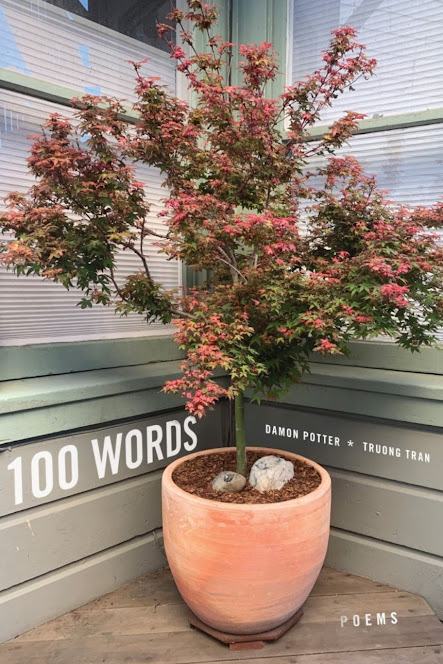
It has been a while since I’ve seen a poetry title by American-Vietnamese poet Truong Tran, so I was intrigued to see his collaboration with San Francisco poet Damon Potter, 100 Words: Poems (Oakland CA: Omnidawn, 2021). The poems that make up 100 Words: Poems are very much composed via a collaborative call-and-response, as they each respond to the prompt of an individual word, set as each poem’s title. As the book asks: how does one see the other? Composed through one hundred words-as-prompts, the project is reminiscent, somewhat, of Kingston writer Diane Schoemperlen’s debut novel, In the Language of Love (1994), a book composed in one hundred chapters, each chapter prompted by and titled “based on one of the one hundred words in the Standard Word Association Test, which was used to measure sanity.”

Composed as a process of vulnerability and exchange, there is something curious in Tran and Potter’s shared poems, uncertain as to which poet wrote which section, a process more open and interesting to read through than had each section been credited. The point, I suppose, was entirely to bleed into uncertainty, and a closeness of reading. In terms of potential authorship, some sections appear rather straightforward, and others, less so. As they write as part of “perhaps an afterword or a new beginning,” a sequence set at the end of the collection: “i am documenting a way of getting to you. it is a map to be shared in the / hopes that one day should that day come that you can use it as a way to / get to me.” There is something quite compelling in the depth of this conversation, into the bare bones of being, speaking on elements of race and privilege, belonging and othering, difference and sameness, either perceived or actual, and how perception itself shapes our lived reality. Opening an endless sequence of questions, there aren’t answers per se, but the way in which each writer responds, both to the prompt and to each other, that provides the strength of this collection. It is the place where these two writers meet, in the space of the poem, of the page, that resounds. As the second stanza/section of the poem “why” writes:

its the question i find myself asking of just about everything in life. why did that happen? why am i here? why are we doing this? why would it matter. that you would agree to do this with a stranger. why? amendment to the word that came before. i hope we are not stranger from this word forward.

Seemingly a debut by Potter, 100 Words: Poems follows a children’s book and an artist monograph by Tran, as well as five previous full-length poetry collection: The Book of Perceptions (Kearney St Workshop Press, 1999), Placing the Accents (Apogee Press, 1999), Dust and Conscience (Apogee Press, 2000), Within The Margin (Apogee Press, 2004) and Four Letter Words (Apogee Press, 2008). A further collection, book of the other (kaya press, 2021), appeared this past year, but I have yet to see it.

self

self is ones body. self is the way one sees their own chest legs waist and or torso or internal self what we think of brains. self is how you see other people see you. receive information. self is a carriage rolling along its pulled by a horse it might be a pumpkin. self is too often a value thought thing and that feels wrong

            *

to take a picture of your foot before it is eaten. to take a picture of you eating your food. the ice cream is melting. the children are crying. we forget how to be humans in the face of inhumanity. we use a telescoping stick to extend our reach. to look back. to capture what’s lost in the act of capturing.


Wednesday, November 17, 2010

A Community Writing Itself: Conversations with Vanguard Writers of the Bay Area, Sarah Rosenthal

The Bay Area, along with New York City, is one of the two major centers of experimental writing in the United States. The Bay Area’s long and vibrant history as a literary center (and one where unconventional activity is accepted and even encouraged), along with its large number of creative writing programs and its bounty of small presses and reading series, make it a magnet for experimental writers. This collection of interviews with Bay Area experimentalists allows us to have our cake and eat it too: We learn more about some of the most compelling experimental work being produced today, and we immerse ourselves in a community which is only the most recent incarnation of a history of experiment dating back a couple of centuries.
I’ve always been taken with any version of literary local histories and archival projects, so Sarah Rosenthal’s recent A Community Writing Itself: Conversations with Vanguard Writers of the Bay Area (Dalkey Archive, 2010) is certainly a revelation, compiling interviews she’s conducted with writers Michael Palmer, Nathaniel Mackey, Leslie Scalapino, Brenda Hillman, Kathleen Fraser, Stephen Ratcliffe, Robert Glück, Barbara Guest, Truong Tran, Camille Roy, Juliana Spahr and Elizabeth Robinson. As her lengthy introduction reminds, this is an area that once gave us the Berkeley Renaissance (Jack Spicer, Robin Blaser and Robert Duncan) as well as Robinson Jeffers, Henry Miller, Kenneth Rexroth and numerous others, information she not only provides as length but gives such a wonderful context to, to open up her series of interviews, conducted over more than a couple of years. Just what is it about the Bay Area that brings out such strong writers, such fierce experimentation?
Brenda Hillman: It's a questions that is so upsetting right now. I was talking to Kathleen Fraser a while ago about the opening up of form in the last twenty years, almost to the point of destroying the boundaries of the poem. It is the artist's job to make form. Not even to make it, but to allow it. Allow form. And all artists have a different relationship to it, and a different philosophy of it. I worked on this poem [“Cascadia,” from Cascadia, Wesleyan University Press, 2001] for eight months; it's very carefully structured. But I wanted it to be boundaryless in a way: It's not punctuated, and I wanted it to go back and forth within itself and within time. I thought, “Well, you can have both things: structure and boundarylessness.” And in fact I think that when you are trying to open up a territory—in this case I was working with a desire to open the lyric—you have to be greedy, in that you want more than you can do. And you're always bound to fail.

SR: You're trying to let error in, but you don't want error to take over the poem.

BH: I wanted every line to be memorable. Also, I wanted to get at and challenge the idea—not a central idea, because the poem doesn't really have a center—Aristotle's idea of change: that you can tell where something is going because of where it ends up. Final cause, or something like that—which is really kind of an anti-divine notion, and which I love as a philosophy of living. It's sort of like, “I'm not sure where I am going, but I can tell it was my fate to be there because that's where I ended up.”