[see part one of these notes here] Monday, July 7, 2025: We woke in Belfast, as one does, and made our way to the shared bus with Rose and her choir, en route to Galway, where the choir would be setting the second city of their three-city tour. I made my slow way through
Toronto writer Miranda Schreiber's fiction debut, Iris and The Dead (Book*hug Press, 2025), an intriguing novel composed as a series of journal entries on youth and trauma, seeking to articulate and clarify the past tense (a very readable book, leaning into the young adult, almost). We passed a sign for
the Brontë Homeland, ancestral home of Patrick Brontë (b. March 17, 1777), father of writers Charlotte, Emily and Anne, as well as a sign for a
Game of Thrones tour, the counterpoint slightly jarring, but providing a particular kind of Irish expansiveness in a very short stretch.
Peat bricks in rows, again. The silence of cows, sheep. Finally, leaning off the highway, a roller coaster (why must they drive so fast, I swear to god) of narrow, ancient roads (often two narrow for passing cars) that took us to the
Clonmacnoise (Cluain Mhic Nóis) Monastic Site, the ruins of a monastery originally founded on a slight hill in 544 on the River Shannon, providing a full view of the river distance. And the tower, also, providing an even better view, for when the Viking ships would have arrived for their usual plunder.
The views were stunning, and we even managed a short tour by one of the staff, an archaeologist (who specified that this is very different than a historian): how his job is to interpret the sites, and not simply what is already known (a bit of a slant on his part, I thought, but it made sense; but one can still "discover" new information through discovering new ways to interpret archival materials, but whatever). His name was Ruairí, the Irish name that anglicizes as "Rory" (I have a niece named such, as you might know), which also has the full Scottish variation as Ruairidh (
such as the current Clan MacLennan Chief;
do you remember when I met him?) (Rory can also be an abbreviation of Roderick). When I offered such, the guide suggested the Scottish was from the original Irish, which I'd be interested to know more about, actually (I had thought Irish Gaelic and Scottish both emerged from a single Gaelic language circa 1200, but I wasn't about to argue with an archaeologist).
Can you imagine this tower was originally twice the height? Apparently it got cut in half not long after it was built, so they made a whole new tower down the hill with the ruin, which is amazing to consider. Would such a tower have remained intact for near a millennium if it had been twice the height?
Our guide conjectured that the historians were incorrect that this was a tower for the sake of protection or as a longer view (one can see pretty far simply by being on a hill), but one of securing valuable items in case of a raid. If the vikings en route, a monk would climb inside (as the doorway is raised up from ground level) with the valuable books, and lift the rope ladder up, thus preventing anyone from following. The only drawback being, of course, that the vikings would have simply tossed in a torch, and lit the whole thing up to either burn or smoke them out (not a perfect system, certainly).
The tour guide also introduced us to a whispering doorway, where one could whisper quietly into one side of the doorway and be heard if one were to place an ear on the other side of the doorway, as a kind of open-air confessional. Whisper quietly, to be barely heard, but to be heard. Some of the choir tested it, and apparently it worked.
Near the end, the choir leader, James, organized the young ladies within the bounds of the ruin of the main building, as they did an impromptu performance [I took photos but do not include here, as one does not post photos of other people's children upon the internet sans consent]. It was incredible, and brought tourists in from all corners of the site to quietly listen, take photographs and recordings (which I wasn't terribly fond of them doing) and simply take in. I've seen versions of this before in other places, other sites, but the experience is far more resonant when one of the participants is your child, after all.
I was curious about this particular ruin [above] just outside the boundaries of the monastery, as we were leaving, but it had not been mentioned. I would presume this an extension of the same thing, possibly. Hm?

From there, we returned to the bus, and the roller coaster of ancient roads (it made for a number of us to feel quite loopy/queasy), and eventually landed in Galway, a very pleasant and seaside tourist town. The whole time, I had a particular Waterboys song in my head, as I'd once heard they from here (although they're from all over Scotland and Ireland, it would seem). Galway smelled like Vancouver, a bit. There were little flags everywhere, as we seem to have found ourselves in a tourist area for dinner attempts. Once we landed, the whole crew, at our university residence, the choir went in one direction, and we went into another, everyone pulling bags and seeking rooms and figuring ourselves out. Although by the time we had completely figured ourselves out from our room, the choir had already been out and was returning from the city centre, where they'd had dinner (roughly a thirty minute walk, we eventually figured out), so we used their cab for our own attempt out into the world.

Upon landing, we saw our pal Susan with some of the older choir members, catching some bubble tea. An old resident sidled up to me there, a bag of wine bottles clattering along, as he insisted he knew me, he knew me. I gave him a "poem" handout, and he said, about time. He knew me, oh yes, he knew me. He was a Bishop, once. Oh, yes. The choir girls looked worried, a bit confused. When Christine mentioned I'd been in Galway back in 2002, he, what? No, he didn't live here then, he was somewhere else. [Reader: I do not think he knew me.]
Tuesday, July 8, 2025: We woke and quickly got on a waiting bus and accompanied the choir on a day-trip to
Inishmore, the largest of the Aran Islands in Galway Bay. At the ferry docks, an outcrop of tourist businesses (including bicycle rental, for those wishing to explore the island on their own) and an array of shops, pubs, horse and buggy rentals, that sort of thing. There were Bed and Breakfasts everywhere, scattered around the island as well. Thirty-one square kilometres and a population of less than a thousand. Enough stone everywhere (fencelines, houses, other structures) that one might think they grew from the ground (something I recall from when Stephen Brockwell and I drove across the west coast of Ireland back in 2002, even seeing some houses, roofs et al, made of stone).
We immediately went for a tour bus that rolls and strolls an hour around the island, slow meanderings into and beyond. Half-through, we landed in a bit of a courtyard, with some shops, and the bus driver told us we had about ninety minutes or so, before we needed to head back down to the ferry.
The choir and their minders headed up the hill, an hour's walk or so to see some fort ruins, without much time for much else, so we decided to remain where we were, wandering a bit for the shops, the food trucks, the view. To be in a place, a moment, after all. Neither Christine nor myself felt much like rushing up a hill (and discovering later that there wasn't any information upon said hill on the fort or environs, which would have made for a less interesting vista). We're in Ireland: must we rush up a hill to catch a stone? There's stone down here, son.
I picked up postcards with local folklore imagery, akin to the animation of
The Secret of Kells (2009), locally produced, of course. A t-shirt with one of them, also (of an old wizard, which I'm sure the children would have said I look like, anyway).
You should look them up, they do absolutely beautiful work. I wrote postcards and made my plans for who might be the recipients of such. Throughout the trip, I had Aoife write postcards for each of her grandparents (they got two each: one from Northern Ireland, another from Ireland) and both of her sisters (I thought Rose might appreciate a postcard from Aoife once home). I wrote my usual thousands, and tens of thousands.
It is a curious thing, to be in this place of stone, of hills and grass. And bicycles. And tour buses.
Christine and Aoife purchased some lovely handmade sweaters from the
Aran Sweater Market (as did a couple of the choir grown-ups). We saw they've a shop in Galway, also. It was cool on those islands, cool in the breeze, cool across the stones, the wind coming up across the water. Fourteen degrees, at most. An east wind, there.
While we were waiting for the group to make their way back down the hill, we wandered over to the remains of a small church, a space at the front where folk would leave coins. I suggested to Aoife that she leave where they were, as she was picking them up, uncertain why they were there. A photograph, that someone had left. I offered a small coin to her to leave as well, if she wished. A small token.
Dear spouse did not appreciate my suggestion that this building, this small church, was related to Donald Duck. Uncle Scrooge, proud member of the McDuck clan, could be a variation of Mac Duach, don't you think? I mean, it makes you think. The Scots and the Irish, never as far apart as both sides prefer to imagine.
A land of stone, this. A land of markers and moments and monuments, held in space. Stone left as footprints, so others might follow.
And then back to the bus, once the rest of the group made their way down that hill. And the bus rolled along, up and down the rolling paths and plinths of stone boundaries and small roads, held together by stone; held together against the boundary of sea, and of wind. The were more donkeys here than I would have thought, and mounds of horses, sheep. Little houses, spread out. Some new construction, often set alongside ancient stone homes left abandoned, fallow. And back down the hills to the bay where the main tour shops, pub. We hadn't much time, so I made my way to the pub and had a wee dram of their local
Aran Islands Irish Whiskey. It was a lovely thing. I was tempted to pick up a bottle to take with, but there wasn't the time. I slightly regret it, as I couldn't find it elsewhere, including the duty-free in the Dublin Airport as we were heading back [
the whisky I had on the Isle of Skye, at least, I can get from here].
The ferry ride back to Galway had a bit of a detour, heading over to the
Cliffs of Mohar and Hag's Head, with the overhead informing us that the view had been included in the H*arry P*tter films, as well as
The Princess Bride (1997), which I thought a good pairing, catching the age-range of most of the passengers, who would have to be familiar with at least one of those films. Incon
ceivable! (You keep using this word. I do not think it means what you think it means.). It took some time, and the boat veered here, there, up and down the waves. I tried to sleep for a part of it, worn out from our days (hiding beneath the hood of the coat Christine pushed me to purchase in Belfast, for warmth and cover; there were blue sunglasses also, but they kept getting mangled).
And then back to Galway again, City Centre. Dinner. Where are we? Back in the tourist centre, filled with churches, restaurants, shops, cobblestone. We needed to find our Aoife a name-plate with her name on it, near impossible on this side (finding Rose is simple enough, naturally). And apparently Lynch is quite the local name, with a castle, even. Might
Chaudiere Books poet Meghan Jackson, formerly above/ground press author Meghan Lynch, know of such a connection? (Probably)
Wednesday, July 9, 2025: Outside the university residence, this Fairy Trail. I kept telling Aoife, as well as the choir children, not to take any food from the fairies (they kept looking at me strangely whenever I said this). Do not play with the fairies. Do they not know of fairies?

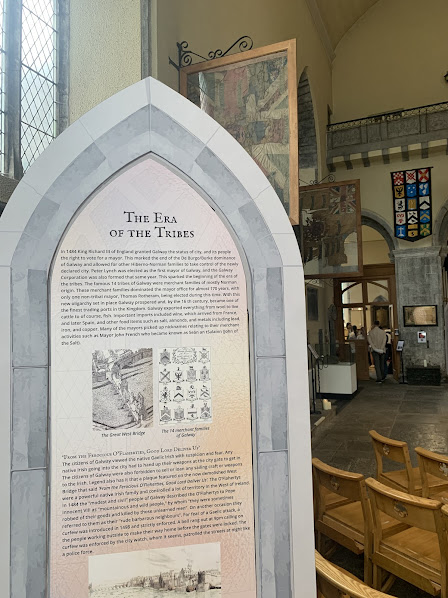
We made our slow way back towards the Galway core as Rose and her choir performed as part of a midweek service at the Collegiate Church of St. Nicholas (founded 1320), a church that local legend dictates Christopher Columbus visited when he came to Galway. A church dedicated to Saint Nicholas of Myra, the patron saint of seafarers (and possibly for explorers set on discovering places and things that others already knew about). As I saw in Belfast, also, I'm not quite used to seeing a church of any sort with a gift shop, but we picked up a thing or two, as we had there. Items for Rose as keepsakes, for her to remember the churches where she has performed. As ever, I've been quietly picking up city-specific fridge magnets, broadening our collection of such at home, each for a location that Christine and I have been to together (and since, with an accompanying Rose and/or both Rose and Aoife). A family collection, say. See all the places we've been! (Although Christine finds the whole thing rather irritating, it would seem)


The building is obviously an old one, and I'm fascinated by the history, and the building, as a tourist site, as well as one of active worship, is a curiosity, the blend of two sides that might not always meet. There were some very cool displays within the building, and just outside (it was closed to the public, beyond the service, that particular afternoon). Stocks!
I'm finding it interesting, also, participating in services. We're there for Rose, certainly, but I've attempted to remain as far away from churches and religion since I left the farm at nineteen (churchgoing wasn't optional in our household). I've always been somewhere between atheist and agnostic, and raised Protestant, so the structures and rituals of the Anglican Church are quite foreign, and even a bit confusing, to me. We're there for Rose, who seems to be starting to lean in that direction, which is fine enough, as long as hers a considered faith, and not merely a following-along (it has led to some interesting conversations between us over the months that she has been in the choir). At the end of the service, I went over to the older minister to give my greetings (as it were), and compliment his younger co-hort on his service. He was a nice enough fella, although at the end, he turns to me and offers: Has anyone ever told you that you look like Billy Connolly?

Yes. Yes they have. (At least five times on this trip, overall, I'd say). Sigh.
And then, back into the light of midday, mid-week, we encountered this statue of
Irish poet, playwright, and novelist Oscar Wilde (1854-1900) and Estonian journalist, critic and novelist Eduard Vilde (1856-1933). Check the link to find out why they are there.
There was an odd tourist-y train that rolled around the downtown that we decided to board, seeking out
a medieval wall supposedly set in the basement of a mall (the mall having been constructed around it, naturally). We couldn't find the mall until the train pointed it out, but we got there.
The walls began construction in 1270, and now they sit beside the food court.
And then an afternoon of laundry (on site, one space for the entire university residence), which the whole crew worked on, it would seem. I just happened to be first one in. The grown-ups came through to put through loads, and then, as the time went on, they sent various of the young ones in to retrieve. It was a credit card system for the machines, soap included. Although I did have to run my two loads twice, as I wasn't smart enough to put soap in the first time. Ah well. But where I was able to sit for a couple of hours with laptop and write out at least the first half of my notes from Belfast.
After that was all figured out (our trio did require fresh laundry, half-way through our twelve days), we stepped out for dinner (walking by the wooded space where the fairies
actually live), and headed back towards the city core.
I saw this sign [above] as we walked. And while we didn't wander over to this particular island, I did look it up.
Nun's Island, the Irish name for such means 'island of the flock of birds.' Lovely.
We saw a handful of locals fly-fishing in the water, also. You can see them, there, on the right, just in the distance.
I don't know who this fella was (I'm a bit disappointed I can't find him online anywhere, given "red chair poetry" seems a very deliberate designation), but he was sitting with table and typewriter (and red folding chair), right in the tourist area, offering to write poems for passers-by, so I couldn't not stop. I gave Aoife some cash to offer him, and he composed a poem for her, about a pickle, as was her particular prompt. I gave him a "poem" handout, of course, but said no more than that.
And Galway, in one of the local tourist shops, as I kept asking where I could find items with Aoife's name (we only have last names here, not first names), before I found one where the fella said, Oh, not here, but in the other location, about ten stores that way! We landed, and Aoife emerged with a bag, including chocolate bars with her name, a nameplate, key chains and god knows what else (I've lost track); the young lady was extremely pleased.
The third most common girl's name in Ireland, I've heard. Although we didn't meet a single Aoife. There was certainly a head or two that would turn whenever I called her name.
Dinner, of course. And a quiet evening, otherwise. Aoife has a scrapbook she spent the trip working on, writing out her own report on what had occurred on our grand trip (with the extra page or two offered for tic-tac-toe).
next up: Dublin,


