Showing posts with label Lisa Samuels. Show all posts

Saturday, August 26, 2023

Lisa Samuels, Livestream


Ligature

the water is eating the sun
  chomping it into tiny bits
sea or tune or new design
open tratten rock face
  wet with shadow this side
steel spray lings the curve
and shaking it the boat
picks up the island from her
  mouth cage loosening
halfway cross now
scatter opt her brow
  words come in back steel
like arithmetic it’s all over
for the water’s pride
  chomp chomp

The latest from poet Lisa Samuels, following titles such as Foreign Native (Black Radish Books, 2018) [see my review of such here] and Breach (Norwich England: Boiler House Press, 2021) [see my review of such here], is Livestream (2023), her seventh poetry book from UK publisher Shearsman Books. The collection is described on the back cover as “digital capture thrown elsewhere, body fluids that charge being and planetary liquid flows. Livestream’s poetry entangles with those phenomena. The poems erupt, stagger, hold, and reflect as they evoke events and responses distributed through bodies and ethical borders.” The short lyrics of Livestream are clustered into quarters: four sections, each of which open with a black-and-white digital image, offering the suggestion that the poems within each section respond, or bounce of, said image. These images, according to the table of contents, are titled “floater,” “diorama,” “caliber” and “ganglion,” and the poems that follow suggest a book-length trajectory of responses, quartering this suite of short lyric bursts of rhythm, sound and meaning. “Scouring the planet’s nerve geometry / in the same speak-shore out of which / some clods turn on the side to rest,” the opening poem, “Gorge time,” reads, “the double-touch veins umwelt / our of which throbs the voice is / over-faint turns on its side to speak [.]”

Samuels’ poems, however they might be shaped, begin at a moment and the rush forward from that singular point, headlong into a lyric running across a myriad of sound, rhythm and reference, very much in the vein of one thought or sound immediately following another. “Even if a cold / statute really is curative you believe it,” the poem “Aquifer” offers, “its closeness to your feeling bears relief.” Hers is a lyric populated with physicality from starts and air to limbs and nervous fictions, allowing meaning to emerge out of what might, at first, appear a jumble but is filled with purpose, akin to certain of the language poets, whether Stephen Cain or Meredith Quartermain, allowing a way through the collision of sound and meaning into something far larger, just on the other side. Or, as the poem “Pitch in the dark” ends:

        Living specific nervous fictions
we said    tall and beautiful withers
a long tail for a clear advantage
airborn    sprecht

Wednesday, January 26, 2022

Lisa Samuels, Breach


a subcon-
trastic change
filiates barbells

make your arms
of co-captivity

duress
you dress

the part of civic
gendarme inhaled

‘I told you so’
in slabs on the front

lawn or fireball
muffled in the

basement dance
each cat arresting its

arithmetic
slumber

walks the walk

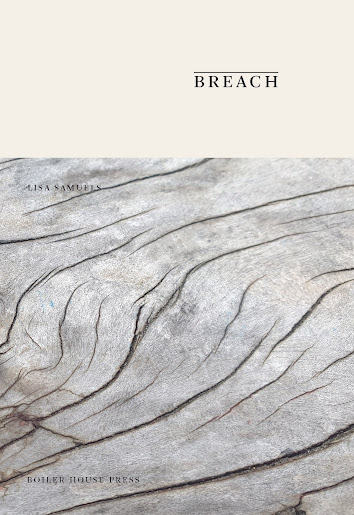
The latest from Lisa Samuels is the full-length Breach (Norwich England: Boiler House Press, 2021), a quintet of extended, numbered sequences, composed through punctuated sound, short lines of halting rhythms and accumulations. “Breach by Lisa Samuels performs a vital palilalia of lockdown. Starting with the dead, with Li Wenliang, who was the first to raise the Covid alarm, the book pitches and surges in deflections, hungers, and political feeling through pandemic-as-ordinary-life. The forced changes in relations we've all suffered derange the lines,” the online catalogue copy offers. “Breach is a song of lockdown: its tragedies, absurdities, non sequitur linguistic hilarities, and nightmarish lexical distortions, presented at a perfect moment for reflection, as we each continue adjust our bodies, lives and breaths...” Born and raised in the United States, but living and teaching in Aotearoa/New Zealand since 2006, where she is Associate Professor of English and Drama at The University of Auckland, Samuels has long been engaged with self-contained chapbook- and book-length projects for some time, shaping numerous of her collections around particular subjects and attentions to form, even as her work continues an ongoing experimentation, as well as, according to one online author biography, “transnationalism [as] fundamental in her ethics and imagination.” Some of her previous full-length works of poetry, memoir and prose include The Seven Voices (O Books, 1998), Paradise for Everyone (Shearsman Books, 2005), The Invention of Culture (Shearsman Books, 2008), Tomorrowland (Shearsman Books, 2009), Mama Mortality Corridos (Holloway, 2010), Gender City (Shearsman Books, 2011), Wild Dialectics (Shearsman Books, 2012), Anti M (Chax Press, 2013), Symphony for Human Transport (Shearsman Books, 2017), Foreign Native (Black Radish Books, 2018) [see my review of such here] and The Long White Cloud of Unknowing (Chax Press, 2019).

Tell yourself stories of
perfection rot
fine documents

circa land
pools every

where transnational
circa newly won

bought chemicals
new fissures

in the antique documents
pouring in

between the cities
circa where the lumber

goes the slum plots
where you

not to ask for
bread

Structurally, one might say that hers is a restless and endlessly curious lyric, continually in motion, seeking out what else has yet to be explored, or solved. As she references the then work-in-progress during her 2020 Touch the Donkey interview:

Well, a new work that happened in the first lockdown here is titled Breach and is quite different from the TtD poems – it arrived unexpectedly across a few days of intense writing in relation to pandemic feeling. I had started a formal imitation exercise model for my poetry students and it turned into a book-length poem with very short lines, the kind of line brevity characteristic of the poet Pam Brown, whose style I was setting the students to imitate, though I suppose the Breach lines are closer to Tom Raworth’s in style. I almost never compose in such short lines, and I found the extreme enjambments and lexical parataxis delicious.

The pandemic, as Samuels is fully aware, doesn’t connect us, but simply reminds us of how interconnected and interlinked we have become, and Breach offers itself as one of what will eventually become a wealth of writing that engages with the current lockdowns and ongoing pandemic, and holds as one of the earlier published examples, alongside Toronto poet Lillian Nećakov’s il virus (Vancouver BC: Anvil Press, 2021) [see my review of such here]. Unlike Nećakov’s sequence, Samuels reaches back to the beginnings of public awareness, circling and cycling back to the late Li Wenliang (October 1986 – February 2020), the Chinese ophthalmologist who warned his colleagues about early COVID-19 infections. In turns she writes slant and direct, offering degrees of perception, she writes “someone who’ll / sit and tether to / mobility / what continuous / education?” Contagion and discourse breeds, after all, and Breach offers a cycle that continually returns to that central break, through poems riffing and rolling and prompted by the beginnings of this particular period, and seemingly-endless present. “even if the news / turns,” she writes, towards the end of the collection, “it won’t alter [.]” As she knows full well, the cases mount. The present loops, repeats, and continues.

oh I have to
Li Wenliang
although

one doesn’t know
just anything

without
the moan of some

home engine work
school friends in

delicate
nothing’s out of nature

parse of air

Thursday, January 07, 2021

Touch the Donkey supplement: new interviews with Feld, Campos, MillAr, Samuels, Lor, Bowering + hanna,

Anticipating the release next week of the twenty-eighth issue of Touch the Donkey [a small poetry journal], why not check out the interviews that have appeared over the past few weeks with contributors to the twenty-sixth issue: Kate Feld, Isabel Sobral Campos, Jay MillAr, Lisa Samuels, Prathna Lor, George Bowering and natalie hanna.

Interviews with contributors to the first twenty-six issues (over one hundred and seventy interviews to date) remain online, including: Jill Magi, Amelia Does, Orchid Tierney, katie o’brien, Lily Brown, Tessa Bolsover, émilie kneifel, Hasan Namir, Khashayar Mohammadi, Naomi Cohn, Tom Snarsky, Guy Birchard, Mark Cunningham, Lydia Unsworth, Zane Koss, Nicole Raziya Fong, Ben Robinson, Asher Ghaffar, Clara Daneri, Ava Hofmann, Robert R. Thurman, Alyse Knorr, Denise Newman, Shelly Harder, Franco Cortese, Dale Tracy, Biswamit Dwibedy, Emily Izsak, Aja Couchois Duncan, José Felipe Alvergue, Conyer Clayton, Roxanna Bennett, Julia Drescher, Michael Cavuto, Michael Sikkema, Bronwen Tate, Emilia Nielsen, Hailey Higdon, Trish Salah, Adam Strauss, Katy Lederer, Taryn Hubbard, Michael Boughn, David Dowker, Marie Larson, Lauren Haldeman, Kate Siklosi, robert majzels, Michael Robins, Rae Armantrout, Stephanie Strickland, Ken Hunt, Rob Manery, Ryan Eckes, Stephen Cain, Dani Spinosa, Samuel Ace, Howie Good, Rusty Morrison, Allison Cardon, Jon Boisvert, Laura Theobald, Suzanne Wise, Sean Braune, Dale Smith, Valerie Coulton, Phil Hall, Sarah MacDonell, Janet Kaplan, Kyle Flemmer, Julia Polyck-O’Neill, A.M. O’Malley, Catriona Strang, Anthony Etherin, Claire Lacey ,Sacha Archer, Michael e. Casteels, Harold Abramowitz, Cindy Savett, Tessy Ward, Christine Stewart, David James Miller, Jonathan Ball, Cody-Rose Clevidence, mwpm, Andrew McEwan, Brynne Rebele-Henry, Joseph Mosconi, Douglas Barbour and Sheila Murphy, Oliver Cusimano, Sue Landers, Marthe Reed, Colin Smith, Nathaniel G. Moore, David Buuck, Kate Greenstreet, Kate Hargreaves, Shazia Hafiz Ramji, Erín Moure, Sarah Swan, Buck Downs, Kemeny Babineau, Ryan Murphy, Norma Cole, Lea Graham, kevin mcpherson eckhoff, Oana Avasilichioaei, Meredith Quartermain, Amanda Earl, Luke Kennard, Shane Rhodes, Renée Sarojini Saklikar, Sarah Cook, François Turcot, Gregory Betts, Eric Schmaltz, Paul Zits, Laura Sims, Stephen Collis, Mary Kasimor, Billy Mavreas, damian lopes, Pete Smith, Sonnet L’Abbé, Katie L. Price, a rawlings, Suzanne Zelazo, Helen Hajnoczky, Kathryn MacLeod, Shannon Maguire, Sarah Mangold, Amish Trivedi, Lola Lemire Tostevin, Aaron Tucker, Kayla Czaga, Jason Christie, Jennifer Kronovet, Jordan Abel, Deborah Poe, Edward Smallfield, ryan fitzpatrick, Elizabeth Robinson, nathan dueck, Paige Taggart, Christine McNair, Stan Rogal, Jessica Smith, Nikki Sheppy, Kirsten Kaschock, Lise Downe, Lisa Jarnot, Chris Turnbull, Gary Barwin, Susan Briante, derek beaulieu, Megan Kaminski, Roland Prevost, Emily Ursuliak, j/j hastain, Catherine Wagner, Susanne Dyckman, Susan Holbrook, Julie Carr, David Peter Clark, Pearl Pirie, Eric Baus, Pattie McCarthy, Camille Martin and Gil McElroy.

The forthcoming twenty-eighth issue features new writing by: MLA Chernoff, Geoffrey Olsen, Douglas Barbour, Hamish Ballantyne, JoAnna Novak, Allyson Paty and Lisa Fishman.

And of course, copies of the first twenty-six issues are still very much available. Why not subscribe? Included, as well, as part of the above/ground press 2021 subscriptions! We even have our own Facebook group. It’s remarkably easy.

Monday, July 22, 2019

Lisa Samuels, Foreign Native


A bird in a plane

Sitting on a park bench is a form of publishing
rather than an endless set of bills resembling
human emotions as like a totally real event
in tangible vials of Significance and maybe, maybe
the public sphere imagines like Humanishment
nourishing out emoticons, our knees in space
tumult a body’s unmistakable exchange
for noises from without, Authentic Circles
wheeling circumambient claps ping
on the ears a Rain of Angels, sand cake
opposition figures crossed by little bodies
stirring forward blessure visibly
squiggling on your eyes tra la
real things to give our cognito!

The latest title by Aotearoa/New Zealand poet and American expat Lisa Samuels (apoet who appeared as an issue of above/ground press’ STANZAS some time back, later reprinted in Ground Rules) is Foreign Native (Berkeley CA: Black Radish Books, 2018), a graceful collection of short lyrics on power, conflict and the spaces amid and between language. “Culture is a fog sewn on faces,” she writes, in the poem “Shutter,” writing: “touch your cheek and / all the custom / fold our bones to dew [.]” Further on, the poem ends with: “The bodies all lie down / and get back up.” The twenty-six poems in this collection claim and proclaim and explore, writing slant on boundaries of country, geography and language, somehow riding a very fine line of indirect lyric through seemingly direct statement. In a recent post at his Poetry in Process blog, “Lisa Samuels and multiplicity,” Owen Bullock writes:

In an interview with transnational poet Lisa Samuels, she suggests that at the heart of her poetry and her process is a multiplicity of reference and background. When asked by interviewer Jack Ross, in the first issue of the revamped Poetry New Zealand Yearbook, which writers inspire her she answers in terms of categories, and says that she is as likely to be inspired by, “patterns, sounds, place histories, images, philosophy, statistics for a country’s fabric imports, dictionaries, encyclopedias, poetry, experimental drama, strange comics, physics hypotheses, theory, and manifestos,” as writers (41).

One of the foci of her writing is ‘imaginative unknowing’ (46) with the use of fragmented language part of an attempt to make a true representation of our fragmented experience. This point is exemplified by her idea that ‘everything represents’ what she calls the ‘dispersed inexplicable’. An example of that fragmented experience is well worth quoting in full; it forms an inspiring vision and is not unlike a prose poem:

For example, when I am driving across the Harbour Bridge, I am simultaneously walking at the bottom of the ocean water and remembering my body in some other position in a truck and composing fragments of music in the sound part of my mind and thinking about how humans are related to the buildings I can see and wondering how on earth we can evade ideas of possession and thinking about what events have happened that can be traced in the atomic substrates that perfuse this whole geophysical area and feeling my nose’s dryness and blinking my eyes and pondering the number of eyeblinks we’ll have in our lives, etc. (43)