God knows the creative process
is a mystery. To make something out of nothing, to see a world in a blank page,
to hear imagined people speak, to touch things that aren’t there, to taste what
is not yet baked, to speak volumes or write an image is something to wonder at,
something awesome to behold. Yet these are the things that artists do every
day. These are the tasks, pleasures and pains that artists, including poets,
undertake. Transmitters of acts of the imagination, poets use language to make
their unique works of art. But how do
they do this?
This is one of the many questions we asked Quebec’s
English-language poets over the four-year lifespan of the online literary
magazine that we, along with Elias Letelier, founded on June 24, 2009, Quebec’s
Fête Nationale. We were curious about their process but we also wondered
whether living in Quebec and writing in the language of “les autres” meant
anything aesthetically, socially, culturally and politically. We had a poetic
and political agenda. Poetry Quebec,
or PQ, was a conscious and deliberate
nod (and wink) to Quebec’s separatist party, the Parti Québécois. We wanted
through our tongue-in-cheek name and motto, “Je me sousviens,” to signal that
Quebec’s English-language poets are Quebec
poets who were, are and will be here to remember and be remembered. The name
and motto were also a manifesto of our engagement.
There
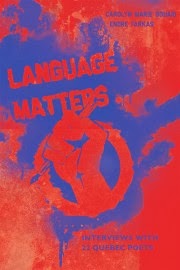
is something very familiar in the framing of the new collection Language Matters: Interviews with 22 QuebecPoets, eds. Carolyn Marie Souaid and Endre Farkas (Winnipeg MB: Signature
Editions, 2013). The press release begins:
Is writing in English
in Quebec a political act? An act of survival? An act of defiance? An act of
futility? An act of celebration? For answers to these questions, look no
further than Language Matters, a
series of candid interviews with some of Quebec’s – Canada’s – most interesting
and innovative poets, which launched on Tuesday, September 10, 2013. These are
poets who write in the dominant language of North America, but are the
linguistic minority in a francophone culture – a minority within a minority. Living
in the birthplace of Canadian poetry that gave rise to A.M. Klein, F.R. Scott,
Louis Dudek, Irving Layton and Leonard Cohen, how do these poets view
themselves and their already marginalized art?
There
is something familiar here, and even curious: but for the date mentioned
within, this blurb could easily be included on the back cover of a similar
collection of essays twenty, or even forty years earlier. Have the questions
really not changed during that period (or for that matter, the poets one might
cite as precursors?)? As someone who grew up just on the other side of the
Quebec border, I’ve a curiosity about such questions of landscape and
geography, and wonder if there should be further questions in other regions
that should also be repeated to the writers within, to allow a different perspective
on other types of geographies, their politics, language and considerations of
local space. Over the years, co-editor Endre Farkas has worked tirelessly to
promote, encourage and explore English-language poetry in Montreal specifically
and Quebec and the rest of Canada generally, through his work as one of the original Vehicule Poets in the 1970s (the group that helped give rise to
Vehicule Press, where he was one of the founding editors) to later founding The
Muses’ Company in 1980, to editing, co-editing and/or contributing to anthologies
such as 10 Montreal
Poets at the Cegeps (Montreal QC: Delta, 1975), Montreal English Poetry of the Seventies
(Montreal QC: Vehicule press, 1977), Vehicule
Poets (Montreal QC: Maker Press, 1979), CrossCut: Contemporary English Quebec Poetry (Vehicule Press, 1982), Canadian Poetry Now (Toronto ON: Anansi,
1984), Voix Off (Toronto ON: Guernica,
1985), The Other Language: English Poetry of Montreal (The Muses’ Co., 1989) and Quebec Suite: Poems for and about Quebec (Winnipeg
MB: The Muses’ Co., 1998). Farkas has spent decades working as an
English-language poet in a geography and political landscape where he has been
very much part of the minority, and through such, his efforts have allowed
certain writers to become known and even flourish where they might not have otherwise
had the same opportunities. But the question of the book becomes: have the
questions one poses to writers in such a landscape really not changed over the
years? It’s as though the framing of the collection doesn’t give nearly enough
credit to the scope of the book’s content, and the engagement each author has
with questions goes far beyond those suggested on the cover. When asked “Would
you say that writing in English in Quebec [is] a political act?” in her
interview, Erin Moure answers:
Not necessarily. Writing is always a
political act, of course. Writing in
English is not devoid of politics, for sure, in terms of the conditions of
production and reception for that hegemonic language in the world. Writing in
English in Quebec is also subject to conditions of writing in a society that
speaks French. So there are political consequences, and social consequences, to
writing in English in Quebec. Yet the act of writing in English, picking up a
pen and writing, is not necessarily a
“political act” for me, who grew up in English in Alberta. The act of writing
in English and including French directly in the poem is a political act,
though. The act of writing and speaking in Galician is a political act.
Originally
conducted to be posted on their online Poetry
Quebec (a website that arrived with much enthusiasm, but seems to have disappeared), the collection includes a selection of a series of interviews conducted
over four years with poets Stephanie Bolster, Mark Abley, Erin Moure, David McGimpsey, Mary di Michele, Gabe Foreman, Catherine Kidd, Richard Sommer,
Maxianne Berger, Steve Luxton, Robyn Sarah, Mahamud Siad Togane, Susan Gillis,
Brian Campbell, Charlotte Hussey, kaie kellough, Moe Clark, Jason Camlot,
Gillian Sze and Angela Leuck as well as interviews with the editors, Farkas and
Souaid, themselves. The interviews (each including a poem or two by the interviewed
poet) connect through a common concern with the intricacies of language (including
multiple languages), and each speak of their engagements with Quebec writing,
writers and the immediate landscapes in which they live. As Susan Gillis says
in the space of her interview, “Living
in English in Quebec is a political act.” She continues:
History and culture are
living continuities. Writing and working and living in a minority language
create an active engagement with those living continuities, a kind of
claim-staking: Look, here’s my little corner of history and culture, alive and
well and kicking. Not threatening, just being. I suppose for some Quebec
nationalists, any other culture’s activity is threatening? Or the very notion
of “just being” is false? I don’t see my work or myself that way, but that doesn’t
mean others might not.
Originally
from Calgary, Montreal-based “word-sound systemizer” kaie kellough provides an
interesting perspective:
for an english writer,
provincial boundaries dissolve. the nice thing abt writing & performing is
that it can travel. if english writers were restricted to publishing &
presenting their works in québec alone, then i might feel that working in
english is a political act. but english writers can publish throughout north
america: the markets for our work are much larger than the markets for french
work. when my first book was published, it was launched in vancouver, ottawa,
toronto, and montréal. further, i was eventually invited to read across the
country - in halifax, calgary, gabriola (bc), saskatooooon, etc. [...] a
french-language poet might get to launch a first volume in montréal, ottawa,
and québec city, if lucky.
What
does it mean to be an English-language Montreal writer, or more broadly, an
English-language writer in Quebec? For some the question is essential, and for
others, the question is a curiosity, nearly in passing. For some writers, these
questions might be entirely irrelevant to the ways in which they write. Thanks to
editors Farkas and Souaid, the question allows the answers to showcase the ways
in which the landscape has shifted over the years, and just how much has
remained the same. I’d be curious to hear others respond to these questions,
such as Montreal-based writers Sina Queyras, Jon Paul Fiorentino and SusanElmslie, as well as some of the younger writers slowly emerging in the city,
such as Helen Hajnoczky and Kirya Marchand. This is very much a collection built originally not as a book, but as a series of online one-offs which, when collected, might show the occasional gap or two. One hopes that further work, and/or a second volume might be
down the road?


