Showing posts with label Amy Dennis. Show all posts

Sunday, July 30, 2023

Once upon a time in the West (of Ottawa, but still in Ontario, (part two,

[see part one here]

Tuesday, July 25, 2023: Slept terribly, despite the better arrangements. The Oakville hotel was fine enough, the kids sharing a bed, but somehow that was a better sleep. Here they have bunk beds with a half-wall between us, and it wasn’t as great. Stupid away-from-home.

Today was attempting to enjoy all the amenities the Great Wolf Lodge offered, especially given how much the damn thing costs. I was tempted to jump across the border and sell a kidney, which prompted my eldest daughter, Kate, to provide me how much I’d get for such a thing (somehow this is information she already knows off the top of her head; “it’s not my fault the internet is gross,” she responded). Again, we literally haven't taken the children to anything, given Covid, so it makes sense, I suppose, that this trip is attempting to make up for the past few years. There was wave pool and arcade and bowling and yoga and an elaborate self-directed wizard-game of some sort and a bunch of other excitements. I used the opportunity to read The Loneliness of the Long-Distance Cartoonist (2020) by Adrian Tomine. It is really good. The children wore themselves out on their quests, we sent each other texts when they ran by (sitting in different corners of the hotel) and I managed some reading.

Sad to hear that a cousin on my birth mother’s side, Jaime, died earlier this week. She was one of the first on my birth mother’s side to reach out upon “discovery” a couple of years back, and responded with an enthusiasm I appreciated. We hadn’t a chance yet to meet, which was frustrating. Through emails, I discovered another cousin, Micah, is apparently here with his family, but not sure if he’ll reach out and attempt to connect. I told his parents, including my Uncle Dale, my birth mother’s brother, that he’s welcome to text me if he’s able and/or interested. As of yet, I have yet to see him (and I’ve been looking).

My pal b stephen harding and his lovely wife Gemma were at the falls yesterday, which was amusing to be that close in a different part of the province. I think we considered the possibility of meeting up, but it wouldn’t have been easy. We’ll catch up on stories once we’re back home.

The entire afternoon, spent in the waterpark area. So much waterpark area. Normally I hate water, but bringing the bags in from the car across two loads yesterday was so bloody hot it was enough to prompt me into the water. Once we’re back home, I’m sure everything will return to normal, and I’ll be avoiding it again like an old, irritable cat. The young ladies don’t know how lucky they have it right now (or maybe they do).

Both nights we’ve been here, seeing a local skunk (I doubt he commutes in) wander by our back door. After the children asleep, sitting just outside the back door. Last night, he startled us, so we came back in. Tonight, he just wandered by.

Wednesday, July 26, 2023: It seems odd to be waking most mornings before the young ladies. I mean, I’m not exactly waking any earlier than normal, but they’re staying up much later, I suppose. To be up before Aoife seems baffling to me. Rose can easily sleep longer if we let her, at least at home. She’s often the last of us to rise. We attended to the last elements of our big ridiculous Big Wolf Lodge adventures (another stretch of the wave pool, at Aoife's insistence) before heading off to catch a quick view of the falls themselves, which was only about a five minute drive down the road. We parked, walked by the carnival row of downtown Niagara Falls strip (ice cream en route, of course, so it would be long gone by the time we returned to the car) and saw the magnificence of the falls. The children were impressed, at least. And then we returned to the car and drove north, easily passing twenty or so cemeteries. Are we driving through cemetery country?

When in Owen Sound, naturally, one begins to think about the sound poetry group Owen Sound, yes? I mean, everyone else does that as well, right?

Rained heavily, but luckily it began well after we landed here. Amy Dennis' house, backed up against the banks of the Sydenham. Lovely. There were swans, also, but swimming separately, as Amy said they must not be getting along at the moment.

A cat in the window across from Amy's house. I don't like the way it keeps looking at me.

Thursday, July 27, 2023: Woke, in Owen Sound. We’re spending two nights with the delightful Amy Dennis, a poet that Christine met during her Toronto days, pre-Ottawa. She even launched her first book this past spring as part of VERSeFest in Ottawa, which was pretty exciting. A slow moving day, simply hanging out with her. Very nice to catch up.


So much Owen Sound! Did you know that painter Tom Thomson is buried here? I even saw a tree en route this way that looked completely like one of his. A lovely small church in the woods, with surrounding cemetery. The church itself long closed, but the building and space restored, which was good to see. One doesn't wish these historic sites to crumble. The children wandered the cemetery looking at names and dates, and attempting to figure out how old everything is. I think the stretch of that kind of time is a bit past them, but hard to tell.


We spent time at a beach, listening to the silence of the waves. The children picked at the stones, seeking fossils. They wandered the beach. We saw a kayaker and a paddle-boarder leave from the cove. All the waves on the shore whispered shush. The children left the shore with a handful of fossils. A bag, even.


Sunday, March 19, 2023

12 or 20 (second series) questions with Amy Dennis

In addition to publications in England and France, Amy Dennis' poetry has appeared in more than twenty Canadian literary publications, such as CV2, Event, Queen's Quarterly, and Prairie Fire. Her poetry has been nominated for two National Magazine Awards and a Random House Creative Writing Award. She placed second in the UK’s National Bedford Open Poetry Competition. While completing her Ph.D in literature, she published THE COMPLEMENT AND ANTAGONIST OF BLACK (OR, THE DEFINITION OF ALL VISIBLE WAVELENGTHS) with above/ground press. In 2022, Mansfield Press published The Sleep Orchard, Dennis' collection of ekphrastic poems in response to the life and art of Arshile Gorky. Currently, she works as a learning facilitator and professor.

[Amy Dennis lectures in Ottawa on Saturday, March 25 at 1pm alongside Natalie Eilbert as part of The Factory Lecture Series at VERSeFest 2023]

1 - How did your first book or chapbook change your life? How does your most recent work compare to your previous? How does it feel different?

My first chapbook was THE COMPLEMENT AND ANTAGONIST OF BLACK (OR, THE DEFINITION OF ALL VISIBLE WAVELENGTHS) with above/ground press.  I’m a private person so beneath the excitement and appreciation, I’ve always felt a degree of vulnerability when publishing, especially now that I’m a mother and live in a smaller city. Releasing my words in a more formal way made me (and makes me) reflect on these things.

Publishing my book, The Sleep Orchard, was a lot different from my other (shorter) publications, because although the book consistently considers the life and artwork of Arshile Gorky in some way, my personal responses range over a considerable breadth of time – dating back ten years to where I am now, a mother of two beautiful little boys, about to get remarried, post pandemic. When I started the collection, I was in the middle of completing my PhD and getting married for the first time. Midway through writing the book, I endured the heartbreak of several lost pregnancies, an international move, and separation. The more recent poems in the collection, interwoven throughout, reflect where I am now, having come out the other side, likely as a different person. The last poem in the book is so sad; I wish I could go back and tell myself there will be peace and hope again after such loss, and so much love too. 

2 - How did you come to poetry first, as opposed to, say, fiction or non-fiction?

I think in images and my mind tries to make sense of things by framing them metaphorically, so I guess poetry is a natural fit. I experience synesthesia at particular times, which is probably linked with a more poetic sensibility.

3 - How long does it take to start any particular writing project? Does your writing initially come quickly, or is it a slow process? Do first drafts appear looking close to their final shape, or does your work come out of copious notes?

One or two fragmented sentences come quickly, allowing me to feel a pulse connected with what I want to convey. If there’s enough of a vibration, I can stay focused. After this initial flurry, the writing slows and approaching the rest of the poem feels like watching a snow globe and waiting for the flakes settle. My space (inward and outward) has to be completely quiet or else I can’t build walls around the poem’s heart; I need those walls because without them, there can’t be a door. I always do several drafts.

I haven’t written for a while now because my energy has gone into financially supporting my family and being as present as I can with my kids.

4 - Where does a poem or work of fiction usually begin for you? Are you an author of short pieces that end up combining into a larger project, or are you working on a "book" from the very beginning?

My response to Arshile Gorky in The Sleep Orchard was the first time I had a larger and more cohesive collection in mind from the start. I saw his painting “One Day the Milkweed” and was hooked. I first stumbled across the image online while living in England, and less than two hours later, I was on a train to the Tate Modern in London to see the Gorky exhibition. The pull I felt was incredible, especially with his later work. I felt a simultaneous distance too – because our worlds were so far apart and that made the dynamic complex. I found small entryways to help with my understanding, such as how much he loved his mother. At times, I tried to take on the first person perspective/voice of those close to him – always women, such as his wives and daughter.

Familiarizing myself with every angle of Gorky’s life and artwork through research created a mental space I could effortlessly slip into during the writing process. Even though the figurative  rooms I entered were always too dark to see clearly in full, I began to sense where I could find cracks in the (embroidered) curtains.

5 - Are public readings part of or counter to your creative process? Are you the sort of writer who enjoys doing readings?

I love to do readings!

Attending readings and workshopping poems with others is a gift that I long for and hope to find again. When aligned with literary communities in Hamilton, Toronto, and Vancouver, my creative process felt more energized. (I love the literary vibe in Ottawa too, but I’ve never lived there; I wish I did!) For the last five or so years, there just hasn’t been time to seek out or connect with a community in this creative/artistic way.

6 - Do you have any theoretical concerns behind your writing? What kinds of questions are you trying to answer with your work? What do you even think the current questions are?

There’s always the old question whether one can or should separate an artist from his work. More and more, I began to empathize with his wife, Mogouch (Agnes Fielding) and actually felt quite a loss when she died not too long ago. The book experiments with these different vantage points, and intersections.

Also – when writing ekphrastic poetry, the presence of artwork can act as a buffer between the writer and uncomfortable subject matter, as well as a buffer between the writer and the reader.  To what extent does this lessen a poem’s immediacy and authenticity? Or, does the presence of artwork as a buffer provide a kind of breathing space that is beneficial for both the reader and writer? What tips the scales one way or another?

7 – What do you see the current role of the writer being in larger culture? Does s/he even have one? What do you think the role of the writer should be?

Writers in general cover such a huge expanse, but I think poets, in particular, encourage readers to pay attention if they can stay still enough while reading. Paul Bowles, in his book Sheltering Sky, says:

Because we don't know when we will die, we get to think of life as an inexhaustible well. Yet everything happens only a certain number of times, and a very small number really. How many more times will you remember a certain afternoon of your childhood, an afternoon that is so deeply a part of your being that you can't even conceive of your life without it? Perhaps four, five times more, perhaps not even that. How many more times will you watch the full moon rise? Perhaps 20. And yet it all seems limitless.

8 - Do you find the process of working with an outside editor difficult or essential (or both)?

Instructors/mentors/editors have been essential and never difficult to work with. I love collaborating creatively with others after a bit of time spent percolating alone, and don’t feel defensive against criticism, probably because emotional distance from my work comes easily once I’m past a certain stage. It’s never good to agree to edits as a blind reflex, but almost always, those I trust offering feedback have been right. Sentimentality or too many burlesque-flavoured words can come with a cost, so I try to “kill those [self-indulgent] darlings” when they slip below my radar. I do need the help at times, although I’d like to think I’m getting better.

9 - What is the best piece of advice you've heard (not necessarily given to you directly)?

I was told recently that I need to give others more credit in their ability to discern. Another person told me it was time I took up more room.

10 - What kind of writing routine do you tend to keep, or do you even have one? How does a typical day (for you) begin?

When I did have a writing routine, it started at night when the house was still and I wrote into the early hours. 

A typical good day includes coffee and/or Leonard Cohen on my way to work.  Every single day without fail, my fiancé sends me the sweetest morning messages while he’s away on the ship.

11 - When your writing gets stalled, where do you turn or return (for lack of a better word) for inspiration?

I’ll echo another writer’s technique as an exercise to propel myself forward. For example, I’ll study and then try to pivot like Ashbery does in Self-Portrait in a Convex Mirror, or try to move subtly and seamlessly through observation and introspection like Jane Hirshfield – examining how she does it. Sometimes, I’ll paint or work with mixed media before returning to poetry.

12 - What fragrance reminds you of home?

When I was little, my mom used to kneel in front of a stained-glass window we had in our living room. On a towel laid out over the cream carpet, she’d iron various shapes of fabric before sewing them onto church banners. The fabric adhesive she used had a particular scent that lasted for a few seconds after she lifted the hot iron.

Also, growing up, I had a fox terrier, and I liked the way her paws smelled after coming in from the freshly mowed lawn. I know: too sentimental but alas, it’s true.

13 - David W. McFadden once said that books come from books, but are there any other forms that influence your work, whether nature, music, science or visual art?

For me, abstract or non-representational art is a great springboard. I like the challenge of seeing myself or bits of my life within in a work of art; sometimes, it’s instantaneous and inescapable.

Also, my dear friend, Dick Capling just published a book of poetry called Fleeting Breath and I feel inspired by his response to nature, particularly his meditations on a butterfly garden in Tobermory.

14 - What other writers or writings are important for your work, or simply your life outside of your work?

I named my youngest son Rilke, and I want to go back to Rainer Maria Rilke now that some years have passed; I have a feeling he’ll speak differently to me now. I’m entering a new stage in my life, and it means starting to reconcile with Rilke’s words:

Sometimes a man stands up during supper
and walks outdoors, and keeps on walking,
because of a church that stands somewhere in the East.

And his children say blessings on him as if he were dead.

Other times, he remains inside his own house,
stays there, inside the dishes and in the glasses,
so that his children have to go far out into the world
toward that same church, which he forgot.

15 - What would you like to do that you haven't yet done?           

I’d like to find an artistic community in my surrounding area that I resonate with, feel comfortable and settled with, unjudged. I’d also like to make writing a more consistent part of my life, and find that sweet balance.

16 - If you could pick any other occupation to attempt, what would it be? Or, alternately, what do you think you would have ended up doing had you not been a writer?

I was a docent at an art gallery long ago, and oh, how I loved it; it would be rewarding to link my love of teaching and writing with art and/or museums. I want to create a course on the expressive arts. For a few years, I taught an “Understanding Art” course at Georgian College and would love the opportunity to teach it again. It’s amazing to see how students come alive in response to art, discovering things when they look inward, into corners.

17 - What made you write, as opposed to doing something else?

I’ve been writing poetry for as long as I can remember. I’m also drawn to writing for children and plan to start that up again, although it satisfies an entirely different part of me, creativity and artistically.

18 - What was the last great book you read? What was the last great film?

Currently, I’m reading All Good Things by Toronto writer, publisher, and public speaker Erin Paterson. It is available through Lemonade Press, a newer publishing company that provides a voice to underrepresented medical communities. It’s a brilliant memoir about genetic testing, Huntington’s disease, infertility, human connection, bravery, and believing happiness is within reach. I recommend it.  https://lemonadecommunity.com/about/

19 - What are you currently working on?

I have three completed manuscripts just sitting on a shelf that I haven’t tried, in earnest, to publish; I plan to revisit at least one of them and respond in a polyphonic way now that years have passed, playing around with layers and peeking into chasms.

12 or 20 (second series) questions;

Sunday, December 11, 2022

report from the mansfield launch, toronto: mclennan, brockwell, dennis etc


This past Monday night in Toronto, Mansfield Press hosted an evening of book launches, including five poetry titles—Amy Dennis' The Sleep Orchard [see my review of such here], Anton Pooles' Ghost Walk, Candace de Taeye's Pronounced / Workable, Corrado Paina's Changing Residence: New and Selected Poems and Stephen Brockwell's Immune to the Sacred [see my review of such here]—as well as my suite of pandemic essays, covering the first one hundred days of original Covid-19 lockdown, essays in the face of uncertainties [I also have copies available, if anyone is so inclined]. It was a very good night! Although the lighting was odd, and more than a wee bit distracting (it kept changing colours, which meant the lighting shifted, and we all each stumbled a bit during our individual sets, finding difficulty with seeing properly). And yes, most if not all of the crowd were masked (unmasking only to read, obviously). And our dear publisher, Denis, was even good enough to post a small report on the event, as well as a lovely post referencing me, my book, and some of my own ongoing reviewing and interviewing work.


Everyone gave stellar readings, naturally. It was particularly interesting, as I hadn't actually heard most of these writers read, so that was good. And there were plenty of folk there I hadn't seen in some time, from Stephen Cain and Sharon Harris, Andy Weaver, Jennifer LoveGrove, Phlip Arima, Carol Harvey Steski and Catherine Graham! Stephen and I travelled to Toronto by train, only staying overnight, but managing to catch a good amount of breath after a flurry of other recent activities and events. Oh, and we saw Mark Goldstein prior to the event, who was unable to come through, but at least we managed to get a good update on his doings. And I got to hang out with Jennifer LoveGrove after! I can't even remember the last time I got to do that. It was curious to realize that the upstairs space of the venue was actually where I'd launched with Mansfield prior, back in 2019, for A halt, which is empty, launching alongside Tim Conley and others. Doesn't that seem like forever ago?

Jennifer LoveGrove


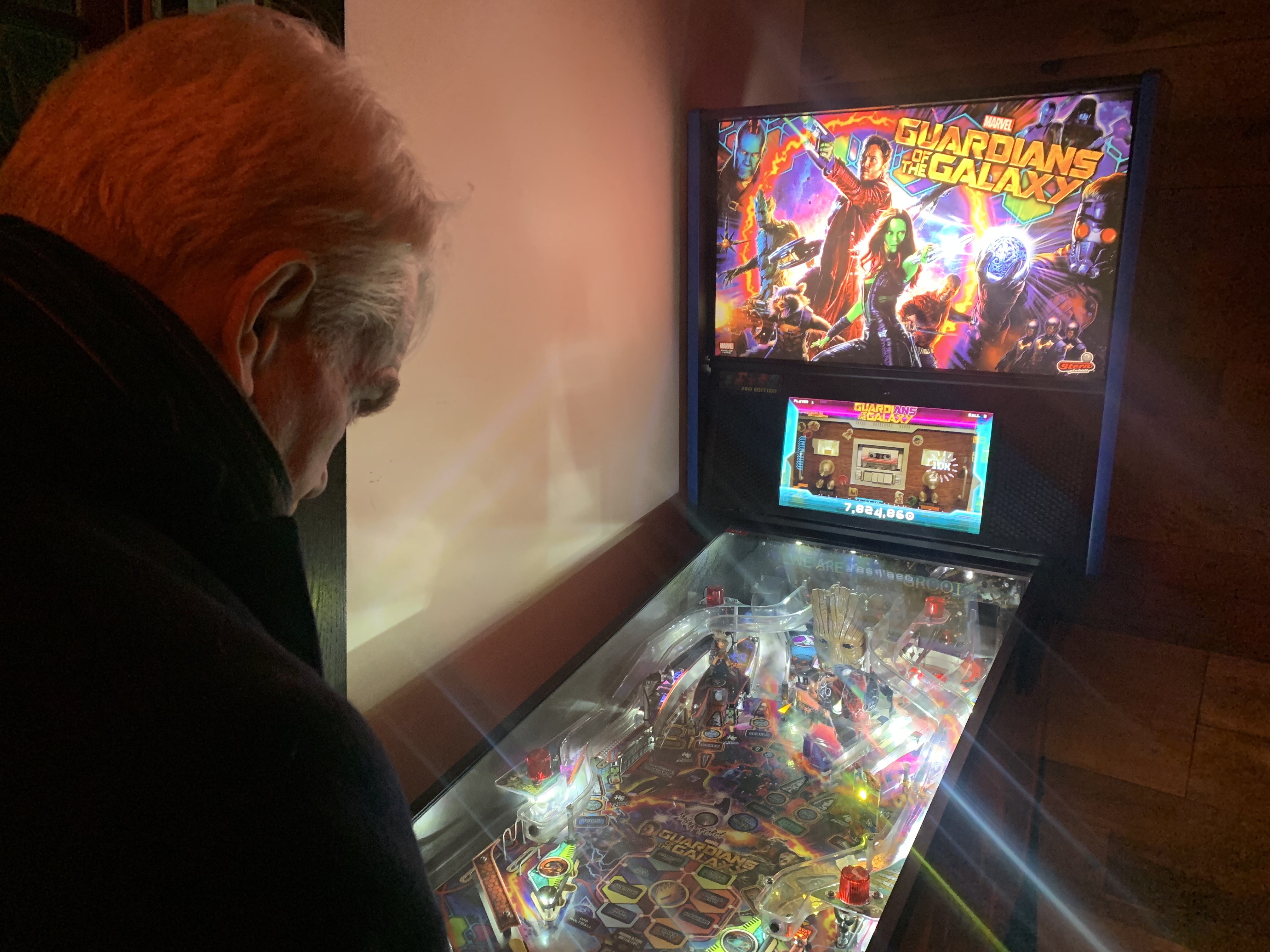
And I even manged to convince Stephen to play pinball with me! Right at the end of the evening, last to leave (naturally). Oh, and did I mention we saw David O'Meara on the train ride back home the next morning?

Sunday, December 04, 2022

Amy Dennis, The Sleep Orchard: A Response to Arshile Gorky


ON WAKING

My lover says I have called out
while asleep for beetroot juice and saffron, declared
the colour of dove’s blood is audible
and must

be written down. I don’t remember.
But know after waking I’ve scavenged

old papers to find antique recipes for ink, hungry
for a hallowed liquid to write about Gorky. In dreams
he is tall and looks into me.

Every morning his paint rattles my thin grasp
on language.

Having produced her chapbook THE COMPLEMENT AND ANTAGONIST OF BLACK (OR, THE DEFINITION OF ALL VISIBLE WAVELENGTHS) through above/ground press back in 2013, it is such a delight to see the full-length debut by Ontario poet Amy Dennis: The Sleep Orchard: A Response to Arshile Gorky (Toronto ON: Mansfield Press, 2022). The Sleep Orchard is presented as a poetic response to the work of the late Armenian-American Abstract Expressionist painter Arshile Gorky (1904 – 1948), who, as a contemporary of Mark Rothko, Jackson Pollock and Willem de Kooning, was considered one of the most powerful American painters of the 20th century. “You loved me because I looked / like that period of Picasso,” she writes, as part of the sequence “MARNY GEORGE / AT 36 UNION SQUARE,” “when the walls were taken off / Pompeii. My pelvic cradle // a lava pond / filled with pottery / and ancient shards. I am almost dead / now. And you are ash in the meadow.” Dennis composes her book-length response via a sequence of self-contained narratives, each of which is set as a single step along a longer path; steps, or perhaps tarot cards: she turns over a card, each one offering a perspective that shifts, slightly, what might have come prior. And it is through this progression that she works to establish her portrait. As she writes to open the poem “STAGNATION, SWELL, / A SUDDEN FLESHING,” “The artist, / his hands, his mother’s absent / hands, painted over as clay blocks // because there’s no real way / of reaching.” There is something in the way Dennis works to not simply write through but into the work of Gorky, discovering, as well, the points where the artist and author begin to meet.

The poems of Dennis’ The Sleep Orchard move from examinations of specific artworks to certain biographical elements of an artist shaped through his escape from the Armenian genocide during the First World War as a child, to later suffering a variety of debilitating losses alongside his many accomplishments—a studio fire, the end of his marriage, cancer surgery and injuries garnered through an automobile accident—before he hung himself in a barn at the age of forty-four. As the poem “HIS WIFE, MOUGOUCH, AFTER / HER AFFAIR WITH MATTA” offers: “Moonstruck / raw, open for him // under the crystal liquids of a phosphor / chandelier—same light source, / years later, that the surrealists used, / blaming him for the suicide / of my husband, branding / his left breast with a hot iron, the word Sade / scorched over both // our breasts.” Her poems are emotionally dense, sharp and shaped but allow for a fluidity of lyric ebb and flow, working up to endings that less end than pause, perhaps, before one might either move into the next piece, or start over at the beginning. As the poem “GRIEF HAS NO WORDS, / ONLY A TRAILING OFF INTO THINGS / REMEMBERED INACCURATLY (MAKING / THE CALENDAR), 1947” begins: “This grey was once / made from the soot / of oil lamps. In its light, there were / voices.”

It is interesting that she refers to this collection as a “response” to Gorky, a designation that allows for critique, descriptive and biographical elements, but one that also isn’t constrained by those same details. One could mention a comparison to Edmonton-based Vancouver poet Catherine Owen’s own full-length debut, Somatic: The Life & Work of Egon Schiele (Toronto ON: Exile Editions, 1998), a collection of narrative lyrics suggested as biography but one, much as Dennis’, was shaped through the author’s own response to the life and the work of her chosen muse. And yet, in The Sleep Orchard, Dennis’ response is one that allows as much of herself to seep into the lyric as her subject. The poem “STILL LIFE WITH SKULL, 1927,” for example, is a poem that folds in the author’s separate experiences with childbirth and surviving a car accident with one of Gorky’s paintings. “The background of the painting a Delphic blue,” she writes, “tilting / at times into white // like my son’s umbilical cord before he was cut / from me. He was cut from me, our blood clamped. Last time // I felt pain like that was the car crash. I healed but my words / broke again as they made their way through my body.” It is as though, through exploring and responding to Gorky, Dennis is examining the very possibility of creating work through (despite and even beyond) her own shared layerings of physical and emotional trauma, whether parental loss, the ends of a marriage or injuries sustained in a car accident. Perhaps, through responding to Gorky’s losses and accomlishments, Dennis is able to see through his work to create her own. And for that, I am deeply grateful.

GORKY FINDS A PHOTOGRAPH
OF HIS MOTHER, FORGOTTEN
IN HIS FATHER SEDRAK’S DRAWER

Did Sedrak feel pulled by the portrait he left
in his drawer: her face—unframed,
scratching under a scattering.

She starved. He slept
every night, clothed, with a hatchet. Who knows

what his death meant for Gorky, whether it swelled
the expanse of whale ribs or Faust, if it echoed in him
as folklore. Or, like the quick sting of sulfur
against phosphorus, the pain was small—the first strike
of a match when one leans in too close
to the flare.


Monday, November 28, 2022

Sunday, November 10, 2013

the eighth issue of seventeen seconds: a journal of poetry and poetics is now online!


Amy Dennis
COMPOSITION, c. 1950, (WOLS)

Phil Hall
Sue Goyette’s Ocean: A Review of a Review

j/j hastain and Ming Jung Oh
Gastropod Notes Or:
A DIY Guide to Growing a Strap-On and Writing with It

Joseph LaBine
Constructing Circles & Confounding Cannons: Categorizing Phil Hall with “The Wayman Olympics” as Afterthought

Gillian Wigmore
guesswork   love

Joshua Marie Wilkinson
The Easement
EIGHTH ISSUE : FALL 2013

rob mclennan: editor
mdesnoyers : design & (re)compiler
roland prevost: founding managing editor