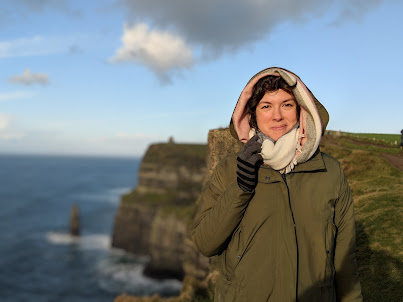
Kimberly Quiogue Andrews is a poet and literary
critic. She is the author of
A Brief History of Fruit, winner of the Akron Prize
for Poetry from the University of Akron Press, and
BETWEEN, winner of the New Women’s Voices Chapbook
Prize from Finishing Line Press. Her recent work in various genres appears
in
Poetry Northwest, Redivider,
Denver Quarterly, the
Los
Angeles Review of Books, and elsewhere. She teaches creative writing
and American literature at the University of Ottawa, and you can find her on Twitter
at
@kqandrews.
1 - How did your first book change your life? How does your most recent
work compare to your previous? How does it feel different?
My first full-length book came out at the very beginning of the
pandemic, so I guess I wish it had changed my life more than it did. But that's
not being generous enough -- having my first book out in the world has opened
all sorts of doors for me, from readings to whole jobs. It's irritating, on a
systemic level, that a printed collection is required to open such doors. But
on a more personal level, it is exceedingly gratifying to see those years and
years of work coalesce into an object that you can hold in your hands, that
other people can hold in theirs and have on their shelves. Unlike individually
published poems, a whole book has the time to make a series of arguments that
are, to use the old cliché, greater than the sum of their parts. My first book
taught me that, to a degree; my more recent work really takes it to ridiculous
extremes. What I'm writing now feels both much more experimental (formally) and
much more rhetorically coherent; if my first book seems like it's aiming for a
kind of formal range or virtuosity, my new work is just like these huge weird
blocky or spindly bits of texts that are all hammering home a big, almost
academic-critical point.
2 - How did you come to poetry first, as opposed to, say, fiction or
non-fiction?
This is probably a common answer, but: I
cannot write plots. I've never been any good at telling stories; my imagination
also seems incapable of the gymnastics required to actually make up a whole
character. The first poem I ever wrote was in early high school, in response to
a friend's sudden and devastating illness. I was trying to capture a kind of
social shock, and it seemed to me at the time like a compressed, singular
thing, like a bright light shining in your face. I suppose that's why it came
out as a poem and not as a narrative. I've been stuck with the genre ever
since.
3 - How long does it take to start any particular writing project? Does
your writing initially come quickly, or is it a slow process? Do first drafts
appear looking close to their final shape, or does your work come out of
copious notes?
I'm in the fortunate position of having several ideas going right now;
starting creative projects has always come relatively easily to me (starting
scholarly ones, on the other hand, I find nearly impossible). I don't do a huge
number of drafts of a given poem; I do, however, take a lot of notes. I tend to
write a lot of single drafts of different poems and then discard whole drafts
and start over; I tell my students that I'm a notorious "blank-page"
reviser.
4 - Where does a poem usually begin for you? Are you an author of short
pieces that end up combining into a larger project, or are you working on a
"book" from the very beginning?
I'm definitely a "book" poet, though I suppose that always
starts by being a bit of a "theme" poet, by which I mean I'll get
stuck on a thing that I want to write about, and then write like ten poems
about that thing, and sometimes that stops shortly thereafter (hence, for
example, my chapbook BETWEEN) and sometimes it turns out to have
legs. I wish, at times, that I could be one of those poets whose books are
simply a series of only loosely connected poems. I'm not really sure if books
like that exist anymore, so great is the impetus towards "project"
books.
5 - Are public readings part of or counter to your creative process? Are
you the sort of writer who enjoys doing readings?
I adore doing readings. Adore it! If you are reading this, email me and
ask me to read for your class/book club/friend group/rowing association! I'm
not sure if I'd say they're a part of my "creative process," but I
find them energizing and fun and an integral part of being a writer.
6 - Do you have any theoretical concerns behind your writing? What kinds
of questions are you trying to answer with your work? What do you even think
the current questions are?
For better or for worse, the writing I'm doing now is 100% theoretical
concern. My current project grapples with the question of how our lives might
be different if we allowed sadness and slowness to be a part of them; it takes
an explicitly anti-capitalist (which is to say, anti-productivity, anti-speed,
anti-consumable-happiness) stance. The real current question, though--not for
me, but for everyone--is climate change. It's not something I'm currently
writing about in a concerted way, though of course one cannot write about
degrowth without also sort of writing about climate change. My next project is
about steel manufacturing, though (see, I told you I'm a horrible
"theme" poet) so it will be interesting to see how it comes up when I
can finally get to that book.
7 – What do you see the current role of the writer being in larger
culture? Does s/he even have one? What do you think the role of the writer
should be?
There are lots of different types of writers, and correspondingly
different types of roles for them. For poets and scholars, though, there's a
type of demonstrated non-instrumentality to our work that is I think (a)
increasingly vanishing and/but (b) increasingly important to safeguard. Lots of
people want to be artists because there's some idea of "freedom" in
there. Is that ideological? Probably. But is there also some truth to the idea
that it's hard to alienate the work of a poet or a painter. When you do, you
get slogan-writing and graphic design, which are not the same things, though of
course they can be very good careers. The role of the writer, then, is maybe
just to demonstrate that we should abolish all careers. A strange thing about
me is that I am very pro-professionalism and very anti-career. I do think
they're separate.
8 - Do you find the process of working with an outside editor difficult
or essential (or both)?
I've not worked with that many outside editors, but my experiences have
been good. My poetry editor, Mary Biddinger, is a marvel. She will provide
exactly the amount of help you need on a given thing. Usually the process of
publishing poetry is a pretty hands-off affair.
9 - What is the best piece of advice you've heard (not necessarily given
to you directly)?
Learn to recognize the people around you whose actions are dictated by
opportunism or other kinds of jobbery, and then proceed to avoid them to the
fullest extent to which that is possible.
10 - How easy has it been for you to move between genres (poetry to
critical prose)? What do you see as the appeal?
I cannot do scholarship when I am writing poetry and vice-versa. The two
genres influence each other enormously -- I'm a scholar of experimental poetry
-- but I can't do them both at the same time. I'm a one-hat kind of person.
That said, when I am writing poetry, I am thinking about scholarship, and when
I am doing scholarship, I am thinking about poetry projects. In that sense
they're inseparable, but the work itself happens almost entirely separately.
11 - What kind of writing routine do you tend to keep, or do you even
have one? How does a typical day (for you) begin?
I, like most people I suspect, am in constant search for the perfect routine.
Right now, I'm finishing a scholarly project, and I write prose best in the
afternoons. So mornings are devoted to walking and administrative
procrastinating, and then I'll (hopefully) settle into writing after lunch. For
poetry, it's the opposite -- I write it best in the mornings, so I'm going to
have to change things up when I get back to it.
12 - When your writing gets stalled, where do you turn or return for
(for lack of a better word) inspiration?
Reading in the general vicinity of what I might want to be writing
about. Every time, no exceptions. Not just poetry, though that's a lot of it.
The reason I have a current book project is because I found a PDF of Saturn
and Melancholy on the internet and was so smitten with it I decided to
write an entire book basically in response to it. That's it!
13 - What fragrance reminds you of home?
I feel like my mom used to have a small bottle of White Diamonds lying
around, and I'd bet almost anything that if I smelled that perfume again I'd be
walloped right back to the suburbs of eastern PA. My other, adopted, home is
central Maine, which smells unavoidably of pine.
14 - David W. McFadden once said that books come from books, but are
there any other forms that influence your work, whether nature, music, science
or visual art?
All of those things influence my work, which sounds like a non-answer,
but when your guiding philosophy is that poetry is just particularly intense
noticing, it kind of doesn't matter what the focus of the noticing is. It can
all become fodder.
15 - What other writers or writings are important for your work, or
simply your life outside of your work?
The classic answer: too many to name! John Ashbery's work gave me my
start, in a real sense, even though that "start" was at the very end
of my MFA. W.G. Sebald keeps me going. Dionne Brand is constantly teaching me
how to think. John Keene is not only one of the world's most remarkable
writers, but also one of the world's most generous and thoughtful people. I go
to Brigit Pegeen Kelly when I want to be astonished. And to Brian Lennon when I
want to remember what's important. There's no end to this list, really.
16 - What would you like to do that you haven't yet done?
[Insert a bunch of deeply un-laudable personal ambitions here.]
17 - If you could pick any other occupation to attempt, what would it
be? Or, alternately, what do you think you would have ended up doing had you
not been a writer?
This was always kind of it for me, I think, though had my knees held up
I probably could have been a ski instructor forever.
18 - What made you write, as opposed to doing something else?
Being really shit at both team sports and acting?
19 - What was the last great book you read? What was the last great
film?
I just read Rebecca Makkai's The Great Believers and
it's just as devastating as everyone says it is. Last great film would
definitely be Face/Off. I hadn't seen it until this past summer! It
belongs in the Louvre.
20 - What are you currently working on?
See question 6, though I'm also trying desperately to finish up a
scholarly book called The Academic Avant-Garde that should be
out with Johns Hopkins University Press late next year. Catherine, if you're
reading this: I'm working on it!
12 or 20 (second series) questions;